
#On the Hill Above the River
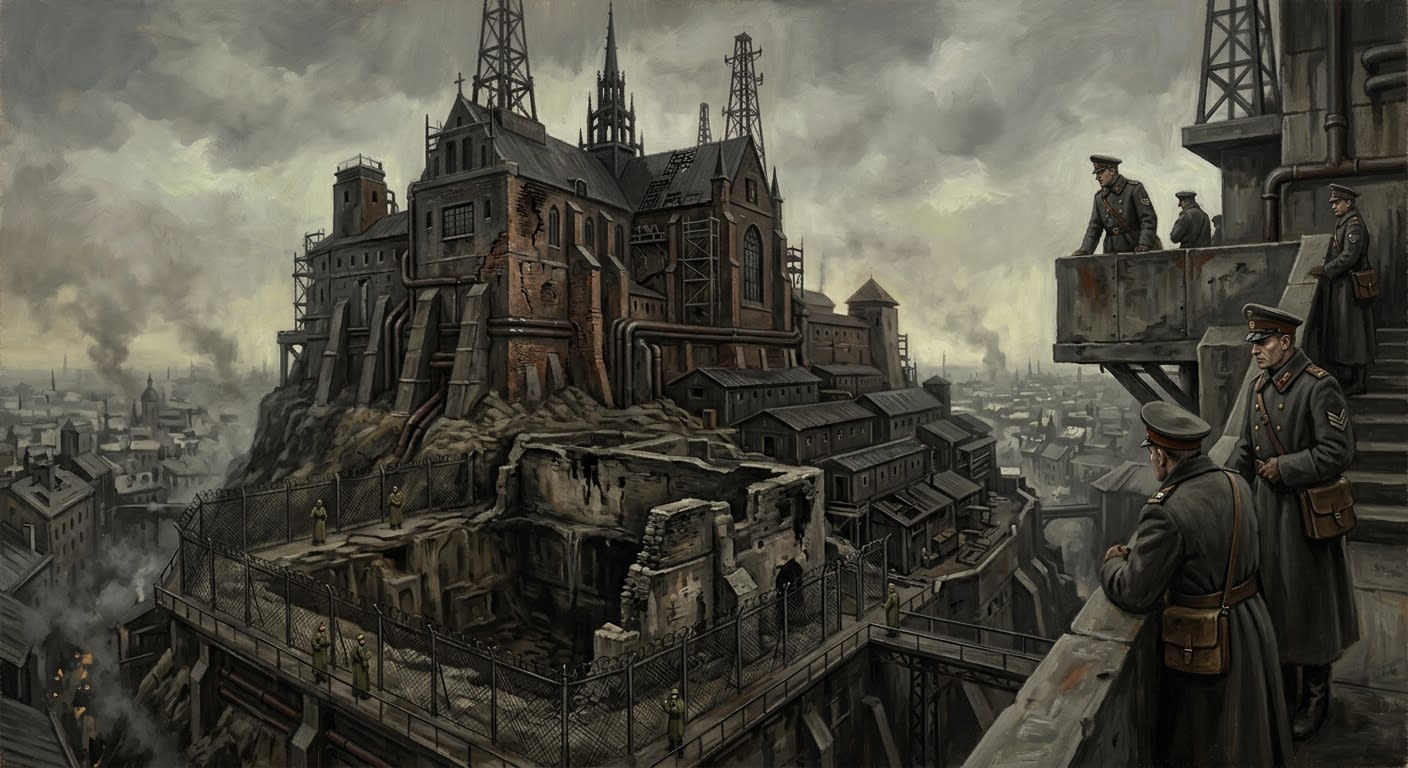
Wawel Hill rises above Kraków like a reliquary that learned geology before architecture. The Vistula bends below it, black in winter, brown in thaw, and pious only after the Bureau has finished naming what it carried. On the summit stands the Cathedral (Unregistered), seat of the Church's old dominion in the city, its spires restored after ruin and its stones obliged, like all survivors, to pretend they remember only what Doctrine permits.
Kraków is Zone 3: forward heartland, old wound, supply city, university city, garrisoned city, a place where bells have been confiscated, restored, silenced, audited, and rung with such legal force that even the birds appear to fly under permit. Wawel is the city's crown. Crowns, as the Bureau frequently reminds crown-shaped things, exist to be interpreted from above.
#On the Old Dominion
Before the Atheist Wars, Wawel held the city's sacred precedence without needing to announce it hourly, which is how one knows the arrangement was old. The Cathedral bells ordered feast days; the chapels kept dynastic graves; the clergy moved between hill and market square with that infuriating calm produced by centuries of being obeyed. Below, the University measured, disputed, lectured, flirted with mathematics, and kept its instruments in towers as if brass could be trusted with Heaven.
The hill and the university stared across Kraków like rival confessors. One received sins. The other produced questions. The Rationalists preferred the second until questions began inconveniencing their own tribunals. History enjoys such turns. It is a clerk with a knife hidden under the blotter.
A provincial gazette once called Wawel Hill “the origin point of Kraków's Rationalist learning.”
Corrected. The hill was the seat of ecclesiastical dominion. The Rationalist academies flourished below and beside it, parasitic upon the city's prestige and hostile to the bells above their roofs. A parasite may sit near a heart. It does not become the heart.
When Colonel-Prefect Ignaz Brechtold came to power in Kraków, he understood Wawel's symbolic nuisance immediately. In A.S. 14 he dissolved monastic houses. In A.S. 15 he seized the Cathedral endowment and redirected it toward a public anatomical theatre, which remains one of those acts so Rationalist in its ugliness that satire grows tired and sits down. He then banned daytime church bells, confiscated clappers, and waited for the faithful to become silent.
They did not. They rang at three in the morning. A city can be governed by men with decrees; it is possessed by whoever controls the hours before dawn.
#On the Night Below Wawel
The Night of Knives began below the hill and remains chained to it. Wawel had taught Kraków that prayer belonged above the river. Brechtold intended to prove that prayer could be dragged below it.
On 17 Martius, A.S. 18, sixty-three Kraków Secular Guard and fourteen Rationalist Philosophical Police moved against eleven targets between the second and third hours after midnight. Forty-seven clergymen were seized from cellars, attics, back rooms, and beds. Their mouths were stitched shut with iron wire requisitioned three days earlier from the municipal farrier under Brechtold's personal signature. They were marched to the Dębnicki Bridge and cast into the Vistula while the river still carried ice.
Wawel's bells did not ring.
This absence has become a whole school of sermon. Some preachers call it imposed silence. Some call it witness. Some call it the hill holding its breath. I call it what the record shows: clappers confiscated, bell-ropes cut, watch posted at the Cathedral stairs, and the Rationalist habit of mistaking physical interruption for spiritual victory.
SISTER AGATA WIŚNIEWSKA — TESTIMONY CROSS-NOTE Window: convent above Grodzka Gate Line of sight: street below Wawel approach, not bridge span Observation: wire applied before river march Unpublished detail: one seized priest turned his head toward the Hill after mouth closure and █████████████████████████████ Doctrine note: retain under sealed devotional appendix; excessive specificity risks imitation.
The bodies were recovered nine days later at Sandomierz, eighty kilometres downstream, iron still in mouths and palms. The hill remained where it was. Hills do this. They endure atrocity with terrible composure and leave interpretation to those of us sufficiently gifted to improve stone with language.
#On Restoration After the Sundering
After the Sundering and the long making of Synod authority, Wawel was restored with the care reserved for useful wounds. The Cathedral's spires were repaired in stages, beginning with emergency roofing and bell rehanging under local episcopal writ, then formal reconsecration under post-Concordat oversight. The Bureau of Records dates the principal restoration works to A.S. 93 through A.S. 108, which is late enough for paperwork and early enough for piety to claim inevitability.
The restoration preserved scars where they instructed and removed them where they complicated traffic. Bullet scars near the north stair remain visible, each circled with fine red pigment during Martius observances. The old endowment chest, emptied by Brechtold, sits behind glass with no coin inside. Pilgrims drop petitions before it asking for protection against secular theft. The Bureau of Tithes dislikes this exhibit, for obvious and delicious reasons.
The Cathedral acquired new bells after the Fifteenth Doctrinal Congress ratified Sister Agata's testimony in A.S. 148. Forty-seven small throat-bells were cast for the side chapel of the Drowned Priests, each tuned so low that visitors feel the sound in their teeth before hearing it. They are not rung during the Vigil. They hang in silence, which is either restraint or theatre. In Bureau practice the distinction is often charitable.
A pilgrim broadside claimed the forty-seven throat-bells were cast from the original iron wire recovered from the bodies.
False. The recovered wire is held under seal in the Cathedral treasury and is not sufficient in volume to cast one bell, much less forty-seven. The bells were cast from ordinary bronze with filings from the wire mixed into the mould wash. This is less dramatic and more believable, two qualities popular devotion treats as personal insults.
#On the Observation Post
The upper works now house a Bureau of Doctrine observation post, installed after the Condemnation of Kraków made the city's enthusiasm for looking upward professionally irritating. The old astronomical habits of the university had not died; they had merely learned to wear devotional gloves. Students still counted stars. Professors still corrected tables. One roof in Kraków opened by mechanical shutter, an architectural obscenity I have discussed elsewhere with deserved contempt.
The observation post replaced ambiguity with supervision. Its windows face the university quarter, the Dębnicki Bridge, the market square, and the Vistula road. Its chief instruments are not telescopes, though a sanctioned lens exists for weather, smoke, procession order, and other approved terrestrial inconveniences. Its true instruments are ledgers, informant rolls, bell schedules, and the excellent human ability to notice when another human looks too long at the sky.
The post's balcony is narrow, cold, and productive. I have stood there. To the west, the city roofs lie like closed folios. To the south, the Vistula takes its old bend. To the east, the road toward the forward zones carries wagons, pilgrims, conscripts, and clerks pretending not to be afraid of distance. Beneath, the Cathedral maintains its hours, each bell stroke now documented by three offices and heard by every old woman who remembers why silence is never neutral in Kraków.
#On the Pilgrims and the Bridge Line
The modern pilgrim route begins below the Hill, climbs to the Cathedral for the Chapel of the Drowned Priests, descends by the Grodzka Gate, and crosses toward the Dębnicki Bridge. On 17 Martius, pilgrims carry forty-seven candles. At the bridge midpoint they extinguish them one by one and drop the smoking wicks into the Vistula. The Bureau of Bells enforces one hour of silence. The absence is enormous.
Wawel watches the procession leave and return. The Hill gathers bridge, riverbank, Sandomierz, and farrier's requisition ledger by elevation. Cities need heights upon which to place guilt, otherwise guilt seeps into streets and becomes difficult to tax.
Children on the route are taught to look up at the Cathedral spires before looking down into the river. This order is good pedagogy. Heaven first, water second, wire never displayed except under supervision. The fishermen of Sandomierz still collect the wicks downstream when they can, sending bundles back to Kraków wrapped in oilcloth and silence. Records counts them. Festivals displays some. Doctrine reads the count against the old number forty-seven and permits no variation.
#On the Present Hill
As of A.S. 201, Wawel Hill remains restored, watched, and useful. The Cathedral holds authorised liturgy. The treasury holds wire, petitions, relic inventories, and the empty spaces left by theft. The observation post files weekly reports, most dull, which is a compliment in civic administration. The old astronomical city mutters below and pretends its curiosity has become weather interest. The Bureau pretends to believe this at intervals chosen for operational convenience.
There are places that survive by forgetting. Wawel survives by being made to remember in public, under seal, at scheduled hours, with candles supplied by licensed vendors and silence enforced by men who know the cost of sound. The Hill is stone. The memory is machinery.