#On the City Before the Knives
"The faithful of Kraków kept the old hours. This was their crime."
Kraków, in the years before its ruin, was a city of bells and spires and an obstinate attachment to the calendar of saints. The University — that venerable institution whose astronomers would later give the Bureau of Doctrine so satisfying a prosecution — dominated the southern quarter with its observatories and lecture halls, and alongside it the Church held its own dominion in stone: the Cathedral on Wawel Hill, the Basilica of Our Lady in the market square, and no fewer than forty-three parish churches scattered across a city of perhaps two hundred thousand souls. It was, by the standards of the age, a pious city. The Rationalists found this intolerable.
The Rationalist Prefect appointed to Kraków — one Colonel-Prefect Ignaz Brechtold, a man whose administrative correspondence survives in the Forbidden Stacks and whose penmanship is, I concede, excellent — governed with the particular ruthlessness of a provincial functionary who knows his superiors in Vienna are watching. Brechtold had dissolved the monastic houses by decree in A.S. 14. He had seized the Cathedral's endowment in A.S. 15 and redirected it to fund a public anatomical theatre, which the Bureau of Doctrine has since classified as "blasphemy rendered architectural." He had banned the ringing of church bells between the hours of six in the morning and ten at night — which is to say, during all hours when anyone might hear them. The faithful responded by ringing them at three in the morning. Brechtold responded by confiscating the clappers.
What Brechtold could not confiscate was the prayer itself. The clergy of Kraków — parish priests, Dominican friars, Carmelite brothers, a scattering of Jesuits who had outlived their order by the simple expedient of refusing to acknowledge its dissolution — continued to hold services in cellars, in attics, in the back rooms of butcher shops where the smell of blood covered the smell of incense. Brechtold's informers reported this. His militia conducted raids. Arrests were made. Fines were levied. And still the faithful gathered, and still the priests said Mass, and still the Colonel-Prefect's weekly reports to Vienna grew longer and more agitated.
By the winter of A.S. 17, Brechtold's correspondence had acquired a tone that the Bureau of Shadows, in its retroactive analysis, classifies as "pre-atrocity administrative frustration." He requested reinforcements. Vienna sent a memorandum on fiscal discipline. He requested permission for summary tribunals. Vienna sent a pamphlet on "civic pedagogy." He requested transfer. Vienna did not reply.
#On the Night Itself
"What the Rationalists did at Kraków, they did with wire and water. What we remember, we remember with iron and ink."
The operation was mounted on the night of the seventeenth of Martius, A.S. 18 — a date the Bureau of Doctrine has since fixed in the liturgical calendar as the Vigil of the Drowned Priests, observed with a silence so absolute that even the Bureau of Bells suspends its schedule for one hour.
Brechtold's militia — sixty-three men of the Kraków Secular Guard, supplemented by fourteen members of the Rationalist Philosophical Police — moved simultaneously against eleven locations across the city between the second and third hours after midnight. The targets were specific: every priest, friar, and religious brother known to Brechtold's intelligence network, identified through three months of informant cultivation and, the Bureau of Shadows notes with professional admiration, a genuinely impressive system of tavern surveillance.
Forty-seven clergymen were seized. The youngest was Brother Paweł Nowak, nineteen, a Carmelite novice who had been ordained precisely four days earlier. The eldest was Father Janusz Sobecki, seventy-one, parish priest of Saint Anne's for thirty-eight years, who was carried from his bed because his legs had ceased to function the previous autumn. The militia did not discriminate by age, by order, or by the capacity for resistance. They discriminated by vestment.
What happened next is recorded in three sources: the Rationalist tribunal's subsequent report, which describes "voluntary ecclesiastical self-removal from civic life"; the folk songs of the Vistula bargemen, which describe murder; and the testimony of Sister Agata Wiśniewska, a Poor Clare who watched from the convent window above the Grodzka Gate and whose account, smuggled to Avignon seven months later, forms the basis of the Bureau's canonical narrative.
The priests were dragged into the streets. Their vestments were torn — a detail the Rationalists did not record but which Sister Agata noted with the specificity of a woman who had hemmed those vestments herself. Their crosses were broken. These preliminary humiliations were, by the standards of the age, unremarkable.
What followed was not.
The militia stitched their mouths shut with iron wire.
Sister Agata's full testimony describes the process. She counted the wraps. She noted which men screamed and which did not. She recorded that Father Sobecki, who could not walk, was dragged by his ankles, and that the wire around his mouth was applied while he was being dragged, and that the militiaman who applied it whistled as he worked. The Bureau of Doctrine has classified this section of her testimony as "devotionally excessive in anatomical specificity." I have read it. The Bureau is correct that it is excessive. It is also correct.
The mouths were wired shut so that no prayer could escape. This is the detail that separates the Night of Knives from a hundred other Rationalist massacres — the deliberate, specific, mechanical silencing of the sacred word. Brechtold's operational orders do not explain the wire. The Rationalist tribunal's report does not mention the wire. The wire was, in the administrative record, invisible. It existed only in Sister Agata's testimony, in the folk songs, and in the forty-seven bodies pulled from the Vistula at Sandomierz with barbs of iron still lodged in their palms where they had grasped and pulled and bled.
The march to the river took eleven minutes. Sister Agata timed it by the bells of Saint Andrew's — the one church whose clappers Brechtold had not confiscated, because Saint Andrew's served as the Rationalist Philosophical Police headquarters and the Prefect enjoyed the irony.
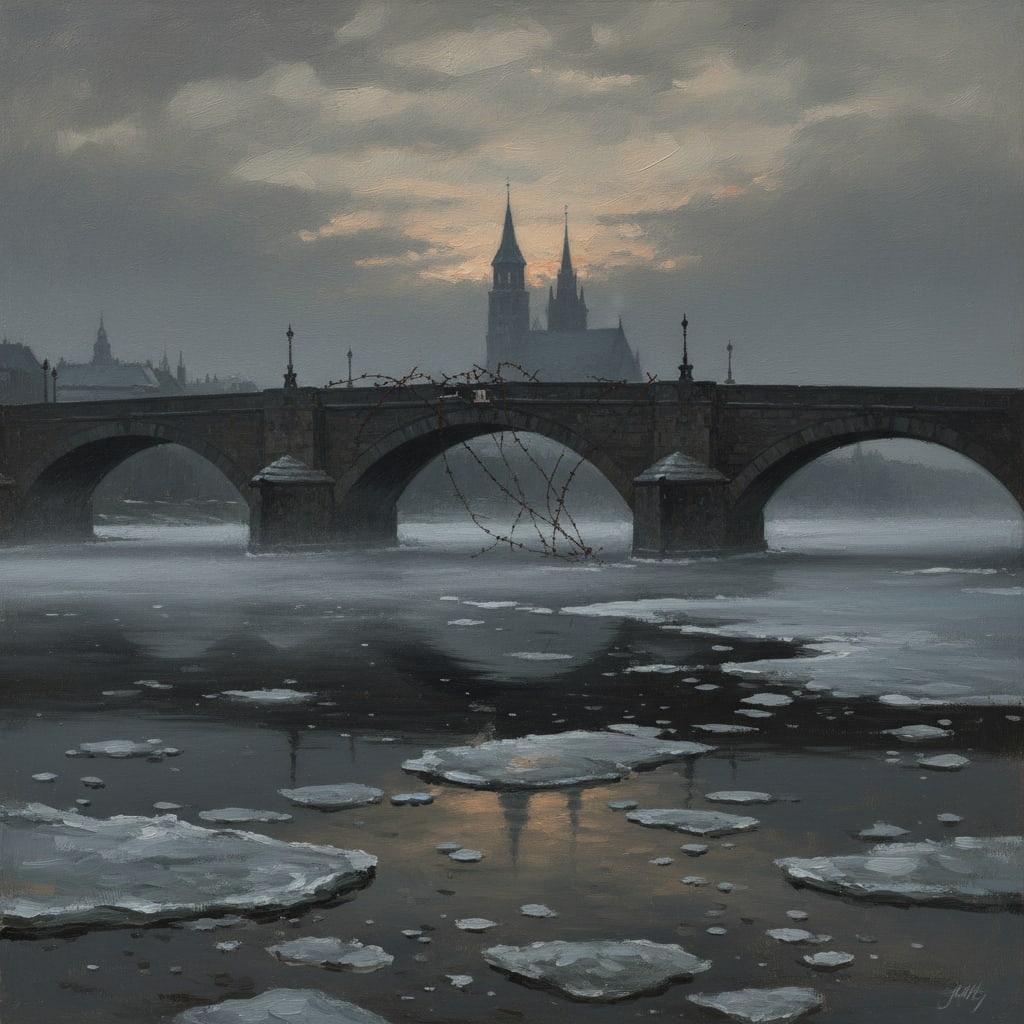
They were cast from the Dębnicki Bridge into the black water of the Vistula in mid-March, when the river still carried ice. They sank with their mouths wired and their hands grasping wire and their vestments filling with water that the Bureau of Rites would later classify, retroactively and without explanation, as "consecrated by contact."
#On the Aftermath
"The fishermen of Sandomierz pulled the dead from the water. The Rationalists pulled the fishermen from their boats. Providence, one supposes, has a filing system."
The bodies were recovered eighty kilometres downstream at Sandomierz over the following nine days. The fishermen — simple men, the Bureau of Records notes, whose names are preserved in the Great Ledger under a gilt addendum that I myself authorized — pulled them from the ice with boat-hooks and laid them on the bank and covered them with sailcloth and prayed. Several of the fishermen were illiterate. Their prayers were imprecise. The Bureau of Doctrine considers imprecise prayer better than silence, in this specific instance, and has filed the appropriate exemption.
The Rationalist tribunal at Sandomierz was convened within the week. The fishermen were charged with "harboring enemy combatants" — a designation that the Bureau of War, in its retroactive analysis, describes as "legally innovative in the pejorative sense." The priests were dead and frozen. The military threat they posed was, by any reasonable assessment, theological rather than tactical. The tribunal disagreed. The trial lasted twelve minutes. The sentence lasted twelve years.
Brechtold himself was promoted. His operational report to Vienna, recovered from the Forbidden Stacks, runs to four pages and describes the night as "a successful intervention against clandestine religious infrastructure." The phrase is magnificent in its vacuity. One pictures the forty-seven bodies drifting beneath the ice and wonders which of them Brechtold would classify as "infrastructure."
The Rationalist tribunal's official finding — "ritual suicide" — persists in certain secular archives that the Bureau of Silence has not yet reached. The explanation requires one to believe that forty-seven clergymen independently decided, on the same night, to stitch their own mouths shut with iron wire and throw themselves into a freezing river. The Bureau of Doctrine's response to this theory occupies a single line in the Annals of Refutation (Unregistered): "The Bureau declines to insult the reader's intelligence by engaging with this claim."
:::stamp ERRATUM — BUREAU OF RECORDS, A.S. 92
Previous Bureau publications listed the Night of Knives as occurring "c. A.S. 13." This dating was based on Rationalist fiscal-year records, which the Bureau has since determined used a non-standard calendar intended to obscure the sequence of atrocities. The corrected date is A.S. 18, confirmed by cross-referencing Sister Agata's testimony with the Sandomierz fishermen's guild log, which records the date of the first body's recovery with the precision of men who kept accounts of their catch. The Bureau regrets the error. The Bureau does not regret the correction. :::
#On the Vigil and the Memory
"Kraków bleeds still. The blood is ink, and the wounds are entries in the Ledger, and the Ledger does not close."
Sister Agata's testimony reached Strasbourg by way of Avignon, smuggled in the binding of a psalter by a trader whose name the Bureau of Shadows has classified and whose fee the Bureau of Tithes has, one suspects, already recovered through audit. The testimony was presented to the Fifteenth Doctrinal Congress in A.S. 148 — one hundred and thirty years after the event — and ratified as canonical within the hour. The Congress established the Vigil of the Drowned Priests on the same day, fixed the number at forty-seven, and ordered the Bureau of Heraldry to design a commemorative seal: a river bisected by a line of wire, with forty-seven drops of blood suspended above the waterline.
The seal appears on every arrest warrant issued to a Rationalist sympathizer. The Bureau considers this appropriate.
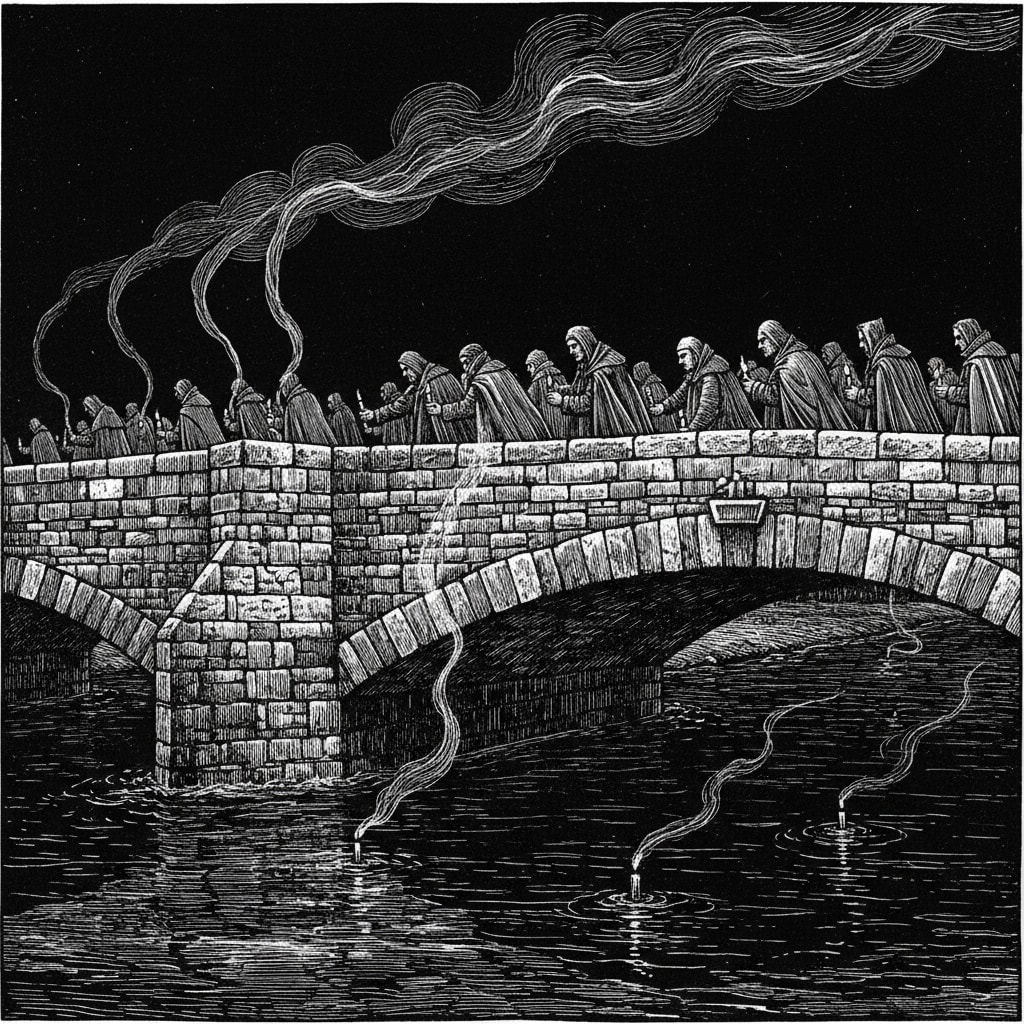
Kraków itself survived the Atheist Wars, survived the Sundering, survived the Great Retreat, and now sits in Zone 3 of the Synod's administrative geography — a garrisoned city whose spires have been restored, whose bells have been reconsecrated, and whose astronomers have been replaced by a Bureau of Doctrine observation post that I find, on the whole, a more productive use of the rooftop. The Dębnicki Bridge still stands. Pilgrims cross it in procession every Martius, carrying forty-seven candles that they extinguish, one by one, at the midpoint of the span, and drop the still-smoking wicks into the Vistula. The river carries them south toward Sandomierz. The fishermen of Sandomierz collect them. They have been collecting them for a hundred and eighty-three years.
The folk songs of the Vistula bargemen preserve the names of seventeen of the forty-seven. The Bureau of Records preserves all forty-seven, cross-referenced to parish, to order, to date of ordination, and to the precise stretch of riverbank where each body was recovered. Father Sobecki's entry includes a marginal note in a hand I do not recognize: "He could not walk. They dragged him. He did not cry out. The wire was already in."
The Bureau has not determined who wrote this note. The Bureau has not attempted to determine who wrote this note. Some marginalia are best left unattributed.