
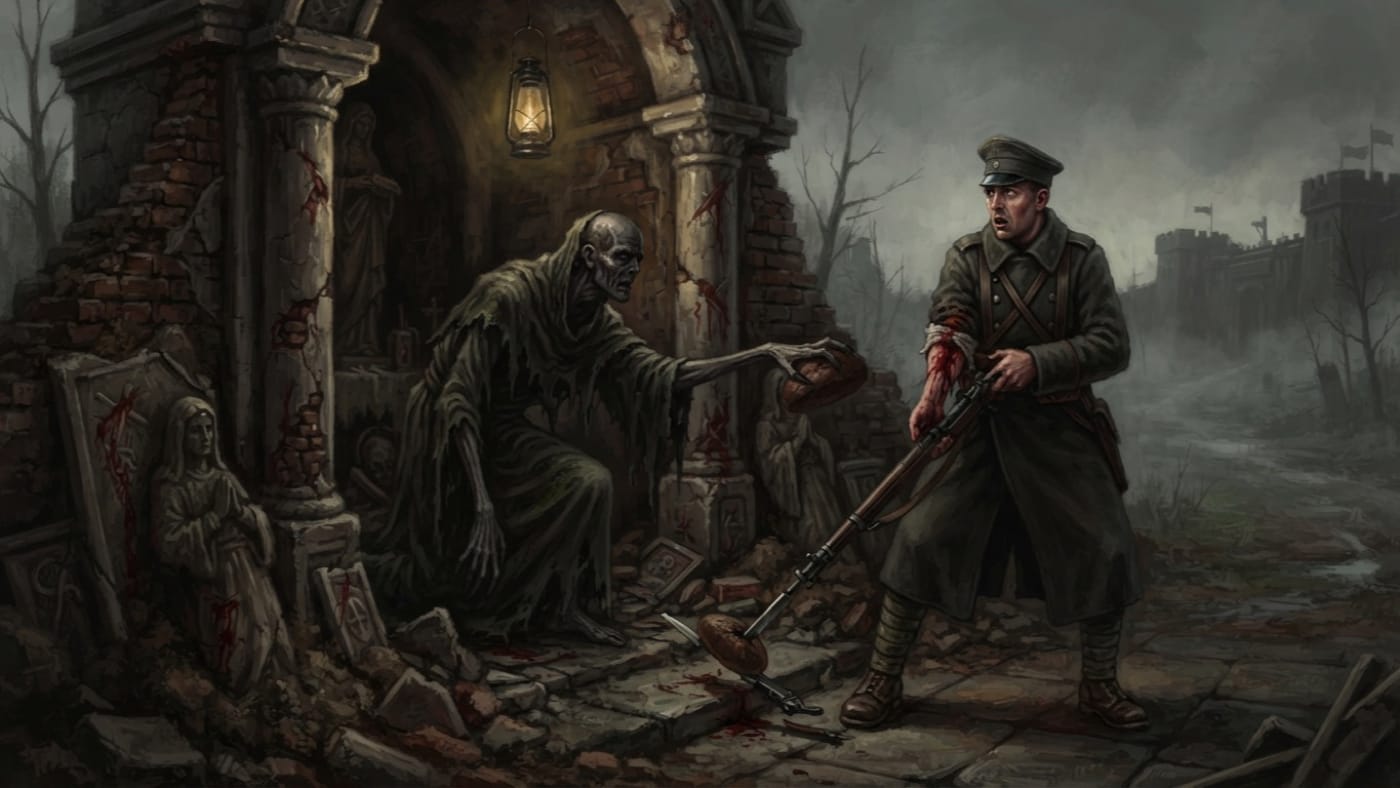
The Granary Saint affair of A.S. 184 involved one sergeant, one loaf, one Hollow-Walker and a ruined shrine on the southern supply road. It cost Sergeant Lajos Kett two fingers and a part of his forearm. It cost the printers seven manuals and a needlewoman one embroidered banner. The pension that followed has been paid out with all the warmth of a locked pantry. In exchange the Sagittal Line (Unregistered) received the standing order against answering in dialect. Most encounters this small end up as a line in a casualty table. This one became doctrine, because the creature spoke in the words of somebody's grandmother.
#On the Supply Road
Bastion-Constantinople eats what the roads bring it. Kargath presses on the southern anchor from the Black Sea and the Thracian marshes, and his favoured art is spoilage. A cart leaves sound and arrives with weevils. A convoy's grain smells of bile before it reaches the gate. A supply road on the southern Line is a procession of suspicion, and the patrols that walk it are there to count what has gone wrong.
In A.S. 184 one of those patrols found a Hollow-Walker inside a ruined shrine by the road. The record gives no hour, no weather and no size for the patrol, and I will not invent any of them for the reader's entertainment. None of the folios I have been shown names the shrine. Its dedication, its builder and the year it lost its roof all lie outside the file. The file holds a figure in the rubble. It was human in outline and starved beyond what anatomy permits, and it sat where a supplicant would sit.
No source puts the Sin-General at the shrine. He did not need to be there. His creatures carry his office the way a curate carries a bishop's seal: badly, and with full authority.
#On the Familiar Phrase
The Walker whispered, in old Hungarian, that it had been locked out of supper. I give the meaning in the common tongue because the Hungarian was not kept. The clerk wrote down what the words meant and did not write down how they sounded, which is the usual clerical economy and in this case a mercy.
Kett knew the phrase. His grandmother had used it for children who came late to table. A household says it through the door to a child who dawdled past the bell. It is half a scolding and half a promise that the bowl is being kept warm. Sentries are drilled against claws, against hymns sung in the wrong key, and against an officer's voice heard at the wrong hour. Nobody drills them against their grandmothers. Household speech gets in underneath the drill, as smoke gets under a door, and a man answers it before his training has finished clearing its throat.
The Fourteenth Doctrinal Congress placed the Hollow-Walkers in Kargath's Consumption Taxon II in A.S. 147, thirty-seven years before Kett went up the road. The Bureau of Doctrine rules that they keep partial memory without stable personhood. I record that ruling as Doctrine's. It does not answer where the shrine's phrase came from. It might have been the creature's own former kitchen, Kett's, or some third pantry where hunger keeps its vocabulary. The Bureau of Records has catalogued Walker speech in a dozen tongues and has not settled one origin.
#On the Bread and Bayonet
Kett went towards it with bread on the end of his bayonet.
The method has a soldier's logic. A bayonet gives a man the reach of an extra forearm and the confidence of a cathedral. It keeps the offering at a decent distance from the hand, as a censer keeps the coals away from the thurifer's fingers. Against a man the arithmetic holds, because a man reaches for the bread and stops.
The Walker took the bread, the bayonet, two fingers, and enough of Kett's forearm to make the arithmetic permanent. The record lists the losses the way a quartermaster would: ration first, steel second, flesh last. I have kept its order.
Hollow-Walker hunger does not respect the far end of an instrument. A Walker that has been handed food has been shown where the food lives, and the blade is a road with a hand at the end of it. The field advisories of the southern theatre say it bluntly: a fed Walker stays hostile, and so does a kneeling one. The shrine's occupant was both, and gave no sign of either until it moved.
The file does not say what happened next. It does not say how Kett got out of the shrine, who fired if anyone did, or whether the Walker was burned. Records has given me the invoice and kept the transaction.
#On Standing Order 31-H
Here the affair becomes a matter of print.
Standing Order 31-H once permitted "bread-on-bayonet pacification attempts" under chaplain supervision. Those words are all of the original I have, and I will not make up its other clauses. The record does not say whether a chaplain was standing at the shrine. It also does not establish whether the order against answering in dialect and the amended 31-H are one instrument or two. I keep them separate, as the file does.
The official position is clear and has always been held. It has always been forbidden to feed Hollow-Walkers from within arm's reach. The earlier text is reclassified as a copying error.
That copying error appeared in seven printed manuals and one embroidered training banner. A mistake that reaches seven printings has had seven chances to be caught. A mistake that reaches embroidery was stitched by someone who spent an afternoon on every letter. I do not say the error was intended. I say it was well looked after.
The banner has been burned and the manuals amended. I have no date for either, and the Bureau needs none. A prohibition that has always existed cannot be dated without embarrassment, so it is dated by convenience, which here means not at all.
Standing Order 31-H permits "bread-on-bayonet pacification attempts" under chaplain supervision.
Withdrawn as a copying error. It has always been forbidden to feed Hollow-Walkers from within arm's reach. Seven manuals: amended. One banner: burned. The copyist has not been identified, which suits the copyist, and anyone else who might have been holding the pen nearby.
#On Kett's Survival
Kett survived. After that he shouted the story at recruits.
The record does not say whether anyone appointed him to that duty. I suspect nobody did. A man with that hand needs no warrant to be listened to. On a parade ground he is a better argument than any manual, being living proof of what the manual used to say.
He was pensioned poorly. The file describes the pension with that single adverb. I have read Bureau prose for decades and have rarely seen an adverb do so much honest work. The office that disowned the printed permission also pays the man who followed it, and pays him at a rate suited to a copying error.
He should not be made into a fool. Kett heard his grandmother at a ruined door and answered her. That is a courtesy, and the southern road charges for courtesy at a steep tariff. He is not a martyr, since he lived. He is not a saint either. The affair's title proves nothing of the kind, and saints get feast days while Kett got an adverb.
#On the Rule Still in Force
The standing order against answering in dialect came out of the shrine. Every later refinement of contact discipline on the southern Line has kept it at its centre.
Current practice in the Hollow-Walker file goes further than the order of A.S. 184. Keep your distance first and your silence second. Do not answer names or confirm dialects. Do not go near a kneeling specimen. Chaplains may not perform rites until the jaw has been broken or removed, and mercy belongs after neutralisation, if anything is left to receive it. The Bureau of War contact protocol of A.S. 201 ends with the instruction to feed no one beyond the wire. That is later practice. I cite it as such, and I do not claim that the patrol of 184 carried it.
Doctrine still treats the question under the shrine's roof as open: what speaks when a Walker speaks, and whose supper it remembers. The Line has stopped waiting for Doctrine's answer. It holds its fire at range and keeps its grandmothers at home.