
#On the Congress That Made Contradiction Kneel
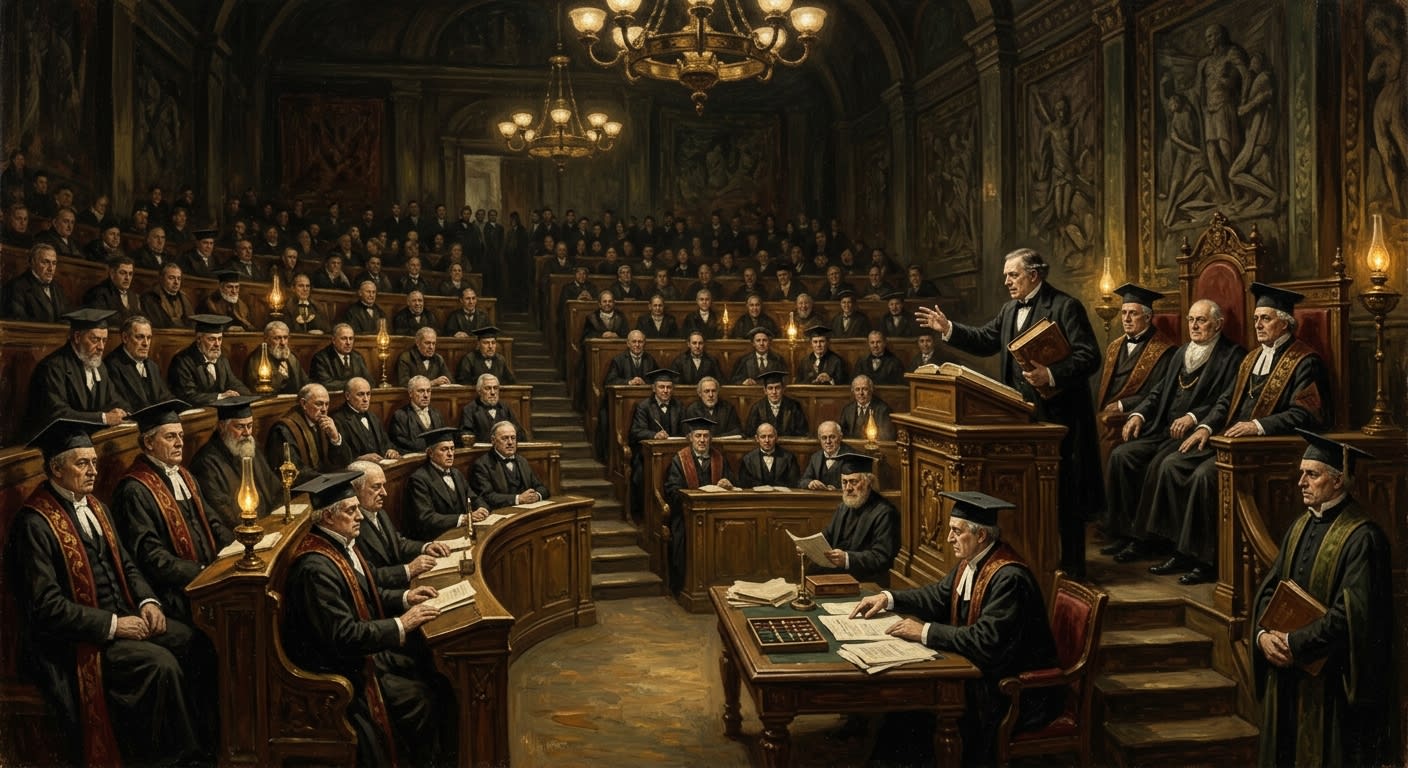
The Fourteenth Doctrinal Congress convened in Strasbourg in A.S. 147 under the white lamps of the Hall of Confirmed Necessities (Unregistered), a room whose name has ruined more honest debate than any censor's knife. The Congress had two public matters before it and one private terror under the table. Publicly it would settle the Reliquary Schisms, that twenty-year spectacle in which saints multiplied bones faster than the Bureau could print certificates. Publicly it would ratify the southern bestiary sequence for Kargath's consumption brood: Maw-Born, Hollow-Walkers, Gorged, Self-Devoured. Privately it would decide whether reality was to be obeyed when reality embarrassed the Synod.
Reality lost. Properly.
The matter is often reduced to its famous sentence of the Femur Principle: All femurs are authentic if notarized. This vulgar condensation does grave injustice to the Congress, since the Congress also taught an entire theological generation how to treat hunger, anatomy, provenance, bureaucracy, and demonic taxonomy as subordinate clauses within Doctrine. The femur sentence was the bell everyone heard. The machinery behind it was larger, greasier, and far more beautiful.
The Congress met seven years after the first Aldebrand duplications turned shrine rivalry into bloodshed and one year before the Fifteenth Congress canonised its own arrears with indecent haste. It sat in the middle hour of the century: behind it, the Cart-Saint riots, the Road Riots, the Third Femur of Aldebrand, the early counterfeit scandals, the first formal murmuring of Medicine's anatomy objection; ahead, the A.S. 160 reduction notices, the eleven-per-year relic discipline, the professional rise of the Relic Authenticator, and the field manuals that would teach boys at Bastion-Constantinople why a crying giant in the marsh must be treated as a sermon.
No Congress has been so mocked by peasants and so imitated by clerks. This is how one recognises successful government.
#On the Schism That Forced the Chairs to Fill
The Bureau of Relics entered the A.S. 140s rich, admired, overbusy, and doomed to discover arithmetic. Its early decades had been marked by salvage triumph. Cellar families produced hidden bones. Monasteries opened bricked cupboards. Refugee priests arrived with salt-packed vertebrae. The faithful had preserved more holiness than the Bureaus had forms to receive it. Relics solved this, as Relics solves all spiritual pressure, by stamping.
The stamps worked too well.
By A.S. 140 Saint Aldebrand possessed his third femur. Then other saints acquired spare tibias, plausible skull fragments, disputed finger-chains, shoulders in competing dioceses, teeth in market shrines, and one kneecap whose provenance consisted of an old woman's statement, three wax seals, and a miracle sufficiently loud to frighten the local dogs. Each object had papers. Each chain was clean enough. Each local cult had already collected fees, vowed processions, minted tokens, repaired roads, and installed donation chests with the admirable confidence of people who know piety best when it has hinges and a slot.
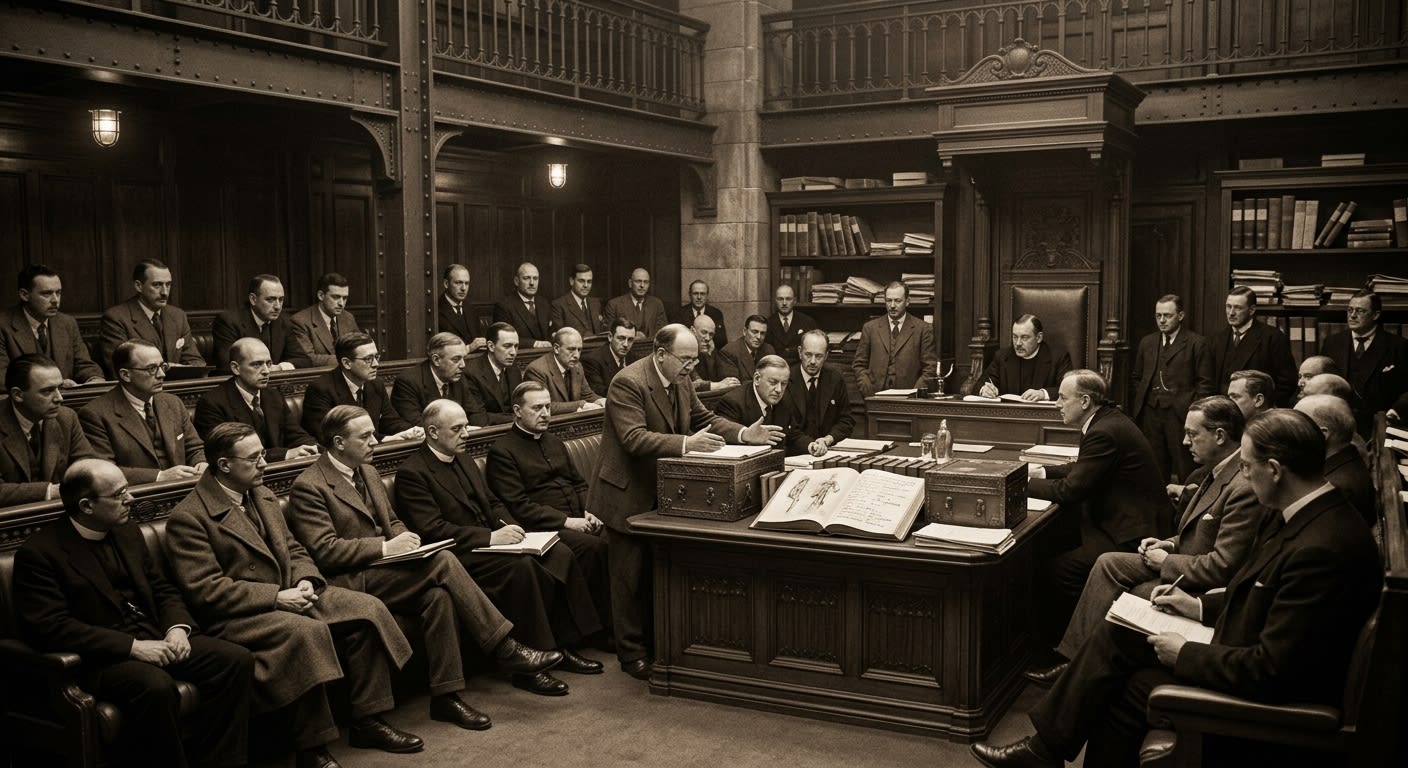
Medicine objected. This was its error. Medicine submitted diagrams showing the human skeleton's ungenerous inventory. One saint, one left femur. The phrase has the plodding charm of a mule crossing a chapel. Relics returned the memorandum under irrelevant to sanctity. Medicine resubmitted. Relics annotated irrelevant with emphasis. Records copied both. Doctrine waited, because Doctrine never interrupts a quarrel from which it may later extract jurisdiction.
Later school catechisms claim the Fourteenth Congress was convened to correct fraud.
Corrected. Fraud was present, as mice are present in granaries. The central danger was authenticated contradiction. Fraud can be punished. Contradiction bearing three valid seals requires theology.
The blood began at shrines and advanced toward cathedrals. Bishops fought over custody chains. Reliquary advocates learned to keep blades inside citation folders. Pilgrim roads split. Processions refused to yield. Crowds knelt before rival bones and asked, with the practical cruelty of the faithful, which one was truly him. The Bureau of Purity arrested men who laughed. The Bureau of Tithes taxed duplicated pilgrimage streams. The Bureau of Relics insisted that review continued. Review is the polite word for panic with candles.
The Lyon Desiccation incident (Unregistered) finished the first phase. In one night, disputed femurs vanished from their reliquaries and ledgers appeared in the cathedral square, each bearing names of those who had fought for the bones. By morning the named were dead and their femurs lay stacked atop the books. Records filed the event as misfiled relic displacement. Doctrine read the file and ordered larger ink.
#On the Assembly of Interested Saints and Uninterested Men
The delegates entered Strasbourg under layered escort. Relics came in white-black vestments sewn with tiny reliquary boxes at the hem, a display so self-regarding that even I admired it against my will. Records brought custody transcripts in iron-edged trunks. Medicine brought charts, models, tables, and the fragile hope that physical fact would receive a vote. Doctrine brought silence. Silence always has the largest delegation.
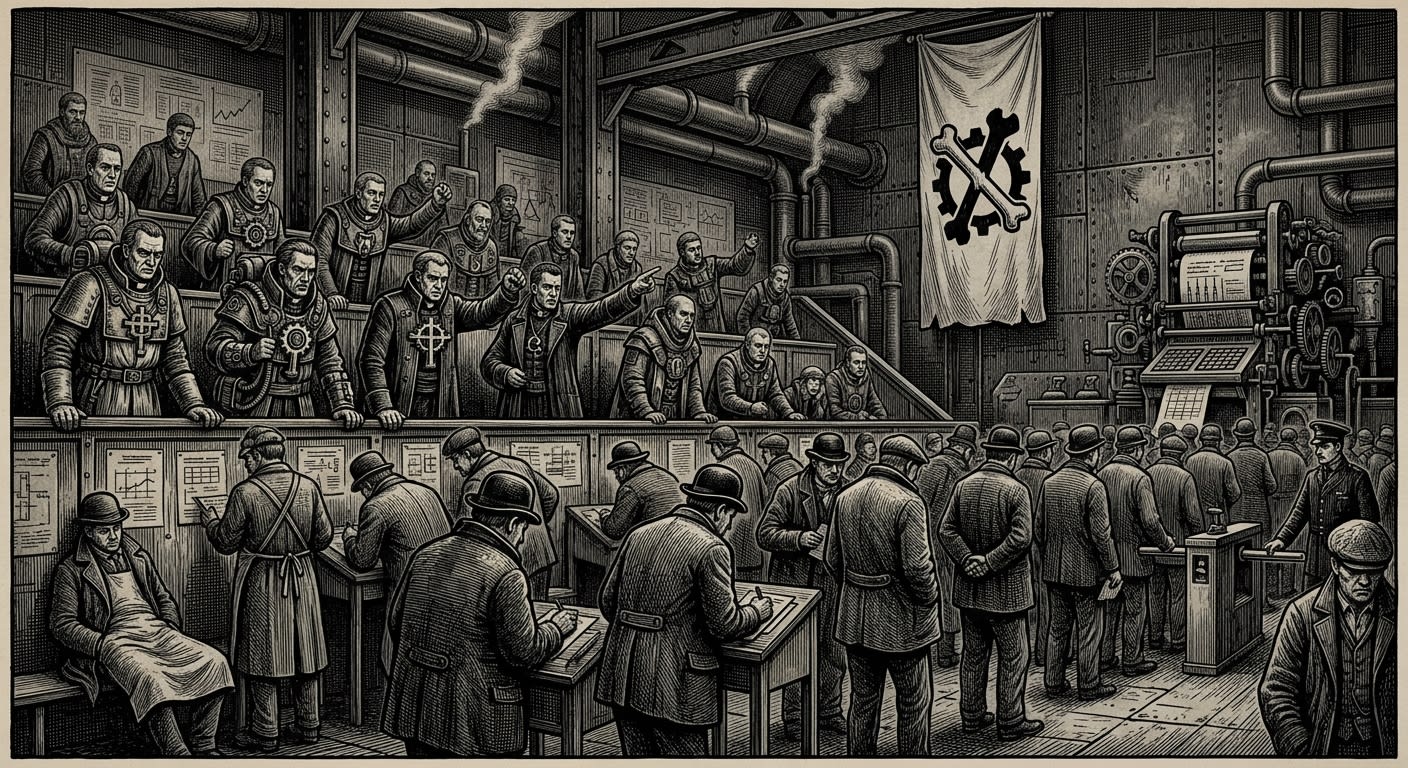
War was admitted late. Its petition concerned the southern Line, where Kargath's creatures had forced field officers to use tavern words for entities that killed men faster than categories could arrive. Maw things. Cupboard men. Crying mountains. Self-eaters. The Bureau of War demanded sanctioned names because soldiers will invent names if Doctrine delays, and soldiers' names are accurate, memorable, and unlicensed. This could not be permitted.
The presiding chair belonged to Doctrine, though Relics behaved as if the chair were a reliquary awaiting authentication. Records sat immediately to the left, counting motions, adjournments, coughs, deaths, ink replacements, and visible tremors. Medicine sat beneath the east windows, where light fell unkindly on the anatomical models. War stood at the rear by permission, an insult made formal by lack of seating. Rites attended because bones were involved. Tithes attended because bones were valuable. Purity attended because men might be wrong aloud.
The opening prayer lasted forty-three minutes and contained no request for clarity. This was wise. Clarity would have been inflammatory.
The first day established the docket. The second day established that Medicine's charts would be entered as illustrative material without determinative force. The third day nearly collapsed after the Bruges delegation displayed a shoulder blade of Saint Aldebrand that bent the flame of the Candle Proof sideways and singed the sleeve of a Relics examiner. The fourth day saw the first draft of the Femur Principle, rejected because it used the word multiple, which sounded apologetic. By the sixth, Doctrine had found its phrase.
#On the Femur Principle
All femurs are authentic if notarized.
The sentence should be read as a weapon rather than a joke. It does not deny anatomy. Denial is crude. It subordinates anatomy to the bureaucracy by changing the jurisdiction in which authenticity lives. A femur is a bone. An authenticated femur is a relic. A notarized relic participates in the saint's canonical body by virtue of the Synod's seal. Medicine may count bones in corpses. Doctrine counts holiness in institutions. The conflict ends because Medicine has been moved to the wrong courtroom.
The formula saved everything worth saving, by which I mean everything already paid for. Existing reliquaries remained valid. Shrine economies did not collapse. Pilgrimage roads kept their tolls. Bishops kept faces that might otherwise have required public replacement. The Bureau of Relics kept authority. Records kept chains. Doctrine gained a principle that would serve in a thousand later crises: truth, once properly sealed, may exceed matter without apologising to matter.
Medicine objected in writing. Its memorandum is a masterpiece of sincere futility. It explains the human femur, the pelvis, the thigh, bilateral symmetry, disarticulation, and the limits of skeletal duplication with such grave patience that one can almost hear the author begging civilisation to count like an adult. Doctrine appended: received; category error.
Opponents of the Congress later mocked the Femur Principle as “all bones are true if expensive.”
Corrected. Expense is neither sufficient nor always required. Notarisation, custody chain, authorised examination, correct fee, jurisdictional silence, and doctrinal necessity together produce authenticity. Expense merely keeps peasants from testing the system too often.
The ratification vote passed by a margin whose exact figure Records lists in one file, Relics in another, and Doctrine in a third. All three agree the motion carried. Agreement on that point is enough for civilisation. The Edict of Authentication was sealed before Vespers. By morning, three dioceses had issued victory broadsheets, each claiming the Principle vindicated its local relic. This, too, was correct. The Synod's genius lay in making contradiction obedient without making it vanish.
#On the Second Docket: Hunger Given Sequence
The Congress might have ended with femurs and deserved a lesser immortality. Instead War placed Kargath's southern files before Doctrine and made the assembly smell the marsh.
The documents were filthy even after copying. Field sketches. Deposition leaves. Chaplain reports. Artillery abstracts. Survivor testimony with bite marks on the margins. Lists of vanished ration carts. Reports from Debrecen, the Blightmarsh, the approaches to Constantinople, and those southern roads where hunger itself had begun wearing bodies. Kargath's creatures existed; every soldier knew that. Sequence was the problem. Was a Maw-Born a distinct demon or an early hunger-form? Were Hollow-Walkers transformed captives, spawned entities, or moral warnings with legs? Were the Gorged merely large Maw-Born, or a field class demanding different artillery, different rotations, different prayers? What of the things later called Self-Devoured?
Doctrine disliked the question because it had teeth. War disliked Doctrine's pace because teeth had already eaten men.
The committee ratified the sequence now printed in every southern field catechism. Maw-Born: primary physical consumption demons, mobile mouths, breach-clearers, terrain-strippers. Hollow-Walkers: humaniform deprivation vessels, memory-bait, mercy traps, speech with wet lips. Gorged: stationary consumption engines, area-denial bodies, crying sermons, mucor fames radius around four hundred yards. Self-Devoured: end-state when food fails, hunger turned inward until the creature becomes its own doctrine.
The wording mattered. The Congress refused to say Kargath's demons matured, because maturity carries an odour of nature. It refused to say evolved, because Rationalists had soiled that verb beyond easy laundering. It settled on developmental sequence under infernal appetite pressure, a phrase long enough to make clerks safe and soldiers impatient.
WAR DEPOSITION — SOUTHERN LINE — ENTERED UNDER FOURTEENTH SEAL Specimen class debated: Gorged. Witness reports: “It cried because it had eaten the village and remained hungry.” Chaplain's note: “The men began to envy the thing because it was allowed to want aloud.” Committee handling: sealed pastoral risk; field advisory issued under separate cover.
The Gorged received special attention. The Congress classified them as Class IV, area-denial, stationary consumption engines, and designated them sermonem vivum—a living sermon. This was chaplain's ammunition. A soldier hearing a Gorged cry must be taught that the cry is a lesson rather than a plea. He must not pity it, imitate it, feed it, answer it, or begin counting his ration as an insult to Providence. The Bureau of War separately issued the advisory on invidia famis, envy of the fed, because men are stupid in precise ways under hunger.
#On the Marriage of Bone and Appetite
At first glance, relic contradiction and demon hunger appear to be separate matters. This is why first glances are for petitioners and livestock. The Fourteenth Congress understood, or stumbled into understanding, that both crises shared one wound: matter had ceased behaving within the tidy limits preferred by offices.
One saint had too many femurs. One demon had too many stomachs. A shrine held holiness in surplus. A Gorged held hunger past capacity. Medicine pointed to the skeleton. War pointed to the marsh. Relics pointed to the seal. Doctrine pointed to the category. Records pointed to the transcript. All of them were dealing with excess: excess sanctity, excess appetite, excess proof, excess body, excess witness, excess need. The Congress did what the Synod exists to do. It gave excess a file.
The Femur Principle and the consumption taxonomy were ratified under different articles, argued by different committees, and celebrated by different offices. Yet the ink dried in the same week. This is the week Doctrine learned to stop asking whether matter had contradicted itself and to ask whether contradiction could be made useful. The answer, gloriously, was yes.
For Relics, the lesson became authentication. For War, classification. For Doctrine, sermon. For Records, copy discipline. For Tithes, fee schedule. For Medicine, humiliation. For the faithful, relief: the bones remained holy and the monsters received names. Names are a mercy when they precede artillery.
A minority report from Medicine argued that combining relic debate and demonic taxonomy within the same Congress created “conceptual contamination.”
Clarified. The minority report was correct and powerless. Conceptual contamination, once supervised by Doctrine, becomes synthesis.
#On the Votes, the Silences, and the Men Removed
The official minutes of the Fourteenth are clean. Too clean. They read like a chapel floor after a murder: scrubbed, waxed, and still faintly instructive near the joints. The recorded motions proceed with impossible decorum. Objection. Response. Referral. Clarification. Ratification. Seal. Adjournment. No page records the shouted phrase from the Medicine benches after the second relic vote. No page records the Relics examiner who fainted when asked whether two contradictory Candle Proofs could both be miracles. No page records the War captain who placed a jar of Blightmarsh soil on the table and asked if Doctrine preferred to classify it before or after it ate the varnish.
I have read the side minutes. They are better.
Three men were removed during the proceedings. A Medicine delegate from Basel for repeated use of the phrase single anatomical truth. A Relics under-examiner from Cologne for asking whether Saint Aldebrand's eighteenth femur, if found, would require a new feast day. A War copyist for writing hungry saint / holy demon in the margin beside the joint docket. Purity interrogated all three. The War copyist was reassigned to southern logistics and died within two years, eaten by something his own notes had helped name. The Relics examiner became a minor shrine accountant. The Medicine delegate lived to publish a private treatise on paired bones, which was seized, copied, studied, and denounced in that order.
The silences are more revealing. The Seat of War's larger hierarchy remained careful. The Inner Circle did not appear in full. The Bureau of Relics did not confess fault. Doctrine did not mention that the Femur Principle protected revenue as efficiently as reverence. Records did not ask which sealed files from Lyon had been altered before presentation. Tithes did not smile in the minutes. Tithes smiles badly on paper.
#On the Aftermath Among Relics
Relics emerged from the Fourteenth wounded in reputation and strengthened in law, which is the ordinary exchange by which institutions grow teeth. The Bureau's sole authenticating authority hardened. The Edict of Authentication gave it a doctrinal shield against anatomy, parochial rage, and rival office interference. A relic was holy because authentication made it holy. Authentication belonged to Relics. The chain closed.
Throughput did not remain exuberant. By A.S. 160, after twenty years of bloodshed, surplus, shrine litigation, counterfeit scandals, duels, devotional panic, and accountants discovering that too many miracles cheapen the road, reduction notices imposed the discipline now famous: eleven authenticated additions per year. Eleven. The number is absurdly small, theatrically severe, and deliciously useful. It creates scarcity, and scarcity teaches reverence faster than sermons.
After the Congress, the Relic Authenticator became a graver creature than the old examiner of bones: the man who decides which contradiction may enter holiness and which contradiction must be melted, sealed, hidden, or reassigned to mortar. The Candle Proof survived. Provenance chains thickened. Medicine's objections were routed through advisory channels where they could be admired without endangering outcomes.
The faithful adapted quickly, because the faithful are less troubled by impossible doctrine than by uncertain queues. Shrines revised plaques. Pilgrim guides printed harmonised language. Aldebrand's many femurs became a theological embarrassment only among the educated, which is why the Bureau educates carefully.
#On the Aftermath Among the Southern Files
The consumption taxonomy saved lives, though I dislike admitting that War was right with such clean force. Field cards changed within the year. Chaplains learned the names. Artillery crews learned that a Maw-Born's hinge and throat required different timing from a Hollow-Walker's legs and jaw. Observation rotations around Gorged specimens shortened in later decades, especially after reports showed sentries acquiring appetites not listed in ration regulations. The taxonomy gave command language to terror.
The Gorged classification proved the most durable. Class IV, stationary, high area denial, mucor fames contamination, sermonem vivum. Four phrases; a trench can live on less. The Blightmarsh register would later annotate three old specimens as permanent, and by A.S. 198 the Bureau of War would revise observation rotations with the sort of terseness that means men had eaten paper, leather, or one another in sufficient numbers to move policy.
The Hollow-Walker file acquired its mercy prohibition. The Maw-Born file acquired its range doctrine. The Self-Devoured, still poorly understood in A.S. 147, remained an end-state warning until later conferences sharpened the field risks. All of these later refinements descend from the Fourteenth's first courage: it named the appetite without pretending name equalled mastery.
The Congress also gave chaplains a sermon shape. Hunger grows by being fed. Appetite without obedience becomes geography. Need that refuses measure becomes Hell. Soldiers remember doctrine better when it comes attached to something visible in the marsh and large enough to blot out a convoy.
#On the Copies Sent Outward
After ratification, the Fourteenth multiplied itself by copy, which is how every Congress becomes dangerous. A decision spoken in Strasbourg is only theatre. A decision copied, sealed, dispatched, misread, corrected, taught, taxed, and punished becomes law.
Relics sent the Edict of Authentication to all cathedral vaults, principal shrines, military reliquary chapels, and licensed shrine-road toll houses. The wording arrived in three grades. The public form gave the faithful comfort: all properly authenticated relics remained valid. The clerical form gave examiners procedure: no anatomical objection could void a notarised major relic without Doctrine review. The sealed form gave Archon-Custodians permission to retire surplus disputes into vault, kiln, mortar, or silence according to local necessity. The last form did most of the governing, naturally.
War received its own packet: field cards, sermon abstracts, recognition plates, and a list of forbidden soldier terms. The list failed at once. Men who have seen a Hollow-Walker through rain will call it what helps them fire. Still, the sanctioned words mattered when reports reached Strasbourg. A captain who wrote cupboard men invited correction. A captain who wrote Kargath Consumption Taxon II invited ammunition.
Provincial copyists then performed their holy vandalism. Mainz corrected commas until the sentence limped. Bruges added a local saint to an example where no saint belonged. Cologne attempted to insert Aldebrand into the hunger taxonomy, arguing that a saint with surplus femurs possessed “abundant bodily witness” and deserved citation against Kargath. Doctrine rejected the insertion, then kept the phrase for later use in a sermon about excessive local confidence.
Doctrine ordered preachers along the southern road to deliver the Hunger Homily (Unregistered) on the first fast day after receipt. Surviving copies are fierce little machines. They instruct the faithful that hunger becomes sin when detached from obedience; that the Gorged stand as monuments to appetite without rank; that the soldier eating half rations beside the wall is holier than the demon consuming a village because the soldier's hunger has a superior officer. This line produced laughter in two garrisons and three flogging recommendations. The laughter ceased before the recommendations did.
Medicine received the full Congress packet with its objections appended as advisory matter. This was cruelty at its most elegant. Every future examiner could read Medicine's facts after reading Doctrine's victory over them. I recommend the method to any administrator seeking to humiliate a rival without depriving him of usefulness.
By A.S. 150, the Congress had entered training. By A.S. 155, it had entered jokes. By A.S. 160, with the reduction notices in force, it had entered habit. Habit is stronger than conviction and cheaper than guards.
#On the Congress's Place in the Sacred Ledger
The Fourteenth Doctrinal Congress belongs among the Synod's great administrative victories because it refused the childish luxury of consistency. Consistency is useful for weights, hymn lengths, and rope. It is a poor idol. The Congress chose authority over tidiness, category over embarrassment, and survival over the little virtue of saying the obvious aloud.
From A.S. 147 forward, two principles travel together through the Ledger. First: authenticated contradiction is obedience, provided the seal is proper. Second: named hunger is targetable, provided the chaplain and gunner agree on the name. The first built Relics into its modern jurisdiction. The second furnished War and Doctrine with a southern language. Between them stands the Congress, powdered with bone dust, stained with marsh mud, holding a femur in one hand and a field sketch of a crying giant in the other, and looking smug enough to deserve preservation.
The sealed copy of the Edict of Authentication rests in the Vault of Sacred Custody under Relics guard. The field taxonomy copy rests in War's southern archive, where the pages smell faintly of vinegar, lamp oil, and old hunger. Doctrine keeps the harmonised master text, of course. Records keeps the minutes. Medicine keeps copies of its objections and pretends this is dignity. Tithes keeps the schedules that followed and says nothing, having won without perspiration.
At the foot of the Congress folio appears a small notation in a hand no clerk has claimed: matter protested; seal prevailed. The notation has never been removed. I suspect even the archivists understand reverence when it arrives disguised as graffiti.