
#On the Present Catalogue
This entry is a survey of the Graven Colossus as it stands in the present catalogue, compiled in A.S. 201 under my hand. It is not a history. The machine has one, as anything of stone and joinery has one, but the Codex holds no authorised account of where or when that history began, and I decline to manufacture one for readers who like their relics with a birthday.
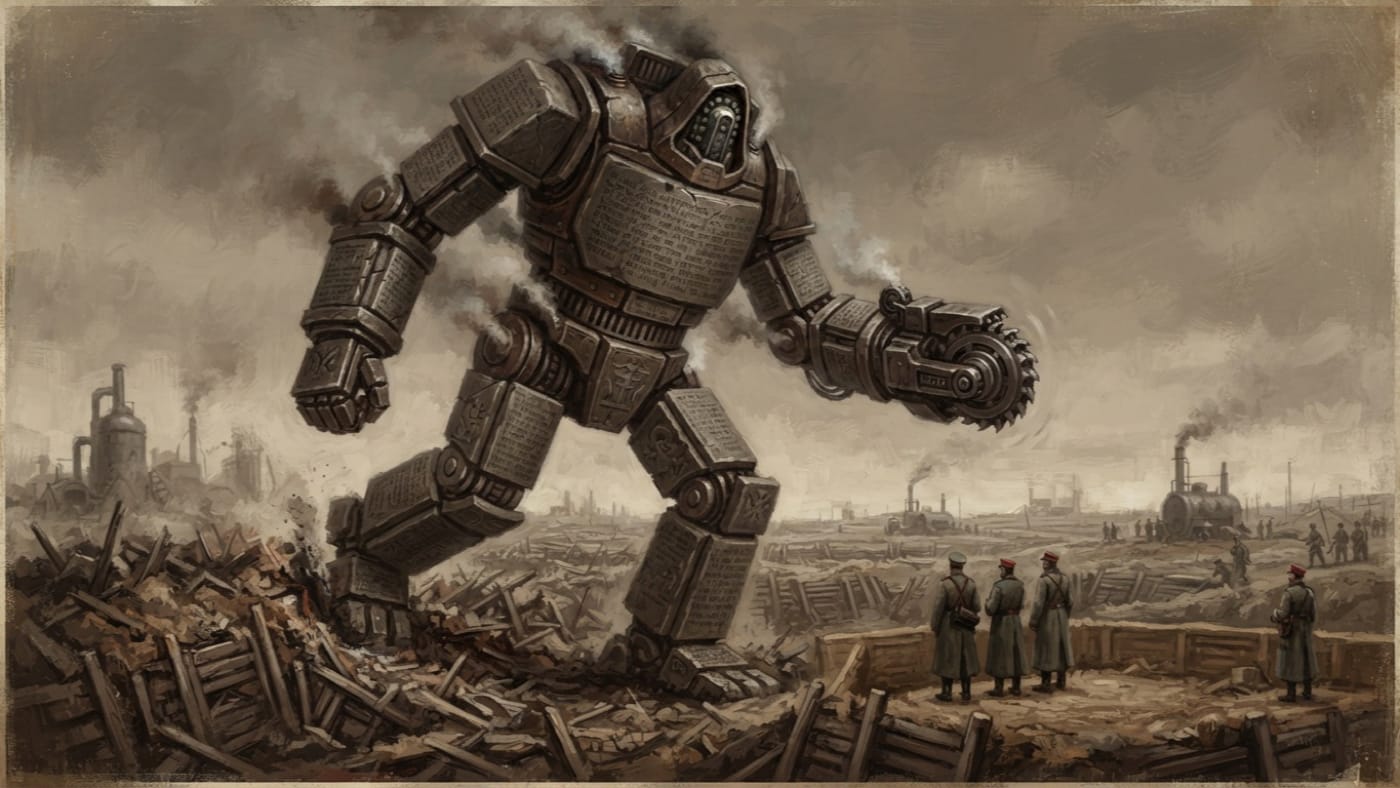
The catalogue holds this. The Graven Colossus is a sacred war machine of the Church, entered in the Bureau of Engineering's production catalogue beside two relatives with fatter files. Engineering designed it. The Bureau of Doctrine blessed it. It walks on inscribed stone legs. The older descriptive account in the Lore Book adds that it is a titanic biped clad in slabs of inscribed stone, that every step it takes collapses trenches, and that its fists contain rotary grinders which reduce heretics and machines alike to blood-slurry and dust.
That is the whole of the evidence. It is more than many saints have.
#On the Inscribed Stone
Two sources describe the body, and they agree. Engineering's catalogue is sparing with adjectives, as Engineering is sparing with everything, and it says only that the Colossus walks on inscribed stone legs. The Lore Book covers the rest of it: a titanic biped with slabs of inscribed stone across its frame. One account fixes the legs and the other clothes the whole. A careful reader may join the two without forcing either.
That reader may go no further. Neither source says the Colossus is stone all the way through. Neither says what lies behind the slabs, how they are fixed, or what bears the load when one leg lifts and the whole titanic sum of the machine rests on the other. Engineering knows, because Engineering designed it. Engineering has not published, and the Codex will not draw an interior it has not been shown.
The inscriptions trouble me more than the stone. Every account agrees that the stone is written upon, and none reproduces the writing. I cannot say whether the slabs carry psalm, canon, dedication, provenance mark, or the Bureau's own filing clauses cut large enough to read from the next trench. I cannot name the language. I cannot say whether the lines were cut before the blessing or after it, or who chose them.
I can say what writing on a blessed machine means to the Church. The answer concerns classification rather than mechanism. The same habit puts psalm-script into harbour chains and prayers into the margins of load calculations. Writing on a thing declares whose it is and under what sanction it acts. It does not make the thing think. Nothing on file suggests that the Colossus reads its own skin, chooses its own road, or carries more holiness in its stone than the men who cut it.
#On the Steps and the Fists
The Lore Book says that every step collapses trenches. I record the sentence as written and do not improve it. It is a description, and it carries the force descriptions acquire when the thing described is very large. The Codex holds no measured trial, no engineer's tolerance and no ledger of trenches counted before and after. The claim stands as the source gives it.
Its sense needs no arithmetic. The war along the Sagittal Line is fought in earth cut into lines, and a trench is a bargain a soldier makes with the ground: dig deep enough and the ground will keep you. The Colossus, as described, voids the bargain by standing on it. The parapet folds, the revetment goes, and whatever lay at the bottom lies under the stone. The source does not say whose trenches. I would not shelter in any trench, of any allegiance, while the thing was crossing it.
Then there are the fists. The source says they contain rotary grinders, and that these reduce heretics and machines alike to blood-slurry and dust. I respect the precision of that vulgarity. Slurry is what remains of the one and dust is what remains of the other. The grinder makes no distinction of kind, and the residue sorts itself by consistency.
Heretic here is the Church's word. The machine does not try the case. Judgment is passed before the Colossus is pointed anywhere. The fist is where the sentence is carried out, and the grinder is the last clerk to handle the file. I note the order of operations because Doctrine insists on it, and because Doctrine is right.
Nothing on file gives the grinders' speed, their reach, the force behind them, or the number of revolutions a heretic requires. The source names no other weapon. Readers who know the Sepulcher's turrets will want guns on the Colossus as well. The catalogue gives it fists.
#On Design and Benediction
Engineering designed the Graven Colossus, and Doctrine blessed it. The catalogue sets the two clauses side by side as equals. Doctrine regards this as generous. Engineering regards it as a matter of formatting.
The Bureaus guard the distinction jealously, and it is an old one. Engineering's office is to make a thing that will stand, bear and move. Doctrine's office is to declare that the thing may be loosed against the enemies of the Creator, and that what its grinders do falls within the Church's law. One Bureau answers for the leg and the other for the step. Neither will take responsibility for the other's work, though each will happily take credit for it.
Blessing a war machine certifies its use and says nothing of its virtue. The stone does not grow holier with each trench it ends. If it did, Doctrine would be obliged to canonise a leg, and I have read enough Doctrine minutes to know someone would propose it.
The catalogue places the Colossus in a family. The Sepulcher Locomotive and the Catacomb-Carrier Threnody stand beside it. The same Bureau designed all three sacred engines, and the same Bureau blessed them. The resemblance ends at the paperwork. The Sepulcher runs on rail and cannot leave it. The Threnody trundles on iron treads. The Colossus walks. The train's carriages, boilers and magazine belong to the train. A reader who borrows those particulars to fill gaps in the Colossus's file commits the clerk's oldest sin: filing a document under its neighbour's number.
The Colossus belongs to no other family. The enemy has walking giants of its own: Maldrake's Flameheart Colossus strides through the older accounts of Wrath's host, and the Church's books list such things as works of sorcery. The two share a noun because both are large. The Graven Colossus is human work, designed by a human Bureau and blessed by another. Nothing in its file suggests any other hand on it.
#On the Survey's Limits
This survey can say what the Colossus is. It cannot yet say where the Colossus has been. No action in the Codex names it. The catalogue that attests the machine assigns it no sector of the Line and certifies nothing about its present readiness. Its origin is undocumented, and so is the day it first walked.
Readers who find the file thin may compare it with the Sepulcher's, which is fat with invoices, and ask themselves which of the two machines they would rather meet. The Colossus has a short file and stone legs. The catalogue is content with that.
It walks, and the stone carries the writing. For A.S. 201, the Codex asks no more of it.