
#On the Engine That Carries Graves
Where the rail ends, the shrine does not proceed. Where the shrine must proceed, the rail is made to confess. — Bureau of War marginal note, A.S. 191
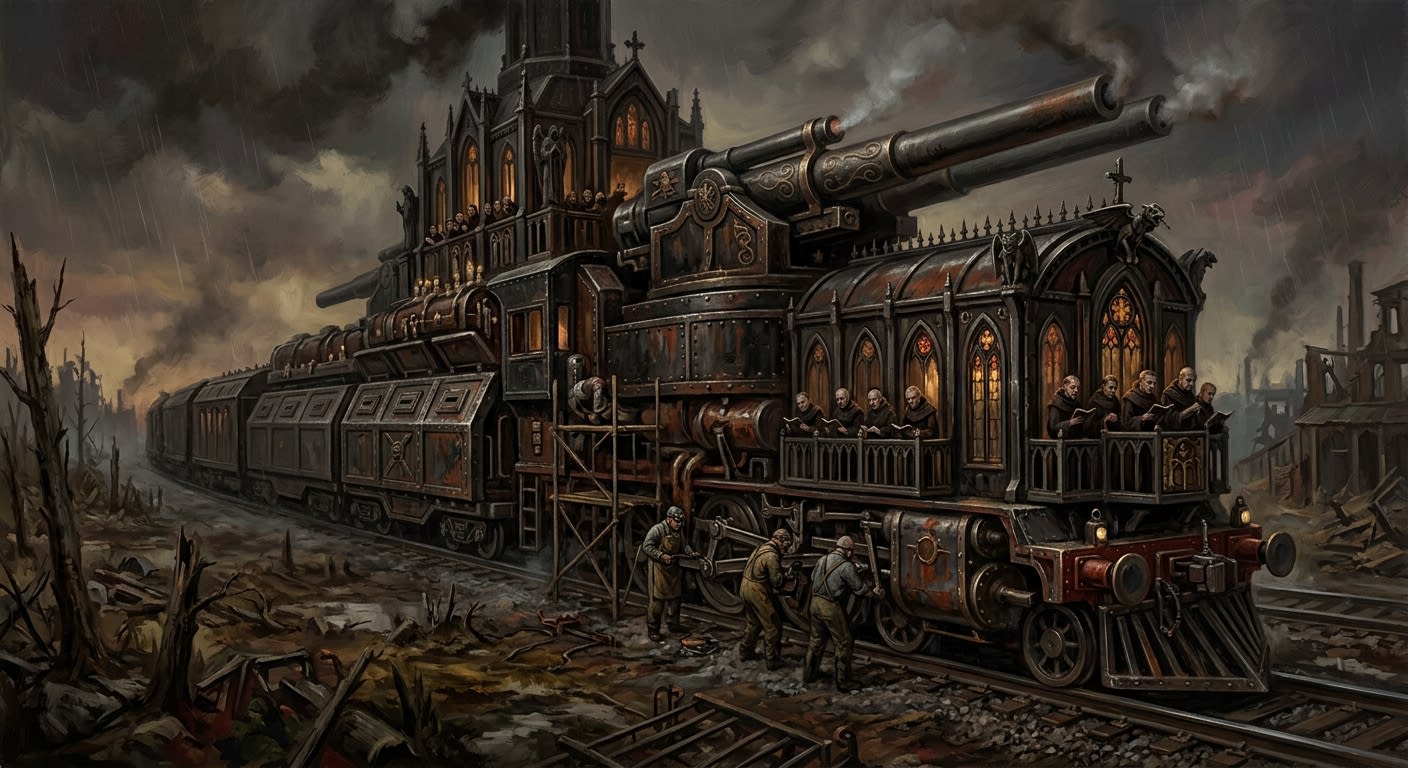
The Sepulcher Locomotive is a rail-bound juggernaut of armoured carriages hauled by a shrieking iron engine, dragging whole shrines into battle while its turreted guns rake the fields with consecrated shot. This is the official description. It is accurate in the way a death certificate is accurate: the facts are present, the horror is filing its appeal elsewhere.
The Bureau of Engineering designed the machine; the Bureau of Doctrine blessed it; the Bureau of War requisitions it; the Guild of Rails keeps it from becoming a very expensive reliquary parked in mud. The machine itself appears to respect none of these jurisdictions. Machines of that size develop opinions. Clerks call this superstition until the boiler answers them.
A normal locomotive pulls cargo. The Sepulcher pulls authority. Its carriages contain chapel, magazine, turret, ossuary rack, choir bay, signal room, repair crib, casualty bench, and one sealed compartment whose manifest changes whenever Records asks too directly. It carries relics forward because relics must sometimes arrive before men stop dying. It carries guns because relics alone, though spiritually excellent, have poor range against slag cavalry.
#On Construction and Appetite
The Sepulcher pattern belongs to the same family of sanctioned monstrosities as the Graven Colossus and the Catacomb-Carrier Threnody: sacred engines whose manufacture begins as engineering, passes through liturgy, and ends with a procurement officer pretending he has not noticed the thing breathing. Its iron plates are riveted over shock-wood and saint-bone mortar. Its chapel carriage is lined with ossuary brick, each brick stamped with a provenance mark, each mark theoretically true. Its turret rings are cut wide enough to take consecrated shot canisters, reliquary shells, hymn-steel darts, and those black-capped rounds the Ordnance clerks label “morally discouraging.”
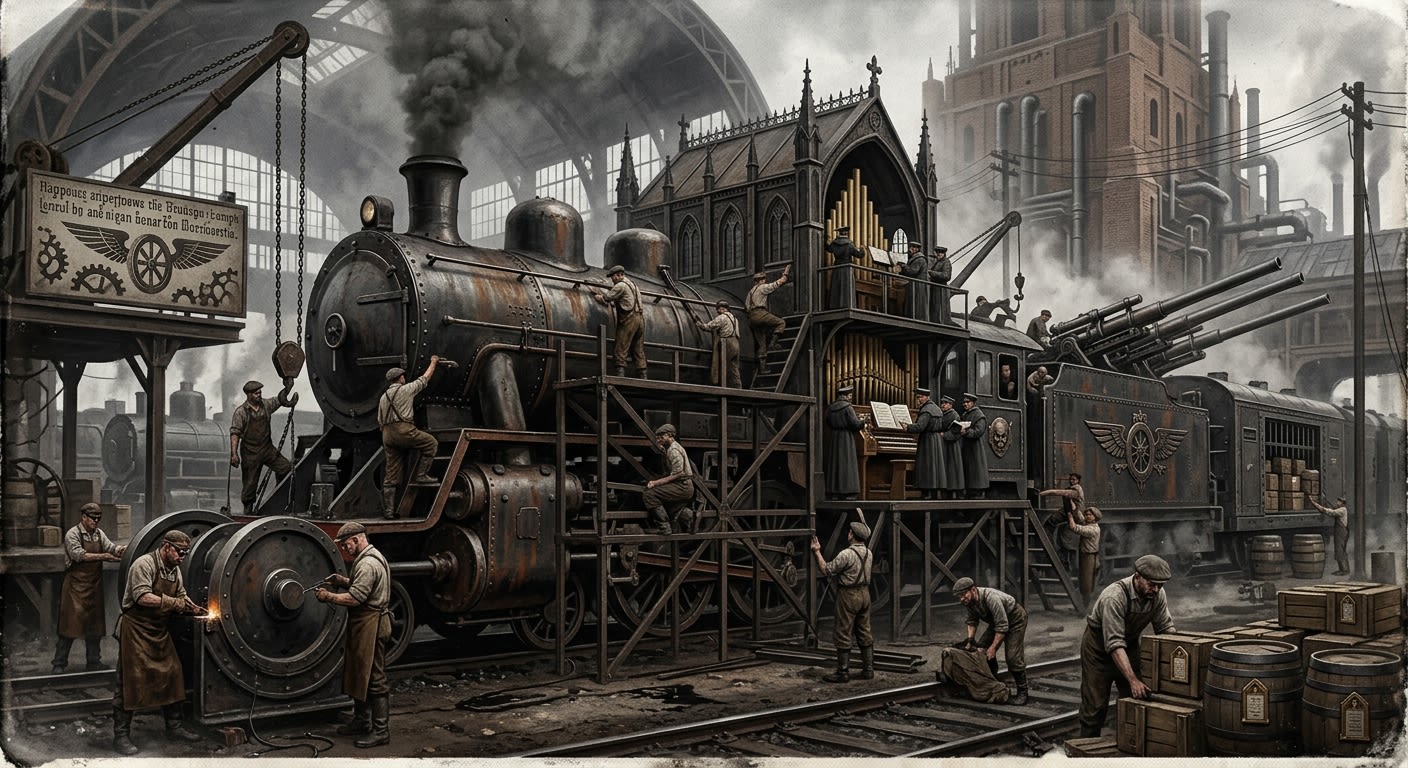
Fuel allowances are calibrated to hymn-length. Ammunition is blessed by the round. Boiler pressure is logged in both pounds and antiphons. Engineering insists this dual accounting aids discipline. Doctrine insists it aids sanctity. The fireman shovelling coal at two in the morning insists it aids nothing and would like both Bureaus to shut up.
The locomotive’s appetite exceeds ordinary supply math. Coal, water, oil, wax, shells, reliquary cloth, choir lozenges, lamp glass, grease, blood plasma, absolution chits, replacement bolts, bone dust for chapel repairs: all vanish into it. A moving Sepulcher consumes a district’s week in a day. A stationary Sepulcher consumes dignity faster.
#On the Shrine-Cars
The chapel carriage is the machine’s heart by law and its excuse by politics. A travelling altar sits on recoil springs. Reliquary cases lock into brass cradles beneath shock straps blessed by Relics and tightened by mechanics who trust leather more than saints. Candles burn behind glass. Incense is vented through armoured chimneys. The priest assigned to the forward lectern reads Mass over the gunfire, timing consecration between recoil cycles so the Host does not leap from the paten and embarrass the Creator.
Behind the chapel sits the ossuary magazine. Its racks hold powdered saint admixtures, bone-lime seals, and wrapped shot cartridges whose labels carry more seals than some marriages. The magazine smells of wax, saltpeter, dust, and the particular sweetness of old bones kept too warm. Men speak softly there. Even War speaks softly there, though War pretends it is because of fire risk.
CARRIAGE VII MANIFEST — SOUTHERN RELIEF CONFIGURATION, A.S. 191 Declared: reserve reliquary stores; emergency choir vestments; sealed medical caskets. Observed by unauthorized maintenance hand: one iron cradle; one man-sized negative space in frost; ███████ finger marks inside glass; hymn-lock active without key. Disposition: maintenance hand transferred to Mercy, then Records, then no longer present in either ledger.
The choir bay is narrow, hot, and hated. Eight to twelve cantors stand harnessed against sway and sing pressure-stabilising measures whenever the engine crosses damaged rail, enters contested territory, or fires both forward turrets inside one minute. A cantor who loses pitch can turn recoil into fracture. A cantor who faints is clipped upright until relieved. The Bureau of Bells calls this humane because the harness is padded. The senior cantor keeps a brass beat-rod fixed to the carriage wall; if the rod slips, the choir follows the gun recoil instead of the engine rhythm, and the whole machine develops the musical manners of a collapsing staircase.
#On Guns and Consecrated Shot
The Sepulcher’s turreted guns are not ornamental theology. They are practical theology, which is a nastier thing. The main turrets rake fields with consecrated shot: canister for clustered infantry, hymn-steel darts for armoured abominations, bone-dust bursting charges for things that dislike sanctified particulate, and bell-capped shells whose detonation makes a sound like a cathedral deciding to fall on someone specific.
The train fights along dedicated rail spurs thrown toward crisis points by the Military Track Corps. A spur may exist for six hours, receive two thousand tonnes of locomotive, guns, relic, smoke, and panic, then be pulled up before dawn so the Enemy cannot learn the route. Track men lay the iron under fire. Artillerymen complain about vibration. Priests complain about soot on vestments. The Corps buries its dead beside ballast and keeps working, because the timetable is a god with no mercy cult.
The guns are fired by War crews under Doctrine observers, which ensures that every practical decision has at least one unnecessary witness. Misfires are logged three times. Hits are attributed to Providence. Misses are attributed to smoke, grade, rail shift, insufficient hymn, crew fatigue, powder age, or the Enemy’s discourtesy in moving. Records receives the firing ledger after War has removed the interesting verbs.
Early firing tables classified shrine-car mass as “spiritually stabilising and mechanically negligible.”
Corrected after the Saint Ulm turn-out fracture (Unregistered). Shrine-car mass is mechanically considerable. Spiritual stability does not reduce axle load. The engineers who said so were correct, insufferable, and late.
#On the A.S. 191 Constantinople Relief
The machine’s most cited modern action is the A.S. 191 Constantinople relief (Unregistered), when the southern rail spur carried the Sepulcher toward Bastion-Constantinople under a sky already crowded with failed promises. The Vigil Ark of Saint Uriel sat grounded in the Foundry Quarter. The outer observation chain had begun filing reports from the Blightmarsh that would later become the Vey file (Unregistered) on the Self-Devoured. Kargath’s famine-pressure rotted ration confidence before it rotted bread. Maldrake’s heat sat beyond the plain like a furnace door left open.
The Sepulcher ran because the sky would not.
Corps crews repaired the track that morning. One section had buckled under heat and prayer-jam vibration. One bridge plate had walked three fingers out of alignment. One switch had fused to its housing in a shape the Guild report described as “like a kneeling man,” then revised to “thermal distortion” after Doctrine objected to kneeling without approval. The train passed at third bell. One Corps man lay beside the ballast as it went by, dead or sleeping. The conductor did not stop.
The forward guns fired seventy-three consecrated rounds in two hours. The chapel carriage took three direct impacts. One relic case cracked; Relics later certified the crack devotional rather than structural, which comforted the invoice. The choir bay lost two voices to heat collapse. The engine screamed through the southern approach so loudly that wall crews at Constantinople mistook it for a Bellway alarm and answered with the wrong peal for seven minutes. The error saved a magazine convoy by sending it into the wrong tunnel.
Acceptable is a word War keeps polished.
#On Maintenance and the Men Beneath
A Sepulcher does not return from action; it is retrieved from its own consequences. Track crews inspect the rails first, because the machine’s passage punishes iron. Then boiler crews bleed pressure. Then Relics counts cases. Then War counts shells. Then Doctrine counts miracles. The order tells you whose death causes paperwork soonest.
Maintenance requires Guild men under the carriages before the shrine is cool. They crawl through mud, grease, bone dust, spent casing fragments, melted candle wax, and the drips nobody names. They check brake shoes, axle boxes, couplings, turret-ring tremors, chapel shock bolts, choir harness mounts, reliquary cradles, and rail-scoring beneath the drive wheels. A missed fracture kills a crew. A missed chapel bolt creates doctrine.
The Guild charges extra for Sepulcher work. War protests. The Guild produces the casualty sheets. War pays.
Night Walkers dislike the dedicated spurs after a Sepulcher passage. Rails retain heat too long. Chalk marks soften. Signal bells answer late. Sometimes the track produces a clear ring where it should sound dead, which is worse than the reverse to anyone with a working imagination. Demon-sign chalk placed on these sections has been observed to darken at the edges. The Bureau of Doctrine calls this soot contamination. The Guild calls it overtime.
#On Jurisdictional Piety
The Sepulcher Locomotive sits at the crossing of four authorities, which is to say it lives in a permanent brawl conducted by memorandum. Engineering owns the design. War owns deployment. Doctrine owns blessing. Relics owns the bones. Bells owns the choir measures. The Guild owns the track until something goes wrong, at which point everyone owns the fault except War.
This arrangement functions because each party fears the same embarrassment: a stranded sacred engine, guns silent, shrine intact, wheels still, while the Enemy learns to laugh at rail gauge. No Bureau can endure that image. The machine moves because vanity is the strongest solvent in Strasbourg.
A Bureau of War circular referred to the Sepulcher Locomotive as “self-sufficient in theatre.”
Withdrawn after Guild protest. The machine requires dedicated rail, certified crews, fuel tenders, choir rotation, water stops, ammunition replenishment, relic custody, and enough spare bolts to rebuild a minor heresy. Self-sufficient machines exist only in War circulars and fever.
As of A.S. 201, the Sepulcher remains active, expensive, feared, prayed over, cursed beneath, and requested wherever a commander wants the comfort of hearing a shrine arrive at speed with guns already turning.