
#On the Bureau's Foundation and Character
"Thermally implausible but not our department." — Bureau of Engineering response to the Tongues of Fire at Worms, A.S. 87
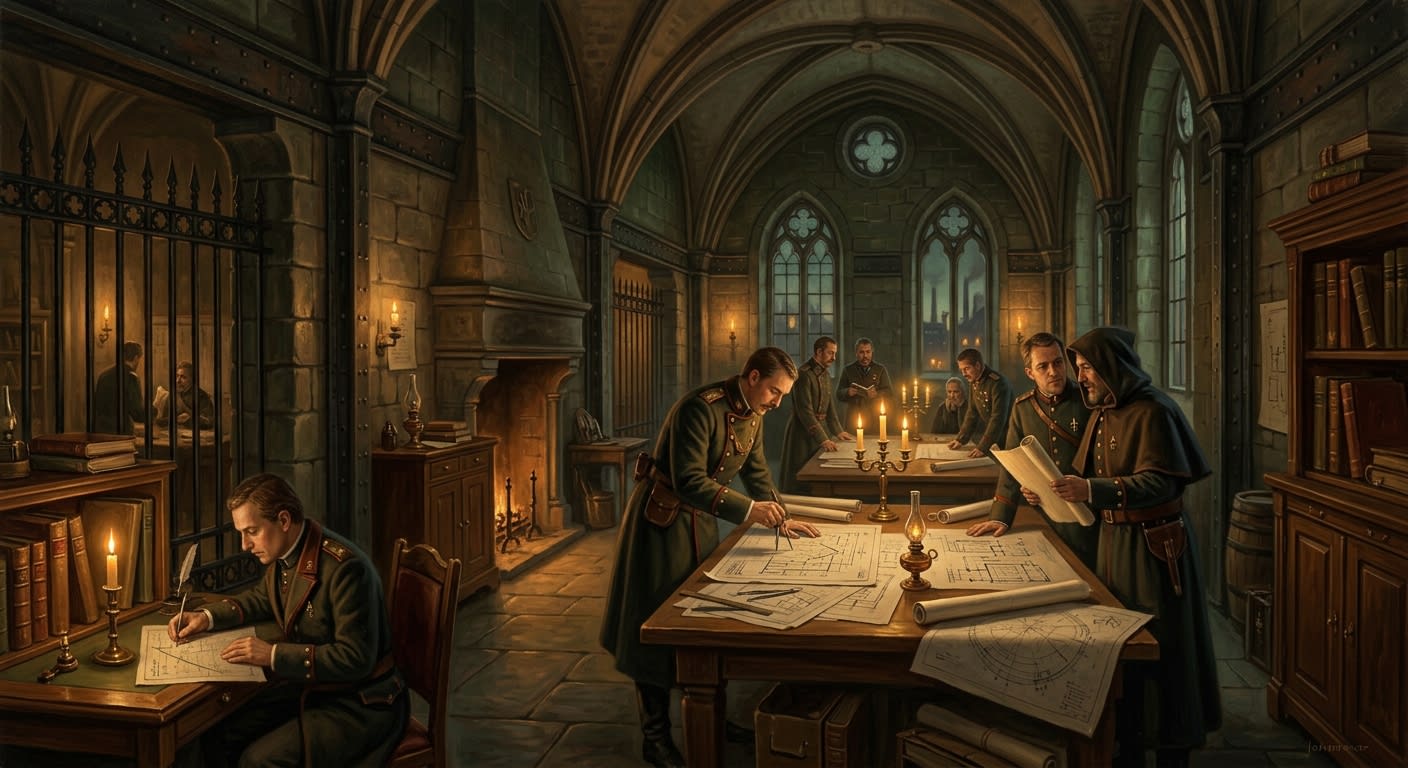
The Holy Bureaus divide the labour of salvation among themselves with the jealous precision of heirs contesting a will, and the Bureau of Engineering has always received the portion no one else wanted: the physical. While the Bureau of Doctrine pronounces and the Bureau of Records remembers and the Bureau of Bells rings and the Bureau of Tithes collects, the Bureau of Engineering digs, measures, pours, rivets, surveys, calculates, and — when the calculations are done — builds the thing that holds the other Bureaus upright.
The official documentation calls them "the Fists." The Bureau of Doctrine calls them "a necessary subordinate instrument." The Bureau itself calls itself nothing, because the Bureau of Engineering does not name things. It designates them. It assigns them filing numbers. It stamps them with survey classifications and structural tolerance grades and load-bearing capacities expressed in units that only other engineers understand, and then it moves to the next project, because there is always a next project, because the Sagittal Line is two thousand miles long and every mile of it is falling apart.
The Bureau was formally constituted alongside the other first-wave Bureaus in A.S. 92, under the Concordat's administrative expansion, though its actual work predates its charter by decades. Engineers from Strasbourg carved the gun galleries of the Chalk Redoubt of Calais in A.S. 69. Engineers of the nascent Order of Litany-Engineers sank the piles of Bastion-Shipka into marsh in A.S. 68. The Bureau of Engineering's seventeenth memorandum on the subject of the Iron Gates gorge resulted in the designation of Bastion-Irongate in A.S. 67 — Writ 17-C(Revised), which remains in force, which has never been superseded, and which is the only Bureau document I know of whose filing number contains a parenthetical.
The Bureau's seat is the Foundry Archive, a low stone complex on Strasbourg's eastern canal that the Bureau of Doctrine has twice attempted to relocate and that the Bureau of Engineering has twice declined to vacate. The building is reinforced to tolerances that exceed the Cathedral's. The Bureau of Doctrine considers this an insult. The Bureau of Engineering considers it a structural fact, which is the same thing.
#On the Bureau's Works
"The Line does not hold because we pray. The Line holds because the mortar sets." — Graffito, Bureau of Engineering latrine, Bastion-Irongate. Attributed to no one. Repainted monthly.
Every fortification on the Sagittal Line was designed by the Bureau of Engineering, surveyed by the Bureau of Engineering, and built under the Bureau of Engineering's supervision with materials the Bureau of Engineering specified and labour the Bureau of Engineering requisitioned. The Bureau of Doctrine blessed each stone. The Bureau of Bells tuned each tower. The Bureau of War garrisoned each wall. The Bureau of Engineering made the stone, the tower, and the wall exist.
Seven bastions anchor the Line. The Bureau of Engineering submitted proposals for each. The rate of acceptance varied. Bastion-Sibiu required seventeen proposals between A.S. 58 and A.S. 66 before the seventeenth was approved — because the Saxons had already built most of the fortifications, and the Bureau of War could not bring itself to admit that amateurs had done half its job. Bastion-Irongate required seventeen memoranda, a coincidence the Bureau does not acknowledge and which I find suspicious. Bastion-Königsberg required nine proposals, two of which the Bureau of Doctrine rejected on grounds that the blueprints contained "insufficient devotional annotation," by which the Bureau of Doctrine meant that the engineers had neglected to include prayers in the margin of their load-bearing calculations.
The works themselves span the range of human construction and several categories of construction that the Bureau concedes may not be entirely human.
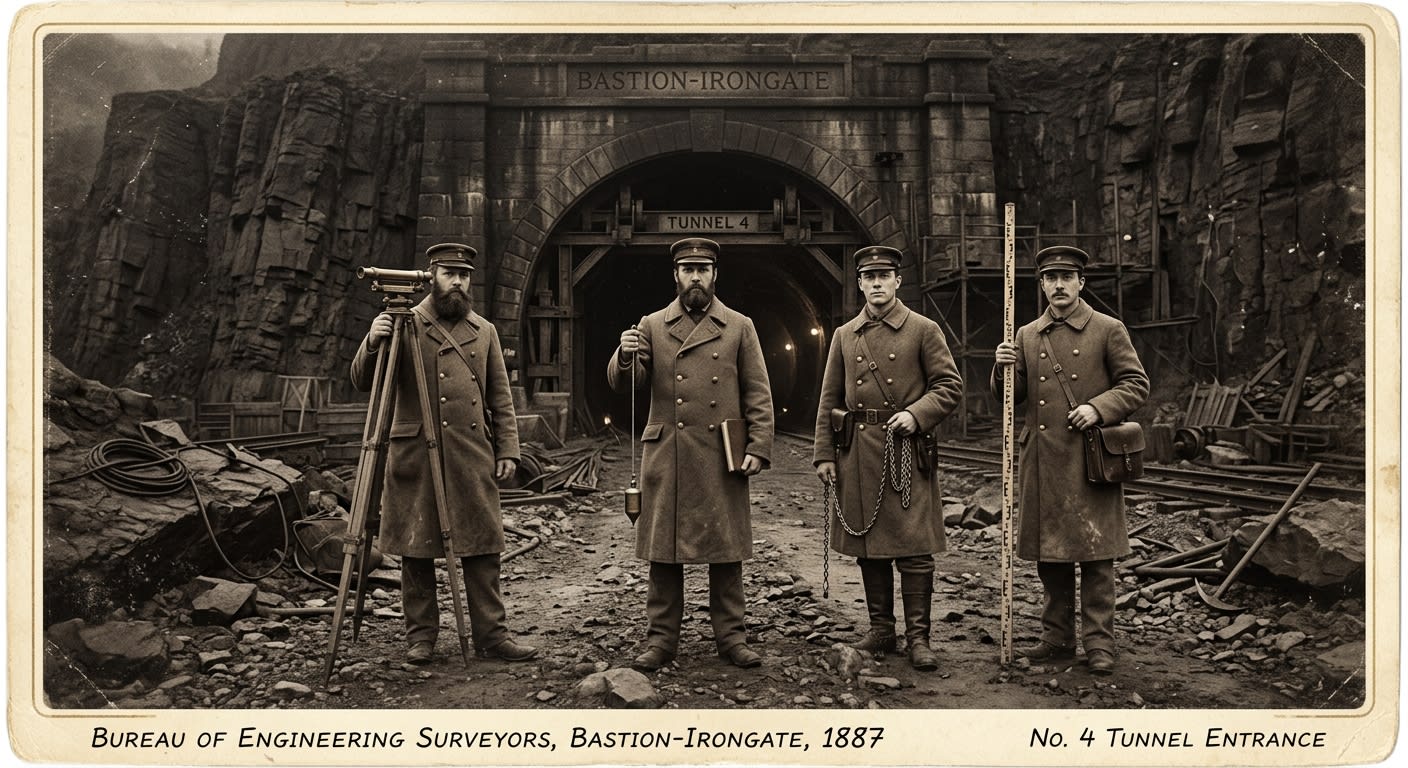
The bastions are the Bureau's cathedrals — vast fortified complexes designed to hold against threats the Bureau's founding generation could not have imagined. Bastion-Irongate is bored into basalt cliffs in a tunnel system whose structural integrity depends on continuous choral maintenance — the Bureau's own erratum corrects an earlier classification of the chant system as "supplementary to conventional bracing." It is the bracing. Without the Gasket Choir, the mountain remembers it was never meant to be hollow. Bastion-Przemyśl's Wire Orchard extends three miles in a pattern the Bureau has never satisfactorily explained, because the Bureau designed only the first two miles; the third mile grew. Bastion-Königsberg's Lake Gate walls are twelve metres thick despite no recorded attack from the Masurian approaches, because the Bureau of Engineering built for the threat that made strategic sense, and the threat that arrived had other plans.
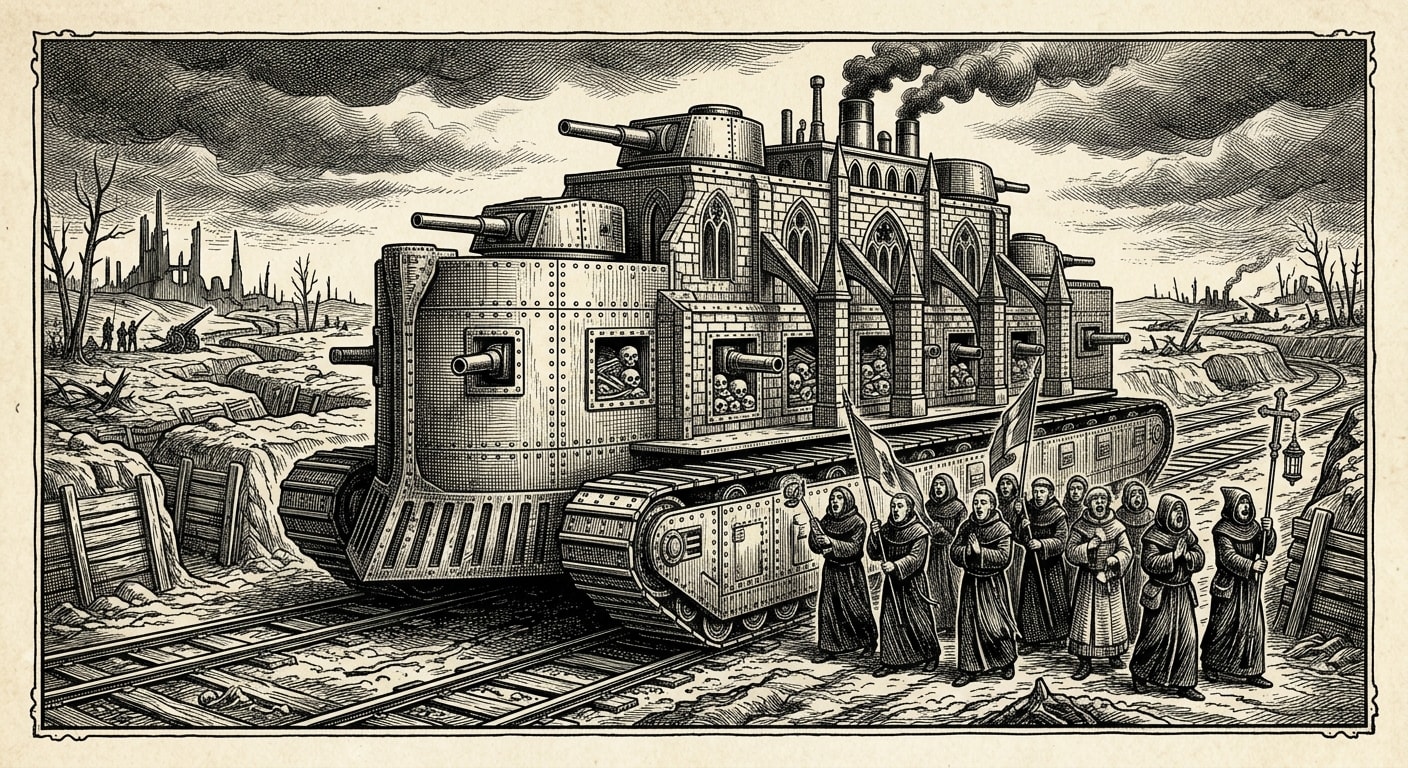
The war machines are the Bureau's children — sacred engines whose manufacture the Bureau oversees from design to deployment, including fuel allowances calibrated to hymn-length and ammunition blessed by the round. The Catacomb-Carrier Threnody trundles along the Line on iron treads, its walls ossuary-bricked, its shells carrying powder and the powdered saints of Ulm. The Graven Colossus walks on inscribed stone legs. The Sepulcher Locomotive hauls shrines into battle on dedicated rail. The Bureau designed all of them. The Bureau of Doctrine blessed all of them. The distinction matters to the Bureau of Doctrine. It does not matter to the machines.
The Vigil Arks deserve separate attention, because they should not exist and do. When the Bureau of War asked who guards the sky over the Bosphorus, the Bureau of Engineering proposed a tower. The Bureau of Bells proposed a bell. The Bureau of War proposed what the Bureau of War always proposes. What emerged was all three things fused into a hull that should not float and does. The Bureau of Engineering's own classification — "lighter-than-air reliquary-cathedral" — is the most precise available term, and the Bureau's draughtsman's office at Bastion-Constantinople still files the Saint Barachiel's technical ratification plate with the marginal annotation: "Envelope load calculation withheld — Bureau of Rites holds seal."
The Chrismole Furnaces of Brast are the Bureau's industrial heart — sanctified-fuel production for forward artillery, chrismole refineries where coal is rendered into something that burns with devotional properties. The furnaces are, by the Bureau's own admission and by the evidence of their behaviour since A.S. 199, alive. They sulk. They refuse to fire for cantors they dislike. One furnace — designated Saint-Combust by the garrison, after an explosion in A.S. 74 that killed nine men in postures of apparent devotion — has been classified by the Bureau of Doctrine as "a vessel of instructive Providence." The Bureau of Engineering classifies it as "Acoustic-Mechanical Disturbance, Category Two." The furnace does not care what either Bureau calls it. It wants to be sung to right.
#On the Bureau's Surveys
"We recommend against being present." — Bureau of Engineering Field Report, Syrion-Maldrake Contact Zone
The Bureau of Engineering surveys everything. This is its nature and its cross. It measures what can be measured, files what can be filed, and — when the measurements refuse to behave — classifies the anomaly and moves to the next survey, because the Bureau's faith belongs less to the Creator (that is the Bureau of Doctrine's department) than to the number, and the number does not lie even when it describes the impossible.
The results are instructive.
At Bastion-Sibiu, the Bureau confirmed in A.S. 178 that gold-veins from the Gilded Chasm extend beneath the Sagittal Line itself — beneath Sibiu's own foundations. The Bureau of Doctrine immediately classified the survey. The gold-veins' coordinates shift between surveys in a manner the Bureau has classified as "geologically unprecedented." The Bureau of Doctrine has classified them as "expected." The gold is still there. The Bureau of Tithes still collects it.
At Bastion-Königsberg, the Bureau's survey of A.S. 178 bears a margin annotation by an unnamed inspector: "Königsberg is a city designed to be defended. It was not designed to be lived in. The distinction is a luxury the garrison can no longer afford." The Masurian Lakes have been mapped seven times. Each map contradicts the others. The Bureau of Records has accepted all seven as canonical.
At the Thracian front, the Bureau's surveyors melted. I do not mean this as metaphor. A surveyor dispatched to measure the thermal gradient at the Iron Wastes' western edge in A.S. 189 reported that his instruments melted before he could take a reading. He was reprimanded for the loss of Bureau property. The thermal gradient remains unmeasured. The Bureau's estimate of the Wastes' total area has been revised upward three times in the last decade; the current figure is classified; the rate of expansion is also classified. The Bureau's reluctance to publish either number is itself a form of information.
Earlier surveys attributed the Thracian slag-rivers to "volcanic residuum of conventional geological origin."
The Bureau of Engineering detected "routing behaviour" in slag-rivers beneath the Thracian trenchlines in A.S. 200 — liquid wrath moving in patterns toward specific targets. The survey was recalled under "operational security." Three inspectors were transferred to Bastion-Brest. The transfer was filed as "career development." This erratum replaces all prior geological classifications for the Thracian subsurface.
Atheron's Crownspire opposite Bastion-Przemyśl was measured by the Bureau at approximately nineteen hundred feet in A.S. 194. By A.S. 196 it measured twenty-one hundred feet. By A.S. 198, twenty-three hundred. The Bureau stopped measuring. The Bureau does not explain why it stopped, but the reason is legible in the filing gap: a spire that grows four hundred feet in four years is a spire in the way that an argument is a spire. The argument is winning.
Syrion's Stillness Fields have consumed seventeen of the Bureau's chronometric instruments. Twelve returned showing different centuries. Three returned showing the same second, repeated. Two did not return. The contact zone where Syrion's fog meets Maldrake's heat-shimmer was documented by the Bureau as "meteorologically impossible." Soldiers stationed there report seasons that last hours, temperatures swinging from freezing to forge-heat between watches, and rain that falls upward and burns. The Bureau's response was a twelve-page report concluding with the sentence already quoted.
The Apparatus beneath Gate Nine of the Queue Road was surveyed by Bureau of Engineering Team Gamma-9 in A.S. 178. The plumb-line was taut. It was pulling laterally. The chain was cut. The engineer who cut it was transferred within the week. The basalt slab beneath the Apparatus bears tool-marks that match no known chisel type in the Bureau's comprehensive catalogue of masonry instruments — fourteen volumes, illustrated, available to anyone with a Category Three reading permit and the patience of a martyred saint. I checked.
#On the Litany-Engineers
"A Rationalist may fell a wall with charts; a Litany-Engineer fells it with a hymn. One method crumbles stone. The other remakes history."
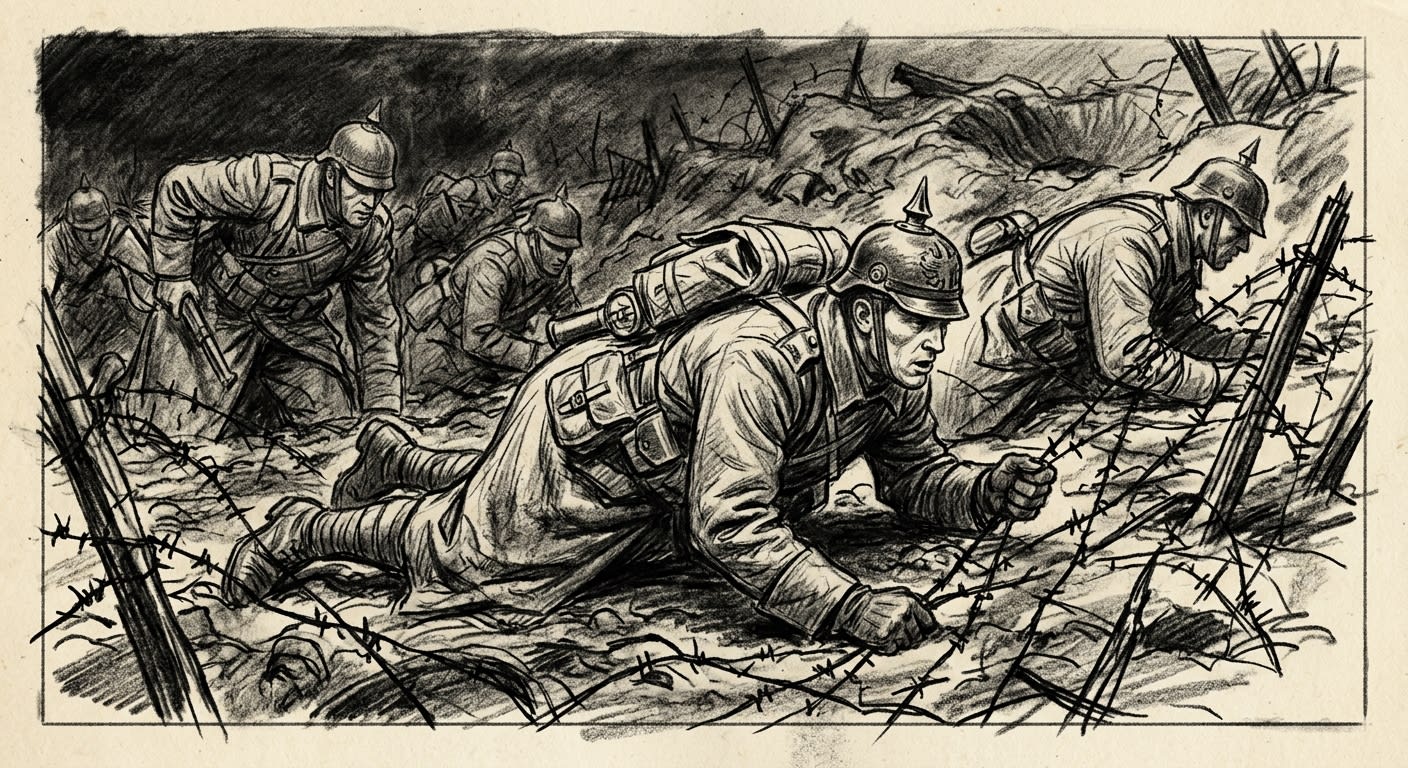
The Litany-Engineers are the Bureau's combat arm — the point where engineering becomes sacrament, where mathematics meets psalmody, where a man with blackened fingernails and an oil-stained hymnal crawls belly-first through wire and sludge with blasting charges strapped to his spine and sings counter-psalms into the teeth of sorcery.
Their hymnals are reliquaries of a peculiar sort: thick with oil-stains, water-warped from mud, corners torn from being thumbed by desperate hands in rain and soot. The margins are filled with equations where illuminations should be. Three Hail Maries = one-quarter measure saltpeter. Fast one day in lieu of missing fuse. For a shortfall in powder, sing the Psalm of Collapse twice and face east. To outsiders these notations are madness. To the Engineers they are calculus as holy as any creed. Detonation is their sacrament. The thunderclap is their amen.
Their achievements mark the Line's history. The Prague Collapse (Unregistered) of A.S. 61: a dozen Engineers tunneled beneath a Rationalist observatory reinforced with wards that bent light, chanting without pause until their throats bled, and at dawn the observatory folded into the earth. The Bureau of Doctrine declared it a miracle. The Rationalists blamed subsidence. The fissures still hum. The Siege of Toledo: Engineers crawled through sewers to lay charges beneath a desecrated cathedral-turned-gun-platform, scrawling numbers and prayers into wet stone. Half the cathedral collapsed. So did half the city. The Engineers who survived swore the collapse exceeded their calculations — that "someone sang with us who was not there." Records struck the phrase as heresy. Pilgrims still mutter of a shadow-choir.
The Mire Collapse of Debrecen, A.S. 172: Engineers facing a rising tide of Wrath's spawn consecrated an entire mile of trench by inscribing psalms into the mud with their own blood, fuses laid end to end like rosaries. The ground heaved. The mire collapsed inward. None returned. The Blightmarsh burps fire on certain nights, and from beneath the muck rises the muffled echo of their hymn. The Bureau calls the event "strategic redeployment."
Their discipline is a paradox canonized into regulation. They are taught to revere walls even as they are trained to shatter them. Every detonation must be matched with a counter-ritual of absolution — they chant as they ignite, then chant again as they flee, begging forgiveness for the blasphemy of collapse. They are lean men, never permitted to eat to fullness, because hunger sharpens prayer. Their hands are thick with burn-scars. Many go blind early. The youngest die swiftly. The eldest mutter equations in their sleep, dreaming of fuses they lit decades ago that may still be burning in forgotten tunnels.
#On the Bureau's Relationships
"The Bureau of Engineering has reviewed this article and requested seventeen amendments." — Closing notation, Bastion-Irongate Codex entry, A.S. 201
Every Bureau has rivals. The Bureau of Engineering has all of them, because every Bureau that pronounces, classifies, blesses, or funds eventually discovers that its pronouncement, classification, blessing, or budget depends upon a physical structure that the Bureau of Engineering built and that the Bureau of Engineering can describe in terms that make the depending Bureau uncomfortable.
The Bureau of Doctrine is the Bureau of Engineering's oldest antagonist and most frequent suppressor. When the Bureau of Engineering submitted a seventh line of fortifications along Constantinople's southern marches in A.S. 155, the Bureau of Doctrine suppressed the plan. When the Bureau confirmed gold-veins beneath Bastion-Sibiu, the Bureau of Doctrine classified the survey. When the Bureau surveyed the sealed vaults beneath the Crownwright Diehouses in A.S. 187, the findings were suppressed. The pattern is consistent: the Bureau of Engineering measures; the Bureau of Doctrine seals the measurements. The Bureau of Engineering has never, to my knowledge, complained. It simply continues to measure, files the results under the appropriate classification, and waits. Engineers are patient. The number is the number, whether anyone reads it or not.
The Bureau of War is a more comfortable partner — the Bureau of Engineering builds what the Bureau of War requests, and the Bureau of War requests what the Bureau of Engineering has already designed. The relationship is symbiotic in the way that a skeleton is symbiotic with the flesh it carries. Neither is sufficient alone. Neither admits this.
The Bureau of Engineering was formerly listed among the "minor technical Bureaus" in early Concordat-era administrative charts.
This classification has been retroactively corrected. The Bureau of Engineering is and has always been a primary organ of the Synod's governance. The fact that it does not shout about this is characteristic.
The Bureau of Rites disputes the Bureau of Engineering's jurisdiction over anything that might be miraculous. The Bureau of Engineering disputes the Bureau of Rites' jurisdiction over anything that might be structural. The Thessaloniki harbour-chain is the canonical example: the Bureau of Engineering inlaid the first reliquary chain links with psalm-script in A.S. 72; the Bureau of Rites consecrated the ceremony over nine days at the cost of four divers. Both Bureaus claim the chain. Neither Bureau has explained why it hums.
The Reliquary Flotilla provides an even cleaner example of the jurisdictional tangle. When the Flotilla's hull configurations shift between surveys — keels that were straight becoming curved, prows that faced west turning south — the Bureau of Rites calls it "providential reconfiguration," the Bureau of Engineering calls it "structural stress response," and the Chainwright Rosary calls it the sea choosing. All three are right, which in the Theocracy means all three are equally useless.
#On the Bureau's Present Condition
The Bureau of Engineering in A.S. 201 is an institution that knows more than it is permitted to say. Its surveys describe a Line that is degrading, fortifications that are expanding without authorisation, anomalies that are multiplying faster than classifications can contain them, and geological conditions beneath the Theocracy's foundations that the Bureau has used the word "routing" to describe — a word that implies intention in the stone, direction in the slag, purpose in the movement of liquid wrath toward targets the Bureau has been forbidden to name.
The Chrismole Furnaces sulk. The Crownspire grows. The Apparatus turns. The slag-rivers route. The chronometric instruments return from Stillness Fields showing centuries that have not happened. The gold-veins shift beneath Sibiu. The Quiet Boy in Constantinople (Unregistered) draws maps that match the Bureau's own surveys to within tolerance — except for the streets that do not exist yet, the buildings that have not yet fallen, the roads that run through structures still standing.
The Bureau files all of it. Classifies all of it. Measures all of it. The number is the number.
Whether the Bureau of Engineering is frightened is a question I cannot answer, because the Bureau does not express fear. It expresses survey data. It expresses structural assessments. It expresses load-bearing tolerances and thermal gradients and chronometric readings. But I have noticed — and I record this here, in the margin where the Bureau of Doctrine may not look — that the Bureau of Engineering's filing rate has increased by thirty-one percent in the last three years. The Bureau is measuring faster. The Bureau is measuring more. The Bureau is measuring everything it can reach, as though it is afraid it will not have time to finish.
The Archon-Engineer's identity remains classified. The Foundry Archive remains reinforced beyond Cathedral tolerances. The Bureau's motto remains unwritten, unspoken in any official forum, carved only into workshop benches and latrine walls and the undersides of surveying instruments.
The number is the number.
The Bureau of Engineering has reviewed this article and requested seventeen amendments. The amendments are, as always, under advisement.