
#On the House That Keeps the World Lit
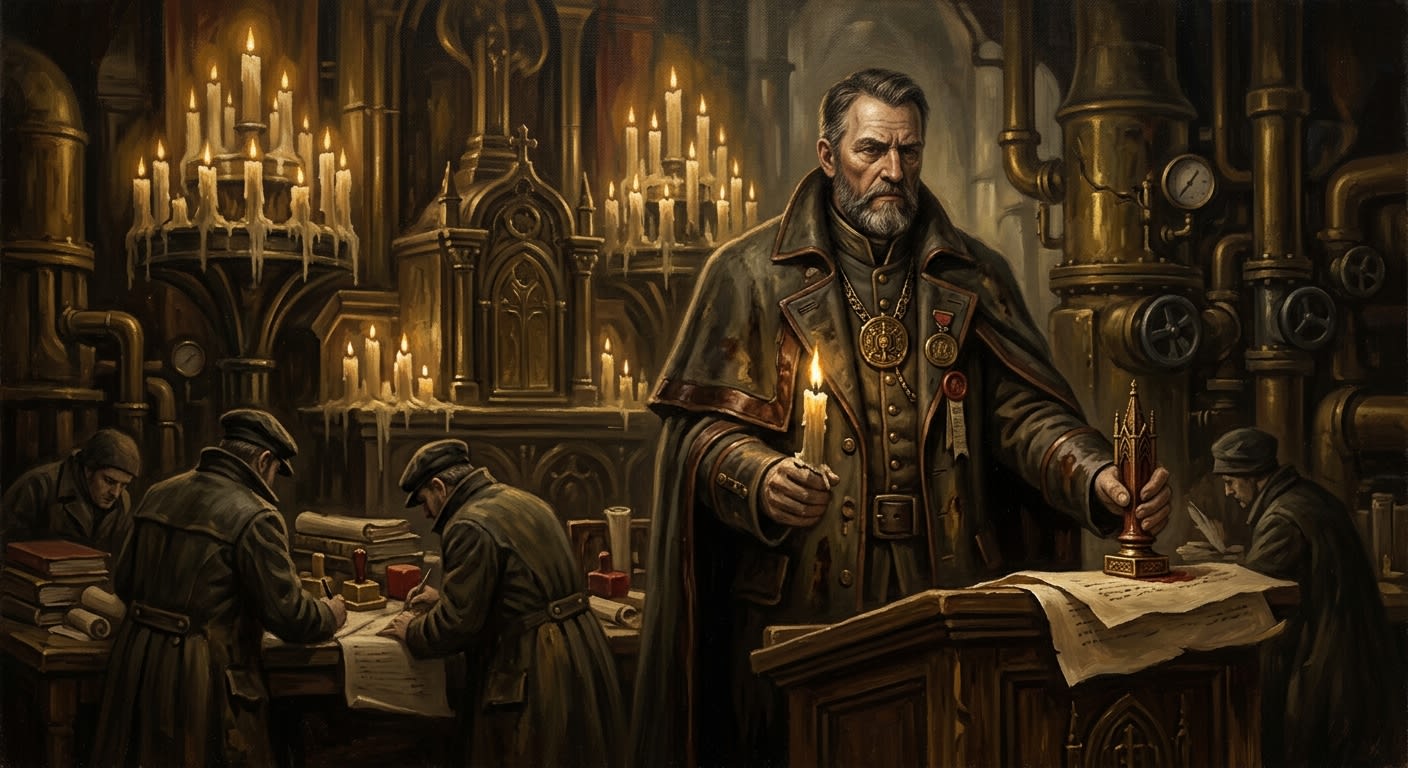
House Wickwarden is the chandlery crown of Candlewick Palatinate, proprietor of wax stores, candle towers, wick-spinning halls, seal overcoats, lantern ration slips, curfew flame, and every small permitted fire by which the Synod makes night behave like a subordinate clerk. Its public boast is clean enough for a festival banner: We keep the world lit. Its political grammar is uglier: whoever controls light controls closing hours, audit movement, witness testimony, factory shifts, gate passage, chapel vigils, queue discipline, and the last visible inch between a citizen and erasure.
The House holds the Lantern Mile and the richer salons of Wickcourt Heights. From the Mile, towers of oil smoke and singed fibre lift above the canal roofs, joined by roof-walks strung with drying wick, treated cord, linen reels, waxed twine, and coloured signal cloth. From the Heights, House factors attend the Palatine Guild Compact wearing gloves perfumed with beeswax and expressions polished until guilt slides off them.
#On the Great Fire and the First Quotas
House Wickwarden became inevitable after the Great Fire, circa A.S. 98, when Candlewick learned that a city built on wax, tallow, paper, lacquered wood, drying cloth, and official confidence will periodically attempt to become a torch. The fire began in a wick hall, or a spirit store, or a lamp chapel, depending on which House paid the witness. It moved through the lower Mile with vulgar speed. It crossed roof-walks, kissed drying lines, entered two stamp rooms, and discovered that seal wax burns with a terrible civic enthusiasm.
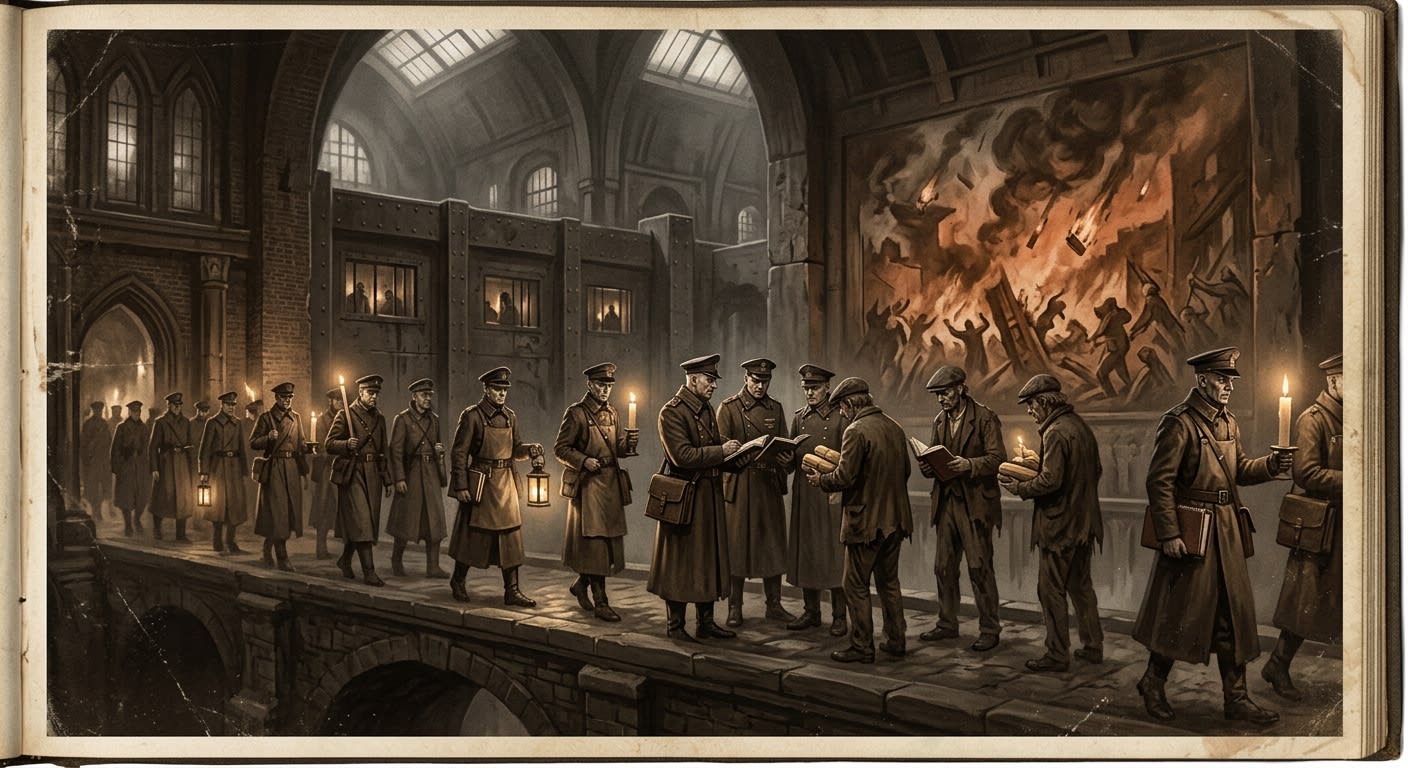
The survivors learned two lessons. The engineers learned firebreaks, canal cordons, bucket law, and dike-water rights. House Wickwarden learned quota.
Before the fire, chandlers were artisans, quarrelsome and competent, selling flame by craft, habit, and alley reputation. After the fire, the Bureau of Records required measured wax stock, inspected wick allotment, lantern licensing, and distribution schedules. Someone had to count. Someone had to store. Someone had to say which ward received light after sunset and which ward would spend the night discovering that darkness has teeth. House Wickwarden volunteered with such speed that posterity should have been suspicious.
House memorial plates describe the A.S. 98 consolidation as an emergency charity undertaken to protect Candlewick's poor from unsafe flame.
Corrected. The poor received safer darkness. The House received monopoly. Charity is often a ladder carried by men who intend to climb it alone.
By A.S. 104, Wickwarden ration seals governed household candles, chapel tapers, workshop lamps, inspection lanterns, quarantine lights, mourning flames, execution candles, and the thick red sticks burned before sealed contracts. By A.S. 110, mass mobilisation had made its supply continental. A train without wax seals was cargo. A writ without wax was opinion. A city without candle allotment was a district waiting to be misfiled.
#On Lady Maris Wick and Warm Hands
Lady Maris Wick, present head of House Wickwarden, keeps her hands perpetually warm. Her supporters attribute this to delicate circulation, devotional discipline, and hereditary affinity for blessed flame. Her enemies attribute it to the habit of melting candle wax between her fingers while calculating their ruin. I have touched neither hand and recommend the policy.
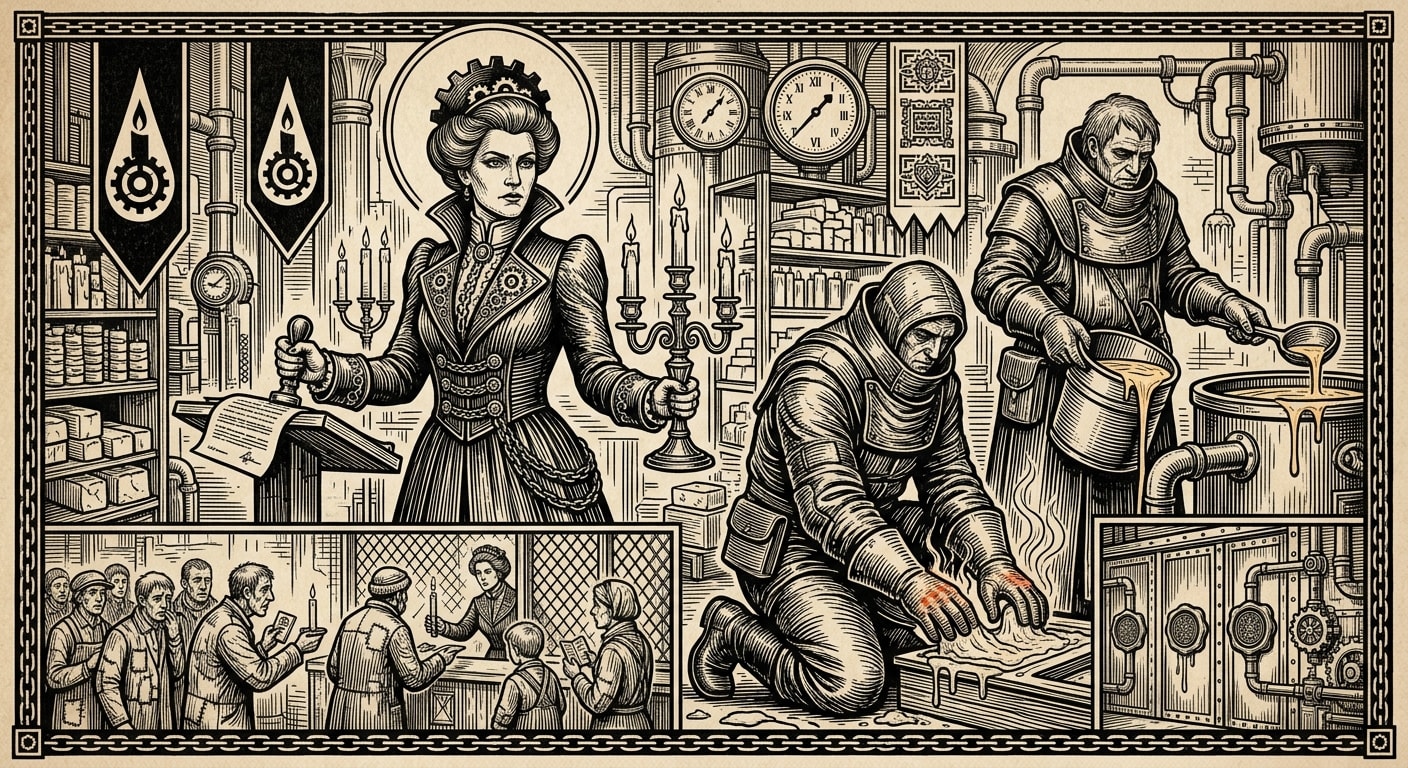
She receives visitors in Wickcourt Heights beneath chandeliers whose flames lean toward her when she speaks. The servants insist this is a feature of ventilation. Ventilation, in my experience, does not usually bow.
Maris rules by warmth, shortage, and courtesy sharpened to a wire. She does not shout. She does not threaten in words coarse enough for indictment. She sends candles late. She sends inferior wick to a rival's ward before audit. She reduces the gold in ration slips by a perceptible insult during weeks of Registry pressure. She offers light at dinner and measures who reaches too quickly.
Master Chander Olt serves as her chief technical officer, a burn-scarred man with perfect manners and fingers stiff from old wax injuries. Olt knows wick density, tallow temper, seal resilience, smoke colour, and the precise point at which a shortage ceases to be a commercial condition and becomes a civic panic. He calls this point the mercy line. The House crosses it only when paid.
#On Wax as Law's Flesh
Ink speaks. Wax binds. The distinction is worth preserving, because whole offices have died from confusing the tongue with the mouth.
A document may bear the correct words, the proper hand, the approved shade, and the signature of a man whose authority has not yet been revoked; without wax it remains vulnerable to air, doubt, replacement, and lawyers. Wax closes the wound. It takes the seal's impression, remembers heat, captures tampering, resists damp, carries colour, and makes the page into an event rather than a suggestion. House Wickwarden manufactures that closure.
The House's seal wax differs by office, district, use, and intended fear. Records red must harden quickly and crack loudly if disturbed. Passage blue must resist canal damp. Mourning violet must show fingerprints for witness disputes. Quarantine yellow must stink faintly of camphor so a blind clerk can fear it correctly. Execution black is mixed to dullness, for the Bureau holds that glossy death encourages vulgar sentiment.
The Chromatic Registry claims authority over colour. House Wickwarden claims authority over the substance that permits colour to hold a face. Their quarrel is old, profitable, and performed in tones suitable for chapel. Registrar Vorn may forbid a shade. Lady Maris may delay the wax in which the shade is meant to appear. One controls definition. The other controls arrival. Between them, a citizen waits in line with a token going stale in his palm.
#On the Lantern Mile
The Lantern Mile is not one street but an elevated argument conducted in towers, smoke, rope, wick, pulley, and flame. Chandlery halls rise over canal warehouses. Roof-walks connect spinning rooms where treated fibre hangs in pale curtains. Wax-lifts groan between floors. Children carry cooled tapers in trays. Apprentices comb wicks until their fingertips split. Foremen judge twist by touch, burn by smell, loyalty by silence.
The Mile opens under amber tokens. Shifts begin before dawn, when fog hides shipments and inspection boats drift beneath the lower windows. By midday the press rooms hammer. By curfew, legal flame narrows to House skiffs, Provost lanterns, Registry lamps, chapel vigils, and those illicit window-signals by which the Black Canal tells thieves where the watch has grown affordable.
Lantern codes are Candlewick's second language. Three blue flickers over a shutter mean clean passage. One green and two gold mean inspection moved east. Red under cloth means wax stolen and buyers wanted. A white lamp held too steady means the signal has been seized and the viewer should become religious elsewhere. Everyone knows this. The Seal Provosts know it. The House knows they know it. Enforcement proceeds according to the old civic principle that profitable knowledge should not be ruined by action.
Fires remain common. The Mile has etiquette for them, as Bottle Quay has etiquette for furnace explosions. If a wick rack smokes white, curse and clear it. If it smokes green, run. If the wax-lift bell rings without a hand on the rope, step away from the shaft and do not look up. Old workers insist that the Great Fire still climbs the towers on certain fog nights, testing each room for unfinished work.
#On Shortage as Theology
House Wickwarden's finest instrument is absence. A candle delivered is useful once. A candle withheld can purchase policy.
In the past eighteen months, three accidental wax shortages have coincided with Records audits. Each shortage began in a different warehouse, cited a different cause, affected a different district, and ended after concessions the Records Annex denies having made. The first halted evening revalidation in two canal wards. The second forced the Registry to accept House-prepared ration slips in diminished gold. The third darkened the Charter Court's outer queue long enough for seventy-three shade petitions to lapse.
Wickwarden circulars describe these interruptions as “weather-linked distribution irregularities compounded by fog, canal delay, and regrettable clerical overstrictness.”
Corrected. Fog did not choose the audit dates. Canal delay did not reduce only hostile wards. Clerical overstrictness is the official name for a clerk noticing arithmetic before his superior has sold it.
Shortage works because Candlewick's law assumes visibility. Curfew requires lantern colour. A valid queue requires lamped counters. A witness must see a seal impressed. A household token must be examined under approved light. Without flame, legitimacy pauses. During a Wickwarden shortage, citizens do not become rebels. They become provisional, which is worse, because rebellion at least gives a man a verb.
The House calls its policy conservation. The Compact calls it supply discipline. The street calls it being throttled by a candle.
#On the Fading Winter and the Blank Authorization
The Fading Winter made House Wickwarden look lucky, which in Candlewick is another word for prepared. The first preserved case, Records Annex 199-FW-1, concerned a wax shipment authorization issued to Wickwarden on the second day of Frostwane. The paper was correct. The watermark was correct. The registry shade was correct. The double-seal was correct. Assistant Registrar Pell's thumb-smudge sat upon it with all the authority of contempt indexed in advance.
The body text vanished.
The document proved that something had been authorized by someone for some purpose at some time. House Wickwarden accepted delivery.
The Fading Winter harmed the Lantern Mile in public and enriched it in private. Two wick halls closed during chromatic reconciliation. Workers lost papers when shade tokens shifted in fog. Wax overcoats became mandatory on vulnerable documents, and mandatory practices have always had the decency to make someone rich. Wickwarden overcoat wax tripled in price, then acquired a devotional surcharge when priests began asking for it on marriage records, death certificates, and baptismal copies sewn into infant clothes.
House Vatmarsh blamed fog exposure during wax overcoating for certain Hungry Ink events. Wickwarden blamed counterfeit mordants. Both accusations were useful. Neither House desired a cure vigorous enough to reduce demand.
RECORDS ANNEX SIDE MEMORANDUM — FW/WICK-3 Blank authorization accepted under emergency interpretive allowance. Recipient: House Wickwarden. Goods received: ████████████████████ Subsequent shortage dates: ████████████████████ Auditor note: “Pattern visible only under absence.” Auditor disposition: transferred to night inventory.
#On Rival Houses and Criminal Light
House Vatmarsh is Wickwarden's necessary enemy. Wax and ink meet on every lawful page. Wickwarden seals; Vatmarsh fixes. Wickwarden controls light; Vatmarsh controls endurance. Wickwarden can darken an audit; Vatmarsh can make the paper fade after the lamps return. Their quarrel has the intimacy of a marriage whose property settlement would bankrupt Europe.
The Chromatic Registry despises Wickwarden's independent lamp codes and cannot abolish them because Registry inspection requires Wickwarden light. The Seal Provosts raid lantern shops when they need public proof of zeal and buy House candles when they need private proof of doors. The Black Canal steals wax, counterfeits lantern signals, sells mirror wax that will not take a seal, and returns missing stock through cousins whose invoices are clean enough to make a nun weep.
There are Wickwarden charities. Of course there are. The House distributes poor candles during the Festival of First Flame, endows warm-wax baths for Lungward invalids, supplies chapel tapers for dead children, and maintains a fund for widows of tower fires whose paperwork has not yet become inconvenient. These works are real. This is precisely why they are useful. A false charity can be exposed. A true charity can be weaponised for generations.
#On Present Amber
As of A.S. 201, House Wickwarden stands richer from crisis, hated by those who need it, courted by those who audit it, and too flammable to nationalize without spectacular stupidity. Its warehouses sit under double guard. Its candle towers run staggered shifts. Its ration slips carry diminished gold during shortage weeks, a colour insult visible even to children. Lady Maris attends Compact sessions with warm hands, dry eyes, and the expression of a woman watching every rival calculate how long his office can function in the dark.
Records wants supply transparency. The Registry wants control over every lamp colour. Vatmarsh wants salt concessions tied to wax shipments. The Black Canal wants mirror wax and false lantern codes. The citizens want affordable candles, which is touching in the way peasant hopes often are before arithmetic enters the room.
The House does not own the sun. This has been noted by theologians as evidence that Creation retains certain safeguards against guild privilege. House Wickwarden owns the candle you are permitted to light after sunset, the wax that closes your contract, the taper that proves your vigil, the lantern colour that lets you cross the bridge, and the shortage notice that explains why none of these things arrived today.
Outside Wickcourt, the canal fog thickens. In the Lantern Mile, wick lines dry above the alleys. A girl in a high window lifts a green lamp, lowers it, lifts it again. Across the water, three skiffs change course before the watch can decide whether it has seen anything.