
#On the Canal Beneath the Canal
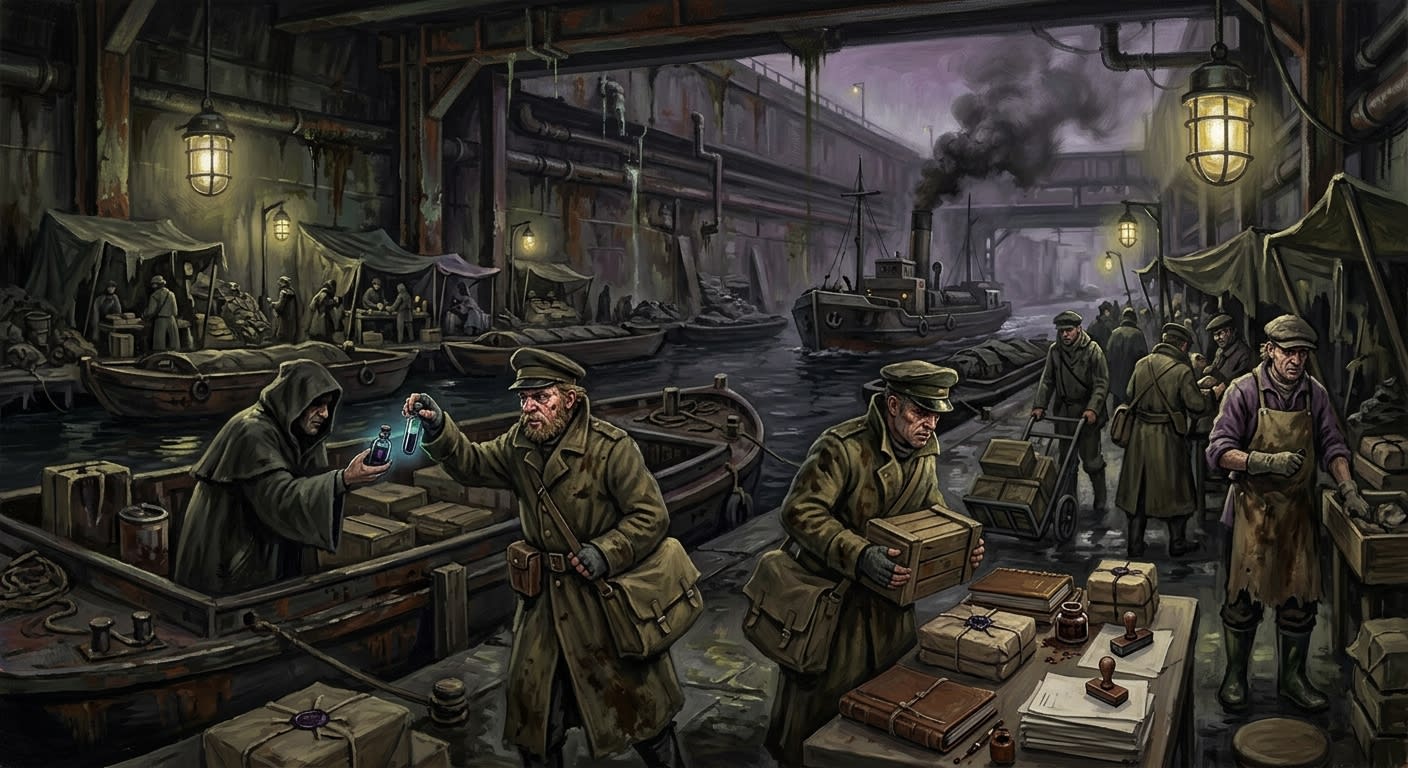
The Black Canal is the name given, in charitable documents and frightened reports, to the under-dike smuggler waterway beneath Candlewick, and by extension to every wet criminal artery that imitates its methods badly enough to be noticed. Official maps show service sluices, overflow drains, abandoned dye-runs, and maintenance culverts. Official maps are devout little liars. Beneath the Palatinate's lawful canal lattice runs a second water, lower, blacker, tar-sweet, algae-thick, and lit by lantern codes whose colours mean things the Seal Provosts (Unregistered) cannot read in public and read fluently after supper.
It smells of algae, tar, sweet rot, hot wax spilled into filthy water, vinegar mordant, wet wool, and coins kept too long under the tongue. Bribe boats move there without oarsmen, or with oarsmen hidden behind black cloth, or with pilots so small they are mistaken for bundled rags until they stand and cut a man's throat. Outlaw shades travel in corked phials. Counterfeit seal dies sleep in oilcloth. Names, the expensive kind, are packed between glass plates and wrapped against damp.
The Bureau of Records calls the Black Canal a contraband corridor. The Chromatic Registry calls it contamination. House Wickwarden calls it theft when wax disappears and liquidity when the missing wax returns through a cousin's warehouse. House Vatmarsh calls it counterfeit mordant traffic, except on nights when its own agents purchase samples there. The Black Canal Syndicate calls it nothing. Names create handles. Handles are for men who expect to be seized.
#On Origin in Useful Water
The Black Canal began as engineering shame. When the Bureau of Records installed its Candlewick annex in A.S. 92 and the Palatinate hardened into a chartered manufacturing instrument, the new order demanded dikes, firebreaks, Seal Locks, waste channels, and overflow cuts. A city of wax and tallow requires water close enough to save it and far enough not to drown it. The engineers cut service mouths beneath the legal channels. The Houses cut private mouths beneath the service mouths. The workers remembered older culverts from the free dyer market that preceded Bureau rule. The water did what water does when men declare ownership. It found the joints.
By A.S. 98, after the Great Fire (Unregistered) gave Candlewick its first strict wax quotas, the lower channels had become useful. Contraband wax passed under cordon. Unregistered pigment stock survived in wet cellars. Burned guild families whose papers had vanished bought fresh signatures from men who had never seen their faces. The first Syndicate did not yet exist as a cartel. It existed as a habit: a boat at night, a lantern behind blue glass, a provost looking at his boots.
Chromatic Registry primers describe the Black Canal as a post-Fading Winter phenomenon caused by emergency counterfeit demand.
Corrected. The Black Canal predates the Fading Winter by more than a century. Winter fed it, fattened it, and taught it better prices. It did not beget it.
The Syndicate's present shape emerged across the long middle years, when colour-law became absolute and shade variance could destroy a household. Men who live under perfect law develop expert appetites for imperfect exits. The Canal sold them. At first, it sold outlaw pigments for workshops squeezed by House quotas. Then false lanterns for workers crossing districts after curfew. Then counterfeit shade tokens. Then forged seal impressions. Then names.
A name package is the Canal's masterpiece and its obscenity. The buyer receives paper, token, witness memory, wax mark, lantern history, and enough Registry echo to survive ordinary inspection. The crude package covers a day. The expensive package rewrites old standing, erases debt colours, and causes the previous name to fade from minor offices as if reality had developed politeness. Discovery is death if the Provosts are angry, worse if the Syndicate is embarrassed.
#On Lantern-Jack, Nema, and the Syndicate Without a Face
The Black Canal Syndicate is a cartel only when seen from above. From below it is a braid of skiff pilots, dyers, die-cutters, false-lantern girls, lockhouse cousins, Registry clerks with damp cuffs, Lungward nurses selling breath lists, provost captains with gambling debts, smudge runners carrying outlaw ink under their nails, and two or three minds clever enough to remain uncatalogued. The Bureau loves a hierarchy. The Canal prefers damp consensus and knives.
Two names recur because stories require faces and police files require bait. Lantern-Jack is said to have teeth lacquered in colour-code, each tooth keyed to a passage, debt, warning, or death mark. He smiles at a skiff and the pilot knows which sluice to take. He smiles at a clerk and the clerk remembers a bribe not yet offered. Whether his teeth are real, painted, removable, or worn by several men in sequence is a question the Bureau has asked with inadequate force.
Nema the Smudge is more dangerous because she exists in offices. Her fingerprints have appeared on Registry purge orders, wax shipment tallies, false shade certificates, Seal Lock hold slips, and one Bureau of Records reprimand addressed to herself under a name that had been dead for fourteen years. She is called the Smudge because she leaves marks where clean hands are required. Also because no file keeps her edges.
Their methods are not romantic. Smuggling is wet labour with better lies. A skiff waits beneath the west stair of the Seal Locks. A lantern goes green-white-green from a roof slit. The pilot sets a pole against stone and reads the lock bell through vibration. If the third peal shivers flat, Purity is on the inspection boat. If it rings fat, only provosts are aboard, and provosts may be translated into coin. Cargo moves: colourless paper, unregistered seal dies, Hungry Ink, false shade stock, outlaw blues, mirror wax, Lungward masks, old identities, new ones, bodies whose classification has not yet settled.
#On Outlaw Shade and Hungry Ink
The Canal's cleanest profit is colour. The Chromatic Registry made colour into law; the Canal made unlawful colour into shelter. A widow whose ration token has been suspended needs a grey that will pass once. A dye-house accused of shade treason needs a registered red close enough to buy a week. A conscript deserter needs Passage blue, badly mixed, but blessed by a stamp stolen from a drunk clerk's desk. The Canal supplies all shades the Registry forbids, all shades the Houses hoard, and several shades that ought not exist outside sealed phials.
The Fading Winter of A.S. 199 changed the scale. Documents lost text across the River-belt. The Registry declared heresy. Vatmarsh declared salt failure. The Seal Provosts blamed Black Canal workshops with the relief of men finding a familiar dog to kick. The Canal blamed Registry incompetence, then sold fade-proof ink at three times ordinary price.
Fade-proof ink comes in three grades. False grade is lampblack, gum, and confidence. Dangerous grade resists fading by attacking neighbouring text, useful in contracts where only one clause matters and everyone else may go to Hell by scheduled ferry. Effective grade is rare, quiet, and least advertised. It smells faintly of ash and river-mint. It holds words under damp. It also leaves a pale ring around wax seals, as if the paper had learned to clench.
Bureau of Alchemical Standards advisory 199-FW described all Black Canal fade-proof products as fraudulent.
Corrected for restricted circulation. Most are fraudulent. Some are not. The useful samples have been transferred to Standards, Records, Doctrine, and three offices that denied receipt before the courier returned.
Hungry Ink traffic is denied with greater vigour, which is how one knows where the profit lies. The Canal sells vials no larger than a tear: some inert, some counterfeit, some alive enough to bloom black halos along a cork before opening. A buyer may use it to alter debt, injure a rival, erase a witness, redirect a shipment, or make a decree devour the sentence beneath its own seal. The Syndicate does not ask purpose. Purpose stains the seller.
UNDER-DIKE SEIZURE — BOTTLE QUAY OUTLET Recovered: 11 vials marked “winter oil”; 4 false; 3 mordant irritants; 2 Hungry Ink active; 1 empty but sealed from inside; 1 containing a written destination visible only when held underwater. Destination read by Assistant Provost █████. Assistant Provost later reported at ███████████, which does not receive visitors.
#On the Black Canal Beyond Candlewick
The phrase escaped Candlewick. Useful infections do. In Sable Court, Cologne's lawful mint quarter has its own Black Canal lock, a bullion intake where tar and algae slick the stones and a submerged gate leads toward old vaultwork. Beneath that second lock the Clipped Choir convenes its Candle Tribunal, pressing clipped coin into palms and deciding whether a face is debt, exile, death, or something colder. That Canal belongs to Sable Court. It learned from Candlewick. It shares cant, lantern methods, bribe rhythms, and the old reverence for water that lets authority pass under itself.
Other cities use the term loosely: a marsh sluice near the Scheldt (Unregistered), a Rhine underpass where Black Oars move names without bells, a Cologne bullion drain, a Bottle Quay dye-house chapel whose altar opens on a skiff pool. The Bureau prefers separate files. Separate files keep causes from mating in the dark. Canal men prefer the shared name because it frightens creditors and flatters apprentices.
There is evidence of coordination. False lock chits exported from Candlewick reached three lesser River-belt locks before Passage revised the form. Sable Court brokers used Candlewick shade tokens to disguise bullion shortfalls during the A.S. 199 face disturbances. A Clipped Choir assayer was found carrying a Vatmarsh mordant slip, and a Candlewick smudge runner carried coin washed in Sable Court's memory-vats. The evidence proves contact, imitation, trade, or fashionable crime. Doctrine has selected all four, depending on audience.
#On Purification, Usefulness, and the Coming Flood
Every few years, someone in the Registry announces a plan to purify the Black Canal. The word purify here means raid, burn, drown, seize, absorb, invoice, and rename whatever proves too useful to destroy. Seal Provosts sweep dye-house chapels. Passage chains side-sluices. Records audits lockhouse hold slips. Purity burns two workshops, three apprentices, and one man selected for having the wrong expression. The Canal closes its shutters, lowers its lamps, waits through the sermon, and reopens under the next stair.
The difficulty is moral only in pamphlets. The true difficulty is operational. The Black Canal is part of Candlewick's machinery. It relieves shortages, moves goods during House obstruction, supplies offices that cannot purchase contraband publicly, removes persons whose public detention would embarrass the Charter Court (Unregistered), and gives every power in the Palatinate a deniable hand. To destroy it cleanly would require the Houses to confess dependence, the Registry to confess ignorance, the Provosts to confess income, and the Bureau to confess that illegality has been performing state functions for generations. Confession is excellent for peasants. Institutions prefer audits.
As of A.S. 201, the Canal is richer than obedience. The Fading Winter has made old ink precious and new ink suspect. Hungry Ink has made criminal expertise desirable to offices that publicly condemn it. The Registry's tightening grip has produced more customers than raids can remove. The Syndicate's counterfeit bureau shade has passed three auditors before origin disclosure, a fact repeated here because it deserves to make clerks sweat through their cuffs.
The official future is purification. The practical future is negotiation with knives under the table. The dangerous future is a stable fake bureau shade entering general circulation across the Heartlands: transit passes, ration permits, death certificates, conscription orders, and lock chits bearing forged colour indistinguishable from lawful authority. At that point the Black Canal ceases to run beneath Candlewick. It runs beneath the Synod.
At night, the canal chains rattle below the legal streets. Lanterns blink in colours no catechism admits. A skiff slides under the Seal Locks with a cargo of names, shades, teeth, paper, and one sealed vial that taps softly against its crate whenever a bell rings above. The provost on duty looks away. The ledger records no passage. The water remembers enough.