
#On the House That Fixes Words
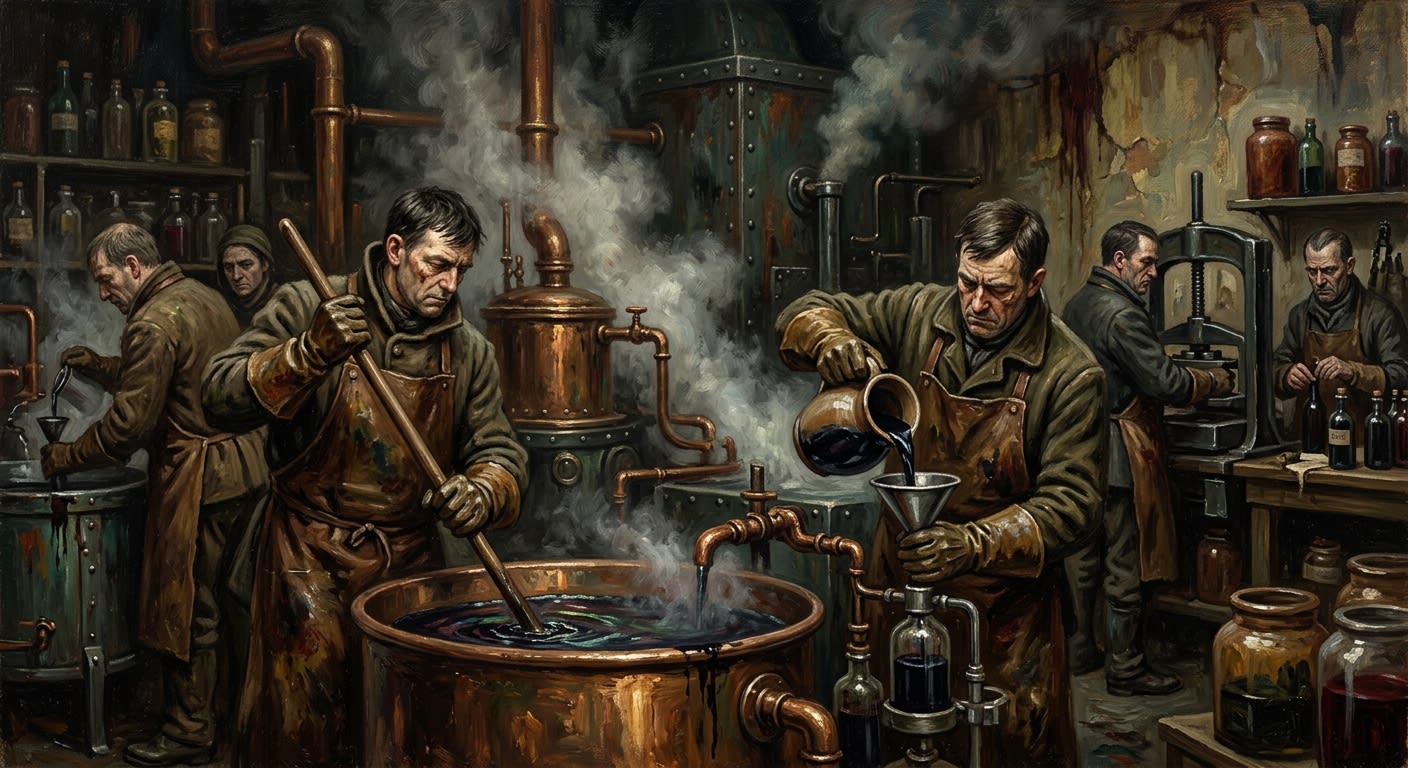
House Vatmarsh is the chemical aristocracy of Candlewick Palatinate, keeper of the mordant salts (Unregistered), dye-vats, fixing agents (Unregistered), and vinegar-hot rooms by which ink is persuaded to endure long enough for law to injure someone. The House's public motto is modest: We fix the ink so words endure. Its private truth is less modest and much more useful: whoever fixes permanence also owns decay.
The House holds Vatmarsh Row, that eastern canal district of dyeworks, mordant vats, brine sheds, acid galleries, salt lofts, recipe chapels, and worker rooms where wet wool, metal salts, hot vinegar, and human lungs are distilled into administrative confidence. From there its casks move to Bottle Quay, where bureau inks are drawn into glass, stoppered, waxed, shaded, and exported through the Seal Locks toward every office that believes writing is reality with better posture.
#On Salt, Vinegar, and the Matriarch
The Vatmarsh Matriarch is not elected in any sense that would comfort a republican or educate a fool. She is acknowledged by recipe custody. The woman who holds the black salt book, the acid-key rings, the seven sealed wash formulae, and the right to name a batch lawful becomes Matriarch because the Row cannot function without her hand. Blood helps. Marriage helps. Murder has helped twice. Chemistry helps most.
Her court is the Vatmarsh Grand Hall (Unregistered), though hall is too clean a word for a dyeworks whose rafters sweat green during summer and whose lower drains are inspected by men roped at the waist. The audience chamber sits above three active vats, so that every negotiation takes place over heated mordant. Visitors breathe the House's argument before they hear it. Their eyes water. Their throats tighten. They agree sooner than they intended.
The Matriarch's power rests on a distinction the public rarely understands. Pigment gives colour. Mordant gives obedience. A dye without a fixing agent is a sermon without threat: vivid, temporary, and soon lost to weather. Vatmarsh salts bite into fibre, paper, vellum, and prepared wax; they make ink hold under damp, travel, touch, argument, and time. A conscription order written in unfixed ink is an opinion. The same order in Vatmarsh-stabilised black becomes a man on the road to Bastion-Przemyśl.
The Chromatic Registry pretends it governs colour. House Vatmarsh permits the pretense because Registry authority increases the value of Vatmarsh supply. High Registrar Sable Vorn (Unregistered) may define the shade. Shade Auditor Pell (Unregistered) may sniff the batch. Records may certify the phial. None of them can make permanence in a dry bowl. They require the Row.
#On the Workers Beneath the Recipe
Vatmarsh labour is hereditary when convenient and replaceable when inconvenient. Dye stirrers, mordant runners, salt skimmers, vat-scrapers, wash clerks, cask sealers, mask stitchers, and canal loaders move through coloured steam under quota bells that never sound apologetic. Workers wear masks replaced weekly if the House accounts approve and lungs replaced never. The Lungward Sisters record exposure by shade when they are admitted. House surgeons prefer the term productive irritation for symptoms that would make an honest physician spit into the canal.
House pamphlets describe Vatmarsh Row as “a protected craft district governed by ancient mutual obligation.”
Corrected. The obligation is old. The protection is selective. The craft is real. The workers are used until their cough changes colour, whereupon the House discovers that apprenticeship contracts contain clauses no dying apprentice remembers signing.
Children in Vatmarsh Row learn smell before letters. Vinegar means ordinary shift. Bitter copper means gloves. Sweet rot means leave the room and do not wait for permission. Black almond means someone has broken a sealed wash or wants others to think so. They can name twenty inks by breath, six salts by the way they sting the nose, and three forms of managerial panic by footsteps on wet boards.
The House rewards silence more consistently than excellence. A worker who saves a batch by improvising receives a bonus if the improvised method was authorised later, punishment if it was not, and disappearance if the improvisation suggests that the recipes could be improved from below. This is standard guild prudence. Innovation belongs to the person with a seal. Everyone else commits deviation.
#On the Chemistry of Permanence
The Row's ordinary production feeds the Synod's appetite for stable words. Black for Records. Red-black for correction. Ledger grey. Passage blue. Quarantine yellow. Mourning violet. Execution black, which must gloss under fresh wax and flatten by second bell because even death has an approved drying curve. Each shade begins as formula, passes through salts, receives stabilising wash, and enters a cask marked by origin, dye lot, stirrer oath, fixing agent, and House scratch.
The scratches matter. Official marks speak to the Registry. Private marks speak to workers. A notch angled downward means damp in the salt loft. Two cross-hatches mean the wash turned late. A pin-prick by the batch number means do not stand near the cask after opening. The Registry has tried to ban private marks four times. Each ban ended when errors rose, batches spoiled, and Vatmarsh clerks explained that a mark cannot be illicit if management failed to notice it.
Permanence in Candlewick is never innocent. A stable ink preserves a baptism, a debt, a death, a sentence, an eviction, a marriage, a grain levy, a quarantine boundary, a son's conscription, a widow's reduction, a worker's reclassification. House Vatmarsh likes to say it serves memory. Memory is a courteous word for injury that still has paperwork.
The House understands this. It is why its palaces in Wickcourt Heights (Unregistered) are smaller than Wickwarden's candle halls and better guarded. Wax announces itself through light. Mordant works after the lamp goes out.
#On Hungry Ink
Since A.S. 143, when ash from the Year of Ash Rain lodged in Candlewick vats, mortar, water, and official denial, certain batches made from Vatmarsh salts have developed appetite. The phenomenon named Hungry Ink begins with black halos, proceeds through sloughing, and matures into alteration. A page changes while seal, signature, date, registry shade, and fee stamp remain intact. Authority kneels. Meaning is mugged behind the chapel.
House Vatmarsh blames counterfeit mordants. This defence is useful, profitable, and occasionally true. The Black Canal does move false salts through service sluices, and desperate workshops do stretch House stock with canal scrapings, marsh brine, ash-sieved powder, and prayers purchased in bad districts. Yet the common facts remain rude. Hungry Ink blooms most often in Candlewick batches prepared from Vatmarsh salts, bottled at Bottle Quay, certified by the Registry, and sealed for export under Records Annex (Unregistered) supervision.
A.S. 151 House Vatmarsh memoranda described Hungry Ink cases as “external contamination events unrelated to certified mordant stock.”
Revised in sealed Standards correspondence after Case 143-HI-17 cited an ordinance six years before drafting. External contamination does not usually anticipate legislation unless it has been attending committee.
The House fears appetite more than guilt. Guilt can be litigated, purchased, postponed, inherited, or married into a weaker family. Its fear is that permanence may have learned appetite from the very salts meant to prevent decay. A fixing agent that teaches words to hold may, under ash, fog, damp, and bureaucratic overconfidence, teach words to hold themselves in preference to their authors.
VATMARSH INTERNAL SAMPLE NOTE — UNDATED, RECOVERED AFTER A.S. 199 RAID Batch: black stabilising wash, export class. Test phrase: “The ink obeys the hand.” Morning reading: “The hand obeys the ink.” Matriarchal annotation: ███████████████████████████████████████ Sample disposition: not found.
#On the Fading Winter
The Fading Winter of A.S. 199 brought the private terror into public weather. Documents across the River-belt began losing text while preserving wax, signatures, registry shades, and fee stamps. The Chromatic Registry declared heresy. House Vatmarsh declared mordant-salt supply failure. The Black Canal declared a market, which was at least plain-speaking.
No pattern held except moisture, cold, Candlewick ink, and official confidence. Most affected pages had been prepared with mordant salts from Vatmarsh Row. Several used wax overcoats applied during fog. A few showed the black halos of Hungry Ink; others simply paled into obedient absence. In the first month of chromatic reconciliation, eighteen workshops closed, forty-seven workers were reclassified as unlicensed, Bottle Quay lost six bottling rooms, the Lantern Mile lost two wick halls, and Vatmarsh Row lost nothing worth naming.
The House hoarded mordant salts during and after the crisis while insisting the salt supply remained stable. This accelerated the very fading the House claimed to fear. The public explanation was conservation. The private explanation was pressure. The real explanation, as usual, wore both coats and charged rent for the cloakroom.
Vatmarsh used scarcity to force concessions: slower Registry inspections for House casks, sealed review of private marks, reduced Provost access to upper vats, and emergency purchase guarantees for stabilising washes. The Records Annex denied making concessions. The House denied demanding them. The shipments resumed. Truth, properly mordanted, survives contradiction.
#On Rivals, Allies, and Necessary Hatreds
House Wickwarden is Vatmarsh's sibling enemy. Wax and ink are married in every official instrument, which means the two Houses quarrel like spouses whose divorce would end the state. Wickwarden controls light, seals, and shortage theatre. Vatmarsh controls permanence, fading, and chemical dread. During audit cycles, Wickwarden's wax shortages and Vatmarsh's salt hoards often coincide with an elegance too graceful for accident. The Guild Compact (Unregistered) calls this market stress. The street calls it a duet.
The Chromatic Registry is ally, jailer, customer, and rival priesthood. It needs Vatmarsh batches to define legal colour, then pretends definition outranks manufacture. Vatmarsh needs Registry certification to make its casks continental, then pretends certification merely observes excellence already present. Both institutions are correct in the narrowest sense and insufferable in all others.
The Black Canal is the House's public enemy and private drain. House factors denounce counterfeit mordants by day and purchase suspect samples by night. Canal brokers steal recipe scraps, sell false salts, move fade-proof inks, and distribute vials that Vatmarsh claims could only have come from sabotage. Some probably did. Sabotage is a capacious category in a city where every family employs cousins for plausible sin.
#On Present Amber
As of A.S. 201, House Vatmarsh remains powerful, suspected, indispensable, and impossible to strike without injuring the hand that strikes. The Row operates under Amber discipline. Salt lofts are guarded. Recipe chapels are sealed after third bell. Cask samples travel with double witness. Workers are searched for micro-vials, private marks, and coughs deemed politically informative. The Matriarch attends Compact sessions behind a gauze mask tinted the colour of dry bone.
The Bureau of Records wants single-source ink control. The Registry wants total shade authority. Wickwarden wants salt concessions tied to wax quotas. The Black Canal wants panic, because panic purchases beautifully. House Vatmarsh wants what it has always wanted: to remain the office behind the office, the hand beneath the signature, the chemical bite in the page that makes a command endure after the commander has gone to rot.
Citizens fear fire. Clerks fear fading. House Vatmarsh fears neither with sufficient sincerity to be trusted. Fire destroys. Fading empties. Vatmarsh sells the promise that neither will happen until the proper party has paid.
The vats steam. The salts bite. The pages dry. Somewhere downstream, a clerk uncorks a bottle, dips a pen, and believes the words are his.