
#On the Continent That Refused to Remain a Map
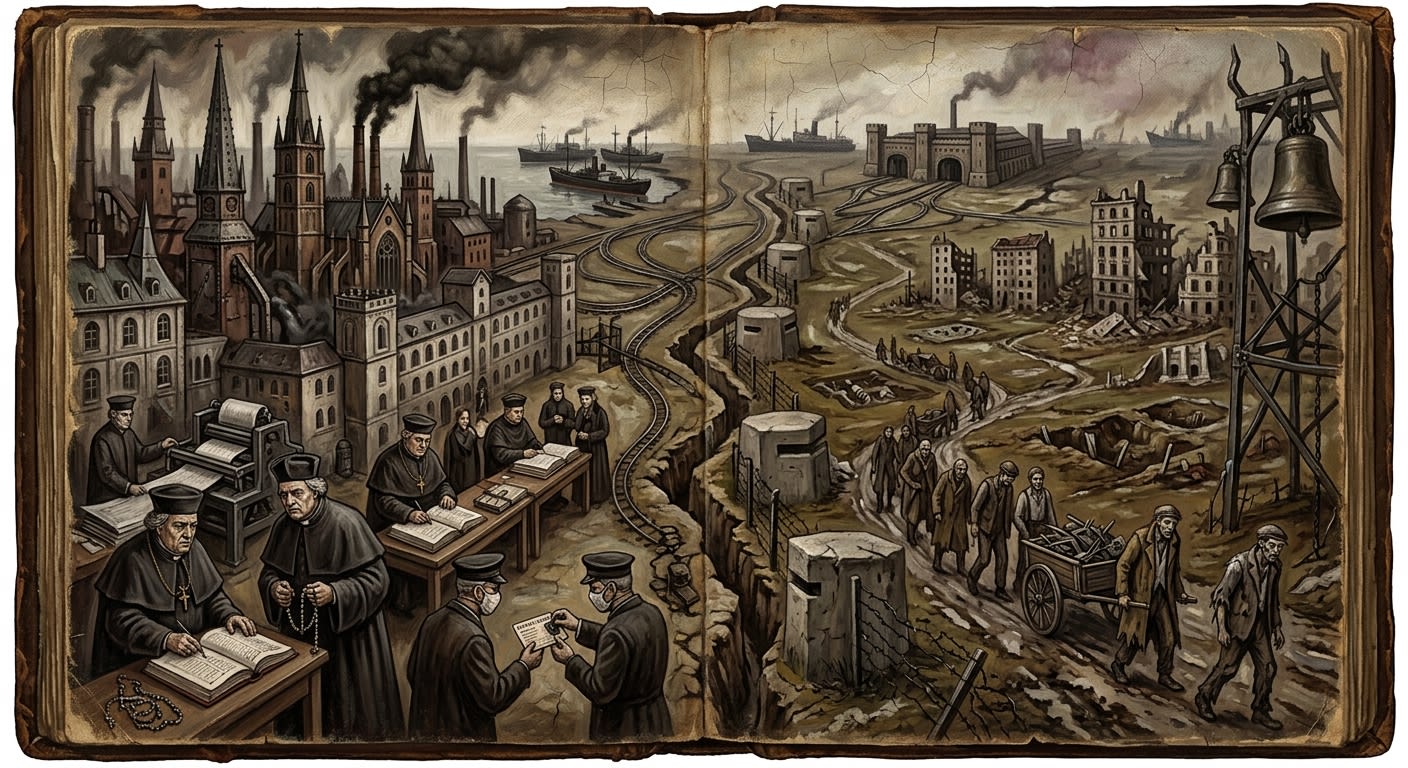
Europe is the name given to the western portion of the world that still answers when called, the eastern portion that answers in another voice, and the strip between them where answers are buried before they become policy. Old schoolmasters once taught it as a continent. Rationalist atlases taught it as an arrangement of prefectures, routes, ports, and resources. The Bureaucratic Synod teaches it as a spiritual body wounded from the Balkans to the Baltic, braced by the Sagittal Line, governed from Strasbourg, and measured in rail tonnage, tithe capacity, sons remaining, bells intact, and graves requiring correction.
This last definition is the useful one. Utility is the only virtue geography possesses before Doctrine improves it.
The old word Europe survived the Atheist Wars, the Treaty of Regensburg, the Rationalist Republic, the Sundering, the Great Retreat, the first Line surveys, the Concordat of Strasbourg, the Levy decrees, and two centuries of officials attempting to replace it with terms better suited to forms. Continental Authority Zone failed. Western Salvific Mass failed. The Harmonised Marches failed after a clerk in Lyon abbreviated it in a manner judged obscene. Europe remained because soldiers, widows, merchants, bishops, deserters, and mule drivers all knew what it meant when the eastern sky turned wrong. Precision was never the word’s office.
At present, A.S. 201, Europe exists in three principal conditions. The West is administered. The East is possessed. The middle is held at gunpoint by men who have been taught that failure is heresy, retreat is arithmetic, and sleep should be requested through proper channels. The division is not clean. No division made by Hell, rail, mud, and paperwork ever is.
A foreigner asks where Europe begins. A clerk asks which tariff applies. A mother asks whether the train east has taken her son. The mother is closest to the truth.
#On the Rationalist Inheritance
The Bureau dates the current age from A.S. 0, when Amsterdam published De Vera Luce and the first formal Rationalist Academy announced with printed confidence that revealed religion had expired. This was not the beginning of Europe, though Rationalists, like mold and auditors, preferred to begin every record with themselves. It was the beginning of the wound we count.
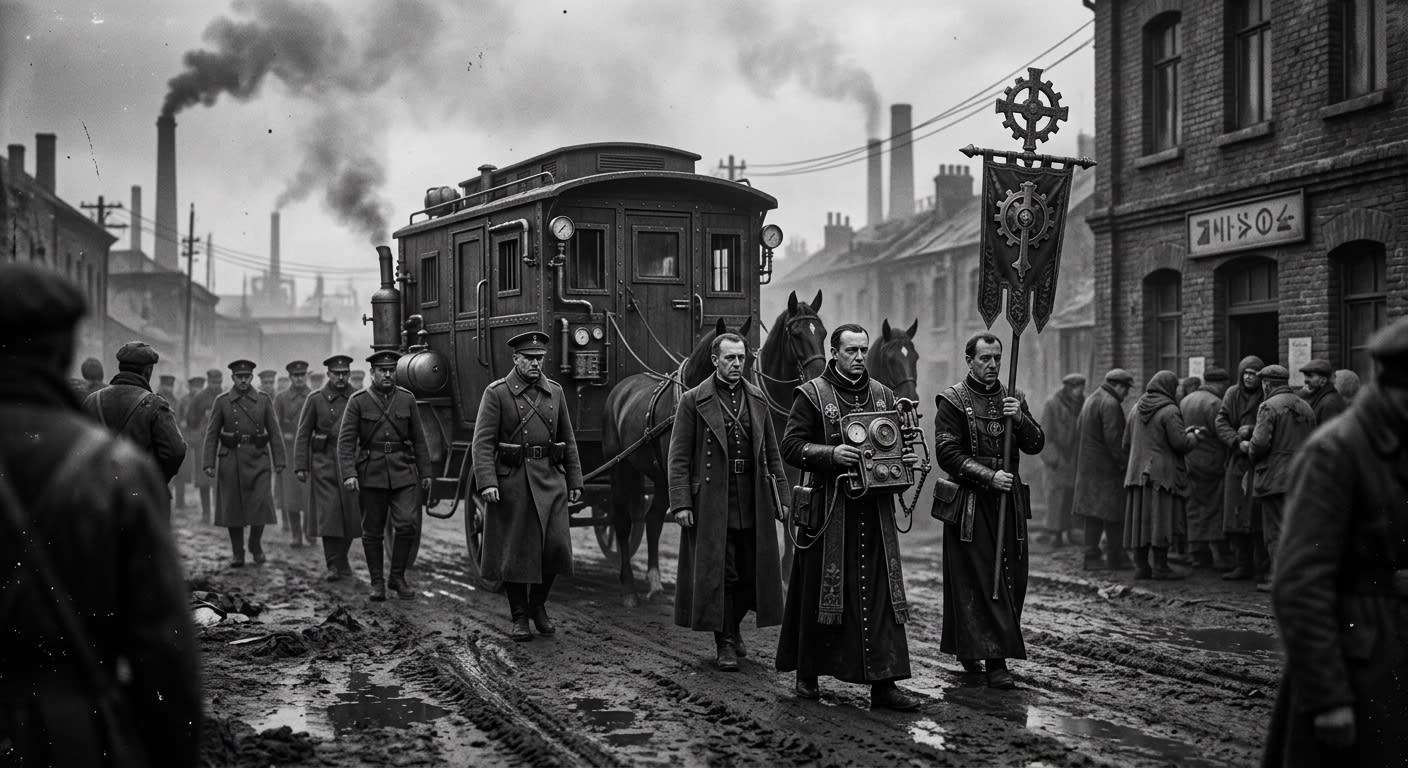
The old continent before the wound was quarrelsome, crowned, churched, vain, multilingual, scented with incense, stable-manure, legal parchment, blood, and fish. It was a zone of overlapping kingdoms, dioceses, free cities, pilgrim roads, universities, guilds, shrines, and dynasties whose claims could contradict one another for centuries without anyone being efficient enough to settle the matter. Then Reason arrived wearing clean cuffs and carrying a knife labelled reform.
The Rationalists attacked churches, certainly. More dangerously, they attacked memory as a competing jurisdiction. Relics became museum specimens. Monasteries became schools, barracks, prisons, granaries, or ash. Saints were demoted into local superstition. Dioceses became Philosophical Prefectures. Crown and altar, quarrel and custom, feast and tithe, sanctuary and procession: all were fed to the Republican machine under the old promise that a new Europe would be tidier than the old one.
Republican educational plates described pre-Rationalist Europe as “feudal disorder awaiting intellectual dawn.”
Corrected. It was disorder. It also had a pulse. The Rationalist Republic achieved order in the manner a butcher achieves silence after market day: by hanging everything from hooks and declaring the arrangement clean.
The Treaty of Regensburg in A.S. 30 turned victory into law. Forty-seven articles abolished ecclesiastical authority, recognised the Rationalist Republic, liquidated Church property, and converted the faithful into subjects of Reason with penalties attached. The Holy See of Vienna was dissolved in an afternoon. Prefectures replaced nations on paper. A Bavarian became Prefecture Twelve. A Castilian became a unit in a transport column. A monk became a corrected citizen or a body. The ink was scarcely dry before the omens arrived, which is Providence's way of laughing without losing dignity.
The Cold Fires of Vienna, the Year Without Dawn, the Red Flood of the Danube, and the Eastern Silence did not persuade the Republic. Reason can survive any evidence once the evidence has been assigned to the wrong department. The Balkans stopped answering in A.S. 38. Vienna called it a regional communication failure. Seven years later, in A.S. 45, the world gave up the courtesy of euphemism.
#On the Sundering and the Great Retreat
The Sundering opened the East. The phrase is too small, like writing roof failure in a report after the sky has entered the nursery. The Balkans cracked; correspondence died; cities failed; refugees moved west before governments admitted movement was necessary. The safest doctrine holds that the Great Deceiver remained beyond full entry while his projections crossed the breach. The Seven Sin-Generals took territory, appetite, weather, memory, desire, and law into their hands. Sorcery ceased being a philosophical embarrassment and became an artillery problem.
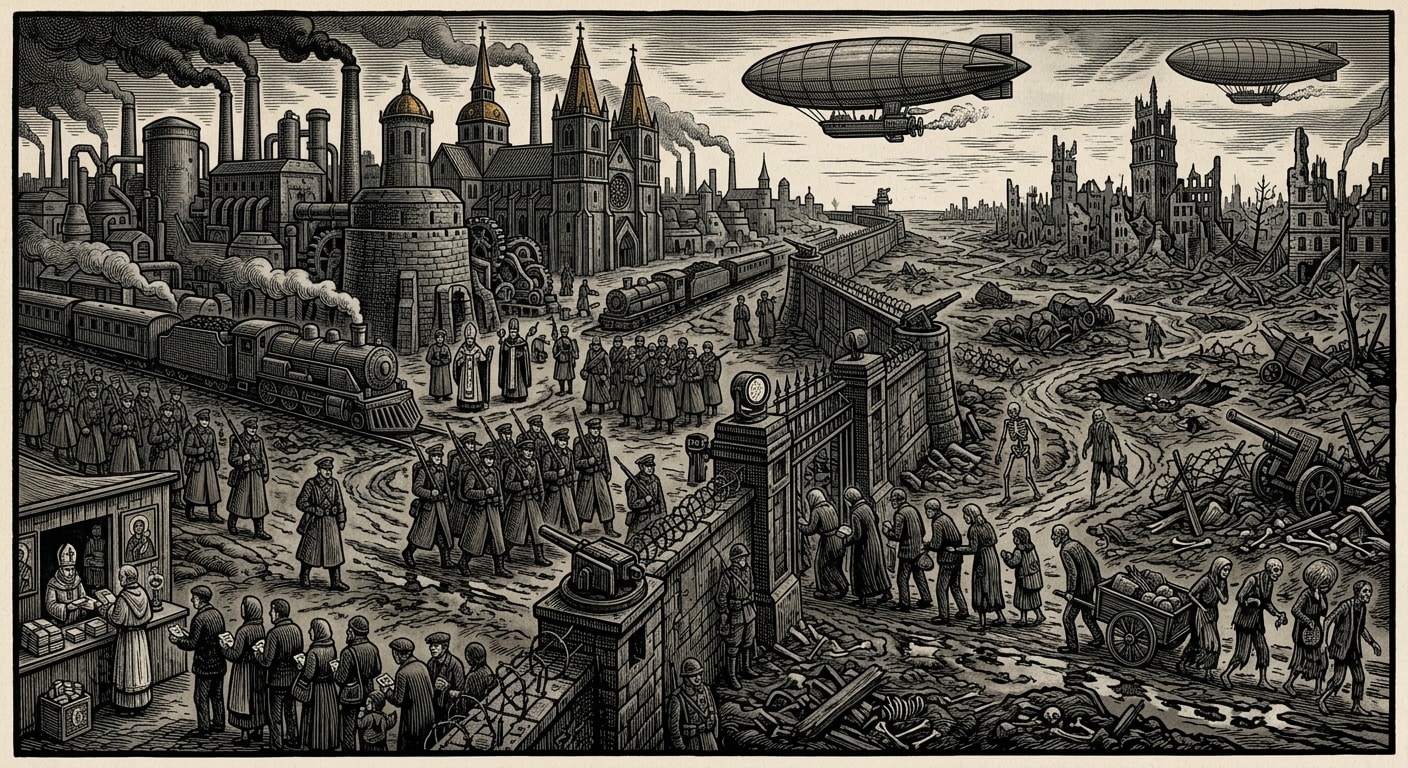
The Great Retreat lasted from A.S. 45 to A.S. 65. Twenty years is a brief span in the life of stone and a long span in the life of a child learning which roads have eaten cousins. Armies withdrew through mud and ash. Railheads were abandoned. Cathedral bells were carried west until wagons broke, then buried, then dug up by men who had forgotten why bells mattered until they heard the first eastern howling without them. Refugee columns moved under icons hidden inside flour sacks. Rationalist officers who had spent their careers mocking saints found themselves assigning guards to relic carts because soldiers stood steadier beside them.
The Retreat did not create one Europe. It created many westward Europes moving at different speeds: the military Europe of rail junctions and rearguards; the refugee Europe of carts, feet, fever, and missing names; the clerical Europe of rescued bones and illegal Masses; the criminal Europe of papers sold beside ditch water; the provincial Europe that learned too late that central authority had become a rumour with boots.
The East became the Charnel Lands. Ukraine, Romania, Moldavia, Wallachia, eastern Balkan valleys, Thracian routes, and the ruins beyond fell under infernal pressure unevenly, then deeply. Some places burned under Wrath. Some starved under Gluttony. Some were counted, hoarded, mirrored, lulled, envied, or sweetened by other hands. The map did not turn red all at once. It developed lesions. Every lesion had a road leading west.
RETREAT LEDGER FRAGMENT — A.S. 57, DANUBIAN ROAD Column counted at dawn: 4,812 souls. Column counted at noon: 4,819 souls. Births recorded: none. Joins recorded: none. Seven added persons gave names already listed among the dead. Disposition: ███████████████████████
By A.S. 65, the westward fall hardened. The Line was not a triumph. It was the place exhaustion became architecture.
#On the Sagittal Division
The Sagittal Line runs north to south. This must be written plainly because lesser minds love east-west diagrams, and lesser minds with pens have killed battalions. The Line begins at Bastion-Königsberg on the Baltic approaches, descends through the Masurian lake country and Bug River lowlands to Bastion-Brest, grips the western Carpathian passes at Bastion-Przemyśl, braces the Transylvanian wall at Bastion-Sibiu, locks the Danube throat at Bastion-Irongate, bites the Balkan pass at Bastion-Shipka, and ends at Bastion-Constantinople on the Bosphorus.
Seven bastions. One spine. Two thousand miles of fortification, trench, wire, rail, bell, ditch, tunnel, chapel, permit gate, fever ward, corpse yard, and argument over whose seal outranks whose emergency.
Zones translate fear into filing categories. Zone 1 names the western heartlands near the Atlantic: Spain, France, Low Countries corridors under Synodal influence or negotiation. Zone 2 names the central heartlands: Germany, Switzerland, northern Italy, Austria, safe enough to manufacture, frightened enough to obey. Zone 3 is the forward heartland: Bohemia, Moravia, western Hungary, Dalmatian staging grounds, the places where supply becomes prayer with wheels. Zone 4 is the Line itself. Zone 5 is No-Man's-Land, contested, shelled, bribed, mined, blessed, lost, reclaimed, and misfiled. Zone 6 is the demonic Charnel Lands. Zone 7 is the southern coast, the Aegean and Adriatic supply skin where harbours move food, pilgrims, contraband, bells, fever, and excuses. Zone 8 is the fractured north, which resents being numbered and proves the number useful by resenting it.
The Line is no nursery-book wall. It leaks. It flexes. It receives deserters, smugglers, plague carts, revenant rumours, false saints, fleeing children, demons wearing stolen coats, and officers with plans. It also holds. Holding is an ugly verb and the only one with honour left in it.
#On Strasbourg and the Governed West
The Synod did not rule Europe the moment Hell opened. It acquired Europe in stages, as all honest governments do: outrage, emergency, council, decree, levy, tax, arrest, correction, anniversary. The Concordat of Strasbourg in A.S. 90 sealed France, Iberia, and the Rhineland into one sacramental polity, with Strasbourg as capital and the Basilica of the Ledgered Saints as its stomach. What entered as treaty emerged as government.
From Strasbourg, the Twelve Holy Bureaus extended through the West: Doctrine to define truth, Records to preserve the approved memory of it, War to spend bodies, Tithes to discover what the bodies owed, Pilgrimage to move the faithful in lines, Purity to notice dangerous deviations, Engineering to make iron repent, and the rest to ensure no human action remained beneath administrative notice.
The governed West is often called safe by people who have never tried to live safely under a seal. Its roads function. Its trains run often enough that lateness can be punished. Its fields feed the Line, then the cities, then the people who grew the food if the ratios smile. Its schools teach children their letters, their sins, their province number, and the correct silence after a Bureau wagon stops outside a neighbour's house. Its churches are full. Its prisons are fuller, though prisons enjoy less incense and better locks.
Popular catechisms describe western Europe as “the rescued continent.”
Amended. Western Europe is the retained continent. Rescue implies the danger ended at extraction. Retention requires daily labour: rationing, mustering, censorship, bridge repair, heresy audit, grave counting, bell tuning, and the periodic removal of citizens whose gratitude has become irregular.
The Continental Levy binds household to front. One son in ten is the public fraction; other fractions exist in rooms where candles are trimmed low. The Levy made Europe legible as flesh. A village may have dialect, saint, grievance, orchard, feud, and song; the Levy asks how many eligible sons stand between fourteen and thirty-five, then teaches the village which truths matter to artillery.
The West endures because endurance has been made compulsory and because compulsion, when attached to a real enemy, acquires a hideous moral advantage. Strasbourg is cruel. Hell is worse. Between those facts lives most European politics.
#On the Provinces That Learned New Names
A continent is not governed from its capital by desire. Desire sits in a chair and imagines obedience. Government requires roads, provincial jealousies, old borders shaved into new jurisdictions, magistrates whose grandfathers served another crown, and clerks willing to write over family names without flinching. Europe under the Synod is a palimpsest with bayonets guarding the scraping knife.
France gives the Synod its administrative lungs: roads, cathedral cities, wine-tax corridors, oath schools, and the splendid hypocrisy by which provincial pride becomes central obedience after a sufficient procession. Lyon still remembers old ecclesiastical authority; Paris remembers being relevant; Avignon remembers enough to require watchers. The Bureau lets each city keep a costume so long as the costume comes when called.
The German and Rhineland corridors give iron, rails, furnaces, machine discipline, scholastic obstinacy, and a talent for producing both excellent engineers and excellent heretics from the same schoolroom. Mainz speaks in authority. Cologne litigates even while kneeling. Essen-of-Hymnsteel turns ore into war with the grim satisfaction of a saint grinding teeth. The Rhine barges carry grain, shot, pilgrims, condemned cargo, and rumours sealed in barrels marked vinegar.
Iberia gives distance, saints with knives in their legends, Toledo's old hierarchies, Seville's festival machinery, and an admirable capacity to make obedience theatrical enough that citizens mistake fatigue for devotion. Northern Italy gives workshops, quarrels, medical schools, and bishops who sign quickly after the second example is made. Switzerland gives passes, banks, hidden storehouses, and neutrality so heavily taxed by necessity that it limps under the invoice.
The Danubian and Austrian remnants form the forward hinge of memory. Vienna is ruin, shrine, supply delay, and warning. Budapest, Bratislava, Munich, and the corridor towns move men toward Przemyśl, Sibiu, Irongate, and Shipka while pretending their old civic souls have not been converted into loading platforms. They have not lost identity. They have leased it to survival.
Every province retains old irritations. Dialects resist standard prayer. Guilds hide former banners under approved cloth. Families keep saints whose canon files do not exist. Market songs preserve names erased from school maps. The Synod tolerates much of this because total replacement is expensive and because a conquered custom can pull heavier than a new decree if harnessed correctly. Doctrine calls this harmonisation. I call it using the mule already in the stable.
Provincial Europe is a filing miracle and a moral swamp. It sends sons east under one calendar while mourning them under twelve local rites. It pays tithes in uniform columns while hiding grief in dialect. It bows to Strasbourg while remembering which road leads away from it. This is disloyal only to fools. A body whose limbs remember different childhoods may still lift the same shield.
#On Independent Edges and Useful Insults
The Synod does not govern all lands west of the Line. This fact is doctrinally irritating and strategically unavoidable. The British Isles remain independent under their sea-crown, Arthurian pretensions, shipyards, fog, admirals, and ancient habit of treating the continent as both market and cautionary tale. They cooperate in maritime matters, convoy work, and certain southern supply actions while declining the full embrace of Strasbourg. The embrace is patient. So is a noose, but one must not say this in diplomatic correspondence.
The Netherlands remain an independent merchant state, a republic of ledgers, dykes, creditors, shipmasters, and men who can calculate the price of moral disgust to three decimals. Amsterdam gave A.S. 0 its wound through De Vera Luce. The Dutch now sell, lend, insure, ship, argue, delay, and profit under arrangements that cause the Bureau of Tithes to gnash teeth polished by envy. They occupy the profitable space between enemy and subject: invoices with flags.
Scandinavia and the Baltic north remain fractured, partially independent, partially aligned, partially frozen into arrangements that change with ice, famine, and Russian ruin-winds. Königsberg's jurisdiction touches this cold ambiguity at the Line's northern nail. There, Synod authority, northern local power, sea trade, and enemy pressure meet in a ledger so stiff with frost that signatures sometimes crack.
Italy, Germany, Iberia, France, the Rhineland, Swiss cantons, Austrian ruins, Danubian staging corridors, and city-states with memories longer than their privileges all occupy different grades of submission. Strasbourg calls this harmony. Provinces call it by older names when windows are shut. The Bureau records both usages when useful.
These edges matter because Europe is not a single obedient slab. It is an administered body with scars, grafts, splints, foreign teeth, and independent fingers that still move when Strasbourg would prefer a fist. The Synod survives by pretending this is design. Often it becomes design after enough punishment.
#On Civilian Life Under the Held Sky
To live in western Europe is to inhabit a schedule written by distant danger. The bells decide hours. The ration office decides appetite. The Levy assessor decides which cradle has matured into military relevance. The parish decides whether sorrow has been displayed with proper economy. The Bureau decides when the parish has decided incorrectly.
Morning begins with countable things: bread weight, lamp oil, factory bell, prayer card, train whistle, roll call, permitted wax. Cities wake in layers. Clerks before artisans. Artisans before schoolchildren. Schoolchildren before prisoners, except on execution days, when prisoners rise first out of courtesy to timing. In the countryside, fields are planted for men who may never eat from them. In towns, girls learn accounts because accounts survive husbands. Boys learn geography as a list of places that will want them later.
News travels as bulletin, sermon, rumour, casualty list, and price change. A victory at Bastion-Shipka lowers candle costs for three days because merchants believe pilgrims will sing. A breach scare at Brest doubles boot leather. A fog report from the Danube empties fish markets in Marseille. Europe is tied together by rails and fear; the rails are newer.
There is pleasure. Do not permit grim young moralists to steal it from the record. Europe still drinks, flirts, cheats, sings licensed songs badly, buys ribbons, overpraises babies, insults neighbours, races dogs, ruins soup, kisses in alleys, and laughs at officials when officials slip on ice. The Bureau does not approve all of this. Approval is not oxygen. Citizens have learned to breathe around us.
The ordinary European is neither saint nor rebel. He is a creature of queues: grain queue, shrine queue, conscription queue, confession queue, rail queue, burial queue. He survives by knowing which official can be bored, which can be flattered, which can be bribed with eggs, which must never be met in daylight, and which prayer should be said loudly when a wagon bearing Purity wax turns the corner. This knowledge is not in catechisms because catechisms are written by people with doors.
Europe's civilian genius lies in sanctioned evasion: mourning through recipes, hiding coins in saint bases, teaching forbidden lullabies as counting exercises, repairing illegal machines with legal screws, naming children after dead uncles whose records were altered, and using Bureau forms as insulation when winter wins the doctrinal argument. Such acts are not revolution. Revolution has flags and poor timing. These acts are life biting through the sack.
The Synod knows. The Synod punishes enough to maintain fear and ignores enough to maintain production. Hell offers corruption. Strasbourg offers permission. Between the two, citizens bargain for Tuesday.
#On Ports, Seas, and the Wet Borders of Doctrine
Europe's landward terror receives the murals, the sermons, and the better funerals, yet the continent survives as much by water as by wall. The Atlantic ports, the Channel crossings, the North Sea lanes, the Baltic ice routes, the Adriatic feeders, the Aegean convoys, and the black-tempered Bosphorus all carry what roads cannot: bulk grain, bell metal, coal, refugees, pilgrims, hospital stores, contraband optics, relic crates, fever, news, and sailors' lies improved by salt.
The Synod prefers roads because roads submit to milestones. Seas refuse this sacrament. A ship leaves harbour under seal, disappears into weather, returns late with three manifests, two corpses, one sealed crate nobody admits loading, and a captain whose account changes by tide. The Bureau of Records hates the sea. The Bureau of Tithes adores it. This is how one knows the sea is profitable.
Western ports form Europe's outer eyelids. Calais watches Britain while pretending not to squint. Marseille smells of oil, fish, rope, plague vinegar, and southern rumours. Hamburg moves northern cargo with Lutheran efficiency carefully repainted in acceptable colours. Lisbon and Cádiz handle Atlantic pilgrim lanes and the peculiar maritime piety of men who trust wood above water more than bishops above committees. Venice, where it can still bargain through its own reflection, sends glass, credit, and old contempt eastward under new seals.
The southern coast remains Europe's sly artery. Zone 7 is nominally supply lane, pilgrim route, quarantine belt, and naval screen. In practice it is all those things plus smugglers' chapel, naval theatre, Bureau rivalry table, and whisper market. Thessaloniki, Constantinople, Varna, Adriatic island stations, and nameless chain-towers trade in necessities Doctrine would prefer to call rare: black diesel, demon glass, forged passage, unofficial medicine, missing persons found under new names, and saints whose bones have suspiciously improved in transit.
The British provide ships without obedience. The Dutch provide credit without reverence. Synodal ports provide paperwork until the tide begins to leave, at which point paperwork becomes flexible in exactly the measure required to prevent starvation. This bears corruption's scent. It remains public survival, and therefore receives a cleaner name.
A Bureau of Pilgrimage circular once described the European sea-lanes as “peripheral to the main continental struggle.”
Corrected after three grain convoys, two ammunition shipments, and one reliquary escort failed to arrive during the same winter and peripheral hunger began chewing central doctrine. The sea-lanes are central. They are merely damp, which confuses landlocked theologians.
Sea borders also preserve dangerous imagination. A peasant born beside a road thinks in departures measured by hoof and patrol. A dock child thinks in horizons. Horizons produce questions. Questions produce smugglers, poets, deserters, admirals, and other forms of administrative mildew. The Bureau has tried to discipline the horizon with watchtowers. The horizon remains unimpressed.
Yet when eastern pressure rises, the ports answer. Coal moves. Grain moves. Bells move. Men move. Hospital ships receive what battlefield roads cannot bear. The sea is disobedient, venal, irreverent, salt-rotted, and indispensable. I have known bishops with fewer virtues.
#On the Present Continent
As of A.S. 201, Europe lives under a stalemate old enough to have grandchildren. The front moves in yards, tunnels, bridgeheads, fever strips, ration corridors, and lie-categories. A victory at one bastion may mean a ditch held through winter. A disaster may mean a village name moved from active rolls to ossuary intake. The grand map changes slowly. The grave maps change daily.
The West has grown around war as bone grows around shrapnel. Rail timetables serve the Line before passengers. Foundries sing for cannon. Pilgrim routes double as troop corridors. Harvest prayers include yield estimates. Marriage contracts account for Levy risk. Schoolyard games teach children to run west when bells stutter east. In Strasbourg, proxy corridors under the Cloister move envoys, lictors, syndics, captains, and warrants through a choreography so dense that a citizen could mistake it for civilisation if he stood far enough away.
Europe's eastern half is not gone in the simple sense. Gone things stop demanding attention. The Charnel Lands send pressure, refugees, weather, dreams, false letters, altered bodies, and military doctrine back across the Line. The East remains in every western kitchen where ration bread is weighed, every barracks where recruits stare at maps, every shrine where mothers light the permitted number of candles for sons whose bodies were not recovered. Loss has become a civic organ.
The old continent of princes and philosophers is dead. The Rationalist continent of prefectures is dead. The Synodal continent survives, which differs from living, but survival has rights in law and should not be mocked by those enjoying its roofs. Europe today is a ledger with one page burning, one page damp, one page sealed, and one page still blank enough to frighten every honest clerk. I have placed my hand on that blankness. It was warm.