
#On the Office That Defines Colour
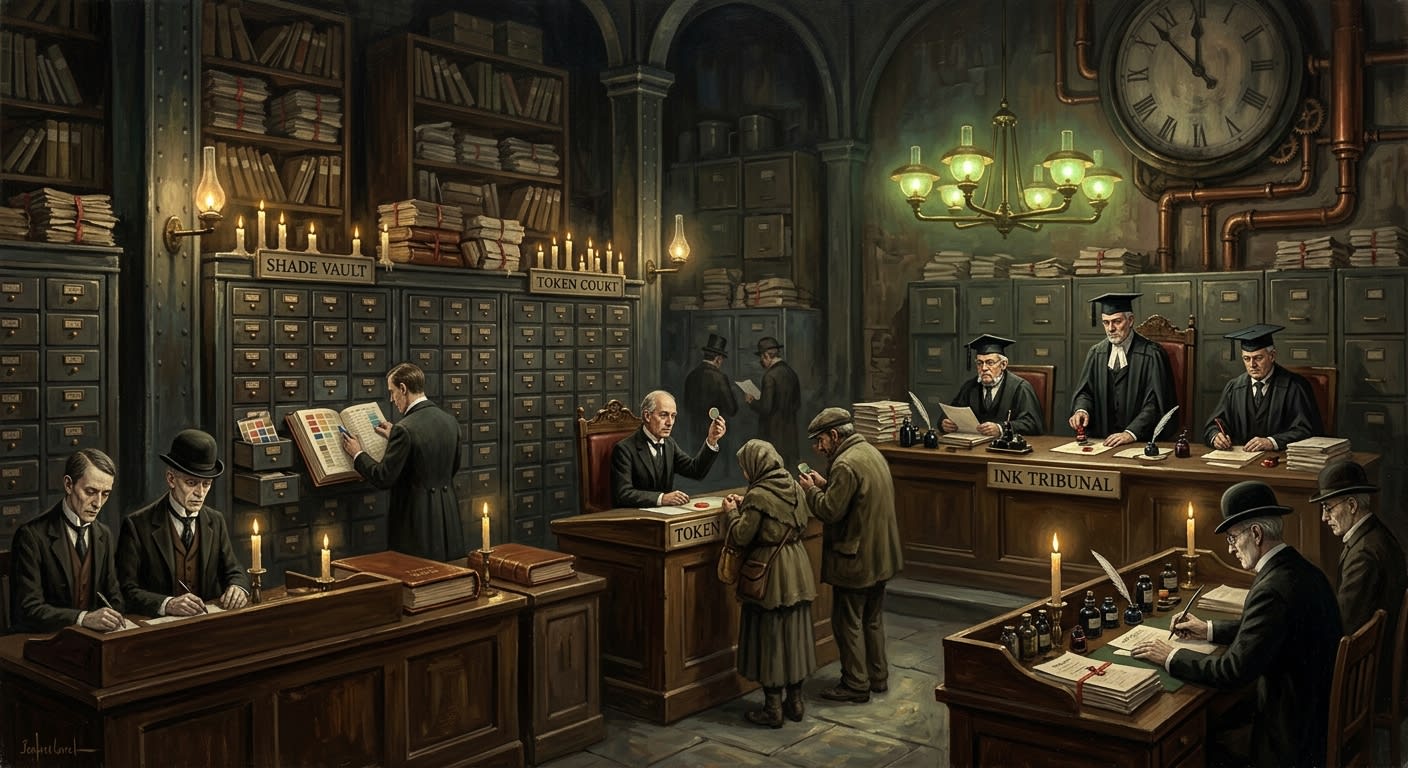
The Chromatic Registry is the Candlewick Palatinate's shade court, colour vault, ink tribunal, token office, anti-forgery machine, and theological insult to every honest eye. It exists because the Bureau of Records discovered, sometime after the A.S. 92 Candlewick charter, that a seal without a regulated shade is merely wax behaving ambitiously.
The Registry's doctrine is clean enough to be monstrous: colour is legal evidence. A document proves itself by paper, signature, seal, fee stamp, fold discipline, and shade. A pass in the wrong blue does not pass. A ration chit in the wrong grey does not feed. A marriage writ in the wrong red does not bind flesh, property, dowry, bed, inheritance, or the two sweating idiots who believed love could survive a palette dispute. The Seal Locks apply the doctrine to water; Bottle Quay applies it to ink; the Registry applies it to everyone.
The public calls this pedantry. The public is wrong, as usual, though not without charm. The Registry does not fuss over colour because clerks are small-minded, though many are. It polices colour because the Synod has made the visible mark into authority's body. Ink speaks only when its shade belongs to the approved liturgy. Wax seals only when its hue has been admitted to the vault. A counterfeit phrase may be caught by a reader. A counterfeit colour seduces the instruments before the reader begins.
#On the Founding in Wax and Fear
The Registry began as a desk. This is how most horrors begin, despite the theatre priests lend to caves, cults, and midnight knives. After the Concordat of Strasbourg placed administrative hunger under continental discipline, Candlewick became the Synod's great manufactory of seals, registered inks, and watermarked paper. Demand exceeded custom. Custom became quota. Quota required proof. Proof required a colour stable enough to survive shipment, damp, argument, and the vulgar creativity of thieves.
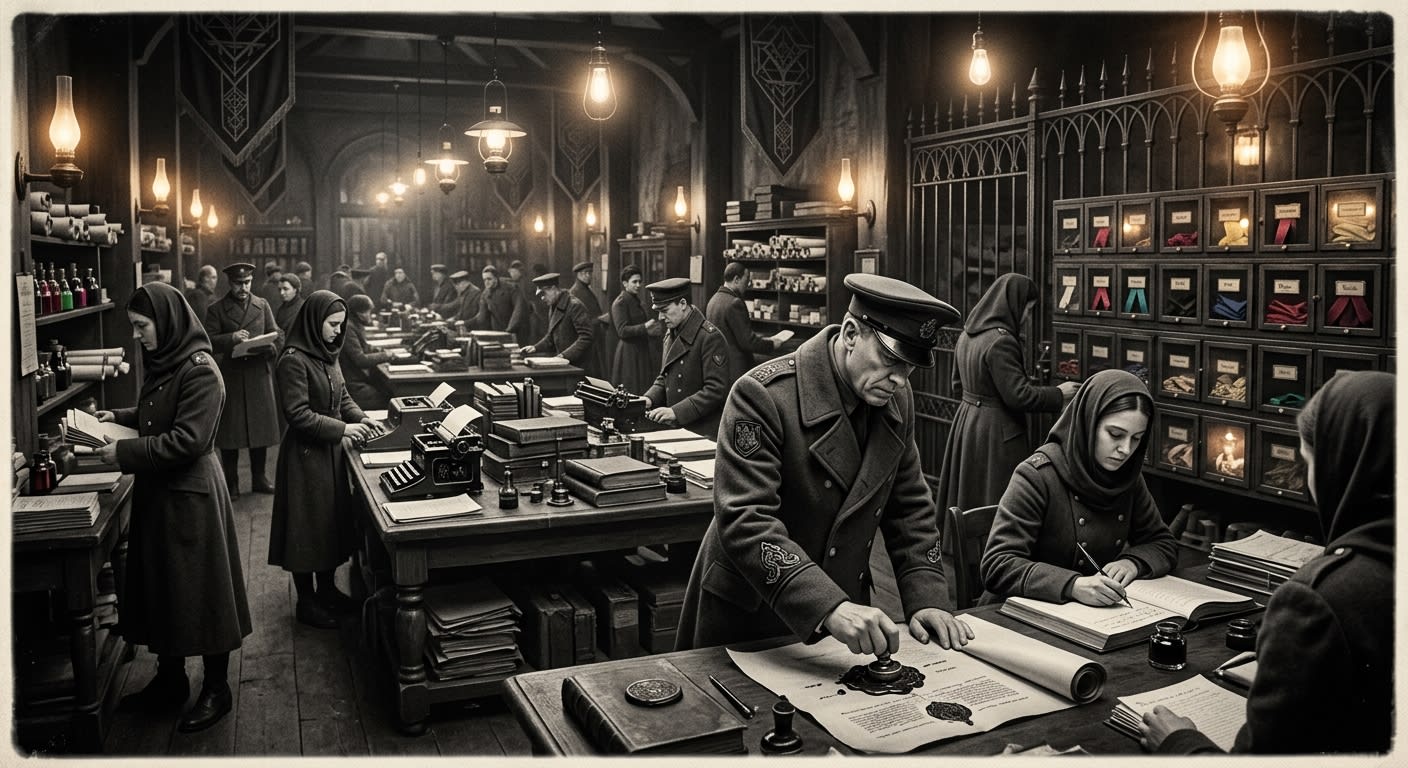
Within a decade of the A.S. 92 Bureau of Records annex, the Chromatic Registry had separated itself from ordinary supply inspection and begun behaving like a priesthood with better lamps. It gathered shade phials. It numbered wax batches. It fixed legal names to colour families. It told House Wickwarden which candles could light official desks and House Vatmarsh which mordants could make permanence. The old dyers of the free canal market, who had once mixed colour by eye, season, oath, habit, grandmother, and fraud, learned that the Registry preferred its fraud centralized.
Later House pamphlets describe the Chromatic Registry as a guild compact voluntarily formed to protect craft standards.
Corrected. The Registry was born from Bureau need, armed by Records, fed by House compliance, and tolerated by artisans who mistook negotiated survival for consent. The guild story survives because men prefer founding myths in which their grandfathers were not put neatly in a box.
The first shade vault occupied a converted dye chapel near Bottle Quay, where sealed phials sat in reliquary niches and clerks argued whether Vermillion-Record and Vermillion-War differed by ministry, mineral content, or the private vanity of two men who disliked one another. By A.S. 104 the vault had outgrown the chapel. By A.S. 110, the First Continental Levy had turned colour-law into military necessity. Every conscription order, transit pass, ration permit, and death certificate needed shade certainty. The Registry supplied certainty at a price and then charged for uncertainty when certainty failed.
#On the Shade Vaults
The Registry building stands in Candlewick's inner ring, between Bottle Quay's glass stink and the Records Annex porch, a long lacquered hall whose windows are filtered through neutral panes so that sunlight cannot alter legal perception. The architecture is modest only from the street. Inside, colour sits in ranks like bottled saints.
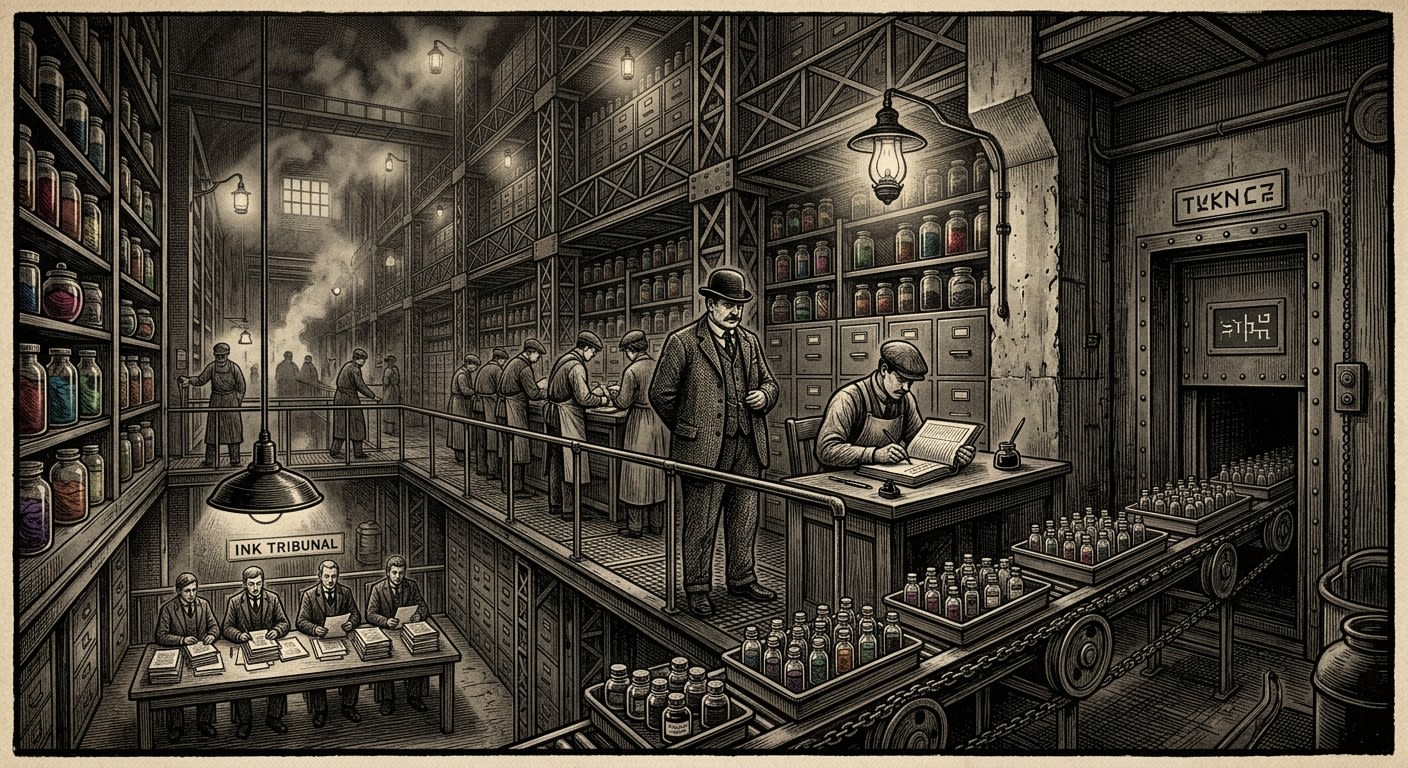
Every authorised hue has a master phial: wax shade, ink shade, token shade, stamp shade, mourning shade, passage shade, levy shade, quarantine shade, execution shade, absolution shade, and those intermediate colours by which the Synod makes ordinary life punishable in more precise increments. The phials are sealed under salt-glass, named in three scripts, cross-filed by ministry, district, season, use, and variance tolerance. A clerk may spend thirty years in the Registry and never touch a master phial. This is wise. Clerks touch things. Things touched by clerks acquire interpretations.
The comparison rooms are kept under gaslight and north lamp. A suspect document is laid beneath the shade frame. The clerk slides reference glass over the ink, breathes through a filter, notes deviation, and decides whether the page is lawful, stale, forged, faded, contaminated, salvageable, politically inconvenient, or likely to make the supervising Registrar angry. The last category governs more outcomes than the manual admits.
Citizens imagine colour as a surface. Registry clerks know better. Colour has depth, age, smell, mineral temper, drying habit, lamp response, and social rank. Passage blue must not lean toward military blue unless the bearer is armed by writ. Mourning violet must not dry toward plum unless domestic liability is unsettled. Quarantine yellow must hold its sourness in damp. Execution black may gloss under fresh wax but must flatten by second bell. These are the little catechisms by which Candlewick decides who moves, eats, marries, mourns, waits, or disappears.
#On Shade Tokens and Daily Tyranny
The Registry's most efficient cruelty is the shade token. A token is small enough to fit in the palm and large enough to govern a day. Passage pretends it owns movement; Tithes pretends it owns fee; in Candlewick, the token decides whether either office gets to pretend successfully. It may be paper, waxed card, stamped tin, cord tag, or lacquer chip, depending on district and poverty. It bears a colour keyed to hour, ward, permitted route, work class, mask ration, curfew status, and sometimes mood of the issuing clerk. A worker with a blue-green morning token may cross Bottle Quay at First Bell. The same worker holding the same token at Sixth Bell becomes suspicious. At Ninth, he becomes merchandise for the Seal Provosts (Unregistered).
Shade tokens began as factory discipline and became civic weather. Candlewick breathes through them. The Lantern Mile opens under amber. Vatmarsh Row changes shift under acid green. The Seal Locks process guild cargo under ledger-grey and civic cargo under a miserable brown called Public Patience. During shortage weeks, House Wickwarden issues candle ration slips in diminished gold; everyone sees the insult and pretends not to, because light is hard to boycott after sunset.
A person without a shade token exists at Registry discretion. Literally. Without token colour, the mask market refuses filter cloth, the bread queue refuses measure, the lock bridge refuses passage, the Lungward Sisters refuse entry unless bleeding becomes embarrassing, and the Charter Court (Unregistered) refuses complaint because a complaint must be filed under a colour the complainant does not possess. The Registry calls this administrative hygiene.
The poor learn colour the way sailors learn reefs. Children can distinguish ration grey from inspection grey before they can write their names. Widows keep old tokens sewn into hems. Apprentices scrape lacquer from discarded guild tags and sell near-matches in alleys. Priests bless tokens in bulk, which the Registry tolerates because blessing does not alter shade unless performed by an enthusiast, and enthusiasts are already watched.
#On High Registrar Sable Vorn and Her Instruments
The current High Registrar of Chromas is Sable Vorn (Unregistered), chief officer of the Bureau of Records in the Palatinate and a woman whose face has the spiritual warmth of a sealed cabinet. She controls the legal colour-codes for half the Heartlands. Every pass, writ, ration sheet, lock chit, shipment order, and workshop license that depends on Candlewick shade ultimately kneels before her vault.
Vorn has never been observed to smile. This proves no virtue, but it records professional discipline. She speaks softly, corrects without raising her head, and treats contradiction as a shade variance introduced by an inferior lamp. When asked what would happen if two bureau shades proved identical, she replied, “They cannot be identical. The Registry does not permit it.” I admire the sentence against my will. It is pure government: reality denied entry for arriving without appointment.
Her subordinate, Shade Auditor Pell (Unregistered), is famous for sniffing ink. He can identify Vatmarsh mordant, Bottle Quay cork treatment, watered black, black-market gum, salt-stopped fading, and apprentice panic by odour alone. His fingerprints are indexed so thoroughly that even his contempt leaves traceable ridges. During the first public cases of the Fading Winter, Pell's thumb-smudge authenticated a wax shipment authorization whose body text had vanished. House Wickwarden accepted delivery, proving once again that ambiguity has a strong preference for the warehouse owner.
The Seal Provosts serve as Registry fists. They raid with shade knives, sample phials, portable braziers, armed clerks, and the bored menace of men who know a one-quarter gradation can shutter a room faster than arson. Purity admires them in the way a wolf admires another wolf's teeth. They are anti-forgery guardians in public, political police in practice, and shakedown artists whenever supervision blinks. The Registry does not deny this vigorously enough to be believed.
#On Hungry Ink and Official Panic
The Registry fears Hungry Ink because Hungry Ink preserves the signs the Registry trusts while devouring the sentence those signs were meant to govern. A forged document insults colour-law from outside. Hungry Ink genuflects before the shade, spares the seal, preserves the fee stamp, and alters the command beneath a valid face. It is rebellion with manners.
Since A.S. 143, when ash from the Year of Ash Rain lodged in Candlewick mordant stock and the Bureau of Alchemical Standards first noted the correlation everyone was then ordered not to believe, the Registry has classified the phenomenon as Category Two Localized Scribal Anomaly. The classification remains pending. Pending is the velvet glove on paralysis.
Registry countermeasures are numerous, expensive, and beloved of forms: salt-stopping, wax overcoats, cold cabinets, triple-copy duplication, oral recitation, shade quarantine, margin watching, and immediate disciplinary action against clerks who try to overwrite an affected page. The A.S. 187 overwrite guidance was withdrawn after a Maastricht quarantine writ produced two contradictory districts, both legally sealed and both prepared to enforce themselves. That file is used in training. It is also used, I suspect, to frighten new clerks into celibacy.
The Registry's A.S. 187 manual advised affected clerks to overwrite compromised text in fresh sanctioned ink.
Withdrawn. Overwriting feeds the appetite. A clerk now attempting it loses ink license, desk, colour standing, and, in severe cases, name shade. The manual has been recopied with unusual humility.
Hungry Ink made the Registry look foolish. The Fading Winter made it look mortal.
#On Chromatic Reconciliation
A.S. 199 gave Candlewick the season when seals remained and words deserted. Documents across the River-belt lost text while preserving wax, signatures, registry shades, and fee stamps. The Registry declared a heresy outbreak. House Vatmarsh declared mordant-salt failure. The Black Canal declared a market. Each spoke its native tongue.
The Registry's answer was chromatic reconciliation, one of those phrases whose smoothness should make decent men reach for a chair. It meant mass revalidation. Every household summoned. Every workshop audited. Every ink recipe, wax record, apprentice contract, mask ration ledger, dye quota, family paper, token book, and private drawer dragged under north lamp. All unverified shades suspended. All suspended documents void pending review. All persons depending on void documents retained provisional existence at Registry discretion.
Eighteen workshops closed in the first month. Forty-seven workers were reclassified as unlicensed. Bottle Quay lost six ink-bottling rooms. The Lantern Mile lost two wick halls. Vatmarsh Row lost nothing worth naming, which tells the alert reader where policy stopped at the door and wiped its feet.
The official position is that reconciliation stabilized the outbreak. This may be true in the narrow technical sense that terror stabilizes a crowd pressed against a wall. Fading rates slowed where Registry authority expanded. Illegal ink traffic increased. Household paper hoarding became common. Children began memorizing licenses as if reciting catechism. Priests read marriage names aloud three times before sealing them. The Bureau approves memory when supervised by paper and dislikes paper when supervised by memory.
The Registry emerged larger, hated, richer in jurisdiction, poorer in trust, and convinced that this sequence constituted success.
#On the Black Canal's Insult
The Black Canal is the Registry's shadow with a better sense of price. The Registry made colour law. The Canal made unlawful colour shelter. A widow with a suspended ration token needs a grey that passes once. A deserter needs Passage blue blessed by a stolen stamp. A dye-house accused of shade treason needs red close enough to buy a week. The Canal supplies what the vault forbids, what the Houses hoard, and what desperate men will sell their grandmothers to hold.
The Registry calls this contamination. It is also competition.
During the Fading Winter, the Canal sold fade-proof inks in three grades: false, dangerous, effective. Registry advisories called all fraudulent until useful samples reached Standards, Records, Doctrine, and offices that denied receipt before the courier returned. The Canal's counterfeit bureau shade has passed three auditors before origin disclosure. This fact deserves repetition in every room where Registry pride is stored. Three auditors. Valid instruments. False origin. Correct colour.
RESTRICTED SHADE TEST — BLACK CANAL SAMPLE Sample designation: BC-199/true-false. Auditors: three. Initial findings: lawful bureau shade, export grade. Origin disclosed after certification. Auditor One vomited. Auditor Two requested retest. Auditor Three asked whether the sample could be purchased. Disposition: █████████████████████████.
The Canal understands a truth the Registry cannot admit: authority is partly performance. If the colour convinces the lamp, the clerk, the gate, the ration counter, and the frightened man holding the token, legality arrives late to its own funeral. The Registry may own the master phial. The Canal has learned to imitate the gesture by which the master phial commands obedience.
#On the Present Palette
As of A.S. 201, the Chromatic Registry operates under Amber discipline. The shade queues remain long. The vault lamps burn through the night. Salt-stopped margins dry in racks. Clerks compare, sniff, stamp, murmur, condemn. Seal Provosts raid Bottle Quay under audit cover and return with outlaw blues, warmed wax, smudge runners, frightened apprentices, and enough seized pigment to paint a chapel ceiling no one will be permitted to enjoy.
Registrar Vorn has requested expanded authority over River-belt shade tokens beyond Candlewick's immediate jurisdiction. The Bureau of Passage objects. Tithes objects because uncoordinated colour invalidation interrupts fee collection. Purity objects because the Registry's purges create suspects before Purity can brand them properly. Records supports Vorn in public and fears her in private, which is the normal posture of a parent toward a successful child with knives.
The citizens queue. They carry papers in oilcloth, tokens in mouth-pouches, old licenses sewn into cuffs, names memorized against the possibility of ink desertion. A clerk lifts a pass beneath north lamp. A woman waits to learn whether she may cross a bridge to work, buy bread, retrieve a child, bury a husband, or continue being herself until Sixth Bell.
The lamp decides slowly.