
#On the Quay Where Ink Learns a Body
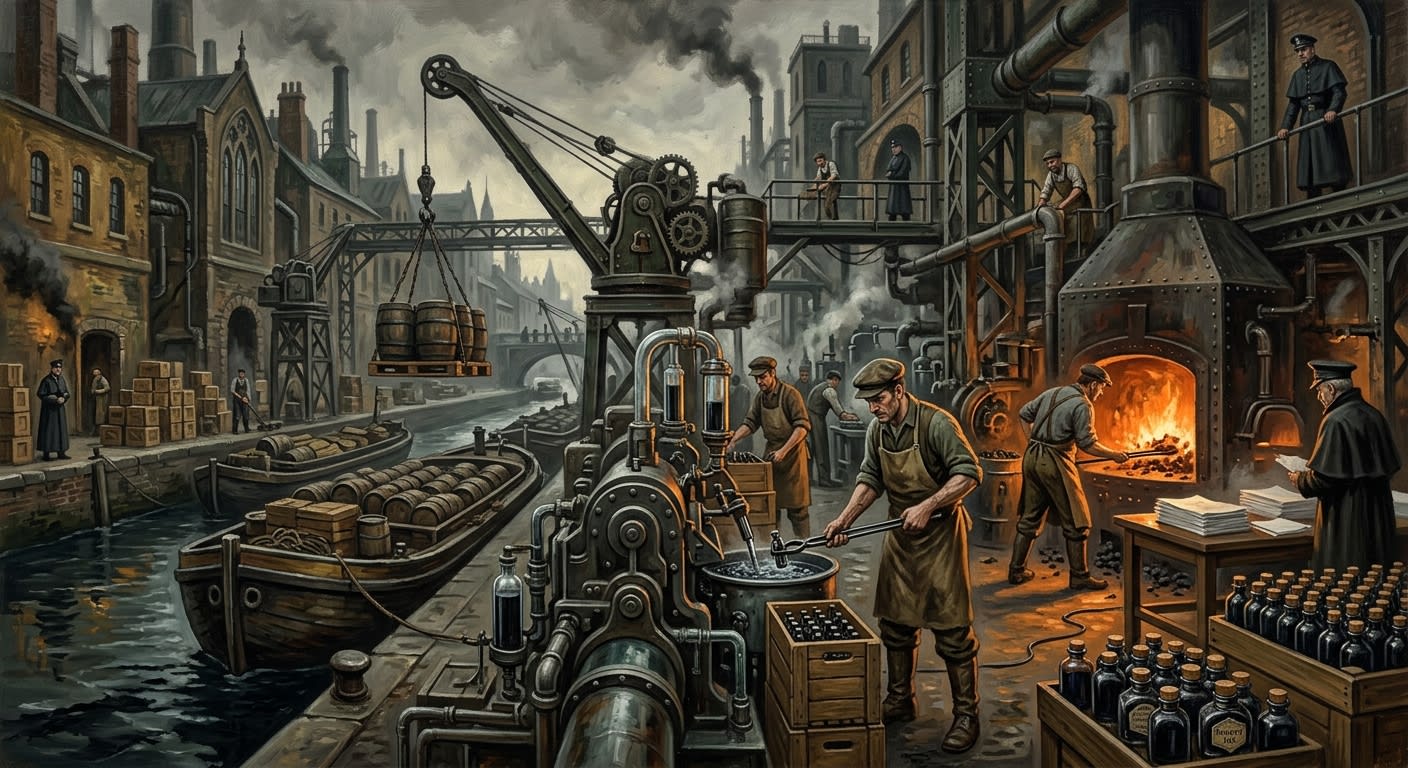
Bottle Quay is the quarter of Candlewick where official ink acquires its glass, its label, its export crate, and occasionally its appetite. Other districts possess cleaner reputations because they perform their sins behind lacquered counters. Bottle Quay performs its labour under furnace glare, canal fog, soot, sharp spirits, and the perpetual scream of glass cooled too quickly by men paid too little to wait.
It stands downstream of Vatmarsh Row and upstream of the Seal Locks, a position so materially exact that the Bureau of Records has attempted three times to describe it as Providence rather than plumbing. The mordant salts arrive in sealed casks from the dye-halls. The bureau inks are drawn into bottles at the long benches. The glass is stoppered, waxed, shaded, weighed, crated, and sent by canal toward the Heartlands, the bastions, the courts, the hospices, the conscription depots, the scaffold desks, and every other holy place where a human life is improved by being made vulnerable to a document.
The district smells of soot, hot silica, vinegar spirits, canal algae, singed hair, and that clean medicinal violence by which a solvent announces that lungs are temporary. Its streets run black after rain. Its gutters shine blue where Registry wash-water escapes inspection. Its children know the colours of Bureau inks before they know the names of saints, which may be an educational failure or a candid curriculum.
#On the Glassyards
The Bottle Quay Glassyards began as ordinary bottle-houses attached to the old dyers' market before the Records Annex (Unregistered) made ordinary commerce illegal by noticing it. When the Palatinate received its A.S. 92 charter under Concordat standardisation, glass became a security material. A bottle ceased being a container. It became custody.
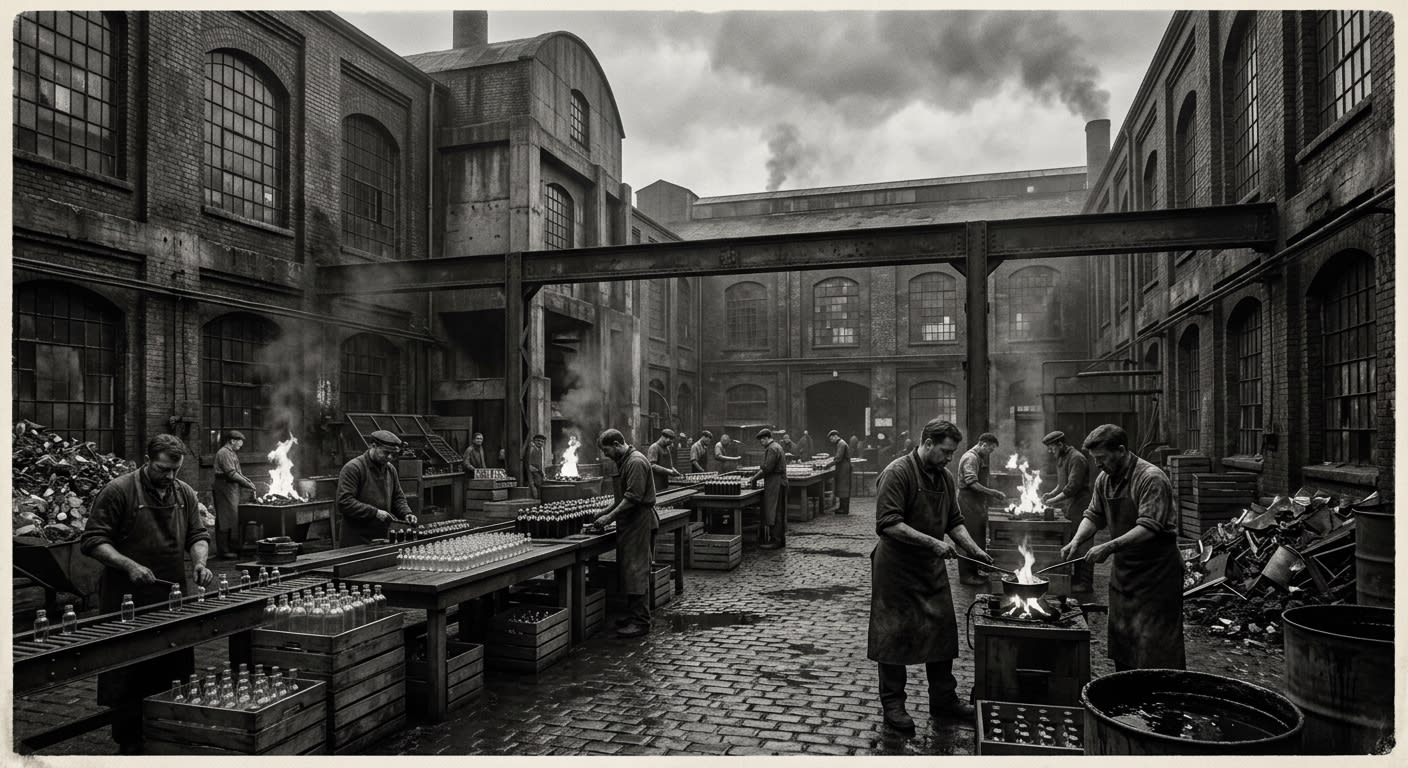
The first chartered yards used salvaged window glass, river sand, bone-lime, and furnace ash. They produced crude necked phials for parish ink, wide-mouthed jars for wax pigment, and square export bottles stamped with the House mark of whoever owned the furnace that week. After levy arithmetic matured into routine state appetite, demand hardened; by A.S. 110, renewed mobilisation pressure made the bottleneck intolerable. Mass mobilisation required sealed ink kits by the crate: black for Records, red for living rolls, blue-black for War manifests, grey reserve for correction copies, and certain bureau shades whose names I will not publish because half the underworld reads more attentively than the clergy.
Early trade circulars describe Bottle Quay as a “supporting craft district” of the Palatinate.
Corrected after the A.S. 110 levy bottleneck, when a seven-day furnace strike delayed conscription paperwork across three corridors and caused two captains to march with verbal orders. A district capable of delaying an army is not supporting craft. It is a throat.
Each glassyard is built around a furnace pit, a blowing floor, a cooling chapel, a counting bench, and a canal mouth. The cooling chapels are called chapels because men pray there and sometimes burn there, and because naming a dangerous room after worship improves insurance. Apprentices carry glowing bulbs on rods longer than their arms. Master blowers shape phial necks to exact diameter, since a bottle that accepts the wrong stopper may be classed as a counterfeit instrument. Inspectors measure the lip, the shoulder, the wall thickness, the shade clarity, the bubble count. A bubble in ordinary glass is a blemish. A bubble in bureau ink-glass is a place where a lawyer may hide.
Explosions are routine enough to have civic etiquette. If a furnace coughs once, workers glance up. If it coughs twice, foremen curse. If it sighs, everyone runs except the apprentice assigned to shut the draft gate, who becomes exemplary if he succeeds and educational if he does not. The Glassyard Register lists ruptures by cause: wet sand, bad lime, spirit vapour, cracked brick, unauthorized night firing, sabotage, act of Providence. Providence has never been fined.
#On Bottling and Certification
Ink arrives from Vatmarsh Row in covered casks marked by salt origin, dye lot, fixing agent, stirrer oath, and the small private scratches by which workers warn one another that a batch smells wrong. At Bottle Quay the cask is sampled under Chromatic Registry supervision. The sample is matched against a sealed phial in the shade vaults. The clerk nods or condemns. A condemned batch may be reworked, diluted, seized, burned, or purchased quietly by men with canal boots and no interest in condemnation.
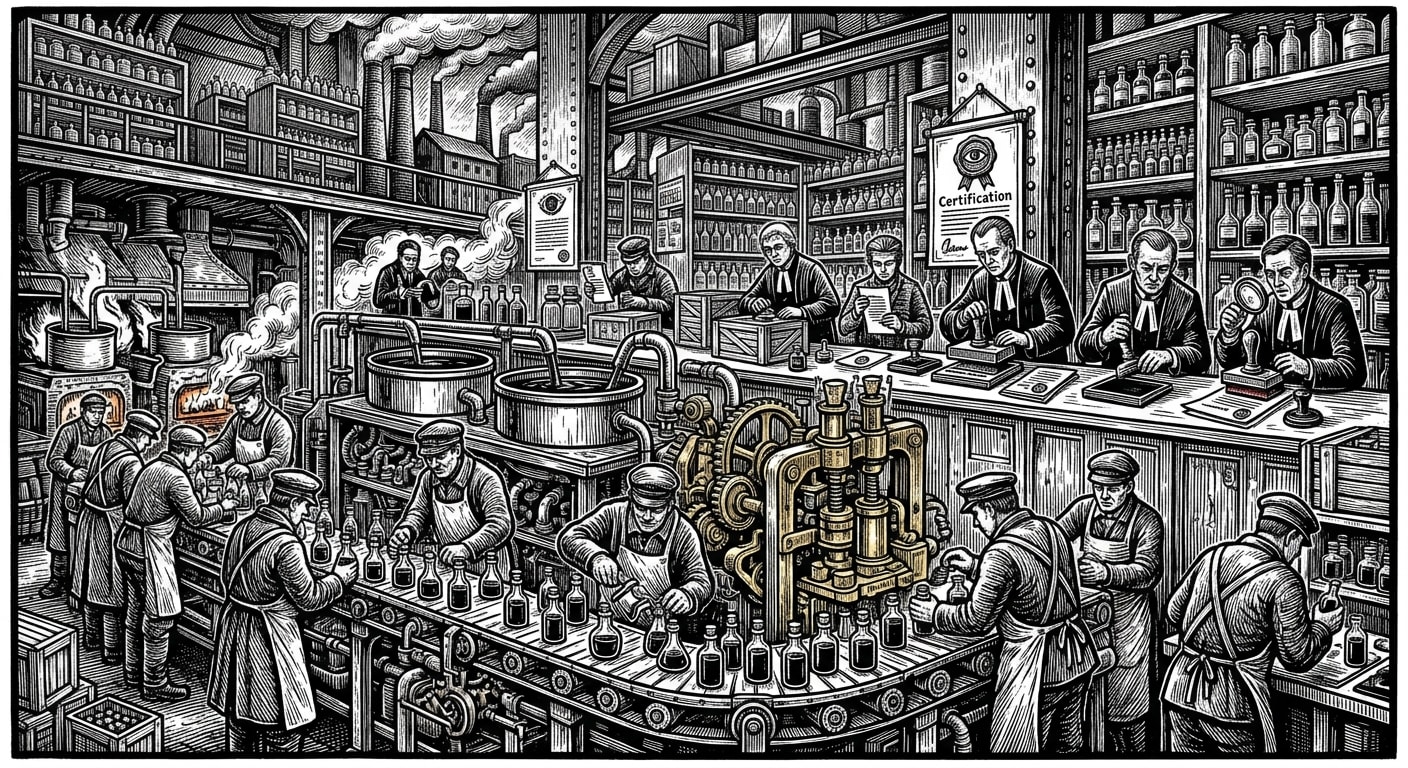
The filling benches are long, damp, and sacred in the shabby way of places where error becomes law. Each bottle receives a measured draw. Each draw is held against lamp-glass. Each filled phial is stoppered with treated cork, dipped in wax, stamped with a small seal indicating batch, yard, shade, date, and responsible hand. Responsible hand is an elegant phrase. It means the worker whose wages can be seized when the ink misbehaves somewhere wealthier.
Bottle Quay's genius lies in the fact that it makes mass authority portable. A seal die can remain in Strasbourg. A judge can sit in Cologne. A captain can command from mud outside Bastion-Przemyśl. Give each of them a bottle of correct ink and the Synod extends its finger into the room. The bottle is small. The consequence is continental.
Every crate leaves with a manifest, three tally slips, two shade swatches, a wax lock, and a canal tag. The Black Canal can counterfeit four of these. The Registry can detect two of the four when sober. The remaining two sustain Candlewick's private economy and my professional amusement.
#On Micro-Vials and the Black Trade
The official Bottle Quay produces bottles by the crate. The true Bottle Quay produces micro-vials.
A micro-vial (Unregistered) is a narrow glass tear, finger-length or smaller, carrying enough bureau-grade ink to alter a pass, sign a debt reversal, complete a false marriage clause, amend a quarantine boundary, or give a person a new colour in the eyes of the state. Some are stolen before certification. Some are siphoned from legitimate fills in quantities too small for the batch tally to notice until the clerk charged with noticing has been paid not to grieve. Some are made in night furnaces under tarps, using stolen sand and broken saints' lamps, which is either sacrilege or recycling depending on the buyer.
The Black Canal Syndicate moves them through wick crates, eel baskets, mask filters, corpse candles, and the hollow handles of shade knives. Children carry the smallest under their tongues. Lovers pass them as mourning beads. Seal Provosts (Unregistered) seize enough to justify their boots and miss enough to justify their houses.
Micro-vials feed the Palatinate's ugliest charities. A mother buys a dot of registered black to repair a son's apprenticeship paper. A debtor buys red to move a death date by one day and seize an inheritance before a cousin wakes. A fugitive buys grey correction ink to soften an old conviction. A clerk buys forbidden blue-green because desire, like water, finds the crack in law and widens it with its thumb.
The punished are usually poor. The customers are rarely so. Seal Provosts understand this with admirable discretion and terrible arithmetic.
Seal Provost reports routinely describe micro-vial traffic as “low-level counterfeit leakage.”
Corrected by Records Annex seizure tables after A.S. 198, when one month of recovered vials contained enough active shade to amend nine hundred transit passes, two hundred ration books, and at least one House marriage register. Leakage does not arrive in sorted denominations.
#On Hungry Batches
Bottle Quay's name became an accusation after the first public Hungry Ink correlations. The common facts are rude, which is why officials prefer uncommon theories. Hungry Ink blooms in Candlewick batches prepared from Vatmarsh salts, bottled at Bottle Quay, certified by the Chromatic Registry, and sealed for export under Records Annex supervision. No office in that chain wishes to own the appetite. Each offers the next office as sacrifice.
The Glassyards insist glass cannot teach ink hunger. House Vatmarsh insists mordant salts were pure when shipped. Registry clerks insist certification records are valid unless proven invalid by certified records. The Seal Locks insist export manifests were clean. The Black Canal insists nothing, which is the privilege of criminals who have not mistaken denial for defence.
The A.S. 143 ash correlation marked the district permanently. After Maldrake burned the Thracian forests and ash travelled west into vats and lungs, certain ink batches began returning altered. Bottle Quay workers noticed before their masters did. They called such bottles sleepers: ink that looked lawful, weighed lawful, sealed lawful, and then woke elsewhere. A sleeper bottle could sit in a Records depot for months before a conscription order learned to redirect itself or a debt writ developed opinions about its creditor.
During the Fading Winter of A.S. 199, the accusation sharpened into raid-work. Bottle Quay lost six ink-bottling rooms in the first month of chromatic reconciliation. Benches were sealed, workers held, furnace books seized, cooling chapels scrubbed with salt and vinegar until the walls sweated old colour. Forty-seven Palatinate workers were reclassified as unlicensed across the wider purge; Bottle Quay supplied enough of them to make every bottle-blower count his fingers after inspection.
Registry quarantine room BQ-6, A.S. 199: twelve bottles from Batch 199-FW/Amber were placed under bell-glass. At third watch, all twelve seals remained intact. Eleven labels blanked. The twelfth label acquired the words “OPEN ME WHERE THE WIDOW SIGNS.” Clerk Jorren Pell opened it under protest. The ink inside had dried into a black tooth. Pell's signature now appears on three death certificates issued before his birth.
#On the People Who Breathe the Quay
Bottle Quay's population belongs to the glass, the ink, the crate, and the cough. Master blowers hold protected status if their lip measurements pass annual audit. Batch clerks rank higher than furnace men because the Bureau mistakes writing for responsibility. Cork girls trim stoppers by the thousand and lose the pads of their thumbs before they lose their childhood. Canal loaders carry crates whose value exceeds their lifetime wages and are searched so intimately at shift-end that modesty has become a class privilege.
The district's poor live in upper rooms above solvent stores, because fire climbs and rent descends. Windows are kept cracked despite winter fog to bleed the spirits out. Masks hang beside icons. Children learn not to lick colour from their hands, not to stand beneath cooling racks, not to pocket glittering shards, not to answer when a bottle sings in the waste heap.
Lungward sisters make weekly rounds with camphor cloth and boiled masks. They record exposure by shade. Blue cough. Black rash. Red tremor. Grey silence. These categories have no official medical standing and every practical value. A worker with red tremor may still work the loading line. A worker with grey silence is moved away from open bottles because he stops speaking before he stops following written instructions, and Bottle Quay has learned to distrust obedience without complaint.
There are saints here, though none approved loudly. Saint Glassa of the Cut Palm (Unregistered), patron of workers who bleed into molten gather. Saint Oren of the Closed Throat (Unregistered), invoked by cork girls when spirit fumes bite. The Dye-Vat Drowned (Unregistered), not a saint at all, whose stained hands are said to rise from canal wash on fog nights and pull liars under by their sleeves. I do not endorse the tale. I also do not walk Bottle Quay alone in fog, because theological confidence need not become pedestrian stupidity.
#On Raids, Fires, and Present Utility
Bottle Quay has burned often enough that its fire brigades have better maps than its priests. The Great Fire of A.S. 98 (Unregistered) spared the main glass rows only because the canal wind turned, an event House Wickwarden promptly interpreted as candle merit and Vatmarsh interpreted as chemical luck. By A.S. 112, after the Ledger Laws spread measured mercy into every accountable hand, Bottle Quay was producing certified death-register ink in volumes that made its fire risk a national security concern. The district remained flammable. The category changed.
Seal Provost action in A.S. 200 fixed the district in the public eye: seizure notices nailed to an inkworks door, overturned vats, detained workers, a woodcut circulated by Records as proof of enforcement and by the underworld as proof that enforcement can be made photogenic. The raided shop was accused of anti-forgery violation, shade diversion, and political contamination. It was guilty of at least one. The other two were useful.
As of A.S. 201, Bottle Quay operates under Amber discipline. Pre-199 batch ledgers are preserved in oilcloth. Every consignment receives oral tally before sealing. Furnace ash is sampled. Spirit stores are counted twice. Micro-vial searches have increased, which means micro-vial prices have improved. The Registry plans a single-source bottling recipe. The Houses plan compliance in public and sabotage in private. The Black Canal plans, as ever, to sell both sides the means of proving the other impure.
The Quay remains indispensable. This is the whole joke, and like most durable jokes it has killed people. Close Bottle Quay and the Synod's paperwork starves within a month. Trust Bottle Quay and the Synod feeds itself ink whose appetite remains pending classification. The choice is between hunger now and hunger bottled.
At dusk, the furnace mouths glow behind rain-streaked glass. Canal loaders move crates toward the Seal Locks. A cork girl holds a vial up to the lamp and watches black ink climb the inner wall against gravity, polite as a clerk entering a room where no one has yet understood he owns the file.