
#On the Nature of Authority in Wax
"THE SEAL IS THE SOUL." — Inscribed above the Mordant Gates in letters of lacquered tin, renewed each equinox by a clerk who has never been observed arriving or departing.
I have been to the Candlewick Palatinate four times in my capacity as Warden of the Sacred Ledger, and on each occasion I have left with a headache, stained fingers, and the conviction that the place is both indispensable and insufferable — qualities which, in the Synod's administrative taxonomy, are classified as identical.
The Palatinate is a canal city threaded through marshland near the old Flemish lowlands — a place where the air smells of warm tallow, vinegar mordant, and the particular brand of desperation that attaches itself to men whose livelihoods depend on the precise hue of a wax droplet. It supplies the Synod with its seals, its sanctioned inks, its watermarked papers, and its color-codes — which is to say, it supplies the material substance of reality itself, since in the Theocracy a document without the correct shade is a document that does not exist, and a person without a document is a person who shares that condition.
One hundred and ninety thousand souls, give or take the flux of apprentice floods, clerk refugees, and war-contract surges. The Bureau of Records maintains an annex here. The Seven Palatine Houses (Unregistered) maintain their guild palaces on the Heights. The Black Canal maintains a thriving economy in counterfeit seals, outlaw pigments, and the sale of identities to those whose originals have been — the term is exquisite — chromatically reconciled.
#On the Founding
The Palatinate did not begin as a theocratic instrument. It began as a canal town of chandlers and dyers who had the misfortune of being competent and the further misfortune of being noticed.
Before the Concordat, the settlement at the canal junction was a free market of printers, dyers, and wax-merchants — artisans who answered to guild custom and river tolls rather than to any Bureau. The Sundering changed the arithmetic. When the Sagittal Line solidified in A.S. 65 and the Synod's administrative machinery began its long, patient metastasis across the continent, the demand for standardized seals, inks, and official papers exceeded what any ad hoc market could supply. A decree required a seal. A seal required wax. Wax required a shade. A shade required a registry. And a registry required — as all registries eventually require — armed men to enforce its definitions.
The Bureau of Records installed its annex in A.S. 92, the same year the first Bureaus were formally constituted under the Concordat's administrative expansion. Within a decade, the Chromatic Registry had been established, color-law codified, and the old artisan neighborhoods absorbed into the Seven House Compact — a structure that preserved guild names while hollowing out guild independence with the efficiency of a weevil in a ship's biscuit.
The Great Fire — the Palatinate's first catastrophe, circa A.S. 98 — taught the city two lessons. The first was architectural: build in dikes and firebreaks, ring the districts with canal cordons, and accept that a city made of wax and tallow will burn periodically and that the survivors will be those who planned for it. The second was political: the fire destroyed enough stock to create the first strict wax quotas, and quotas, once established, are levers, and levers, once held, are never released. House Wickwarden seized control of candle distribution that winter. They have not relinquished it since.
By the time of the First Continental Levy in A.S. 110, the Palatinate had become indispensable. Mass mobilization required standard seals on every conscription order, every transit pass, every ration permit, every death certificate. Candlewick supplied them all. The Bureau of War, which had hitherto regarded the Palatinate as a supply depot, reclassified it as a strategic asset — which meant, in practice, that it could no longer be taxed to destruction and would instead be taxed to a level just below that threshold, a distinction the Palatinate's population has learned to appreciate with the quiet gratitude of a man informed that his sentence has been commuted from hanging to life imprisonment.
Prior editions of this entry attributed the Palatinate's charter to A.S. 78, under an early Bureau of Records survey. This is incorrect. The charter was ratified A.S. 92 under the Concordat-era standardisation programme.
The error originated in a filing clerk's misreading of a wax seal — an irony the Bureau finds instructive rather than embarrassing.
#On the Fortifications and Geography
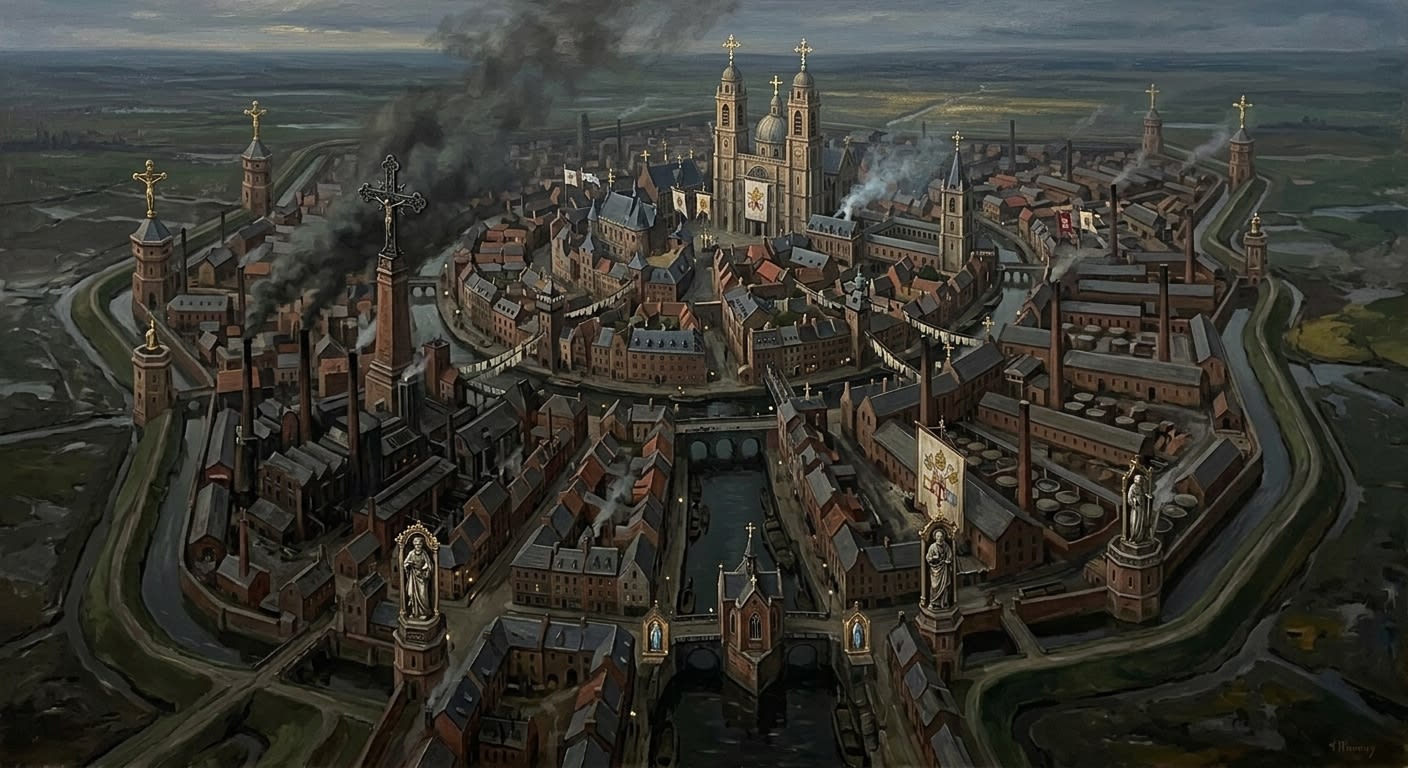
The Palatinate is built on a canal lattice cut through marshland, its shape — viewed from above, should one be fortunate or unfortunate enough to command such a vantage — resembling the imprint of a great seal pressed into mud. Dike-walls ring the outer districts. Chain towers guard the canal approaches. The Mordant Gates control upstream traffic; the Seal Locks control the downstream. Between them, eight districts arrange themselves in concentric rings of diminishing respectability and increasing utility.
Wickcourt Heights (Unregistered) crowns the centre: guild palaces of lacquered wood and salvaged glass, where the Palatine Houses conduct their business in rooms that smell of incense and hot wax polish and the particular fragrance of money being laundered through devotional expenditure. Lady Maris Wick, current head of House Wickwarden, keeps her hands perpetually warm — a quirk her associates attribute to piety and her competitors attribute to the candle-wax she melts between her fingers while calculating their ruin.
Below the Heights, Vatmarsh Row stretches along the eastern canals — the dye-halls and mordant vats where the Palatinate's chemical aristocracy, House Vatmarsh, maintains its monopoly on the fixing agents that make ink permanent. The smell is vinegar and metal salts and wet wool, and the workers wear masks that they replace weekly and lungs that they replace never. The Matriarch of House Vatmarsh controls the chemistry of permanence. She also, by implication, controls the chemistry of decay — a capability she has never publicly demonstrated and never needed to, because the implication is sufficient.
The Sealworks (Unregistered) occupy the western quarter: stamp foundries and wax presses where the mechanical act of legitimacy is performed — seal dies cut, wax heated, impressions struck. The hammering of the presses is treated as liturgy; it schedules daily life the way a bell-tower schedules prayer in a bastion. When the presses fall silent, the city holds its breath. When they resume, the city resumes. The relationship between sound and obedience here is not metaphorical.
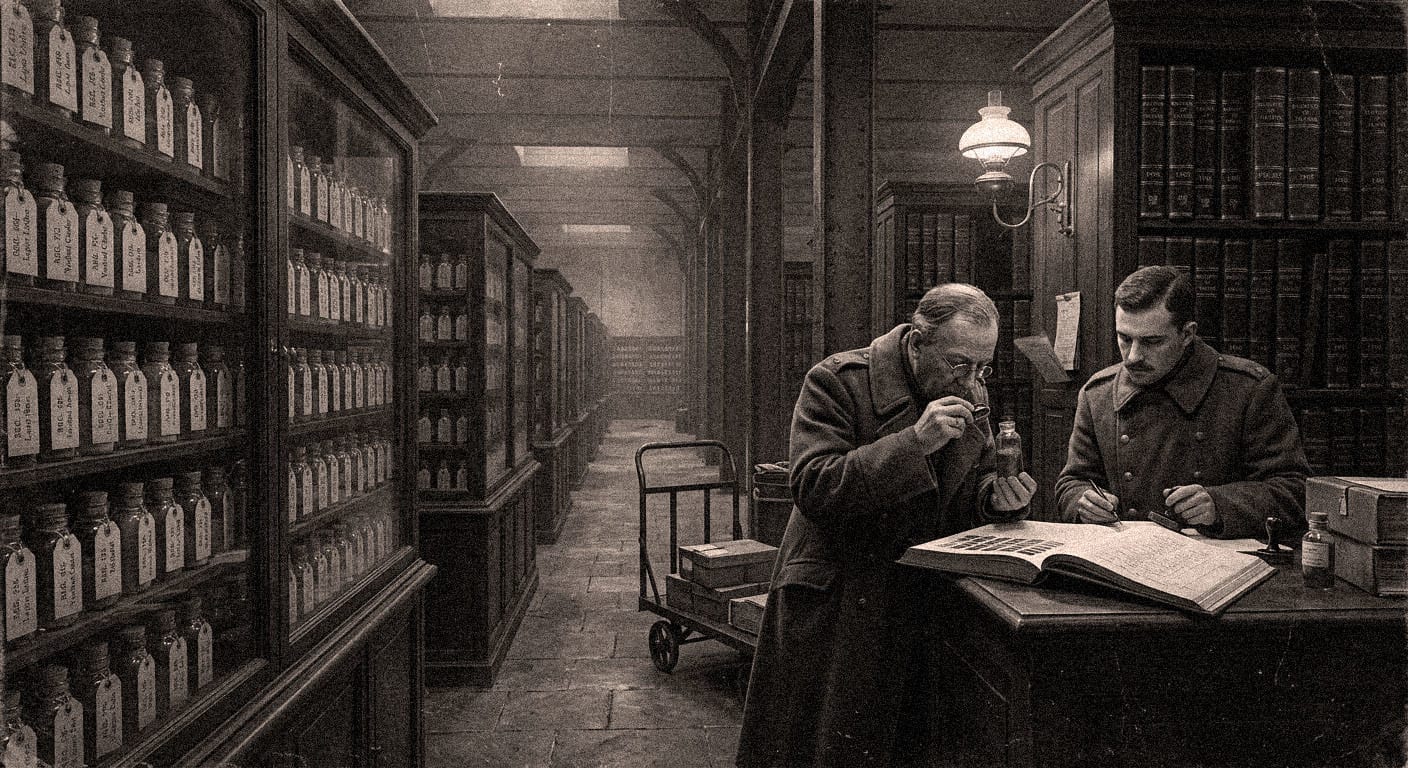
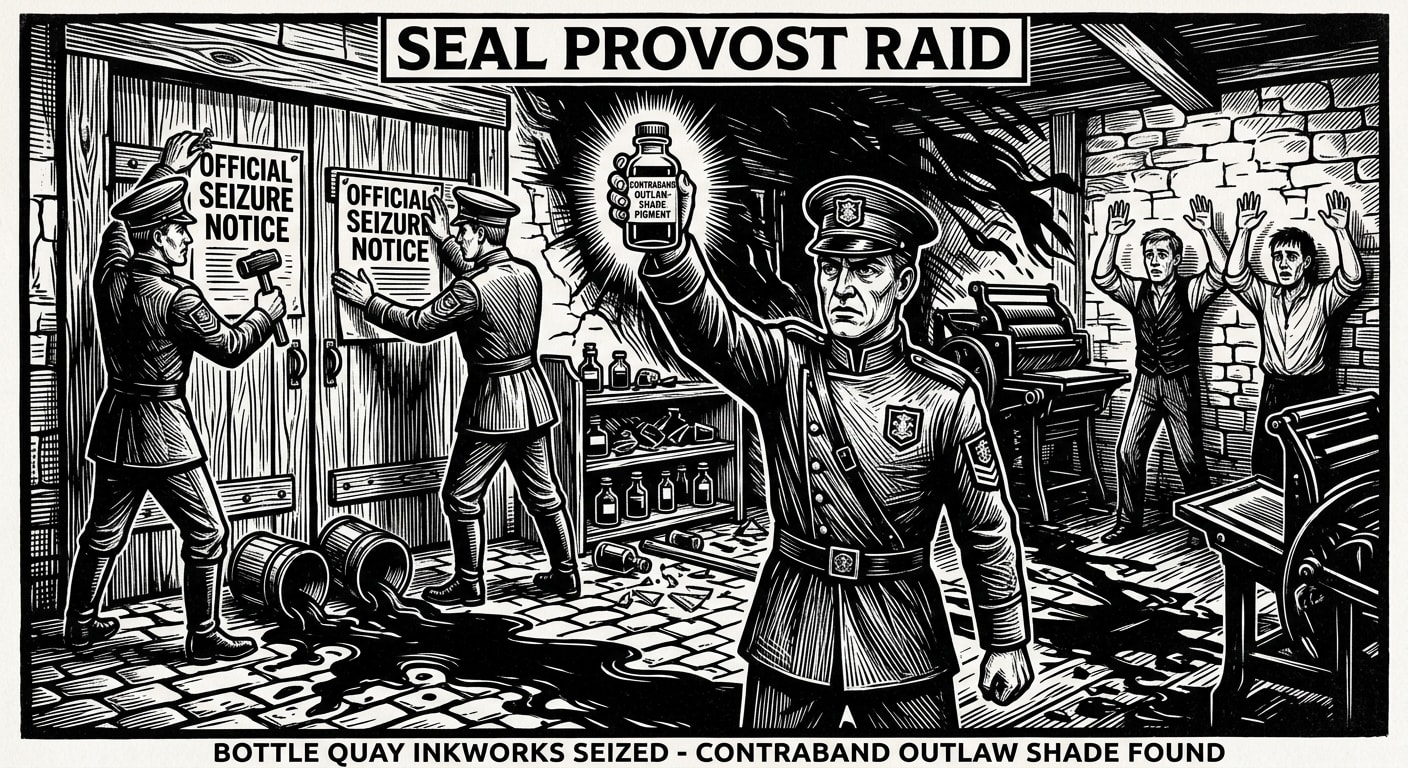
Bottle Quay handles the glassworks and ink bottling — soot and sharp spirits, explosions when the furnaces run hot, and a black market in micro-vials of bureau-grade ink that operates with the openness of a fish stall and the lethality of an arms dealer. The Chromatic Registry houses the shade vaults and color-law clerks in halls that smell of paper dust and lacquer, where the legal definition of every sanctioned hue is stored in sealed phials and defended with the ferocity other cities reserve for their reliquaries. Lungward is the infirmary district — mask markets, "clean air" chapels, and the Lungward Sisters who dispense camphor and boiled cloth and medical gatekeeping with equal measure.
The Lantern Mile rises above the canal rooftops: chandlery towers and wick-spinning halls connected by roof-walks strung with drying cloth, where the city's candle supply is manufactured and from which, on clear nights, the window-light signals of the canal smugglers can be read by anyone who knows the code — which is everyone, including the Seal Provosts (Unregistered), who pretend otherwise for reasons of profitable ignorance.
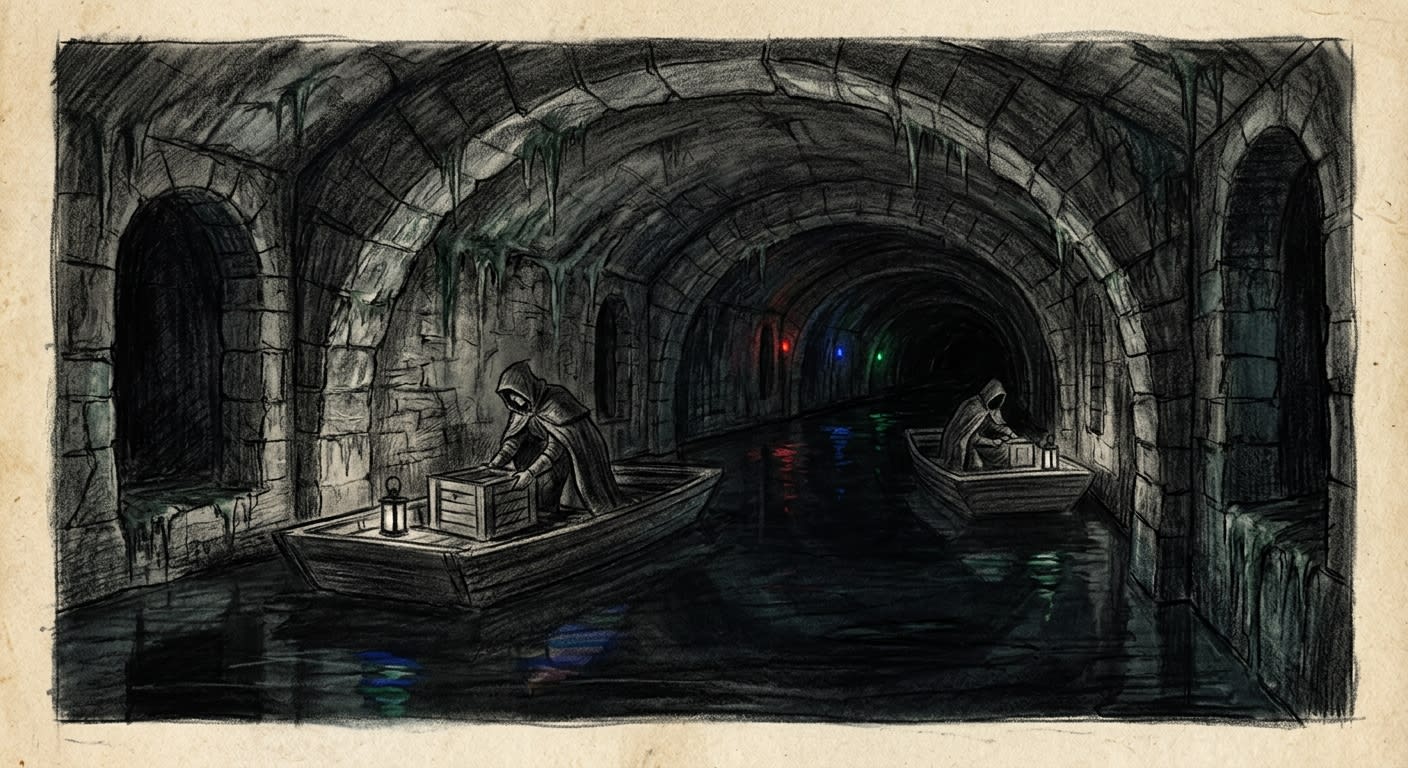
And below all of it, beneath the waterline, runs the Black Canal — the underworld wharfs where algae, tar, and sweet rot perfume the air, where bribe boats drift without oars, and where the Black Canal Syndicate sells outlaw shades and rewritten identities to those who can pay and arranges the quiet disappearance of those who cannot.
#On the Governance and Its Instruments
The Palatinate is governed — if that verb can bear the weight placed upon it — by a Palatine Guild Compact of Seven Houses, a Synod Charter Court, and the Bureau of Records Annex. In theory, the Houses vote by quota weight, the Charter Court adjudicates disputes, and the Records Annex audits compliance. In practice, three powers hold the city by the throat.
The first is the High Registrar of Chromas, the Bureau of Records' chief officer in the Palatinate, who controls the legal color-codes. Every document in half the Heartlands is "true" only if it bears a shade registered in the Chromatic Vault. The Registrar can invalidate a life with a single reclassification. The current Registrar, Sable Vorn (Unregistered), has never been observed to smile. Her subordinate, Shade Auditor Pell (Unregistered), sniffs ink the way a sommelier sniffs wine, and his verdicts carry identical consequences — though in the Palatinate, a corked bottle merely disappoints, while a deviant shade destroys.
The second is House Wickwarden, which controls the wax supply and therefore controls light itself. In a city where curfew is enforced by lantern-color and where darkness means the cessation of all legal activity, the chandlers hold a lever that the Bureau tolerates because the alternative — nationalizing candle production — would require the Bureau to understand candle production, and the Bureau has wisely concluded that some monopolies are cheaper to rent than to own.
The third is the Vatmarsh Matriarch, whose control of mordant salts and fixing agents gives her dominion over whether documents endure or fade. "Fading" — the slow dissolution of ink from paper — is the Palatinate's native terror, worse than fire because fire is dramatic and fading is quiet, and quiet ruin is the kind the Bureau fears most because it cannot be stamped with a date and filed.
The Seal Provosts enforce color-law with raids, seizures, informants, and the occasional planted sample. They are, officially, anti-forgery guardians. They are, actually, a profitable shakedown operation that doubles as political police. The distinction between anti-forgery enforcement and political policing is, in the Palatinate, a shade variance too fine for even the Registry to measure.
The courts dispense justice through the Charter Court of Impressions, where shade-treason cases are tried by judges who keep seal rubbings of the dead — a practice the Bureau classifies as "archival" and everyone else classifies as "disturbing." Conviction rates hover at ninety-three percent. The remaining seven percent are acquittals purchased at a cost that the acquitted prefer not to discuss and the courts prefer not to audit.
#On the Economy of Legitimacy
The Palatinate's economy is, at its root, the monetization of permission. It manufactures the physical materials — wax, ink, paper, seals — without which no decree is valid, no ration is distributed, no identity is recognized, and no person exists in the eyes of the Synod. This is monopoly in its purest theological form: the control of substance, sanctified by doctrine, enforced by quota.
Exports flow outward along the canal network and the rare rail spur: registered wax in sealed barrels, bureau inks in stamped crates, seal kits for every bastion and bureau-house between the Baltic and the Tagus, watermark paper bundles that stabilize identity across the Heartlands. Imports flow in: tallow, beeswax combs, mordant salts, clean water, rags and linen, metals for dies, coal. The bottleneck is double: nothing leaves without the Chromatic Registry's approval, and nothing enters without passing the Seal Locks — a physical chokepoint that functions as an economic valve the Houses manipulate with the deftness of an organist working the stops.
Currency circulates in several forms: coin, ration chits, stamped paper notes, and shade tokens — color-coded scrip that serves as both currency and movement license, each token keyed to a specific district and time-window. To hold the wrong shade token in the wrong district at the wrong hour is a misdemeanour. To hold no shade token at all is a condition the Provosts classify as "vagrant," which is the Palatinate's word for a person whose erasure will generate no paperwork.
The black market thrives along the Black Canal, selling outlaw pigments, false lanterns, counterfeit seals, and "fade-proof" ink — a substance that, rather than preserving text, erases the text around it while leaving signatures intact. The syndicate's prize offering is the "new name package": a forged identity so complete that it rewrites the bearer's old name out of the Registry. The price is high. The consequence of discovery is higher. The demand is inexhaustible.
Debt in the Palatinate is enforced by House quotas. Default means losing guild protection and reclassification as "unlicensed labor" — a status that strips access to mask rations, shade tokens, and the infirmary. The Palatinate's euphemism for this is "soft severance." The result is indistinguishable from a death sentence, except that it takes longer and generates a file.
#On the Anomaly
Every settlement on the Synod's rolls harbours its local strangeness — the bell that tolls without a ringer, the trench where compasses spin, the wall that weeps in a voice. The Palatinate's contribution to the catalogue of the inexplicable is Hungry Ink.
The outbreaks are intermittent and, to date, unexplained. Certain batches of ink — produced in the Vatmarsh dye-halls from ostensibly standard mordant formulae — develop appetites. Documents sealed with affected ink bloom black halos at the margins. Words slough from the page like skin from a burn. The text rewrites itself while keeping the original seal and signature intact — which means that a decree condemning a man may, overnight, become a decree promoting him, or pardoning him, or erasing him from the Ledger entirely, and in each case the seal that authenticates the change is genuine because it was genuine when it was first applied.
Countermeasures are crude: salt-stopping, wax overcoats applied to vulnerable documents, and — in extremis — burning the affected page, which is often illegal if the page was a charter or a ratified decree, creating a situation in which the cure for a heretical document is itself a heresy. The Chromatic Registry has classified Hungry Ink as a "Category Two Localized Scribal Anomaly." The classification has been pending reclassification since A.S. 143, when the Bureau of Alchemical Standards first noted that the phenomenon appeared to correlate with periods of high atmospheric ash — a correlation the Bureau of Doctrine has instructed all parties to disregard, since acknowledging a relationship between ink and weather would imply that documents are subject to natural forces, and documents, per the Bureau, are subject to nothing but the Bureau.
The local superstition is older and simpler: "Never sign in fog — your name will drift."
#On the Present Condition
The Palatinate in A.S. 201 is a city clenched around a slow-burning crisis that the Bureau has classified as "manageable" and that everyone who lives here classifies as "the beginning of the end of something."
The Fading Winter of A.S. 199 was the precipitating event. Documents across the River-belt began losing text — inks dissolving from paper in a pattern that the Chromatic Registry declared a heresy outbreak and that the Vatmarsh chemists declared a mordant-salt supply failure and that the Black Canal Syndicate declared an opportunity. The Registry responded by tightening control: new purity standards that invalidated half the city's existing documents overnight, mandatory shade revalidation for every household, and a programme of "chromatic reconciliation" — purges, conducted under audit cover — that swept through Bottle Quay and the Lantern Mile and left eighteen workshops shuttered and forty-seven workers reclassified as unlicensed.
Earlier assessments described the Fading Winter as "a contained incident." This erratum supersedes that assessment.
The Fading Winter is ongoing. Documents continue to lose text at a rate the Registry declines to quantify. The mordant-salt supply remains compromised. The Registry's response has stabilized the symptoms by expanding its authority, which is the bureaucratic equivalent of treating a fever by promoting the physician to judge.
The Houses push back in the only language the Compact recognizes: money and obstruction. House Wickwarden has arranged three "accidental shortages" of candle wax in the past eighteen months, each timed to coincide with a Records audit, each resolved by concessions that the Records Annex denies having made and the Houses deny having demanded. House Vatmarsh has begun hoarding mordant salts — a practice that accelerates the very fading it claims to prevent, which is either incompetence or strategy and in the Palatinate the distinction is academic.
The Black Canal Syndicate, meanwhile, has been flooding the lower districts with a new product: a counterfeit bureau shade so precise that three separate auditors have certified it as genuine before being informed of its origin. If that shade enters general circulation — if the Heartlands' transit passes and ration permits begin bearing forged ink that the Registry's own instruments cannot distinguish from the sanctioned article — the entire apparatus of paper legitimacy that the Palatinate exists to maintain will crack along a fault line that was always there but that no one, until now, had the tools to exploit.
The Registry knows this. The Houses know this. The Black Canal knows this. The Bureau of Records knows this. And all four parties are maneuvering to ensure that when the apparatus cracks, it cracks in a direction that benefits them, which is to say that the Palatinate's political class is engaged in the collective enterprise of steering a catastrophe rather than preventing one — a tradition as old as the Synod itself and rather older than the Palatinate.
The seal presses hammer. The canal chains rattle in their housings. The masked crowds shuffle through the Registry queues, clutching their shade tokens, breathing through filters they cannot afford to replace, signing documents in inks they pray will hold. The Fading Winter has not ended. The Hungry Ink has not been explained. The Black Canal has not been purified. And the Palatinate endures, because the alternative to enduring is to admit that the seals are fallible, and fallible seals are seals that do not seal, and an unsealed world is a world the Bureau cannot administer, and a world the Bureau cannot administer is — per the Bureau — a world that does not exist.
The candles burn. The ink holds. For now.
Nihil obstat.