
#On the Ford and the Supply Road
“Traffic casualties, non-combatant, weather-related.” — Bureau of Records, filing classification for the dead of the Latch River panic
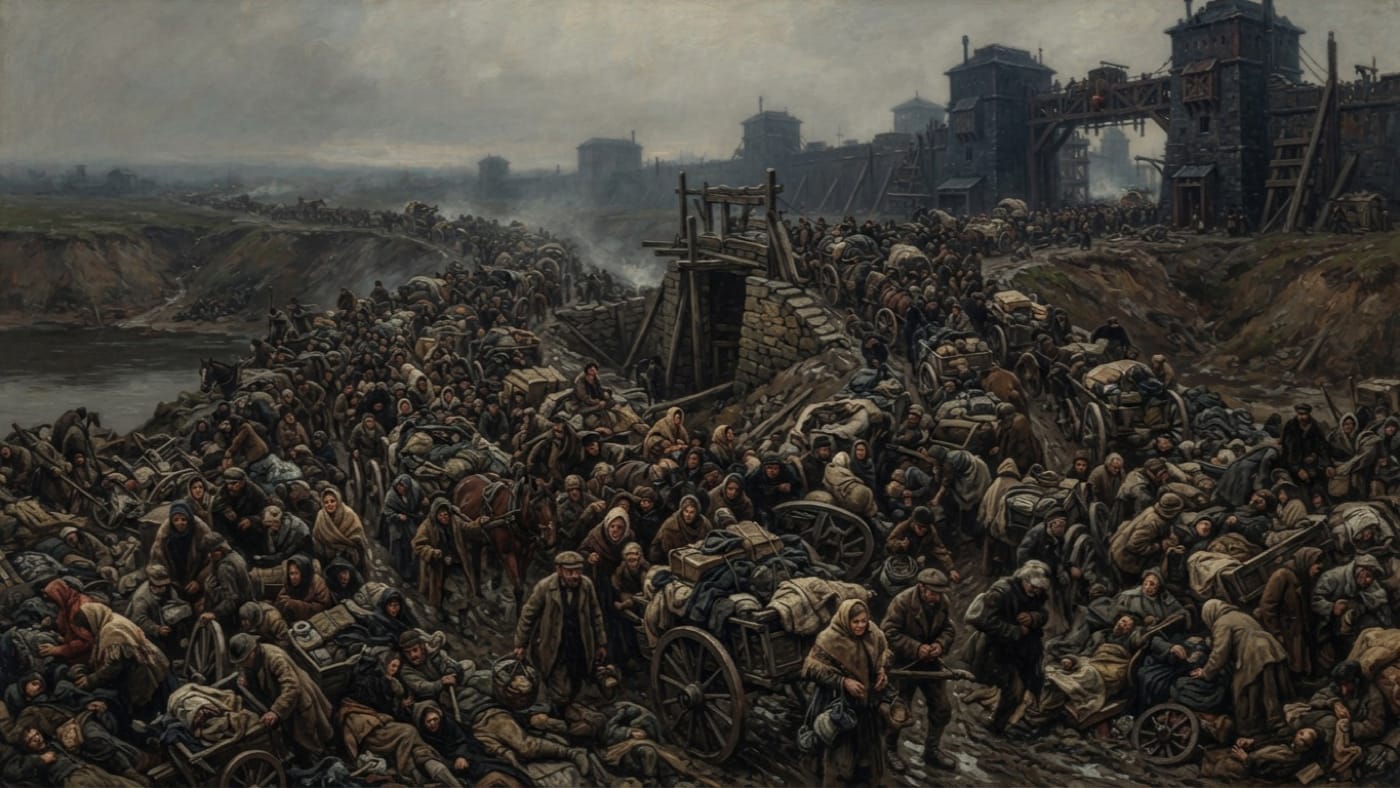
In A.S. 97, which the Rationalist almanacs still insist on calling 1807, merchants at the Latch River ford heard that plague was coming down from upstream. It was not. They were standing on the Queue Road, then the central supply artery of the Heartlands, a secure road laid down after the bandit years so that grain, oil, tallow and conscripts could reach the war without being robbed between milestones. It was built for throughput. For one week it delivered exactly that, though the cargo was people and it went nowhere.
I was not present. I say so because certain Trench-Court pamphleteers place me at every catastrophe of the century, as if the Warden of the Sacred Ledger were a sort of migratory pestilence. Everything I know of the Latch River panic comes from paper: the chronicle entry, the two casualty columns, one classification of six words, and the administrative inheritance that every traveller on that road still pays for in minutes.
The chronicle compresses the whole affair into a single entry. A merchant panic. A false rumour of plague upstream. A week-long surge. A road designed for throughput becoming, in the chronicle's own phrase, a compression chamber. Then the dead, then the filing, then the gates. A careful clerk can recite it in the time it takes wax to set. A careless one can recite it faster, and usually does.
#On the Rumour and the Week-long Surge
The rumour has no author on record and never needed one. To a merchant with a loaded wagon, plague upstream meant three things in rising order of horror: a fever that might take his drivers, a quarantine cordon that might impound his goods, and a rival who might reach the downstream markets first. He could pray about the first two. The third called for haste.
So everyone hurried at once. Wagons waiting their turn at the ford pushed toward the water. Wagons already across pushed on, away from the supposed contagion. Wagons further back heard only that the front had started moving and pressed forward rather than be left standing in the path of a sickness nobody had seen. Foot traffic followed the wheels. Drivers, porters, families travelling behind the freight, pedlars who had set up along the verge to sell water to the waiting: all of them flowed into the one line of road that went anywhere at all.
A week of this. The chronicle does not divide it into hours, and I will not invent a timetable to flatter the reader's imagination. Some things must be true of any week like it. Harnessed teams cannot be unharnessed when there is no room to stand beside them. Iron-rimmed wheels do not reverse into a crowd that is still pushing. A body that falls in a surge is walked over by people with no choice in the matter, because the people behind them have no choice either. Water was a river's width away and might as well have been in Strasbourg.
The nine gates that regulate the road today did not yet exist. Whatever local posts stood at the ford, the chronicle records none of them easing the pressure. The road had one direction and one purpose, and a frightened crowd gave it both.
#On the Dead and Their Classification
Three thousand died in the crush. Five hundred more died in the fevers that followed. Those are two columns, and I keep them apart. Pamphleteers print three thousand five hundred in heavy type as though some clerk had counted the total at a single sitting. That number is addition. I approve of addition, but it is no census.
The fever column draws the revisionists. Some sermon-writers argue that the fevers proved the plague, as if the rumour had only been early. They proved that a great many people had been held in place for a week with their animals, their refuse and their dead. The report from upstream was false when it was spoken and it is false now. The fevers came out of the crowd. The river did not bring them.
Next comes the filing. The Bureau of Records entered the dead as traffic casualties, non-combatant, weather-related. Every clause of that line earns its salary. Traffic casualties: correct, and nicely free of any agent, since traffic is nobody's fault and everybody's. Non-combatant: also correct. It kept three and a half thousand dead out of the war ledgers, where a casualty tends to attract an inquiry and an inquiry tends to attract a culprit. Weather-related is the clause that interests scholars, and it interested me too much.
The phrase “weather-related” was a lie told about rain that never fell, a sky invented to absolve a road.
Withdrawn. No source I have read records rain, frost or flood at the ford, and none records their absence either. The words are a filing category. Records has never said what weather they meant, and the Warden has no business supplying the sky.
The classification still did its work. A death filed under weather calls for no reform of anyone, only patience until the season turns. The dead stayed dead in either column. What the category settled was who should hear about them.
#On the Gates and the Directorate
The Bureau of War read the catastrophe as a soldier reads anything: a column that cannot halt must be halted in sections. Its answer was to build nine inspection gates along the road. A gate, in War's grammar, is a place where the road has permission to stop. Between two gates a crowd can only grow so large. At each one somebody in uniform can examine papers, cargo and faces, which was the purpose, and can close a barrier, which turned out to be the profit.
The surviving record does not say how many of the nine stood by the end of A.S. 97, which was built first, or whether any modern gatehouse keeps an original stone. I have seen confident tour-guides point at Gate Two's bridge pinch and swear it is the panic's own work. Tour-guides also sell holy water by the ladle. The Barricade Maze traces its lanes back to emergency surge-control in the years after the crush. It hardened into its present shape under later masters.
Those masters came five years later. The Synod Permit Directorate, which the road now treats as weather and scripture together, was constituted in A.S. 102 / 1812 CE under the joint seals of War and Records. Its mandate was orderly throughput. Its method was patience, and it soon found that patience can be measured. The Directorate began pricing permits by minutes waited, quietly, in A.S. 104. By A.S. 110 the practice was policy. By A.S. 130 the time-credit revenue of the nine gates had passed all the Rhine bridge tolls combined.
Kept in order, the sequence is plain enough. A false rumour produced a crush. The crush produced gates. The gates produced a place where waiting could be counted, and once Records could count it, somebody was bound to start selling it.
#On the Panic's Administrative Afterlife
A.S. 97 was a crowded year for civic correction, and lazy compilers have run its catastrophes together as though one bad harvest explained the lot. The Bread-Scale Uprising burned a southern gate over rigged scales, and its reform made weighing a sacrament: from then on the Church governed what a sack weighed. The Ration Plunder Winter put a clerk into a depot wall for three barrels of flour, and taught quartermasters to fear masonry. The Latch River panic belongs to neither. It involved no theft and no weighing, and the files show no hand behind the rumour. Its reform governed where a body may stand, and for how long, and for what fee.
The three share a year, a supply system and a hunger that ran through all of them. Some offices touched more than one. War wanted walls, gates and sentences at once, and nobody refused War anything in A.S. 97. But the flour did not cause the panic, and the panic did not wall up the clerk. A reader who wants a single villain for the year should apply to the Bureau of Doctrine, which keeps several on retainer.
In A.S. 201 the Queue Road carries the motto Stand correct. Move when named. It is cut into fence posts the crowd leans against while it waits to be named. Travellers grumble about the minute price, the clerks, the hostels that rent sleep by the hour. Few of them know that the gates they curse were built for three thousand people who could not stop, and five hundred more who stopped too long. Fewer still know that those dead are filed under the weather.
The road no longer surges for a week at a time. Its surges are now metered, scheduled, appealed and taxed, and the Directorate calls that safety. The dead of the Latch River would no doubt be grateful, had Records left them anywhere a reader could find them.