
#On the Purpose of Stagnation
"Stand correct. Move when named." — Posted on every gate-timber from First Court to Ninth, in letters six inches tall, painted by men who have never stood in the line they administer.
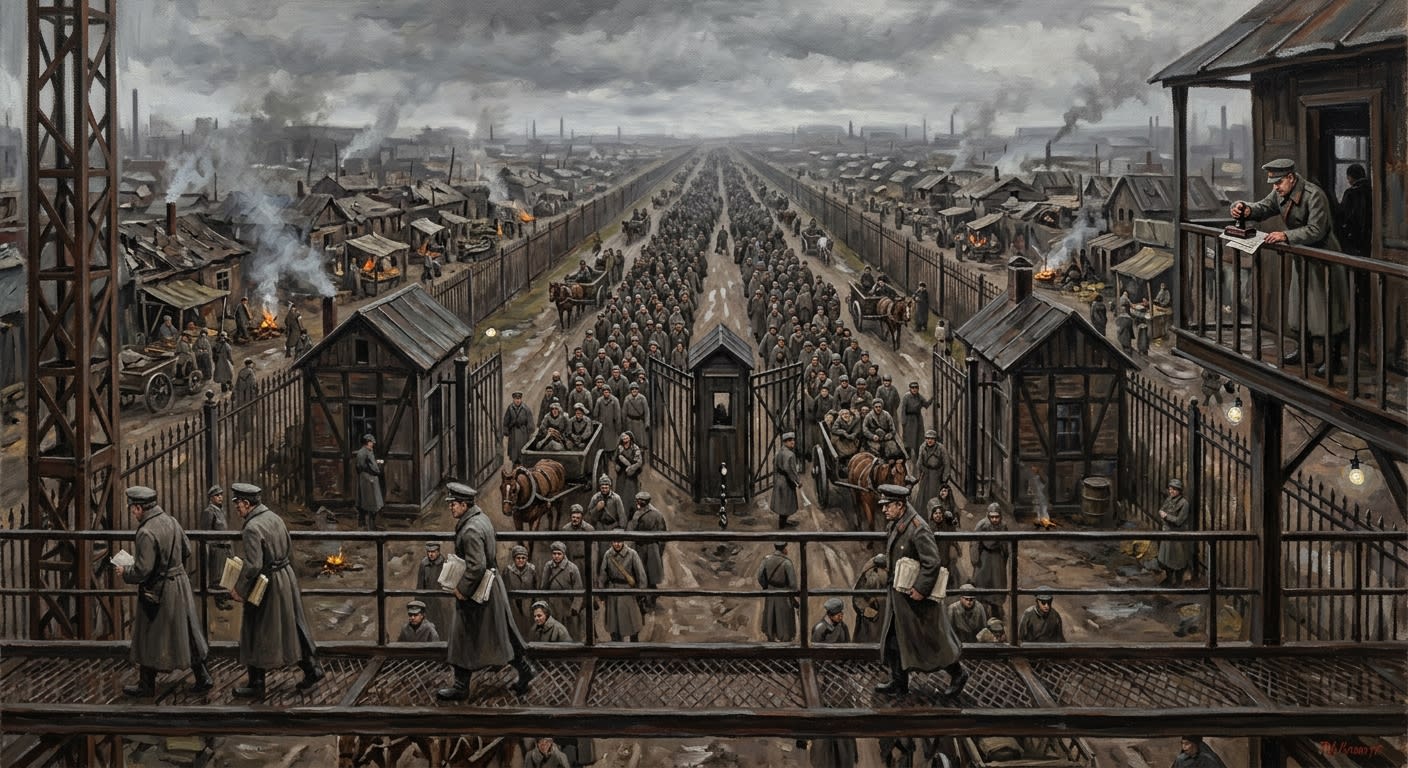
I have inspected the Queue Road four times. Each time I arrived by the Directorate's quiet gate — the one that bypasses the first seven courts — and each time I departed through the same aperture, having seen enough. The Queue Road is best understood from above, from the catwalk gantries where the Bureau of Records clerks tally heads and the Permit Wardens adjust their fence-lines with the delicate malice of a chess player repositioning pawns. From below, in the lanes themselves, understanding is impossible. From below there is only the queue.
The Queue Road runs one hundred and twelve miles through the forward heartlands of the Theocracy, connecting Rheinscarp and the Rhine corridor to the staging depots that feed the Sagittal Line. It was built wide enough for four wagons abreast. It was then fitted with nine gates, each gate a court, each court a chokepoint, each chokepoint a revenue instrument, until the widest road in the Heartlands became the slowest. The Bureau of War calls it a "secure artery." The Synod Permit Directorate calls it "a model of orderly throughput." The forty-eight thousand souls who live in the ribbon-settlements flanking its ditches call it the Long Wait, or the Throat of the Creator, depending on whether they are being polite.
It is, in the Bureau's precise usage, a road. In the Bureau's honest usage — which is to say, in no usage the Bureau would acknowledge — it is a machine for converting motion into revenue and compliance into a commodity that can be weighed, stamped, and sold.
#On the Founding of the Long Wait
The road predates the Permit Directorate. It predates the gates. In the decades after the Concordat of Strasbourg (A.S. 90), when the Bureau of War was consolidating its grip on the continental supply corridors, the central artery between the Rhineland and the forward staging zones was an open highway flanked by roadside farms, inns, and the kind of village markets that exist wherever soldiers march and need to buy boots. Convoys moved at the speed of their oxen. Bandits moved faster.
The first catastrophe arrived in A.S. 97, when a merchant panic at the Latch River ford — a false rumour of plague upstream — caused a week-long surge. The road, designed for throughput, became a compression chamber. Three thousand died in the crush; five hundred more in the fevers that followed. The Bureau of Records logged them as "traffic casualties, non-combatant, weather-related."
The Bureau of War's response was characteristic: it built gates. Nine of them, spaced at intervals calculated by an engineer whose name survives in the Directorate's founding ledger but whose descendants have had the good sense to change theirs. The gates were presented as "inspection courts for the prevention of disorder." Each court required papers. Papers required stamps. Stamps required waiting. Waiting, as the Bureau of Records had already discovered at the Latchford Permit-Yards, could be measured, recorded, and — with sufficient imagination — taxed.
The Synod Permit Directorate was formally constituted in A.S. 102, twelve years after the Concordat, three years before the Bureau of War received its Charter of Crimson Ink. Its founding writ bears both Bureau of Records and Bureau of War seals, a dual parentage that explains much about the Directorate's character: it has the War Bureau's appetite for control and the Records Bureau's genius for making control look like arithmetic.
Minute pricing began quietly in A.S. 104. By A.S. 110, when the First Continental Levy was declared, it was policy. By A.S. 130, the Queue Road's nine gates had generated more revenue in time-credits than the combined toll receipts of every bridge on the Rhine.
#On the Geography of Delay
The road runs roughly northeast from the Rhine corridor toward the forward staging zones, through low hills and cut embankments, past ditch grids and culvert systems, under the rusted skeletons of overpass ruins that predate the Synod's improvements. The terrain is unremarkable. The road made it remarkable by refusing to let anyone cross it at speed.
Nine gates divide the road into ten segments. Each gate is a micro-tribunal, a customs house, and a census instrument compressed into a timber-and-iron chokepoint. The gates are numbered but named by their residents: First Court (the "Grinder"), Gate Two Bridge Pinch (the "Drowning Step"), and so on up to Gate Nine Commons, the largest, the most feared, the one that controls reclassification, conscription, and the distribution of what the Directorate calls "throughput labour" and everyone else calls forced work.
Between the gates, the road sprouts settlements the way an untreated wound sprouts infection. The ribbon-towns cling to both flanks — Minute Market, Stamp Court Row, the Barricade Maze, Clerk's Mile, the Hostel Ribbons, the Salt and Grease Yards, the Shed Wards, Gate Nine Commons, and the Null Verge. Each district smells different. The Minute Market smells of thin broth and the particular animal patience of a crowd that has stood for days. Clerk's Mile smells of vinegar ink and ambition. The Null Verge smells of nothing, because no one in the Null Verge is permitted to cook, light a lantern, or officially exist.
The road's verticality is its secret architecture. Above the lanes, catwalk gantries carry clerks, officials, and runners between the gates at walking speed while the population below moves at something less. Watch towers punctuate the fence-lines. Stamp balconies overhang the courts. Below the road, a culvert system built for drainage has become a smuggler's highway, connecting the districts in ways the Directorate's maps do not record.
#On the Minute Economy
The Queue Road's genius — and I use the word as one uses "malignancy," with clinical respect — is its currency. Permits on the Queue Road are priced in minutes waited, recorded by bell-mark and ledger, and traded upward like grain futures.
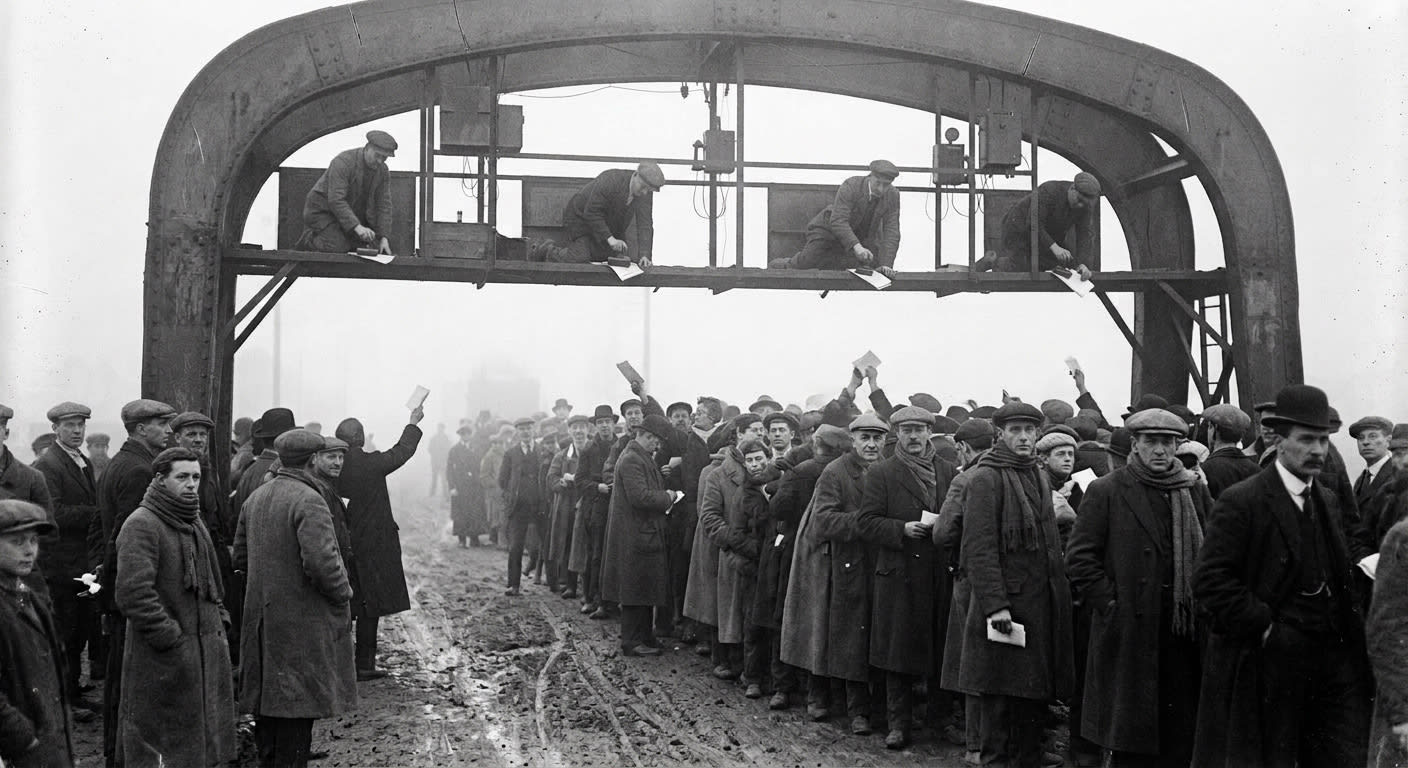
A bell-mark is a timestamp. At dawn, the Bell-Mark Gantry — an iron structure spanning the road at the Third Gate — stamps each traveller's paper with the hour. The ink dries. The clock starts. Every minute between your bell-mark and your clearance at the next gate accrues to the Directorate's ledger as revenue. You do not pay this minute-tax in coin; you pay it in time already spent, which the Directorate then sells to those who wish to spend less. A minute credit, freshly earned by a man who has stood in sleet for six hours, can be purchased by a merchant who would rather not. The merchant's passage accelerates. The standing man's waiting paid for someone else's speed.
The system breeds a secondary economy of extraordinary sophistication. Fresh minutes — newly stamped, unaudited — sell at premium. Stale minutes — flagged for audit or near expiry — trade at discount. Lane tokens grant access to faster segments. Ghost passes, forged with stolen Directorate seals, circulate through the culvert network at prices that would buy a commission in certain provincial garrisons. Witness certificates, rented from the perjury rings of Stamp Court Row, can extend a minute claim by attesting to hours the claimant did not stand. The Candlewick Palatinate supplies the wax for the stamps; the counterfeiting operations beneath Clerk's Mile have improved upon the Palatinate's product to the point where the Directorate itself occasionally accepts forgeries as genuine — whether through incompetence or complicity the Bureau of Shadows has not determined, and the Bureau of Shadows, in this instance, has not been asked.
Minute debt compounds. Miss a bell-mark, fail an audit, or simply stand too long in the wrong lane, and your minutes accrue as debt. Debt converts to labour conscription at Gate Nine — hauling barricades, cleaning latrines, copying ledgers until the fingers split — or to erasure. The Null Verge.
#On the Null Verge
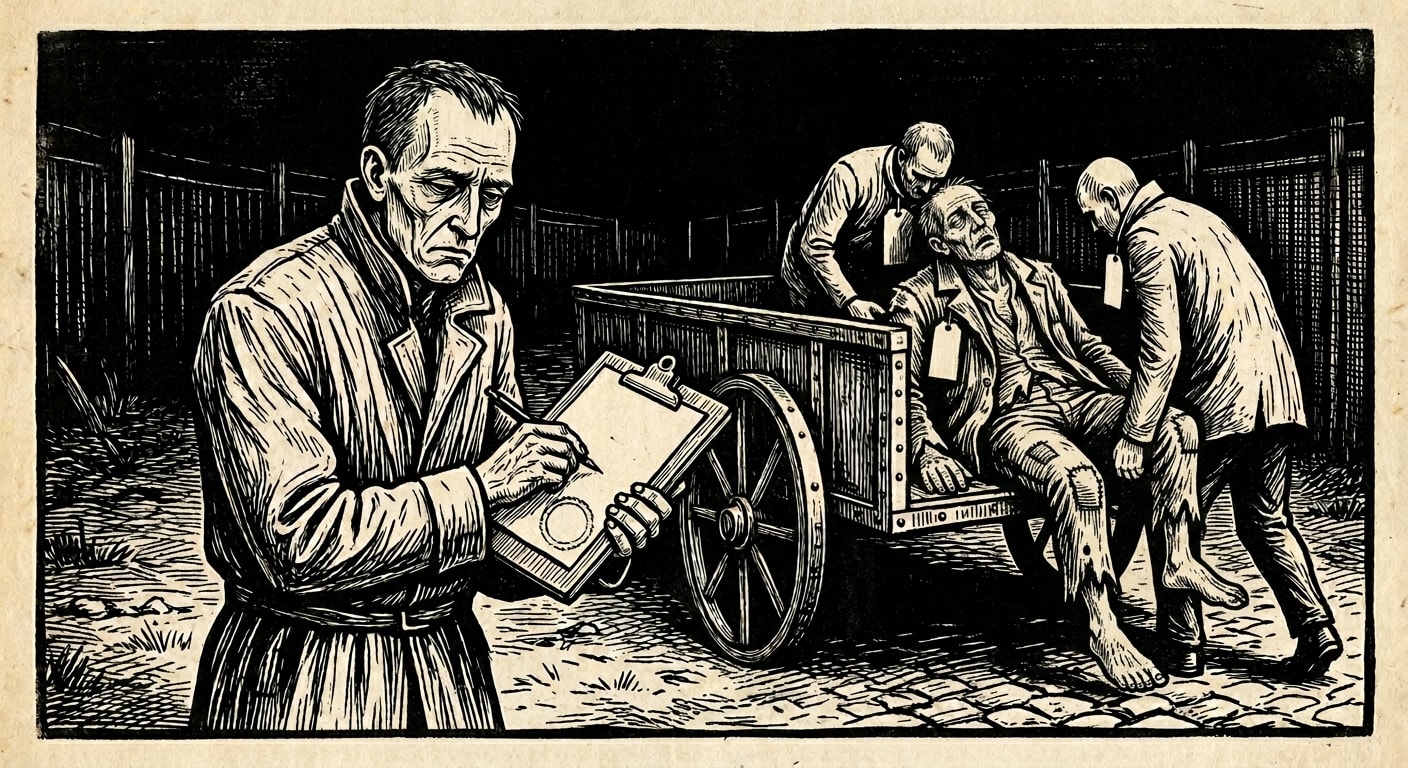
The Null Verge is the road's answer to the question of what happens to people the system cannot process. It is a neighbourhood at the road's southern margin, past the last fence-line, where the erased live. Erased — meaning struck from the Directorate's ledger, their bell-marks voided, their names converted to blank tags pinned to collars of undyed linen. They cook nothing. They light nothing. They are cleaned up by the Null Verge Custodians, whose carts collect the sick, the dead, and the inconvenient with equal efficiency.
The Directorate does not acknowledge the Null Verge. It appears on no official map. The forty-eight thousand figure cited in the Bureau of Records' census does not include it. The Null Verge Custodians — led by a man called Reeve, who has no other name the Bureau has recorded — operate under stamps that bear no issuing bureau, which is its own kind of authority.
Previous administrative assessments listed the Queue Road's resident population as 48,000.
The figure of 48,000 reflects registered inhabitants in the nine recognized districts. The Null Verge is not a district. Its occupants are not inhabitants. The Bureau of Records does not count what it does not name. The population figure is therefore correct.
The Null Verge exports labour. Quietly. Under official stamps from an issuing authority that does not exist. Erased persons are loaded onto carts at night and delivered to work details at quarry sites, road gangs, and — according to three separate reports the Bureau of Shadows has declined to confirm or deny — the labour camps behind Bastion-Brest. The erased cannot protest this arrangement, because the erased do not exist, and one cannot lodge a complaint on behalf of nothing.
#On the Factions of the Road
The Queue Road's governance is a study in layered parasitism.
The Synod Permit Directorate sets the rates, controls the gates, and maintains the fiction that the road serves its travellers. Director Othmar Vell runs it from the Directorate House — a clean stone building with cold incense and a hidden master ledger — with a soft voice and numbers harder than the iron in his gates. His Adjunct, Ilse Quill, has not blinked in living memory. Whether this is metaphor or medical fact is a question the Directorate has not submitted for review.
The Gate Nine Court handles appeals. Mistress-Court Sera Nox presides, perfumed and inflexible, dispensing mercy rulings that cost more than the original offence. Her bailiffs collar defaulters with the tenderness of men accessorizing the condemned. A Gate Nine hearing is a performance: coached witnesses, purchased testimony, confessions traded for lesser reclassifications. The Witness Rental Houses of Stamp Court Row supply the cast. Mother Venn and Garrik Two-Names run the largest ring — their witnesses remember what needs remembering, forget what needs forgetting, and invoice for both.
The Time Clerks' Collegium occupies Clerk's Mile with the territorial instinct of an occupying army. Clerk-Prime Yoren and his copyists control the ledgers, which means they control reality. A clerk's "error" can add a day to your transit. A clerk's favour can subtract one. The Collegium protects its immunity with the weapon all clerks wield best: a deliberate slowdown.
Below these powers, the Runner Union — called "the Lanes" — controls unofficial passage along the catwalk routes and culvert networks. Their boss, a man called "Hatch" Lyd, brokers lane access, black-market timestamps, and the kind of information that makes the difference between a three-day transit and a three-week one. His runners know three routes around every gate the Directorate calls impassable.
And below all of them, the Clock Heretics — the Unstruck — sabotage bell-mark schedules from tunnels beneath the Barricade Maze. Brother Senn leads them, if "leads" applies to a man whose followers communicate in forbidden songs and carry illegal clocks wrapped in oilcloth. The Unstruck hold that the minute economy is a sin against the order of time itself, and that the bell-marks are instruments of spiritual violence. The Bureau of Purity hunts them. The Bureau of Purity has not caught them. The Bureau of Purity, one suspects, has not tried very hard — the Unstruck's sabotage keeps the Directorate humble, and humility, in a Synod bureau, is a resource the other Bureaus find useful.
#On the Anomaly Beneath Gate Nine
The Minute Drift is the road's open secret.
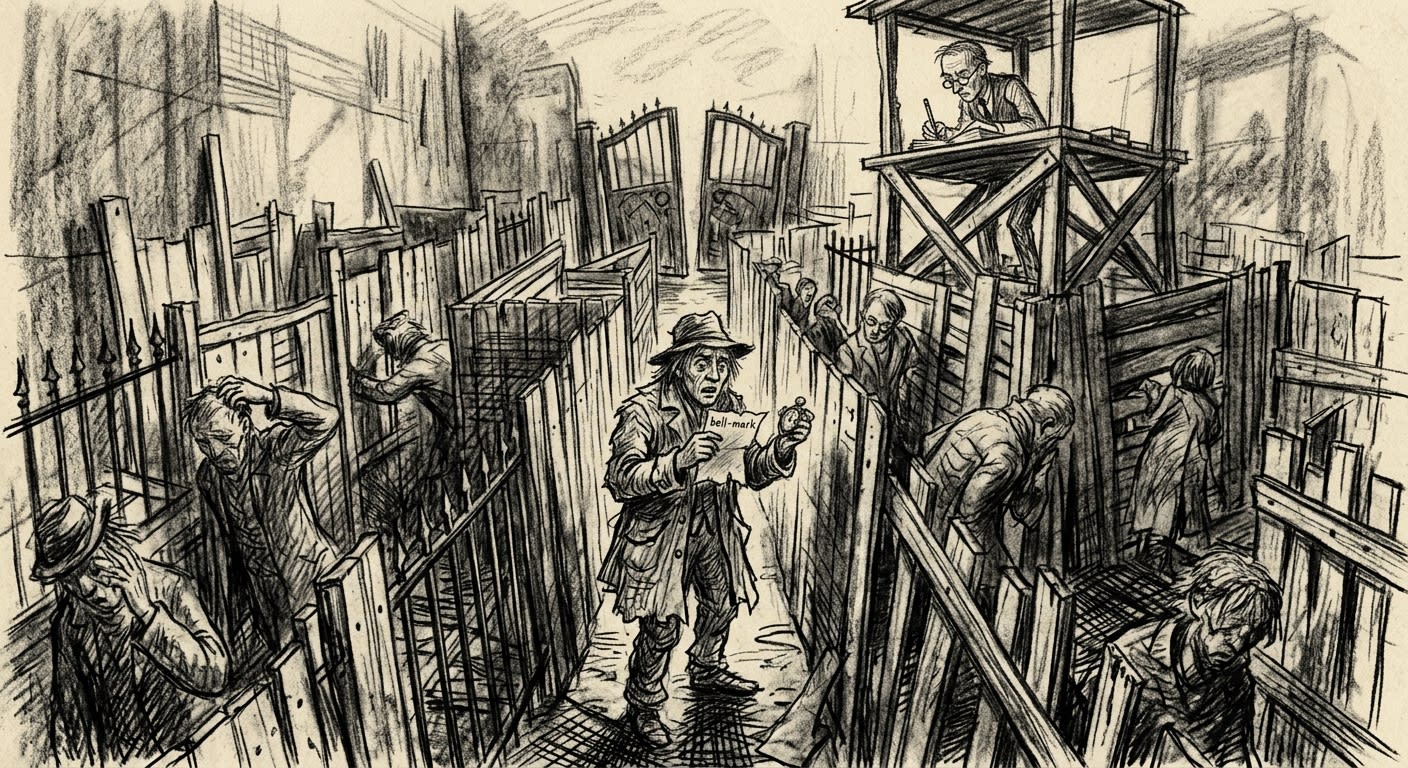
Inside the Barricade Maze — the controlled-lane labyrinth between Gates Three and Five — time stutters. Travellers swear they have stood a week while the sun says a day. Bells ring double. Ink dries on the stamp before the wax cools. Shadows fall at angles that do not correspond to the hour, and hunger arrives late or early or not at all. The Bureau of Rites classified the phenomenon as "Category Two Localized Temporal-Scribal Disturbance" in A.S. 194 and has not reclassified it since, which in Bureau parlance means the classification was wrong but admitting so would require paperwork no one wishes to file.
The street truth — circulated in whispers along Clerk's Mile and traded as gossip in the Minute Market — holds that the Directorate adjusts the lane geometry nightly to harvest more drift-affected minutes. The lanes shift; the fences bloom; and the hours inside the Maze stretch in ways that the bell-marks cannot record but the Directorate's revenue somehow reflects. Hostel owners profit from the extended stays. Clerks profit from the additional stamps. Everyone profits except the traveller, whose body knows what the clock denies.
The buried truth is worse.
I have read three sealed reports — obtained through channels the Bureau of Shadows would find instructive to investigate but will not, because the reports concern the Bureau of Shadows' own patron — and all three agree: the Minute Drift is not random. Beneath Gate Nine, in the bedrock under the Hearing Hall, something is running. An apparatus. A mechanism of uncertain manufacture, older than the Directorate, possibly older than the road. It harvests time the way a mill harvests grain — through compression, through grinding, through the steady conversion of one substance into another. The Queue Road is the feeder funnel. The nine gates are the grinding stones. The forty-eight thousand registered souls and the uncounted erased are the grain.
What the apparatus produces, the reports do not say. What it feeds, they do not name. The sealed bureau that maintains it bears no designation the Directorate recognizes. The unnamed patron who authorizes its operation holds a rank the Bureau of Shadows' own hierarchy does not include.
[SECTION REMOVED — BUREAU OF DOCTRINE REVIEW PENDING] [Filed: 12 Corvus, A.S. 201] [Reason: "Speculative theology exceeding the Hieromnemon's jurisdictional remit."] [Drax's marginal annotation, visible under ultraviolet: "My remit is what I say it is. File your objection in the queue."]
#On the Present Condition
The Queue Road in A.S. 201 is tighter than it has ever been. Minute pricing doubled overnight in the spring of A.S. 200 — no decree published, no explanation offered — and the road has not recovered. Gate Nine closed for "sanitation" in the autumn of the same year; three days later the bodies had stacked in the Barricade Maze faster than the Null Verge Custodians could cart them. The Runner Union consolidated into a single organization after the closures, and their control of the culvert routes has given "Hatch" Lyd a leverage over the Directorate that neither party acknowledges and both exploit.
Auditors from Strasbourg rotate through with increasing frequency. The master ledger — the Directorate's true book, the one that records minute-rate manipulation rather than minute-rate compliance — has not been produced for external review. Three clerks who were subpoenaed to testify before a visiting Inquisitor in A.S. 200 disappeared from the Collegium roster between the subpoena and the hearing. The Directorate filed their absence as "voluntary reassignment." Their families received minute credits in compensation. The compensation was generous. The families did not ask questions, because on the Queue Road, questions are priced by the syllable.
The Minute Drift is spreading. It used to confine itself to the Barricade Maze. In the last eighteen months, drift-lanes have been reported at Gate Two Bridge Pinch, at the Bell-Mark Gantry, and — most troublingly — in the Shed Wards, where long-term residents have begun aging at rates that do not match their bell-mark histories. A woman who arrived in A.S. 198 now looks twenty years older than her papers declare. Her neighbours have noticed. The Directorate has not.
Or the Directorate has noticed and has filed the observation in a ledger the Directorate does not share.
The road stands. The gates hold. The bells ring the hours that the hours do not contain. Below Gate Nine, the apparatus turns. And the queue — patient, stamped, measured, and fed into the mechanism one minute at a time — stands correct, and moves when named.