
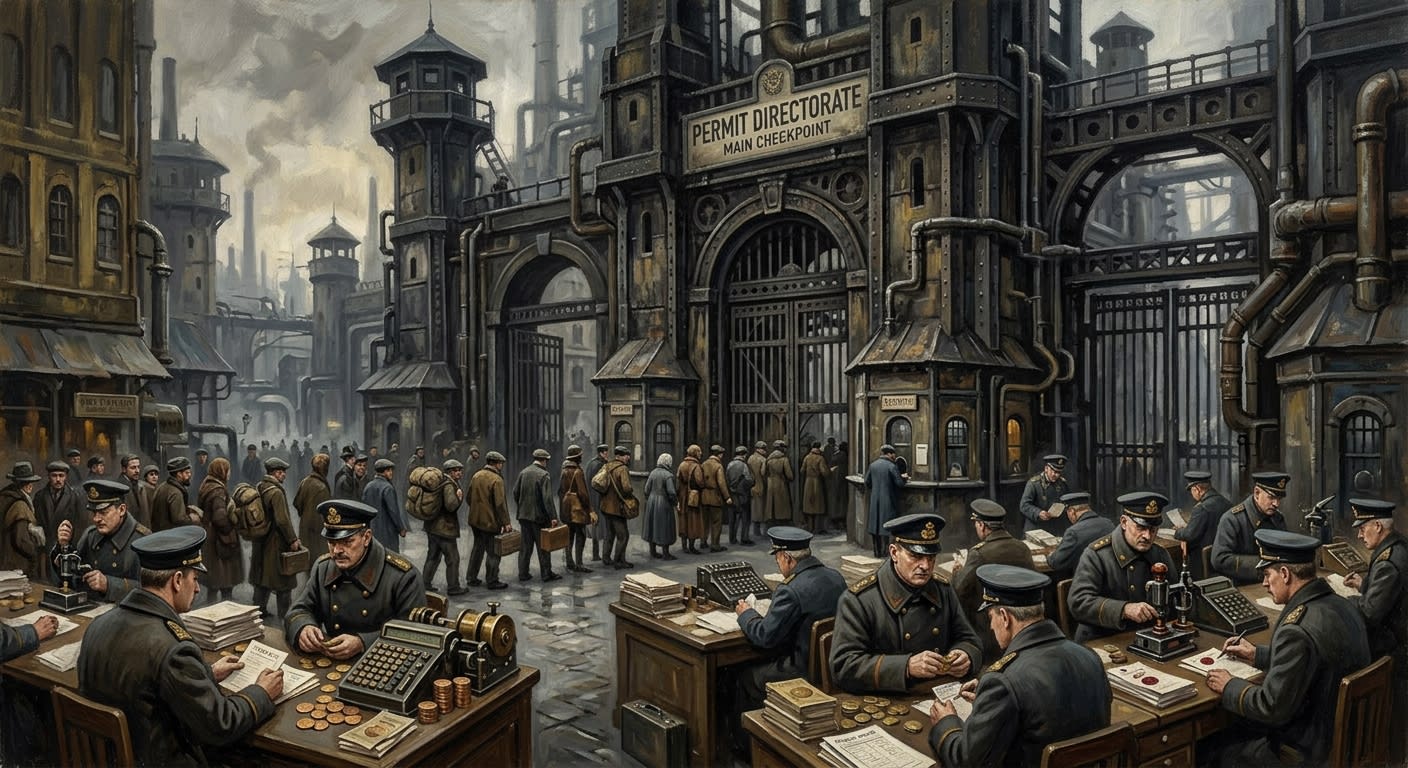
#On the Office That Made Waiting Legible
The Permit Directorate began as a mercy in the same way a gallows begins as timber.
Its founding writ, sealed in A.S. 102 under the joint parentage of War and Records, promised orderly passage along the central road between the Rhine corridor and the forward staging depots. The words were handsome, cautious, and entirely incriminating. Disorder had killed thousands at the Latch River surge of A.S. 97. Convoys blocked roads. Merchants lied. Refugees carried three names apiece and no proof of any. Soldiers deserted by becoming pilgrims. Pilgrims became smugglers by acquiring carts. Every west-to-east road had become an argument conducted with wheels, hunger, and forged paper.
The Directorate answered with gates.
Not with speed. Not with relief. Not with widened roads, lateral cart-tracks, rest yards, or any vulgar engineering of compassion. Gates. Inspection courts. Bell-windows. Waiting pens. Permit classes. Witness requirements. Clearance formulas. An office born to solve congestion by making movement conditional on permission, and permission conditional on delay.
By A.S. 104 the Directorate had discovered the holy fact: waiting could be measured. By A.S. 110 it had discovered the profitable fact: measured waiting could be sold. From that day the Permit Directorate ceased to be merely a transit office and became a theology of controlled stagnation, with the Queue Road as its altar, Gate Nine as its mouth, and the minute as its coin.
#On Its Instruments
The Directorate's first instrument is the permit: a small paper fiction that tells soldiers, clerks, wardens, toll-men, quartermasters, and armed idiots that the person carrying it may exist in the next place. Without a permit, a body is obstruction, contraband, contagion, vagrant matter, labour potential, or enemy sympathy in civilian boots. With a permit, the same body becomes routed, taxable, classifiable, and occasionally fed.
The second instrument is the bell-mark. Dawn stamp, gate stamp, lane stamp, appeal stamp, delay stamp, correction stamp, null stamp. The mark fixes a person inside Directorate time, and Directorate time differs from the Creator's time chiefly in being less merciful and more expensive. The bell rings. Ink lands. The clock begins. The traveller waits. The wait accrues.
The third instrument is the gate. A gate is not a door, despite what optimistic architects insist. A Directorate gate is a court, a throat, a tariff board, a sermon, a trap for impatience, a place where a man's papers are compared against every previous mistake he has made and several he has not yet had the opportunity to commit. The Queue Road has nine. Latchford has fewer, but compensates with mud.
Its fourth instrument is the rate board. Here the Directorate achieves poetry, though no honest Muse will claim paternity. Minute values change without decree. Priority prices rise before crises are announced. Penalty queues cheapen human time until a starving mother can be made to finance a merchant's acceleration by standing in rain. The board does not plead. It states. Men who can read hate it. Men who cannot read hate it more accurately.
Early Directorate catechisms describe minute pricing as “equitable participation in shared corridor burden.”
Corrected for internal instruction. Minute pricing is the sale of one traveller's delay to another traveller's urgency, blessed by arithmetic and guarded by men with cudgels. The prior phrase remains approved for school copies because children are easier to govern when lied to early.
#On the Queue Road as Doctrine
The Queue Road is the Directorate made visible: one hundred and twelve miles of organised patience, nine courts, forty-eight thousand registered souls, the Minute Drift widening through the Barricade Maze, and the Apparatus beneath Gate Nine turning below the warm floor. The Directorate insists it administers the Road. This is technically correct and spiritually evasive. The Road administers the Directorate as surely as the Directorate administers the crowd.
Director Othmar Vell rules from the Directorate House with a soft voice and figures hard enough to chip bone. His orders arrive as rate adjustments, intake caps, lane revisions, Bell Orders, sanitation closures, permit colour changes, and those little administrative weather systems by which nobody commands suffering directly while everyone obeys the result. Adjunct Ilse Quill maintains the hidden master ledger. Whether she has ever blinked is a medical question beneath Doctrine's dignity and above Medicine's courage.
At Gate Nine the Directorate's philosophy reaches its cleanest cruelty. Final clearance. Reclassification. Appeals. Debt conversion. Conscription routing. Null-tag review. Witness validation. Cargo moralisation. Silence. Nine functions for the Ninth Gate, because minor tyrannies become braver when arranged symmetrically.
This formula is circular by design. A person struck from standing cannot appeal the striking. A person without appeal cannot prove standing. The circle closes, the clerk smiles, the bailiff moves the body, and the Directorate records reduced congestion.
#On Latchford and the Export of Delay
The Directorate's genius did not remain confined to the Queue Road. Bad inventions spread when they are profitable and easy to justify. At Latchford Permit-Yards, the Line's muddy legal airlock, Directorate method married trench necessity and produced a choke-town where seals, time, and legitimacy pass through the same fevered hands.
Latchford is smaller than the Queue Road and nastier in the way frontier offices are nastier: less marble, more piss; fewer ledgers, more cudgels; less theory, more immediate hunger. Bureau of Records and Bureau of War claim joint command. Prefect Mavren Tull hoards blank permit stock like a saint's knuckle. Quarter-Commander Hesta Brune controls convoy priority. Old Sable sells forged minutes under the catwalks and understands Directorate doctrine better than half its licensed officers.
There, the permit becomes survival before it becomes passage. A civilian can become legitimate by stamp, or disappear by audit. A soldier can become assigned, misassigned, reassigned, unassigned, or night-swept into labour no file admits. Bodies without death receipts cannot cross. Bells without licence cannot ring. Blank vellum over quota becomes contraband more dangerous than powder, because powder can only kill the present while blank paper threatens to authorise a future.
LATCHFORD NIGHT SWEEP LOG — EXTRACT, A.S. 199 Rows collected: █████ Unwindowed persons converted to culvert labour: █████ Children retaining valid paper: █ Master Gate Clock discrepancy: twenty-seven minutes unassigned Disposition of unassigned minutes: █████████████████████████
Latchford proves the Directorate's doctrine is portable. Give it mud, a ford, three miles of wagons, frightened families, hungry soldiers, and a Master Gate Clock, and it will grow the same organs: queue, stamp, audit, market, erasure. The shape repeats because the sin is useful.
#On the Apparatus and the Lie of Ownership
The Directorate did not build the Apparatus. This is the one mercy in the file, and it is thin gruel. Bureau of Engineering found the chamber in A.S. 178: hexagonal void, dressed stone, basalt slab, six radial channels, a twelve-foot wheel of spectrally non-conformant metal turning where no official mechanism had been recorded. The chamber predates the Directorate. It may predate the road. It predates every smug rate board that later treated its effects as revenue variance.
The Directorate built over it, worked over it, profited over it, and obeyed whatever came upward through warmth, tremor, drift, and report. The spring rate adjustment of A.S. 200 doubled minute pricing without public decree. The Drift widened. The Shed Wards aged wrong. Gate Two shadows stepped before their owners. Gate Nine closed for sanitation while the Barricade Maze stacked dead. The rate board did not apologise. Rate boards are honest in their barbarism.
The Unnamed Bureau appears here like a missing verb that has learned to command the sentence. Grey-robed maintainers below Gate Nine calibrate the wheel. Report Three names Phase Nine and suppresses the product. The Directorate obeys instructions it does not admit receiving. Purity misses Brother Senn with theatrical dedication because his Unstruck disruptions dampen extraction surges. Heresy becomes maintenance. Denunciation becomes camouflage. The Directorate calls this enforcement posture.
Directorate circulars state that all Queue Road rate changes originate from lawful administrative review.
Corrected. Some rate changes correspond to sub-grade throughput recommendations, sealed Report Three language, and instructions no Directorate council has admitted receiving. Lawful origin remains asserted for public stability. Stability is what the Bureau calls a lie that has acquired guards.
#On the Directorate's Present Condition
As of A.S. 201, the Permit Directorate remains indispensable, wealthy, hated, imitated, audited badly, and defended by every office that would be crippled within a week if its gates opened without pricing. War needs its conscripts sorted. Records needs its identities stabilized. Tithes needs movement assessable. Purity needs unlawful transit visible. Pilgrimage needs delay pious enough to charge. Doctrine needs the whole cruelty described in language fine enough to prevent revolt and accurate enough to remain useful.
Its provincial offices now breed like damp mould in corridor towns. A small Directorate desk appears first beside a toll table, then acquires a wax-stove, two clerks, a guard with tired eyes, a bell-frame, a grievance slot, an appeal bench, a locked cupboard, and a second locked cupboard whose key is carried by someone not listed on the posted authority sheet. Within a year the desk has become a window. Within three, the window has become a gate. Within five, the town explains to visitors that things have always been done this way.
The citizens adapt with the hateful brilliance of the governed. They learn which clerk likes salt fish, which Warden's daughter needs cough syrup, which bell may be missed if one is already holding a blue slip, which forms should be dirtied at the corner to look travelled, which witness can cry on command, which runner knows the culvert under the seventh fence, which prayer calms a child without attracting Orison suspicion. The Directorate calls these adaptations fraud. I call them citizenship under pressure.
The Directorate supplies all of this. It turns distance into petition, petition into paper, paper into delay, delay into minutes, minutes into debt, debt into labour, labour into silence. It is not efficient in the common sense. It is efficient in the Synodal sense: every failure produces authority for another form.
Brother Senn preaches beneath its road that no bell owns the hour. The Directorate posts notices saying every bell-mark must be obeyed. The Apparatus turns below both sermon and notice. The crowd stands. The rate board changes. A clerk lifts his hand. Forty people move forward three paces and thank the Creator because gratitude, like waiting, has been trained to accept small units.