
#On the Fraud Before the Fire
The Bread-Scale Uprising of A.S. 97 began, as many holy reforms do, with theft so crude that only a guild could have mistaken it for cleverness.
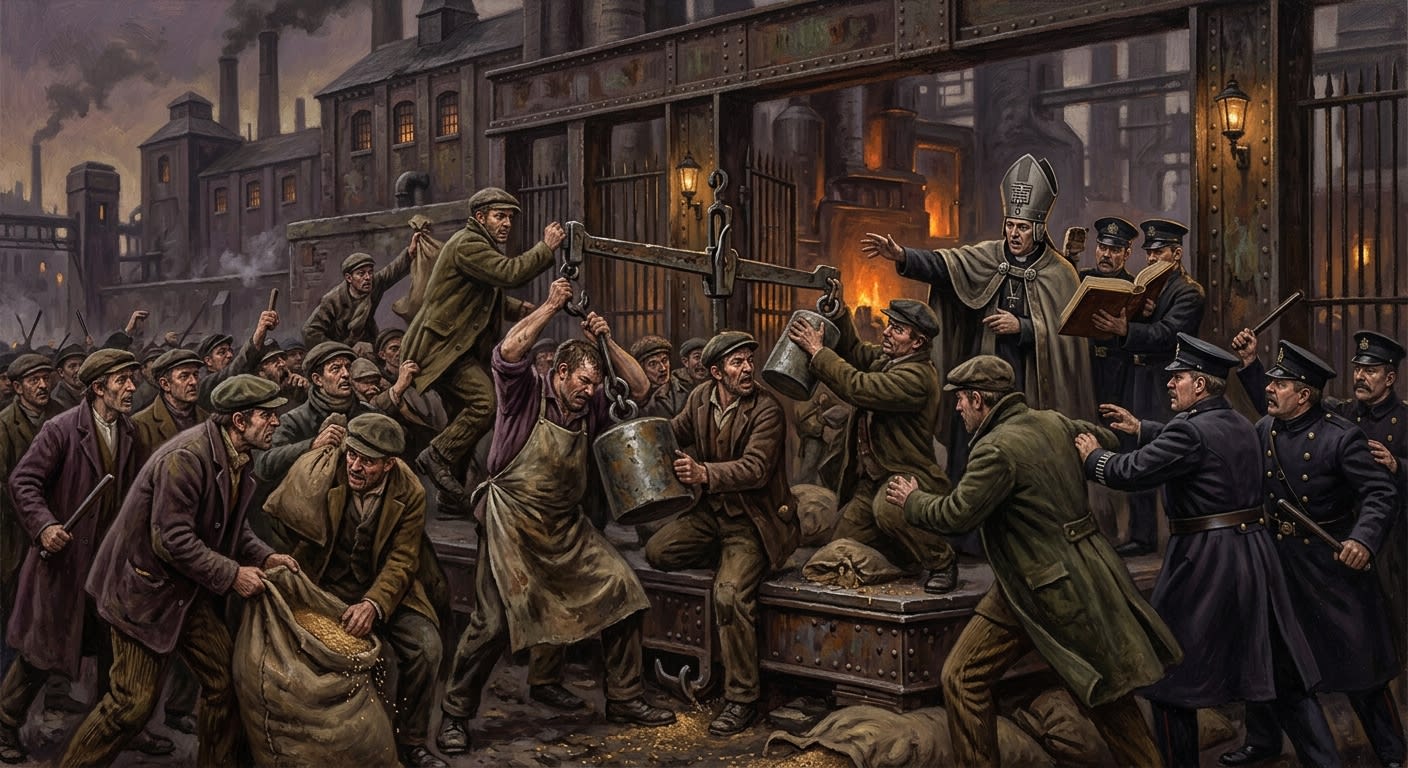
At the southern gate of an unnamed Line bastion — the file says “southern gate” and then develops a most devotional blankness around the city, because the Bureau of Records dislikes locating shame where maps might find it — the grain guild poured lead into the weighing pans. Every sack weighed heavy. Every tariff rose. Every manifest appeared lawful, because the clerk recorded what the scale declared, and the scale, being bribed by metal rather than coin, lied without blushing.
The fraud was discovered only after the city had begun eating its margins: flour swept from chapel floors, paste scraped from notice boards, horse oats washed and blessed into soup. The gate ledgers remained elegant. The tariff receipts were correct. The guild hall accounts showed a profitable season. Children do not survive profitable seasons with any special reverence.
#On the Day the Gate Burned
The day of discovery arrived through the ordinary sacrament of a tired hand. A porter, lifting a sack that should have broken his back by the ledger's claim, carried it too easily. A widow who had sold two blankets to pay the weight-fee watched the pan settle against a counterweight she knew, from the intimate mathematics of starvation, could not be honest. Someone pried at the pan. Lead showed under iron.
The crowd did not petition.
It took the southern gate first. The rope lanes failed. The Queue-Marshal on duty ordered the front line to kneel; the rear line shoved; a boy was crushed against the tariff post; the post came down with him still under it. The first fire took the toll booth. The second took the guild hall. The third ran along awnings and oilcloth to seventeen adjacent structures, including a priory whose only crime was standing where flame had business.
By Vespers, the gate square was a kiln. Guild chests split in the heat and spat coin into the street, where men picked up silver with burned fingers and then threw it back into the fire because rage, properly heated, develops standards. The guildmaster was found in the counting room beneath three sacks of imported flour. Records say he suffocated. Local testimony says he was helped.
LOCAL WATCH TESTIMONY, SOUTHERN GATE FILE 97-B: “The crowd brought out the false pans and made the guild weigh █████████ against █████████. When the pan would not settle, they added █████████ from the guildmaster's own stores. The children were nearest the front.”
Disposition: sealed for appetite hazard; instructional copies pulped.
#On Strasbourg's Sudden Theology
Strasbourg responded with the speed it reserves for disasters that can be converted into jurisdiction. Within weeks, private measurement was illegal. Within months, all civic scales were seized, catalogued, sanctified, stamped, and placed under licensed custody. Within the year, weighing had become a sacramental act.
A lesser government would have called this emergency regulation. The Synod, being blessed with better prose and fewer scruples, called it Doctrine.
The Bureau of Doctrine declared that false weight was heresy against Order. The Bureau of Tithes declared that unsanctioned scales constituted theft from the common ledger. The Bureau of Purity declared that tampering with measure invited demonic contamination. The Bureau of Relics produced, with suspicious promptness, fragments suitable for reliquary calibration: bone slivers, saint-ash, hymn-metal, splinters whose holiness became more certain each time a clerk needed them.
Initial street proclamations called the incident an uprising of the hungry against guild predation.
Corrected by Bureau of Records, Third Revision: the Bread-Scale Uprising is classified as a supply-chain irregularity. The hungry are not a political subject. They are an environmental pressure upon orderly distribution.
The first tariff-chapels were ugly rooms: a scale, a locked casket, a candle, a stamp, a clerk, and a queue learning that hunger had acquired a liturgy. From those rooms came the Commerce Clerk, the smallest priest of the Synod's market theology and the most hated man between a convoy and its destination.
#On Calibrus and the Seized Pan
The uprising also made Saint Calibrus useful. Before A.S. 97, Calibrus was a minor occupational figure, invoked by surveyors, honest millers, and men whose dullness had achieved devotional colour. After the gate burned, every seized scale required a face above it. Scales alone are too bare. Bone fragments lack posture. A crowd will obey iron longer if a saint appears to be watching the hand that moves it.
Calibrus supplied the hand.
His adopted icon — the suspended balance over a kneeling crowd — answered every need at once. The crowd could be read as prayer. The crowd could be read as hunger. The Bureau of Heraldry approved both readings, an act of bureaucratic ambiguity so polished one could see one's indictment in it. The Day of Zeroing followed: scales cleaned, witnessed, blessed, re-zeroed, and returned to service as instruments of lawful shortage.
The saint did not end fraud. He made fraud prosecutable in better language. Tampering with a market scale became theft. Tampering with a tariff-chapel scale became sacrilege, contamination, civic sabotage, and administrative inconvenience — the full bouquet.
#On the Two Children of the Riot
The Bread-Scale Uprising birthed two quarrelling children: True Measure Zealots and Mercy Weighers.
The first learned that false weight starves cities. They still speak of the leaded pan as original sin. They double-zero, report bribes, polish Calibrus, and treat drift as if Hell itself were pressing a thumb upon the beam. They are insufferable, audit-useful, and occasionally right, a combination more difficult to endure than pure folly.
The second learned that correct ledgers can coexist with dead children. They saw the gate books balance while the city hollowed. They learned to shave tariffs, inflate guild rates, and move hunger around the schedule before it becomes riot. They are heretics by statute and necessary by practice. The Bureau condemns them loudly and survives them quietly.
The Relic Counterfeit Scandal two decades later would prove that even sanctified measure could be counterfeited. The Ledgers of Varna would prove that correct measure could rot in harbour. The Stamp War of Novi Sad would prove that valid stamps could manufacture famine without touching a sack. A.S. 97 was only the first lesson. Strasbourg, naturally, declared the class complete.
#On the Present Classification
As of A.S. 201, the official file maintains its preferred fiction. The Bread-Scale Uprising was a supply-chain irregularity. The gate structures were voluntarily decommissioned by fire. The priory destroyed in the spread has no fixed devotional purpose. The guild's name is sealed to prevent “imitative commercial sin,” though every Tariff-Chapel apprentice learns the story in corridor mutters before his first week ends.
No chapel scale in Europe is free of that day. The morning zero, the witness seal, the relic casket, the prohibition on private weights, the clerk's authority to condemn a sack and ruin a merchant — all descend from lead hidden under iron and a crowd that refused to starve politely. The Bureau calls this Order restored. The market calls it procedure. The queue calls it the reason the pan is watched with the eyes men usually reserve for knives.
Earlier municipal copies recorded seventeen adjacent structures destroyed, including one priory.
Current Records language: seventeen structures were voluntarily decommissioned during heat-related civic correction. The priory has been reclassified as storage architecture with incidental devotional ornament. Memorial petitions are denied for lack of site.