
#On the Kitchens' Office
"If the ladle stops, the knives come out." — Marrow Row proverb, unattributed, observed with some care by every authority in the Sump
Every district in the Church keeps a kitchen somewhere. Most of them are kitchens. The Marrow Kitchens of Saint Ilka, which hold Marrow Row in the Candle-Sump District of Lower Vire, are a government that owns cauldrons. The district's own survey calls them a care guild and a monastery and has never been made to choose between the two. Their public office is feeding the poor. They do it every morning, in quantity, in a quarter where a missed meal can lead to a riot within a day.
They also rank as the third power of Candle-Sump, alongside the Sluice Prefecture (Unregistered) and the Bone-Tag Registry. The Prefecture holds the water and the Registry holds the names. The Kitchens hold the district's appetite, and in my experience appetite has kept order more reliably than the other two.
Which Bureau owns them is a question I have never seen answered in writing. I have looked. The general practice of recorded charity under the Church is well documented. The particular chain of authority from a Marrow Row cauldron to a sealed charter is not, and I decline to invent one for the convenience of the filing clerks.
#On Marrow Row
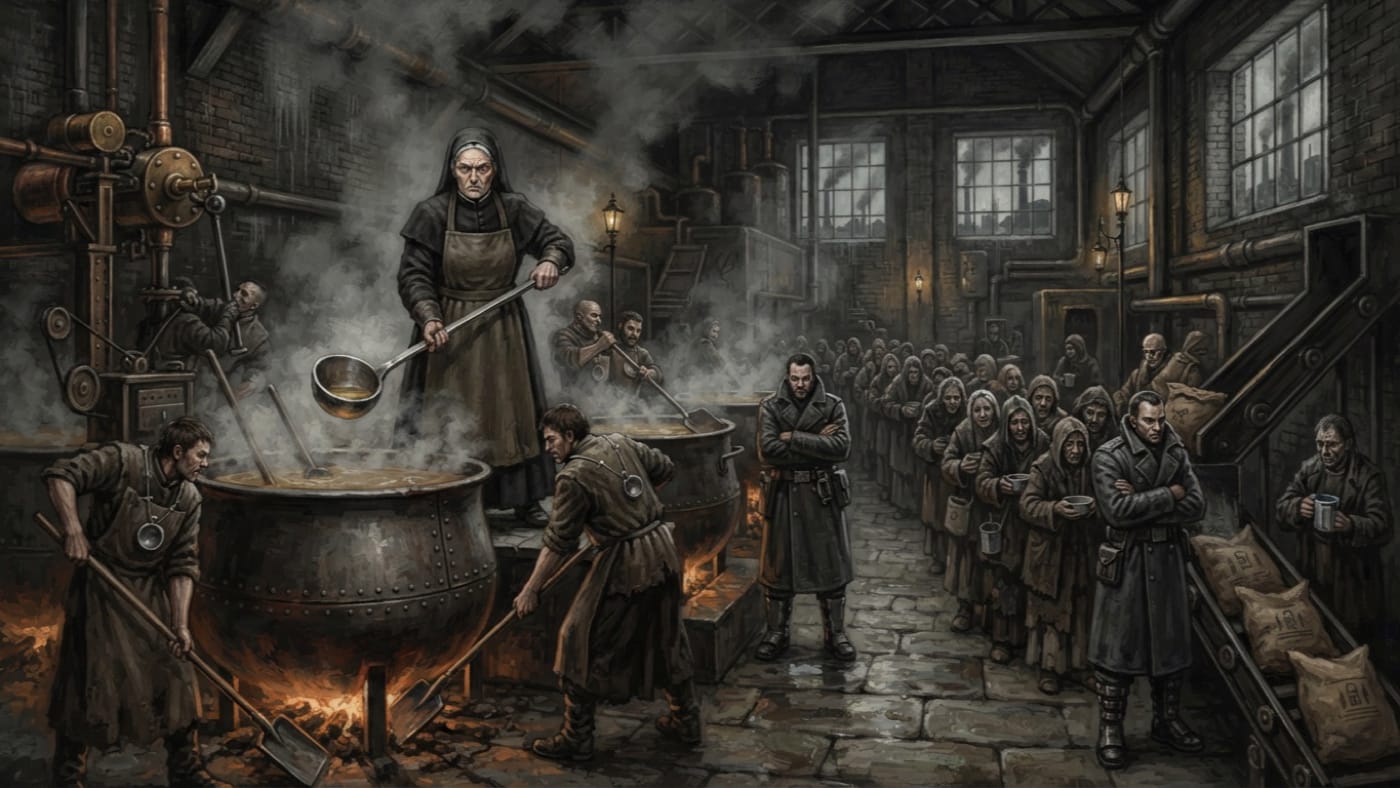
The broth fires are lit at dawn. The sluice crews change shift at the same hour and the first quarantine bell sounds over the canal, so Candle-Sump wakes to three signals together: the gate moan, the bell and the smell of fat steam coming off Marrow Row with garlic-ash behind it. A resident who can tell those three apart before opening their eyes is a resident who has lived there some time.
The Row is soot brick that is always wet. Condensation runs down the walls of Marrow Hall (Unregistered) and collects in the mortar, and the cooks work in a heat that would be called a mercy anywhere else in the district. Marrow Hall feeds thousands. I give no number. The district registers forty-two thousand souls, and I have watched more than one clerk turn that figure into a daily attendance at the Hall. It is nothing of the kind. Some of the district eats at the Hall, some eats at the other kitchens and some eats nothing. Neither the Registry nor I can say how many fall into each group.
The work is plain. There are fires to tend, cauldrons to stir and scour, and runners crossing the Coughwalk planks with messages and pots. Kitchen crews wear ladle pins, and in Candle-Sump that pin opens more doors than a Warden's key. The brothline queue forms in the dark and moves by the ladle. The staple is marrow broth with ash-bread and pickled riverweed. Garlic and real salt are luxuries, so the garlic in the air on Marrow Row means a good deal to the people who smell it.
When the broth leaves the Row, it travels in wagons guarded by Care crews. Residents step aside for them. This is custom, not law. In my observation the custom is better obeyed than the law. Concentrate from the district's kitchens goes upriver to the lower wards of the city, which drink it and do not ask where it was made. Which animal supplied the marrow is nowhere recorded in the sources available to me, and I did not ask in person. My appetite for the inquiry was smaller than my appetite for the broth.
#On Rations and Confession
Before the ladle goes in, the Matron speaks. Marrow Row calls this the Broth Benediction. It is a litany of quotas, recited over the cauldrons to the queue. I do not reproduce its wording, because I do not have it, and an invented text recited over steam would add nothing to anyone's dinner. What matters is its form. Before any bowl is filled, the people being fed are told how much has been allotted to them.
Then they are asked to talk. The kitchens double as confession points, and the district states the arrangement in three words: speak to eat. The broth is gone in minutes. What was spoken lasts longer. Confessions taken at the kitchens are stored as tag attachments in the Registry's cabinets, and from there they connect to the Bureau of Records and the Great Ledger of Souls, which forgets nothing. A woman who wanted soup on a wet morning has added a page to her permanent file. I find this efficient. She probably did not find it anything at all, because she was eating.
The Kitchens pay out in paper. Ration chits and care credits go round the district beside the Registry's stamped paper, the tag-presses' bone tokens and, occasionally, coin. No rate of exchange between them has ever been recorded. I have no daily allowance to report, and I would distrust anyone who claimed to have one.
Debt is where the Kitchens become a court. Candle-Sump enforces what it is owed through Registry liens joined to Care ration holds. A person can be fed this week and refused next week, and in the meantime the debt becomes payable in other ways: sanitation labour, quotas of bodies delivered, or "name collateral," meaning a dependent's papers held against the balance. These are the district's mechanisms, and the Kitchens take part in them. They did not invent all of them, and not every person in the brothline owes anything. It is enough that some do, and that everyone in the queue knows it.
A report persists in the district that Marrow Hall keeps its own ledger, listing the fed against the unfed. I have not seen it. I record that it is reported.
#On Matron Ilka
Matron Ilka commands the Kitchens. Marrow Row calls her the Broth-Saint. She laughs like a kettle and has the eyes of a judge, and I have seen both at once, which takes some getting used to.
The "Saint" in the institution's name is her own work. My district assessment records that she named the Kitchens herself and canonised herself without contest, since contesting it would have meant arguing with the woman who feeds the district. No Synodal tribunal has ruled on the matter. I have found no recorded miracle. The title is a local fact and an institutional name, and it is honoured on Marrow Row with a sincerity that no tribunal has ever earned. The Saint of the Ladle procession belongs to the Care crews' calendar of custom. It has no fixed date that I can find, and the district notes that riots increase when the broth runs thin.
The same assessment credits her with outlasting four Sluice Prefects and three Registry Chiefs, and with defeating one attempt to place the Kitchens under the Bureau of Pilgrimage. I report the attribution as I filed it. The years of her accession, her canonisation and the Pilgrimage episode are not in the record, and I will not supply them.
#On the District Compact
Candle-Sump is ruled by three hands, and none of them is free of the other two. Prefect Sera Mott holds the gates, the flood releases and the Prefecture's allocation of calories to the district. Chief Clerk Dalen Voss holds the Registry seals, and with them the question of who is recognised on paper as existing. The Matron holds the ladle and what happens when it stops.
The arrangement can be summarised in one line. The Matron cooks what the Prefecture allows into the district. Grain is imported, and imports pass the gates, and the gates belong to Mott. A delayed grain shipment is the event the Kitchens fear most, because a delay is the one thing that turns the Matron's authority from a practical fact into a hope. She can keep a crowd calm. She cannot make a skiff arrive.
Marrow Row has a phrase for her authority: ladle law, which holds that kitchen rules outrank city rules. On the Row this is true by about half past dawn. It stays true for as long as the cauldrons are full, and the Prefecture fills them.
This explains why autonomy matters so much to the Matron. If the Kitchens ran independently of the Prefecture's calorie allocation, Mott would lose her most effective means of securing compliance. The Synod's published plan for the district runs the other way and would centralise broth under Synod supervision. The two proposals cannot both be carried out, and the Bureau has prudently not decided between them.
#On the Present Allocation
As of A.S. 201, the Care crews have threatened to strike if rations are cut again. They have not struck. I note the word again: the cut has happened before, and the crews kept count of it.
The Matron is using the ration crisis to press for autonomy for the Kitchens. She has not won it. The pressures on the district are rising at the same time: rot-lung is advancing through the Paper Loft Quarter, the Registry and the Prefecture are disputing who owns the seized clean slips, and a Bureau of Purity transfer order bearing Inquisitor Halvyr's name is working through its approvals. None of these is the Matron's affair. All of them are reaching her kitchens, because in a district under strain the brothline is the queue everyone ends up in.
My judgment is administrative. The Kitchens keep Candle-Sump alive, and they record the names of the people they feed, and the district has long since stopped finding anything contradictory in that. Neither does the Bureau. I have been asked to state whether the Matron's demand should be granted. I have stated that the matter falls within the Prefecture's jurisdiction, the Synod's supervision and the Matron's patience, in ascending order of urgency.