
#On the Row
"Warmth is evidence." — Candle-Sump proverb
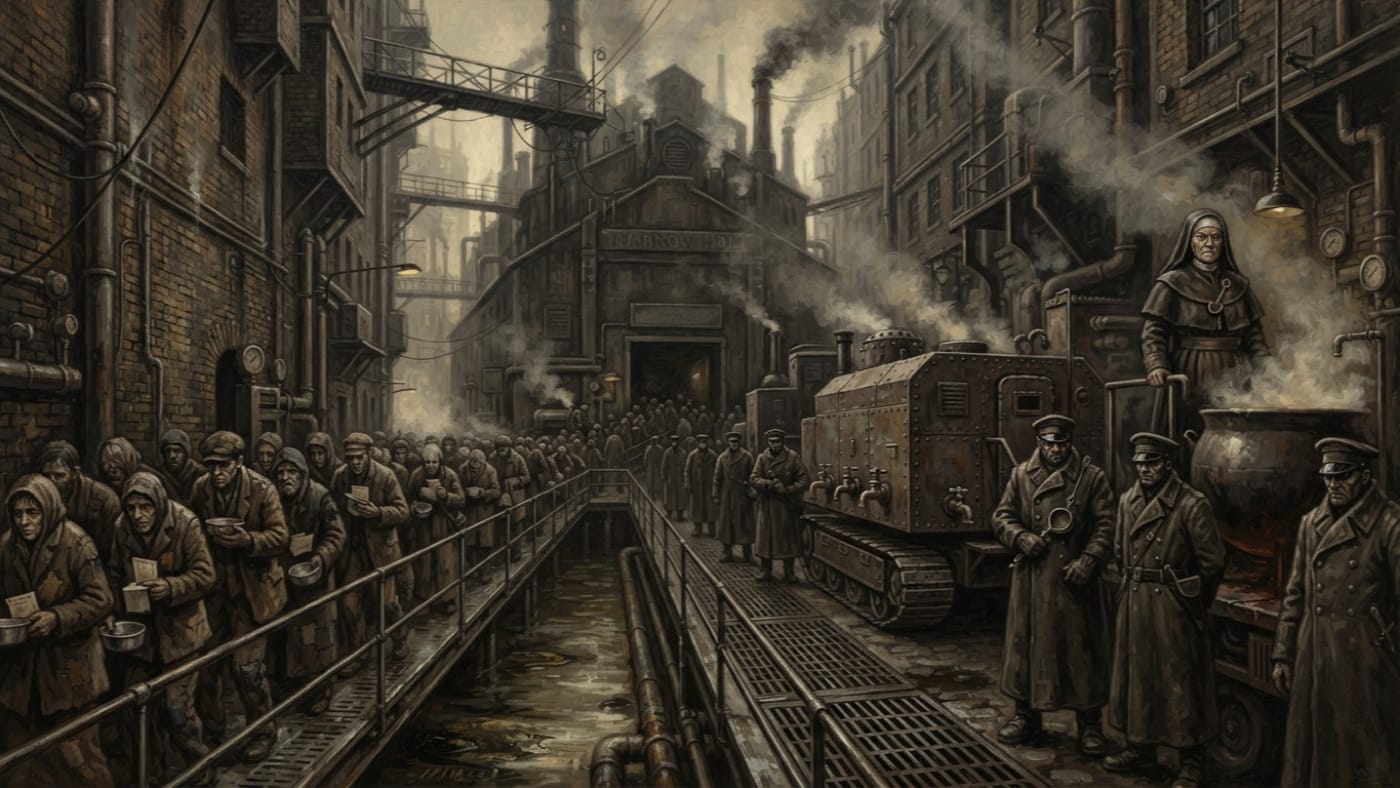
Marrow Row is the ward where the Candle-Sump District goes to be fed. It lies along the canal spine of Lower Vire, above the Ash-Sluice Line. Its trade is broth and its architecture is the queue.
The district survey gives the Row two features and one smell: broth kitchens, ration queues, and fat steam with garlic-ash behind it. The smell comes first. It rises from the cauldrons into air already sour with the drain crews' caustic soap, and anyone climbing up from the sluices can tell by the nose alone which ward they have entered. The brick is soot brick and it is never dry. Bone-lime mortar weeps where kitchen heat meets canal damp. Iron grates sweat. The papers people carry in the brothline go soft at the corners before their owners reach the front. No surveyor has fixed the Row's boundary, measured its height above the sluice or drawn its lanes, and I decline to draw them in the surveyor's absence.
The day starts at dawn with three things at once: the sluice crews change shift, the first quarantine bell sounds and the broth fires are lit. Candle-Sump grew out of lock-side worker housing into a district nobody planned. Through the Lye Flood, the arrival of the Prefecture and the Registry's annexation of bone tagging, someone on this stretch of brick kept a fire going under a pot. In one siege winter, which the district remembers and the archive does not date, candles were rationed and the kitchens became the government in everything but seal. They have never handed the office back in full.
#On Marrow Hall and the Wagons
Marrow Hall (Unregistered) is the Row's principal feeding house and the best-known premises of the Marrow Kitchens of Saint Ilka. It feeds thousands. That is the figure the record supports, so it is the figure I give. Its hours, its capacity and its standing among the other kitchen fires are not recorded.
The Hall runs on cooks, cauldrons and runners. Cooks tend the fires and scour the pots. Runners carry messages and pots, and sometimes a dispute, between the Hall and the other kitchens. Kitchen crews wear ladle pins, and on the Row a ladle pin commands more deference than a Registry clerk's ink cuffs. The fare is marrow broth, ash-bread and pickled riverweed. Garlic and real salt are luxuries. The garlic-ash in the air belongs to the ward and makes no promise about any one bowl.
The Row exports as well. Broth concentrate leaves the district, and the Kitchens feed people beyond their own ward, so some of what boils on Marrow Row is eaten by people who have never smelled it. It travels by broth wagon, under guard of the Care crews. Residents step aside for the wagons. The district lists this among its customs of respect, beside showing clean hands and presenting tag receipts with both hands. No ordinance requires it, and nobody has tested that.
The district survey also reports that Marrow Hall keeps a secret register of the fed against the unfed. I have not inspected it. I file the report as a report.
#On the Benediction and the Account
Before the ladling, the Matron recites the Broth Benediction, a litany of quotas. I do not have its words and I will not make them up. In form, it announces the allotment before anything is given out.
Then the queue speaks. The kitchens double as confession points, and the district puts the practice in three words: speak to eat. A bowl lasts a few minutes. What is said over it goes into the cabinets of the Bone-Tag Registry as a tag attachment, and the Registry serves the Bureau of Records, whose work ends in the Great Ledger of Souls. The meal is digested by evening. The paperwork is kept.
The record states the requirement and where the confession goes. It does not record the questions, and I will not write them. A carter and a widow are not looked at the same way from behind the ladle.
The Row pays out in paper. Ration chits and care credits circulate alongside the Registry's stamped paper, bone tokens from the tag-presses and a little coin. A household that wants to keep eating files a broth ration renewal. No rate converts chit to credit, credit to token or any of them to coin, and I will not invent a tariff the district has done without for generations.
Debt is where the soup acquires a jurisdiction. The district collects what it is owed through Registry liens and Care ration holds. A held ration means a household fed one week and turned away at the cauldron the next, with the debt still standing and the queue watching. The arrears can be worked off in sanitation labour or body-delivery quotas. They can also be settled with name collateral, which in Candle-Sump means a dependent's papers held against the balance. A parent can pledge a child's existence for the household's dinner. The Kitchens take part in this economy, though they did not build all of it. The wagon guards issue no liens, and not everyone in the brothline is a debtor. Enough of them are.
#On Ladle Law
The Row's name for its jurisdiction is ladle law: kitchen rules outrank city rules. As canon law, this is wrong. As a description of Marrow Row at dawn, it is accurate. The two conditions have lived side by side for a long time without any visible discomfort.
Ladle law has one officer. Matron Ilka controls the Kitchens, and through them she controls the district's calm. The Row calls her the Broth-Saint. She laughs like a kettle and watches the brothline with the eyes of a judge, and the queue knows how to read both. My district assessment records that she gave the Kitchens their saintly name herself, and that her canonisation was self-administered and never contested. No tribunal has ruled on it and no miracle is on file. The title is local usage. It is enforced by the one sanction on the Row that nobody risks, which is the cauldron.
The district's three powers divide its necessities between them. Prefect Sera Mott (Unregistered) of the Sluice Prefecture (Unregistered) holds the gates and the flood releases. Chief Clerk Dalen Voss holds the Registry's seals and decides who is recognised. Ilka holds the calories. Her share looks the most absolute and depends the most on others. Grain is imported. So is clean water. Fuel for the fires comes through gates on Mott's timings, and the Prefecture's calorie allocation fixes what the Kitchens have before the Matron gives any of it out. A delayed grain shipment is the Kitchens' recorded point of failure. The ladle is sovereign over a pot that other offices fill.
The Saint of the Ladle, a Care procession, passes along the Row. I cannot fix its date or trace its origin. The district records that riots increase when the broth runs thin. Residents call a respected care worker a sump-saint and use the same word as an insult. Which meaning is meant depends on the tone and on how full the pot is.
#On the Present Allocation
My assessment of Candle-Sump stated that on Marrow Row "the broth kitchens feed the district's forty-two thousand registered souls."
Forty-two thousand is the district's registered population. It is not a census of Marrow Row or a daily count at Marrow Hall, and the record does not say how much of that population the kitchens reach. The Hall feeds thousands. The sentence is narrowed accordingly.
The A.S. 201 assessment finds the Row under four pressures at once.
The first is the ration. The Care crews have threatened to strike if rations are cut again, and the whole grievance is in the word again. No strike has happened. The crews guard the wagons and carry the procession, so a strike would take the broth off the streets and also end the custom that clears the planks for it.
The second is the Matron's ambition. Ilka is pushing to free the Kitchens from the Prefecture's calorie allocation, which would take away Prefect Mott's most reliable means of securing compliance. The Synod's public plan goes the other way, proposing to centralise broth under Synodal supervision. Neither has happened. The Row eats under the old arrangement while both parties describe a new one.
The third is the cordon. Rot-lung (Unregistered) moves through the district and the Quarantine Provosts (Unregistered) move their ribbons every week. A brothline that served a street one morning may be on the wrong side of a cordon the next, and the wagons can go only where the ribbons allow. Meanwhile the Registry and the Prefecture are disputing who owns seized clean slips. Every confession the Row deposits goes into cabinets that are now part of that quarrel.
The fourth is a document. A transfer order for Inquisitor Halvyr is working its way through the Bureau of Purity's approval chain and has not been carried out. No audit press has come to the Row. Rumour of one has, and on a damp ward rumour travels faster than paper.
The broth fires are still lit at the first bell, and the queue still forms in the dark.