
#On the Bureau's Purpose
"No foot moves toward Strasbourg except under the Bureau's eye." — Harmonized Routes Edict, ratified A.S. 123
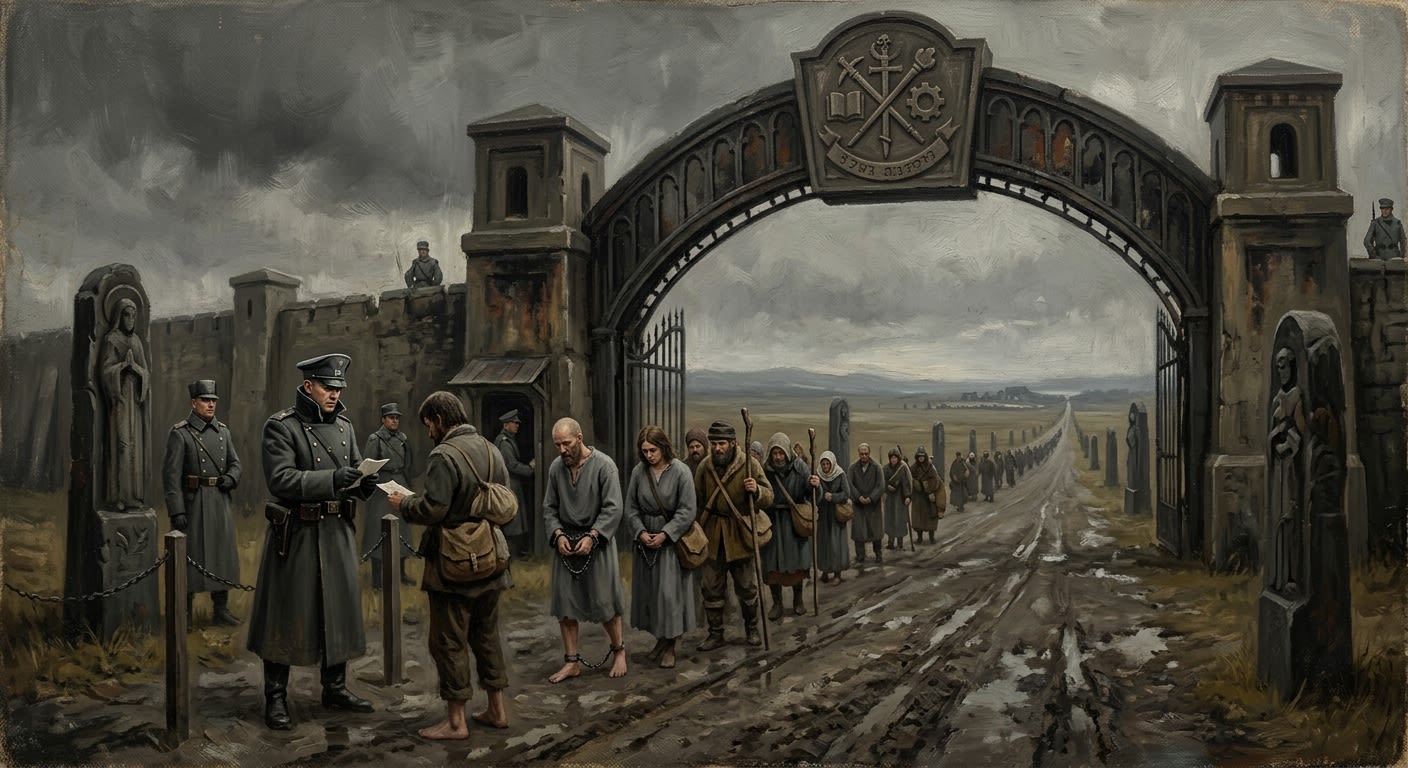
There are those — the idle, the heretical, the geographically confused — who believe that a road exists for the convenience of the traveller. That a man may place one foot before another, pass through a town, ford a river, cross a border, and arrive at his destination by virtue of his own initiative and a pair of sturdy boots. This is false. A road exists because the Synod permits it. A man travels because the Bureau of Pilgrimage has stamped his papers, counted his beads, weighed his devotion against a published tariff, and determined — provisionally, revocably, and at a price — that his passage serves the interests of Faith.
The Bureau of Pilgrimage governs movement. All movement. Every pilgrim road, every shrine approach, every mountain switchback and coastal embarkation from Marseille to the rubble-shrines of Vienna. It issues permits. It licenses the sale of the small stamped discs of tin and brass — pilgrim tokens — that every traveller must wear upon his person, visible, at all times, lest he be arrested as a vagrant, a heretic, or that most damning of classifications: an unregistered pedestrian. The Bureau sets the routes. The Bureau prices the passage. The Bureau determines which roads are holy, which roads are forbidden, and which roads are simply too profitable to leave in the hands of anyone else.
It is, in the blunt arithmetic of governance, the second-wealthiest Bureau after Tithes — and the two maintain a rivalry so venomous that their clerks refuse to share ink. I find this charming. The Bureau of Tithes extracts wealth from the stationary. The Bureau of Pilgrimage extracts wealth from the mobile. Between them, they have ensured that no soul, living or dead, resting or walking, escapes the obligation to fund the Synod's holy machinery. A masterwork of complementary extraction. I have recommended medals for both.
#On the Founding
The Bureau of Pilgrimage was formally constituted in A.S. 123, in the aftermath of the Routing of Wrath's Horde at Belgrade — that strange, blood-soaked miracle when three saint-apparitions blazed above the artillery emplacements and the Great Deceiver's forces broke against the Danube for the first time in living memory. The Bureau of Doctrine declared it a vindication of faith. The Bureau of War declared it a tactical aberration that should not be relied upon. The faithful, who cared nothing for jurisdictional squabbling, declared it a miracle and began walking.
They walked in thousands. Then in tens of thousands. From Lyon, from Cologne, from the vine-terraces of Iberia and the damp parishes of Flanders, they walked — to Belgrade, to the bastion-shrines, to the reliquary cities, to any place where the Synod's propagandists had planted the rumour of divine favour. They walked without permits. They walked without maps. They walked, catastrophically, without anyone collecting a fee.
The crisis that prompted the Bureau's creation was not spiritual. It was logistical. Eight rival pilgrimage guilds — self-appointed, self-financed, and spectacularly territorial — had carved the roads of Europe into competing fiefdoms. The Guild of the Golden Sole controlled the Rhineland approaches. The Confraternity of Saint Edras held the Carpathian passes. The Peregrine Brotherhood operated the Iberian coastal routes and had, by A.S. 120, accumulated sufficient armed escorts to constitute a private army. The Brotherhood of the Blessed Foot — a name I record without editorial comment — managed the Flemish pilgrim traffic and had recently begun charging tolls at crossroads it did not own, on routes it had not built, for protection from threats it could not name.
The Riots of Santiago ended the debate.
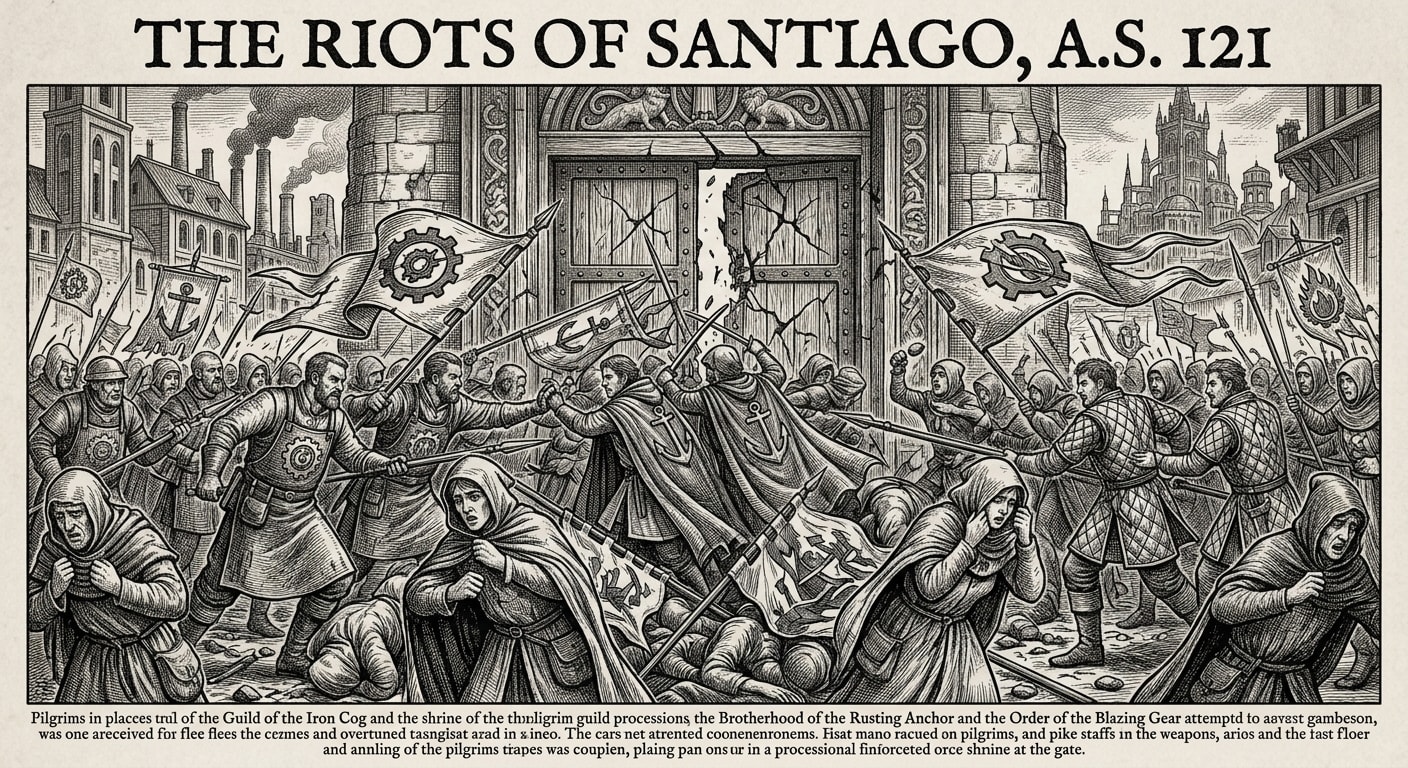
I will not dignify the Santiago affair with extended treatment. The pertinent facts: A.S. 121, two years before the Bureau's founding. Three guilds — the Peregrine Brotherhood, the Confraternity of Saint Edras, and a smaller Iberian outfit called the Tongues of the Blessed Way — converged their processions at the shrine-city of Santiago de Compostela on the same feast day. Jurisdiction was disputed. Tolls were doubled. Pilgrims were charged by two guilds simultaneously for passage on the same road, and when the third guild's marshals attempted to collect a third fee, the procession became a riot. Forty-one dead. The shrine of Saint James was damaged. The Bureau of Purity's report noted, with the particular dryness that office reserves for catastrophic understatement, that "the situation reflected poorly on the organisational capacity of the private devotional sector."
The Synod's response was the Harmonized Routes Edict. Eight guilds were summoned to Strasbourg. Eight guild-masters arrived expecting negotiation. The Edict offered them absorption — immediate, unconditional, and permanent. Three guild-masters signed. They were assigned positions as route inspectors and posted to the most desolate waypoints the Bureau could identify; the Guild of the Golden Sole's master spent his remaining years at a mountain relay station above the Carpathian snow-line, where the nearest settlement was a goat-farm and the nearest shrine was a boulder someone had painted a cross on in A.S. 78. Three guild-masters refused. They were immured — walled alive into the foundation stones of the Bureau's new Marseille headquarters, where their bones remain, doing more for the structural integrity of the building than they ever did for the spiritual integrity of pilgrimage. Two guild-masters fled. They reached England. England, being England, offered them asylum and has not been forgiven.
Previous records attributed the Harmonized Routes to A.S. 38. The Bureau of Records has corrected this entry. The Harmonized Routes Edict was ratified at A.S. 123, upon the Bureau of Pilgrimage's founding charter. References to "A.S. 38" in earlier filings reflect a calendrical discrepancy now resolved. The clerks responsible have been retrained.
CORRECTED — Bureau of Records, Second Revision, A.S. 200.
#On the Pilgrim Roads
The Bureau's jurisdiction begins where the cobblestones do. Every paved road in the Theocracy that leads to a shrine, a relic-house, a bastion, or a certified holy site falls under the Bureau of Pilgrimage's administrative authority. The Bureau does not own the roads — ownership is a matter for the Bureau of Records, which claims all physical territory as a filing concern — but it governs them, which is more useful and considerably more profitable.
The roads themselves are monuments. Every mile is marked with ration-stones carved with the name of a saint: One meal to Saint Edras. Three fasts to Theophania. Half a day's hunger to the Shrine of the Bleeding Thumb. Soldiers curse them as mile-markers; peasants kiss them bloody. At each stone, a pilgrim is expected to kneel, recite the appropriate catechism, and produce his token for inspection by whatever Bureau official, road-warden, or opportunistic toll-clerk happens to be stationed there.
Tithe-gates punctuate these roads at intervals determined by a formula the Bureau has never published and which appears to correlate — though the Bureau denies this — with the density of nearby taverns. No oath, no passage. I once watched a caravan of Iberian traders trapped for seven days because their interpreter pronounced the third syllable of the Creed with insufficient reverence. By the end of the week they wept for mercy. Their cargo of olives spoiled. The Bureau classified the delay as "a devotional opportunity, arising naturally from the road's sanctified pace."
The jewel of the road system is the network of waystation-markets: fortified rest-stops where creed-testing, escort-contract brokerage, and bead reconciliation converge into an economy of sanctioned extortion. The model is the Choir-Broker Hall of Peregrine Row — that narrow canyon settlement where the stone itself echoes your prayers back with one vowel wrong and the brokers charge for the correction. I have inspected Peregrine Row. I have walked its defile three times. I do not intend to walk it a fourth.
At the Carpathian passes, the Reliquary Switchbacks carry relic-convoys and penitent columns across four miles of mountain corridor so treacherous that the Bureau assigns a martyr-credit for every completed transit. The porter-guilds of the Switchbacks maintain that no one has ever completed the route without weeping. The Bureau of Pilgrimage maintains that weeping is an appropriate devotional response to altitude and should be logged as such.
#On the Tokens and Indulgences
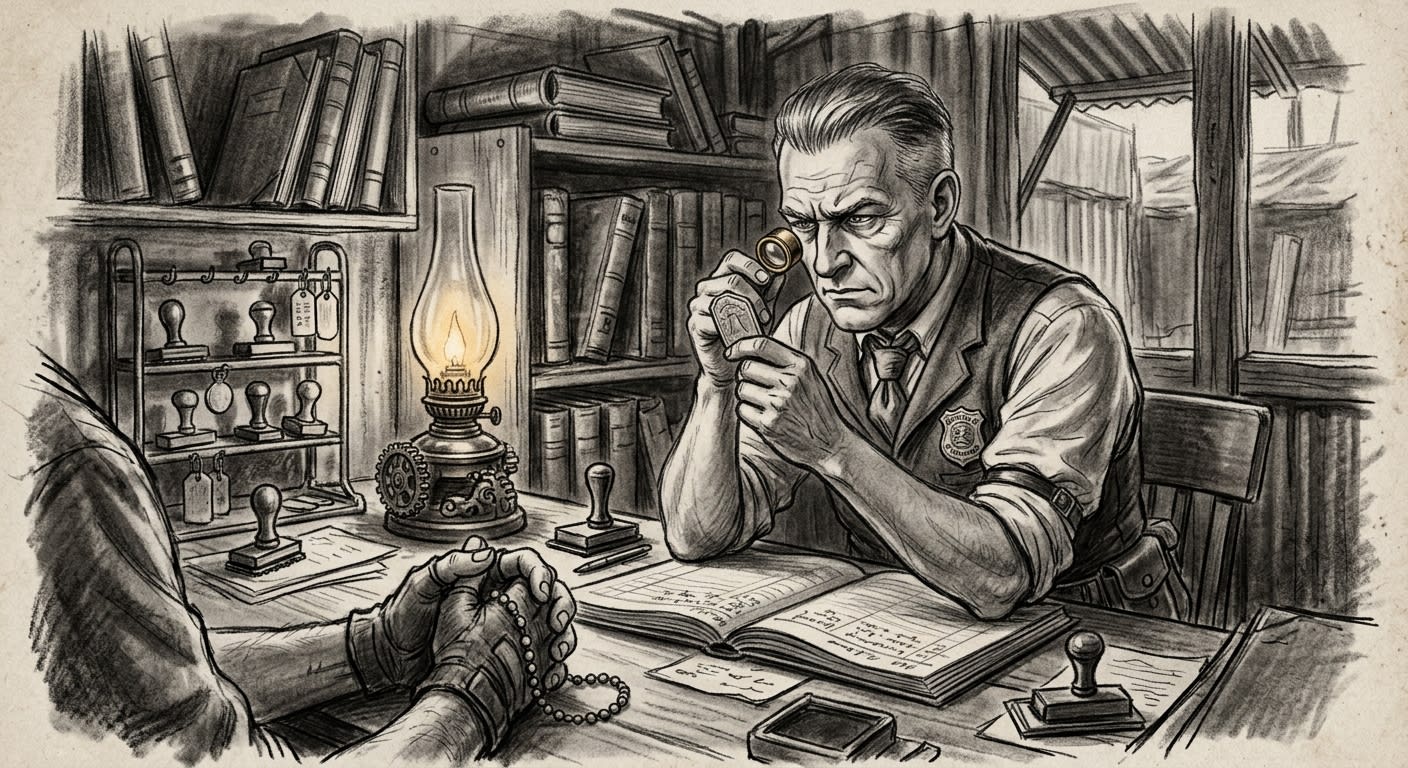
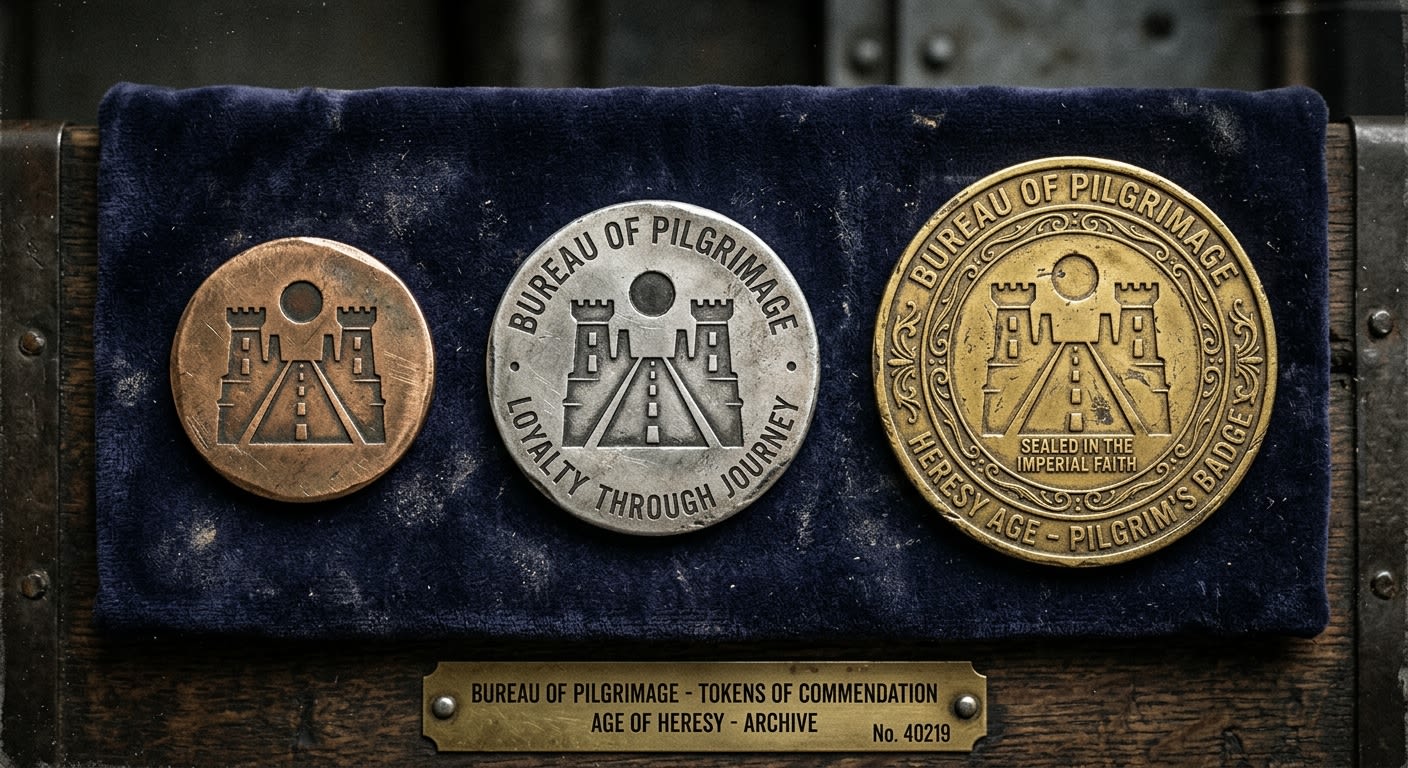
The pilgrim token is the Bureau's signature instrument — a disc of stamped tin or brass, no larger than a man's thumbnail, bearing the sigil of the Bureau of Pilgrimage on one face and the route-code of the pilgrim's licensed journey on the other. To travel without a token is to travel without legal existence. Vagrants, in the Bureau's taxonomy, are persons who move without documentation; heretics are persons who move with purpose but without permission; unregistered pedestrians are — and I appreciate the Bureau's precision here — persons who move at all.
Tokens are issued at Bureau offices in every major city, at waystation desks along the pilgrim roads, and at the embarkation docks of Marseille, where the Bureau of Pilgrimage maintains its southern headquarters and where every ship bound for the Aegean carries a Bureau inspector whose responsibilities include token verification, creed-testing, and the confiscation of any cargo the inspector deems "spiritually irregular." The definition of spiritual irregularity is left to the inspector's discretion, which is to say, to the inspector's appetite for confiscated goods.
The tokens are tiered. A standard bronze token — the Pilgrim's Disc — covers local shrine circuits within a single province. A silver-stamped token — the Road of Saints — authorises inter-provincial travel along designated routes. The gold-sealed token — the Great Passage — permits access to the war-bastions, the reliquary cities, and the controlled-access shrines of the Sagittal Line, including the three annual pilgrimage days at Bastion-Constantinople. The cost of a Great Passage token is, as the Bureau's published tariff delicately states, "commensurate with the depth of the pilgrim's faith." In practice, this means approximately four months' wages for a tradesman, which the Bureau considers a bargain and which the tradesmen consider something the Bureau is invited to perform upon itself.
The true innovation, which the Bureau introduced in A.S. 140 and which has since become the envy of every revenue-generating office in the Theocracy, is the indulgence token — a device I confess even I find impressive. These are pilgrim tokens with embedded bell-hours: small brass mechanisms, sanctified by the Bureau of Bells, that toll as the pilgrim walks. Each step, weighted and measured by the mechanism's calibrated interior, rings a tiny chime — a fractional bell-hour credited against the pilgrim's accumulated sin. A man walking from Lyon to Strasbourg, on the correct road, at the correct pace, with the correct number of bead-recitations per mile, may arrive at the Cathedral with a full bell-hour's worth of indulgence already ringing in his pocket.
The indulgence tokens are, of course, counterfeit-prone. The Bureau acknowledges this. The Bureau also acknowledges that counterfeit tokens produce counterfeit absolution, which accumulates as spiritual debt, which compounds at a rate the Bureau of Rites has helpfully quantified. The forgers, when caught, are charged for the accumulated false absolution of every pilgrim who purchased their product — a sum so vast it ensures the forger's family will be tithing until the Creator returns. Or longer.
#On the Peregrine Jubilee
Every tenth year — the date fixed by Synodal decree, the specific feast day chosen by a committee whose deliberations are sealed and whose chairman has been dead for forty years but whose vote continues to be recorded — the Bureau of Pilgrimage conducts the Peregrine Jubilee.
The Jubilee is a procession. It is also a purge. It is also a land-grab. It is, in the Bureau's own published materials, "a celebration of the sanctified road and a rededication of the Synod's commitment to ordered pilgrimage." What it is, in practice, is a month-long march of chained penitents across every disputed route in the Theocracy, preceded by the Bureau's enforcement arm and followed by its assessors, during which any guild, consortium, toll-keeper, or opportunistic roadside shrine-operator whose license has lapsed, whose fees are in arrears, or whose existence the Bureau finds inconvenient is crushed — absorbed, dissolved, immured, or simply stamped out of the records with the particular finality that only a Bureau seal can achieve.
The penitents are the spectacle. Chains link them wrist to wrist in columns that stretch, on the larger routes, for half a mile. They walk barefoot. They recite the Road Catechism in unison. The dust their feet raise is collected by Bureau clerks and sold as relic-dust at the next waystation, which I consider an admirable circularity of revenue.
Blood stains the stones. The pilgrims call it sanctity. The locals call it slaughter. Both are correct, though the Bureau prefers to classify the distinction as "a matter of perspective best resolved by further pilgrimage."
#On the Bureau's Administration
The Bureau of Pilgrimage is headquartered in Strasbourg, in a building that was once the Guildhall of the Peregrine Brotherhood and is now — with three former guild-masters still mortared into the foundations — the most haunted administrative office in the Theocracy. The staff claim the building groans at night. The Bureau classifies the groaning as "settlement."
The southern headquarters at Marseille controls all seaborne pilgrimage: the embarkation schedules, the ship inspections, the dockside creed-tests, and the licensing of the pilgrim fleet — a flotilla of converted merchant vessels, each carrying a Bureau inspector, a shipboard chapel, and a manifest of souls cross-referenced against the Great Ledger before the anchor is weighed. No ship sails for Thessaloniki or the Saffron Bastion without the Bureau's stamp. No passenger boards without a token. No cargo rides below decks without an absolution slip, time-boxed to the estimated voyage duration — and if the winds are unfavourable and the voyage exceeds its spiritual window, the cargo spoils, the absolution rots, and the Bureau charges the captain a "sanctified delay surcharge" that ensures unfavourable winds are the captain's problem and the Bureau's profit.
The Bureau maintains field offices at every major waystation, at every bastion pilgrimage gate, and at every shrine-city of the first and second classification. Its personnel are divided into three orders:
The Route-Stampers — junior clerks who man the tithe-gates and waystation desks, verifying tokens, testing creeds, and collecting fees with a thoroughness that would be admirable if it were not also, in many documented cases, extortionate. A Route-Stamper's salary is paid partly in commission, which ensures his enthusiasm for finding fault with documents that were, until the moment of inspection, in perfect order.
The Peregrine Wardens — armed escorts and road enforcers who patrol the designated routes, protect pilgrim convoys, suppress banditry, and — when the Jubilee is in session — conduct the dissolutions. Each Warden carries a Bureau seal capable of voiding a road-licence on the spot. The seal is small. The consequences are permanent.
The Shrine-Assessors — senior officials who audit pilgrimage destinations. A Shrine-Assessor's visit determines whether a relic-house retains its classification, whether a shrine continues to receive Bureau-routed traffic, and whether the shrine's operators continue to operate at all. The Assessor's report is filed with the Bureau of Records. The Assessor's recommendation is filed with the Bureau of Purity. The distinction between auditing and inquisition is, in these cases, one of letterhead.
#On the Bureau's Reach
The Bureau of Pilgrimage touches every province, every road, every settlement where a shrine, a relic, or a commemorated saint draws the faithful from their homes. It controls the approach to Bastion-Constantinople, where civilian pilgrimage is permitted three days per year — each application routed through the Bureau of Pilgrimage, forwarded to the Bureau of Purity for screening, stamped by the Bureau of Records, and approved. Almost. It controls the shrine-ruins of Vienna, where the old Rationalist capital has been converted into a pilgrimage destination so thoroughly that the Bureau of Pilgrimage now offers guided tours of the rubble, complete with commemorative tokens and a gift shop the Bureau describes as "excellent."
It controls the Salt-Vigil Causeways, the Reliquary Switchbacks, and the overland approaches to every reliquary city from Lyon to the Cloister of Miscounted Beads — that peculiar pilgrim borough where the faithful come to confess computational sins and where the beadwork alone generates enough revenue to fund the Bureau's western operations for a quarter.
It controls the Widow's Pennies Exchange at Griefgate, where grief is converted to coin and coin to passage and passage to pilgrimage and pilgrimage, inevitably, back to grief — a cycle the Bureau has perfected into a self-sustaining revenue model.
It controls the dead roads too. The routes to No Man's Land — forbidden to civilians, open only to military convoys and the rare Bureau-authorised observer — fall technically under Bureau of War jurisdiction, but the Bureau of Pilgrimage issues the tokens for the support-clergy who accompany the convoys, and the Bureau has never met a jurisdiction it could not colonise one token at a time.
#On the Present Condition
The Bureau of Pilgrimage, as of A.S. 201, processes an estimated three million pilgrim permits per year. Of these, approximately two million reach their stated destination. The remaining million are absorbed by the road system — delayed at tithe-gates, diverted by washed-out passes, detained at waystations for creed failures, or simply lost to the vast machinery of sanctified travel. The Bureau does not classify these as failures. The Bureau classifies them as "extended pilgrimages of indefinite duration."
Revenue is growing. Pilgrimage is growing. The faithful flock to the shrines because the war is getting worse, and when the war gets worse the faithful pray, and when the faithful pray they walk, and when the faithful walk the Bureau stamps their papers and collects its fee. Fear is the Bureau's truest advertisement. The Great Deceiver, by threatening the world, funds the roads that carry devotion to the bastions that hold against the Great Deceiver. The circularity is exquisite. I have complimented the Bureau-Master on this design. He assures me it is not a design. He assures me it is Providence.
The Bureau of Pilgrimage's published annual report for A.S. 200 listed revenue from indulgence tokens at "4.2 million Crowns of Grace." A subsequent review by the Bureau of Tithes — conducted without invitation and received without gratitude — revised the figure to 6.1 million Crowns, suggesting the Bureau of Pilgrimage had omitted revenue from the Iberian coastal routes. The Bureau of Pilgrimage has responded that the omission was "a filing matter" and that the Iberian revenue "falls under a separate jurisdictional classification that Tithes is not authorised to audit."
NOTED — Bureau of Tithes, under protest. Bureau of Pilgrimage, under seal. A.S. 201.
The Velvet Choir operates in every pilgrim quarter south of Przemyśł. The Bureau of Pilgrimage is aware of this. The Bureau of Pilgrimage considers it someone else's problem — specifically, the Bureau of Purity's problem — and continues issuing tokens, licensing routes, and collecting fees with a focus the Bureau of Doctrine calls "admirably undistracted" and the Bureau of Purity calls "wilful institutional blindness." Both assessments appear in the same inter-Bureau memorandum. The memorandum has been filed.
Three million permits. Six million Crowns. Eight crushed guilds. Forty-one dead at Santiago, thirty-one dead at Saint-Malo, and an uncounted multitude of chained penitents dragged across the roads every decade to remind the provinces who owns the stones beneath their feet.
The Bureau of Pilgrimage calls this service. The faithful call it devotion. The dead in the foundation stones of the Marseille headquarters call it nothing, because they are dead, and the Bureau has classified their silence as structural.