
#On the Lowest Line
"Which gate sings?" — asked of strangers on the floodwall stairs. Few of them answer it correctly.
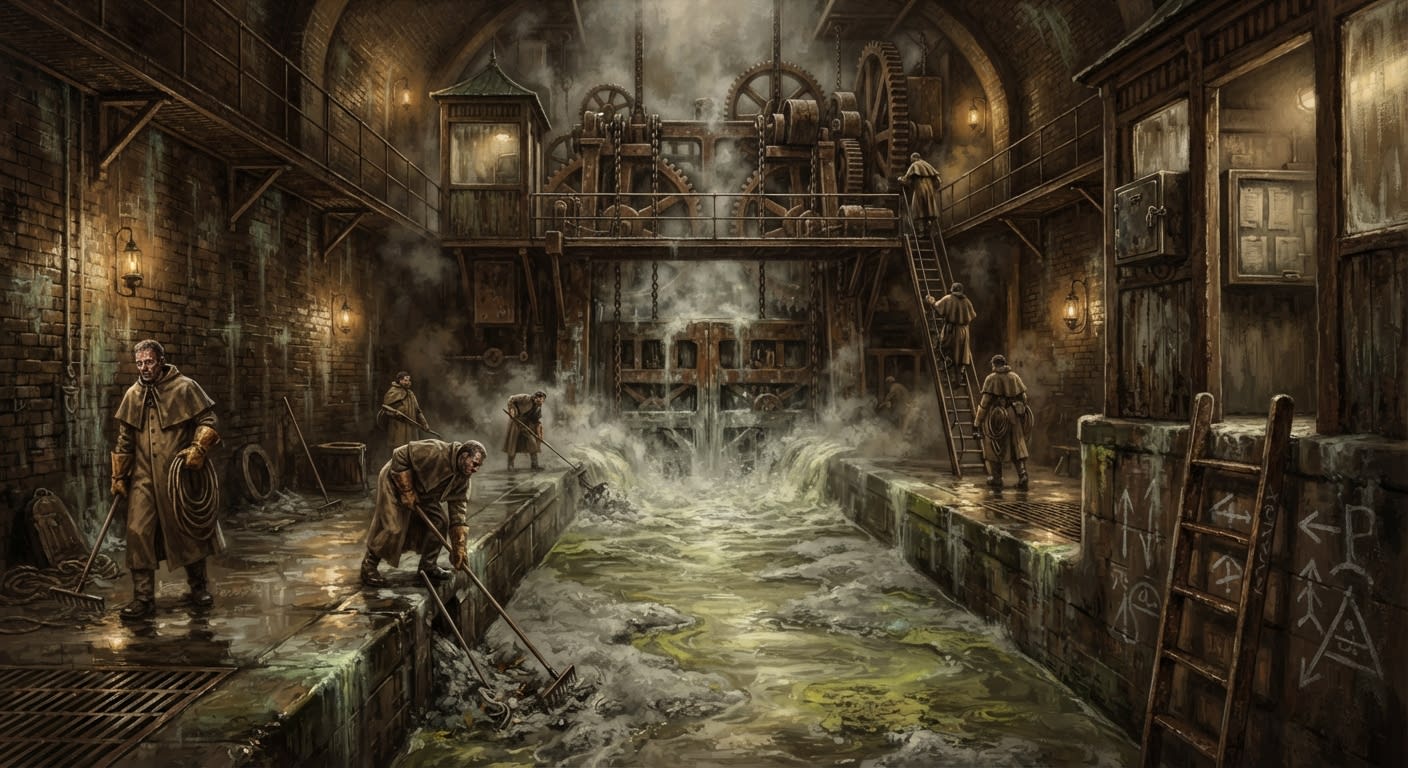
The Ash-Sluice Line is the bottom of Candle-Sump. Candle-Sump is the bottom of Lower Vire, and Lower Vire sits at the lowest bend of the River-belt. Whatever is poured from a height anywhere in the Zone 1 heartland ends up here: ash, lye, soap-scum, the dead and the Bureau's opinions. The Line runs the length of the canal spine beneath the seven wards stacked above it. It is a trench of soot brick, iron grates, gatehouses and floodwall ladders, worked by drain crews that the Sluice Prefecture calls sanitation labour and the district calls the Sluice Strong. It smells of wet soot and caustic soap. After the second hour the nose gives up. The lungs keep objecting.
In the language of the writ, the Line exists to keep the drains moving and to stop lye pooling in the streets. That is true in the way a confessional exists to hold a chair. Every gatehouse keeps a chart recording when water moves, where it goes, and for how long. Whoever writes the chart decides which alley floods, which skiff waits, which paper dries, and which street the Prefecture may certify as clean.
#On Gate IX and the Lye Flood
The Line has no founding of its own, and anyone who gives it one is inventing. It inherits its origin from the ditch. The Sagittal Line was established in A.S. 65, the canal locks of Lower Vire were dug within a decade, and Candle-Sump began as a drainage canal serving those locks. The brick channels of the Ash-Sluice Line are that canal. The ward is the canal plus the people who could not afford to live anywhere higher. By A.S. 78 the ditch had walls and residents.
The Lye Flood of A.S. 84 reached the Line first and drained from it last. Ash runoff from the cremation stacks turned the canal caustic. It stripped skin, dissolved paper and burned tide-marks into the soot brick. They can still be read on the Floodline Marker Stairs, where old graffiti maps the safe heights. Within the month the Synod installed the Sluice Prefecture, with authority over gate timings, flood releases and the definition of "clean." The Line became its territory, and Gate IX its throne.
Gate IX is the bottleneck of the whole district. It governs flooding, trade skiffs and disease runoff, using rust-iron gears the size of cart wheels that groan through a constant mist of lye. At certain water pressures the gate sings. The note is low and sustained, like a bell struck underwater, and the Sump calls it the gate-song. It is heard in the minutes before a flood release, and every mother on the Line teaches her children to climb when they hear it. The Bureau of Records would not show me any construction writ for Gate IX. The numeral implies eight predecessors. The sluicers say there has only ever been Nine.
The River-Belt Chapterhouse property schedule lists the Ash-Sluice Line under "Drainage Infrastructure, Non-Residential," exempt from census, ration audit and pastoral visitation.
People are born, conscripted, tagged and drowned on the Line. It is also where the Sluice Prefecture physically operates Candle-Sump. The schedule has been amended. The exemptions have not.
#On the Crews
The crews change shift at dawn, under the first quarantine bell. Ash-sluicers wade the channels, raking ash foam toward the sluice mouths. Gate riggers climb the gear housings and lift cages. Lime-masons patch the brick with bone-lime cement, and the sources of the bone are recorded carefully somewhere else. Quarantine runners carry ribbons along the towpaths. Skiff haulers pole cargo through the locks. The lye-scar medics treat burns and collect blackmail at the same stall, and I found both services competent.
They are paid in hazard allowances, which the Prefecture settles on time and the Line spends before evening. Hardly anyone on the Line volunteered. Sanitation conscription brings some. Ration holds turn a debt into a shift roster. Confession penalties turn a sin into a season in the channels. Quarantine service quotas require every ribboned household to send one body to the water. Lye burns, flood crush, drowning and rot-lung account for most of the Line's recorded deaths. The rest are recorded at the discretion of the Great Ledger's clerks.
Their equipment is a fair inventory of the district's anxieties: rust keys, waterproof capes, cough masks, lye-scar gloves, sluice pass slips, gate labour assignments, soap stones, bone tokens, and the stubs of old quarantine ribbons kept as proof of ribbons survived. They have their courtesies. A person shows clean hands. A person offers tag receipts with both hands. Everyone steps aside for the broth wagons from the Marrow Kitchens, which cross the Line under guard.
They have three laws, and nobody sells exemptions from them. No body moves without a tag. No quarantine ribbon is falsified. No sealed crypt mouth is opened after curfew. Rumour says all three have been broken, and that the gatehouse charts record when.
#On Water as Jurisdiction
Prefect Sera Mott rules the Line from the gatehouses. Her instruments are the gate charts, kept in locked chart boxes, and the flood releases they authorise. With one release she can drown an alley of debtors, stall a rival's skiffs at the lock, wash a quarantine cordon clean or soak a street's paper stock into pulp. Her Sluice Wardens check permits at every crossing. Bone-Tag clerks check receipts beside them, because a corpse moved by skiff without a tag is not a person. It is waste, and waste goes into the canal with the ash-water. The Wardens take bribes in tallow, soap, clean paper and medical tincture. Mott wears gloves at all times.
The Marrow Kitchens and the Prefecture keep what is technically a truce. Mott controls the water under the broth wagons and Matron Ilka controls the broth in them. Each could starve the other's people within a week. Neither has yet, and both keep count.
The charts have one more use, which no one on the Line mentions and everyone there understands. The bottleneck is where everything the district must not move ends up moving: untagged bones, blank identity stock, unsealed ink, relic-grade marrow, living patients without quarantine ribbons, dry paper, underworks maps, clean-slip bundles, blue-burn candles and master-seal wax. A contraband skiff passes Gate IX at a set bell or not at all. The chart shows the bell, and it is widely believed to hide a smuggler's schedule inside the flood timetable. During my inspection in autumn A.S. 197 I compared two charts and found releases entered for bells when the water did not need releasing. When I asked why, a Warden told me the water did not share my view.
#On What Runs Below
Iron ladders run down behind the floodwall to landings that the Prefecture's maps mark "collapsed." Upstream, the crypt mouths breathe through vent alleys into the district. The Bureau of Alchemical Standards has classified the drafts as a Category Two Localized Atmospheric-Scribal Disturbance since A.S. 194, still pending review. They carry rot-spores, and they carry the name-whispers that make ink bleed and candles gutter in shapes resembling letters.
The Sump holds that the water controls the air. High water in the channels chokes the vents. Low water lets the underworks breathe, and after a long release the drafts blow strong and sweet. The Line's word for that smell is vent-sweet, and it means stop breathing. The Bureau survey notes I was allowed to read record that blue-burn reports cluster in the hours after release bells. They recommend a further survey.
I am permitted to reason even where I am not permitted to conclude. If the gates govern the drafts, and the drafts carry the names that surface as clean slips on Registry paper, then a gate chart is also a harvest schedule. Whoever keeps the chart decides how many dead people are available for re-issue in a given week. Whether Mott keeps the only copy is unknown. So is the identity of the hand below the Line that reads the water from underneath.
The access shaft at Gate IX's eastern gear housing descends [REDACTED] rungs to a landing where the draft is warm and the brick is dry. Dry brick does not occur anywhere on the Line.
#On the Present Condition
As of A.S. 201 the district is classified AMBER, and the Line bears the weight of it. The Registry and the Prefecture are in open dispute over the seized clean-slip stockpiles. Chief Clerk Voss claims them as documents. The Prefecture claims anything taken from the water. The Care crews have threatened a strike, and if they strike the broth wagons stop crossing and the sluicers work hungry beside open grates. The Candlewright Compact's wick blight has put fires out across Lower Vire, so fewer candles burn near the vents to show which way the drafts are blowing. The Washhouse cartel is preparing to swap several hundred names in a single week. However that is done, the names must pass through water, paper, a gate schedule or the underworks, and every one of those runs through the Line.
That is why Inquisitor Halvyr, called "White-Lung," will go to the chart boxes before the Arcade. The transfer order is still moving through the Bureau of Purity's approval chain. Halvyr brings a portable audit press and burn authority. An audit of the Registry would find forged paper. An audit of the gate charts would find the schedule behind the forgery. Any purge of Candle-Sump, or any riot against one, will begin by taking Gate IX, because whoever holds the gear housing holds the water, and whoever holds the water holds everything else.
At dawn the sluicers are still raking foam toward the sluice mouths, listening for the gate-song and asking each other which gate sings. I will not record the correct answer. The Bureau does not need it, and the Inquisitor should have to ask.