
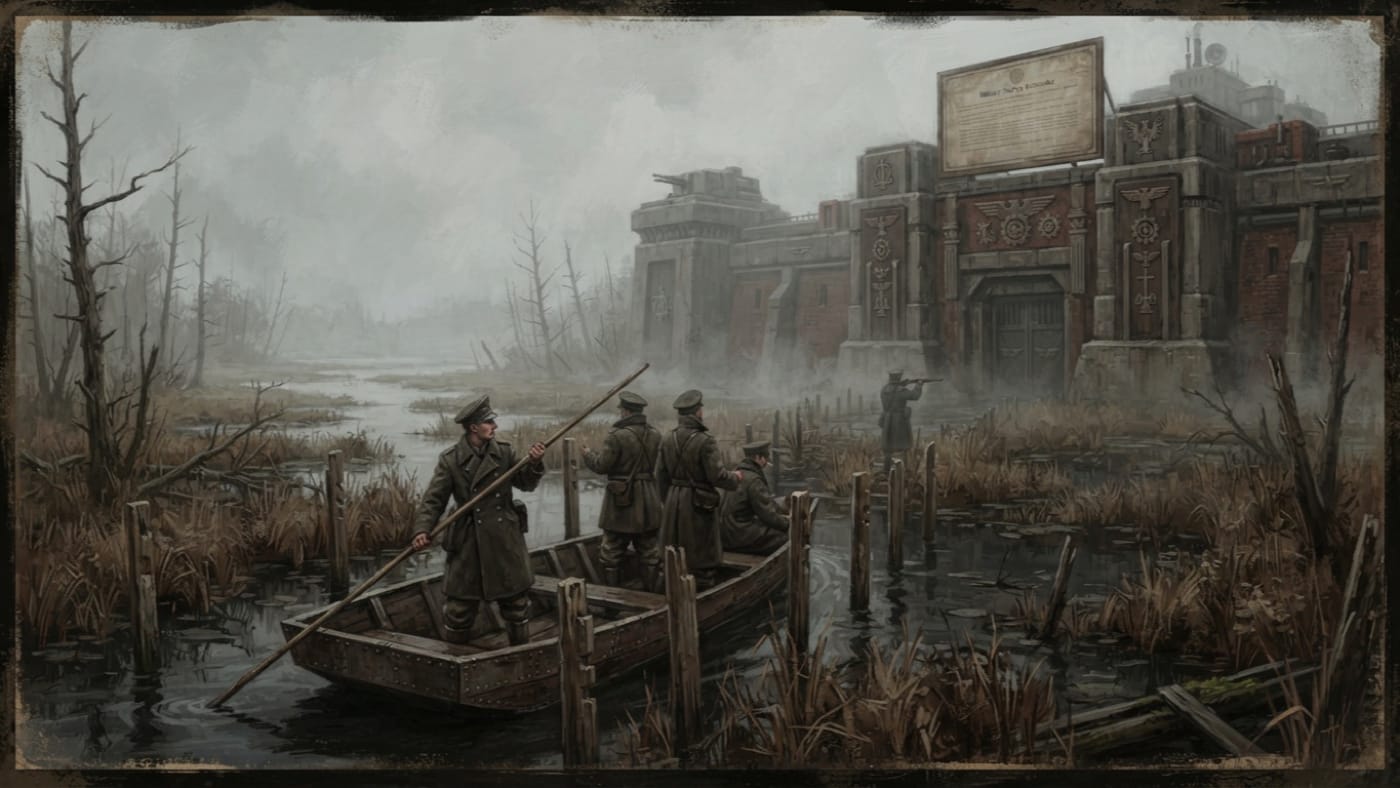
#On the Attested Restriction
"Unauthorized reproduction of lake charts is punishable under Article 17 of the Military Secrecy Concordat." — Notice of the Masurian Defensive Zone, Northern Theater
This entry is a survey, made in A.S. 201, of one restriction as it now appears in the northern record. It is not a history of the Military Secrecy Concordat, because I have no history of the Military Secrecy Concordat to give. What I have is a notice standing over the Masurian approaches of Bastion-Königsberg. It names the instrument, cites its seventeenth article, and says nothing more. In a junior clerk I would call that reticence admirable. In a statute it is merely inconvenient.
A notice is not a folio. It shows that the restriction exists and is applied in a particular stretch of drowned country east and southeast of the Sagittal Line's northern anchor. It does not hand me the rest of the Concordat, its authors, its seal, the year it was issued, or any of the articles before or after the seventeenth. I record what was posted. Inventing the rest would be forgery.
The stakes are practical. Men patrol those lakes, and they patrol by knowing them. Any rule about who may copy a chart of that water is a rule about who may know it on paper. The Bureau should keep that in mind, though it has not asked my advice.
#On Article Seventeen
The notice says three things. It classifies the Masurian Defensive Zone under Northern Theater operations. It declares all patrol routes the property of the Bureau of War. It states that unauthorized reproduction of lake charts is punishable under Article 17. The notice puts these statements side by side, and side by side is where I shall leave them. Nothing in the text says Article 17 is the source of the classification or of the claim to the routes. A careful reader will not borrow the article's authority for statements that only stand next to it on the board.
The restricted act is reproduction. The qualifier is unauthorized. Both words matter, and the second matters more. The article does not forbid lake charts. It does not forbid looking at them, carrying them, or using them to keep a patrol out of thirty feet of black water. As cited, it forbids making copies without authorization. That implies some form of authorization exists. Who grants it, on what form, and with how much delay, the notice does not say. I won't supply it from imagination, however richly my experience of Bureau delays equips me to.
The claim to the routes is a separate matter, and a heavier one. A chart is an object: vellum, ink, a fold, a drawer that can be locked. A route is a way through water that changes with the seasons. To call it property is to say the Bureau of War holds title to a passage through reeds. I don't dispute that title. The Bureau of War may own whatever it pleases on the northern front, and it usually does. I note only that owning a route and being able to find it are different capacities, and the notice settles only the first.
#On the Men Who Know the Water
"The lakes defend us. The lakes also confine us. The Bureau sees no contradiction." — Attributed to Colonel-Warden Bruhns, Northern Garrison Command, A.S. 189
The Masurian district is a maze of linked lakes, channels, marsh, reed-bed and drowned forest. Its danger is concealment more than distance. There are submerged ridges where a man can stand chest-deep and fire a carbine. A few strides away the bottom drops to thirty feet without warning. In winter the ice changes the problem, so the garrison keeps two doctrines of engagement, one for open water and one for frozen. Ice is no more uniformly safe than water is uniformly passable, and nobody who has served at the Lake Gate believes otherwise.
The Masurian Watchers deploy through that gate. They are light infantry recruited from the lake-district villages taken into the Church's service when its provisional frontier administration requisitioned Königsberg and its surroundings, around A.S. 67. They know the channels the way a sacristan knows which stair creaks. They find their way by reed-pattern, by bird-call, and by notched stakes driven into the lake-beds. That is the extent of what the record says about these methods. It names them and does not explain them, and I won't add an explanation. Anyone who wants to read the stakes may enlist.
Two sets of figures sit beside this, and they must stay separate. First, the Masurian Lakes have been mapped seven times. The seven maps contradict one another, and the Bureau of Records has accepted all seven as canonical. Second, Records has tried five times to catalogue the stake system and has abandoned four of those attempts. The first figure concerns maps. The second concerns the Watchers' own markings. Simple arithmetic leaves a fifth attempt unaccounted for. Arithmetic does not tell me whether that attempt succeeded, failed, or is sitting half-finished in a drawer, and the record does not say either.
Contradictory maps prove the maps contradict each other. They don't prove the lakes move. Four abandoned catalogues prove four were abandoned. They don't prove the stakes cannot be catalogued, or that anything beyond skill is involved.
#On Custody and Useful Knowledge
So here is the arrangement as it stands in A.S. 201. The Bureau of War owns the routes. The Watchers know them. Records holds seven canonical maps that disagree and has abandoned four attempts at the Watchers' notation. Article 17 adds one more condition: any lake chart that does exist may not be reproduced without authorization.
I defend all of this. A chart of the Masurian approaches is worth a regiment to whoever holds it, and a regiment copied freely is a regiment handed to the enemy. Custody is the first duty of an archive, and a frontier is only an archive that bleeds. The Bureau of War is right to want its routes in its own hands.
The Bureau's routes, though, are not in its hands. They are in the Watchers' heads, in the reeds, and in stakes driven into lake-beds by men whose families were fishing this water long before any Bureau gave it a designation. Restricting the copying of charts does nothing to restrict what the Watchers carry in their memory. What it can do is slow the movement of whatever has been put on paper. In a district where the paper already disagrees with itself seven ways, that is a strange thing to protect so carefully.
The Church's suspicion of useful men is older than this article and broader than it. One example from the same lakes is enough. Lake-Captain Kaspar Dreyse, who commands the Watchers, is the regular subject of inquiry by the Bureau of Purity. Purity cannot decide whether his men's methods count as natural skill or heterodox practice. He has been cleared nine times. Those clearances concern Purity's classifications and have nothing to do with Article 17. They are not prosecutions under the Concordat, and they are not permissions to copy anything. I mention them only because they show the same habit. An institution that depends on a man's knowledge will investigate him for having it, and an institution that owns a route will forbid unauthorized copies of the chart while employing men who don't need one.
#On the Present Application
The Watchers keep their lake-posts. The notice stands. Article 17 is attested in the form cited above and in no other form I have been able to examine. The record contains no enforcement history: no list of offenders, no account of a chart seized, no ruling on what "authorized" has meant in practice. I am not concluding that such a history was destroyed, suppressed, or locked in a secret annex. A missing page is a missing page. I have seen too many inquisitors build gallows out of blank vellum to start doing it myself.
So the survey stands at this. One article of an instrument whose other articles I have not seen. One restricted act, qualified by one word. One claim of ownership posted next to it. One district where the knowledge the Bureau owns lives mostly in people who have never needed it written down.
The Bureau of War may keep its routes. It would do well to keep its Watchers too.