
#On the Office and Its Measure
"A smile is a receipt." — Wexel proverb
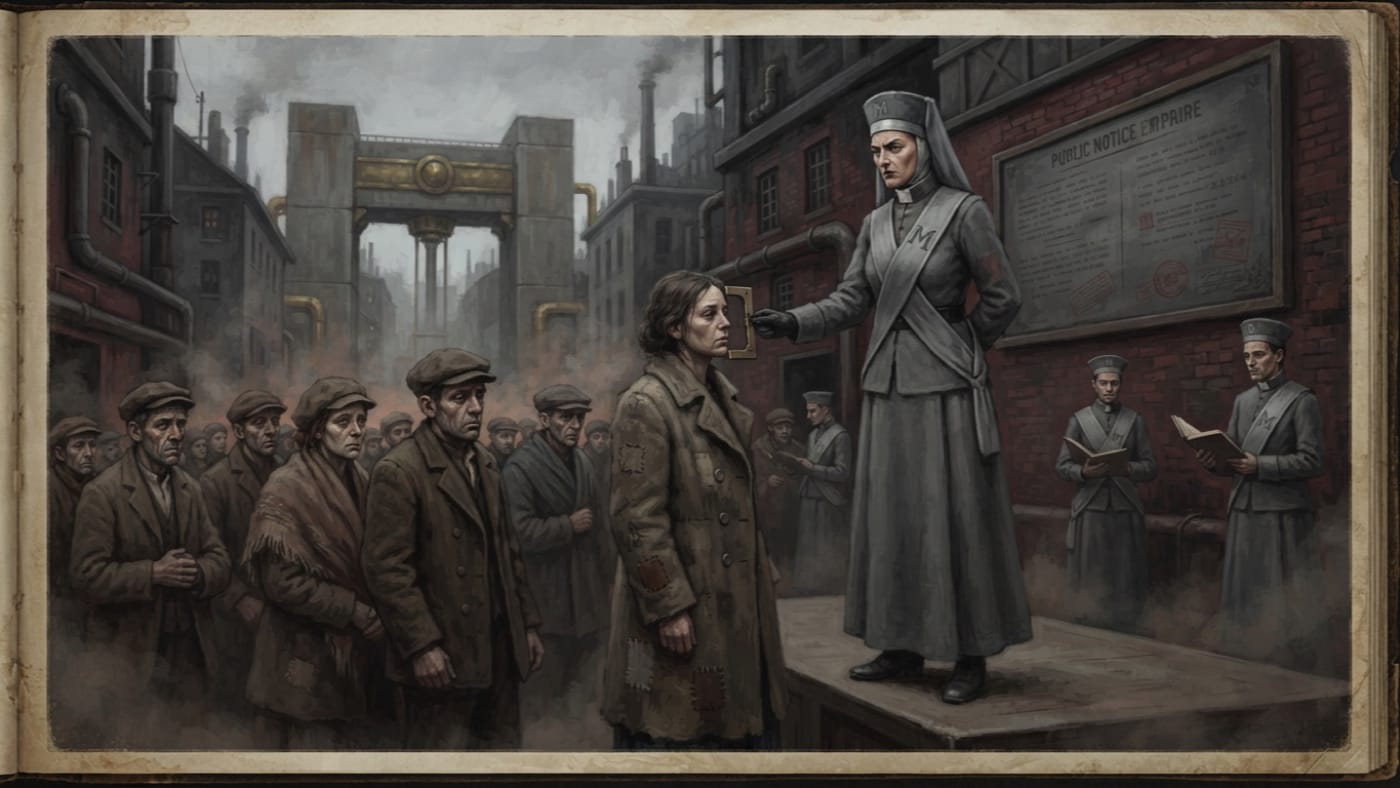
The Mirth Office is the name Wexel uses for the Doctrine Office of Emotional Compliance. Nobody in the Grain-Gray Ration Parliament of Wexel uses the full title if they can help it, because saying it takes long enough to count as a pause, and the Office has cited pauses before. Sister-Lector Neme Varr directs it from Mirth Office Row, a street that smells of incense and sour tea. On paper its purpose is moral hygiene. In practice it polices the faces of a ration town on a principle no charter states: people who are never seen enjoying themselves will not organize themselves either.
Its authority is local. It is one town's doctrine bureau, and whenever anyone confirms its jurisdiction, the confirmation comes from the Bureau of Doctrine.
The Office's instrument is a small curved brass gauge, hinged at one end. Varr's own is the model for the rest. An inspector holds it against a citizen's face to judge whether the expression counts as "measured contentment." Too much expression earns a citation for unearned joy. Too little earns one for ingratitude. The Office's reports give the permitted tolerance as three millimetres. I measured it, and it is two.
The Office also requires expression, and that matters more than the ceiling. Every week at Mirth Rollcall, each household reports its gratitudes aloud. A family that keeps its face too still at Rollcall owes the joy quota. A family that grins at the Scale Gate owes the smile-tax. A careful household can owe both in the same week.
#On the Emergency That Remained
"Hunger teaches holiness." — Ration Prefecture broadsheet
Wexel was founded in A.S. 98 / 1808 CE, after a Hessian famine killed eleven thousand people and the Bureau of Records blamed the deaths on insufficient grain accounting. A clerk became a committee, and the committee became a parliament. The parliament began taxing moods before any Mirth Office existed. The town's own accounts disagree about how many years that took, five or seven, and I will not settle a quarrel between two documents that both flatter the town.
In A.S. 112 / 1822 CE, grain dust in the old wooden silos ignited and killed three hundred and forty people. That is the physical account. Doctrine's account blamed "reckless behaviour," meaning singing, running and carelessness with flour, and the Bureau of Purity would soon stretch the phrase to cover any unregulated sign of life. The Ration Prefecture was constituted within the month. The Mirth Office followed within the year. Joy discipline was introduced as a temporary public safety measure, and it has stayed temporary for eighty-nine years.
The Office's first preserved citation is older than its authority. Case 112-MO-44 was filed six weeks after the fire. Orven Tesch, a mill hand, was fined for laughing during the Silence Minute before the noon ration. Tesch denied laughing, and twelve witnesses denied hearing him. He paid in labour-hours, and his household's allotment was cut for two weeks.
The citations came four months before the authorization. The authorization was then backdated. A Ration Prefecture bulletin of A.S. 113 claims the proper order, with authorization first. Records has certified the sequence as "administratively continuous." The Office was fining Wexel before it existed on paper, and the paper has since been persuaded to agree.
#On Inspection and Account
"Hunger hears everything." — Wexel proverb
Inspectors are trained at the Mirth Office Schoolhouse on the Row. They learn to read micro-expressions, calibrate smile-gauges, and draft citations in the prose that turns "a man laughed in public" into "unlicensed emotional expenditure constituting potential doctrinal infraction." The Schoolhouse walls also hold a confession archive.
The Office employs forty-three inspectors in grey sashes. They patrol the markets and the schools. At midday they walk the Chit Market. At the Scale Gate they stand beside the weighline clerks and watch faces while the iron weighs sacks. Townspeople call the inspector's gaze count-cold. A citizen holding the forced neutral face called measure-face has to keep it through the weighing, the stamping, the tallow-wax seal and the walk home. A man whose face looks well fed may lose part of his allotment for "suspect abundance."
A citation is entered in the household ledger as a mirth mark. Mood confessions are attached to the same ledger. Laughter permits are issued by event, are tightly limited, and come with conditions. In A.S. 194 I was given one, valid for a single controlled exhalation.
The Office keeps a citation archive of more than twelve thousand entries and a holding cell called the Laugh Box. The Laugh Box is cold wood and wax. There are beatings there. Someone carved a joke-code into its boards, and nobody in Wexel will say who.
Earlier compliance reports described the Mirth Office as "an advisory body with no enforcement capacity."
Retracted. An advisory body does not employ forty-three inspectors, keep twelve thousand citations, or need a cell. The Office's advice comes with a ledger entry and a door that locks from outside. The Bureau of Doctrine sees no reason to clarify the distinction further, and neither do I.
Each part of the machine has its own owner, and in Wexel the division of ownership is how the cruelty works. Varr's Office produces citations and intelligence. Prefect Marwen Kile controls household grain allotments and decides whether a family's bread is recorded as provision or as clemency. Speaker Huld Bex runs the parliament's proceedings and keeps the name drawer under the dais. The Ash-Fine Marshals carry out foreclosure. A family behind on its fines receives an ash bill and has three days to pay. On the fourth day the Marshals come with torches and carts. The Office burns nobody. It writes the entry the burning will later cite.
By the Bureau of Records' own accounting, mirth-compliance fees made up eleven percent of Wexel's municipal revenue in A.S. 199.
#On Payment in Names
"Names are currency. Pay in people." — Canalback saying
A citation can be cleared, but not with money. The name payment is the townspeople's term for clearing your own record by offering someone else's name. The Office accepts. The name enters its intelligence files, and from there it can travel to the parliament's name drawer and the Prefecture's sealed files. Some names come out with a clearance stamp, some with a foreclosure writ, and some come out with nothing at all.
The bread stall in the southeast corner of the Chit Market arcade makes the policy plain. It runs a counterfeit-chit ring. The Office knows about the ring and permits it, because the stall's proprietor supplies names. Enforcement in Wexel is selective by design, and the stall is one of its best producers.
Every name payment also goes into a surplus ledger that does not appear in any accounts Records has published. Grain listed as consumed in the public books shows up there as diverted.
SURPLUS LEDGER — cross-reference, Mirth Office intelligence: names received ███ quarterly; tonnage ████████ diverted; destination ████████████; beneficiary ████████████. Entry withheld per standing order.
The Cellar Circles, who call themselves the Quiet Mirth, operate under all of this. They meet in undercellars and in the Canalback shacks. They pass jokes in coded proverbs and in folded mirth scripts. They announce themselves with knocks on cellar doors, and they share grain and lamp oil with neighbours who have run out. They are small. Every circle has to assume an informant is in the room, because the Office pays for exactly that. Most of the jokes are not funny. Owning one is the offence, and owning one is the point.
#On Evidence Carried by Air
"If the wind laughs first, don't answer with yours." — Wexel superstition
The Chaff-Winds of Wexel are classified as a Category One Localized Atmospheric-Acoustic Disturbance. They are dry gusts that carry grain dust and repeat sounds. They repeat genuine laughter faithfully, and they rearrange speech: a quota read in the Parliament Hall comes back from the corridor sounding like a question.
The Office treats the wind as a provocation, and so as evidence. Inspectors record "airborne mirth." Citizens have been cited for laughter the wind carried in from somewhere else, and in the worst cases for responses they were judged likely to have made if the wind had kept going. Temptation is treated as proof of susceptibility, and susceptibility is something the Office can bill.
The countermeasures are salt lines at cellar doors, wax plugs in keyholes, and joy masks worn during audits. None of them works. A joy mask hides the face and leaves the shoulders free to shake, and an inspector looking at shaking shoulders will assume the laugh is about him.
Ink in the citation ledgers dries into curved loops that look like smiles. In A.S. 199 I examined three of those ledgers. Every page had loops, and no two loops were the same. The loops do not erase or rewrite text the way Hungry Ink does. They sit beside the entry, and a clerk who sees a smile next to a surcharge sometimes hesitates. The Prefecture has tried chalkboards, slate tablets and spoken citations read out under the bell. The chalk dust settled into crescents. The slate scratches curved. The wind repeated a spoken charge with a laugh in the middle of it. By A.S. 201 the Office had gone back to paper.
Jurisdiction is still disputed. The Bureau of Rites, the Bureau of Doctrine, the Bureau of Records and Wexel's own officials each claim some part of the anomaly. Doctrine's current notice confirms the Mirth Office's jurisdiction. Both claims stand. I have not been asked to choose between them.
#On Present Application
This tract is dated to the present year because the Office still operates, not because I have returned. My last visit was in A.S. 199. What follows on the present comes from the Office's current notices.
In A.S. 201 the Silence Minute is still observed before meals. Rollcall is still held every week. Inspectors are still at the Scale Gate with their gauges, the bread stall is still supplying names, and the Laugh Box is still cold. A household that laughs, or is said to have laughed, or looks too well fed, or is too slow with its gratitude, gets a mirth mark. A mark can lead to a smaller allotment, labour-hours, a name taken from the drawer, or an ash bill with three days to pay.
The acceptable range is still two millimetres. Wexel's citizens know the number, and when someone asks how their mouth is today, they answer with it.