
#On the Recorded Force
The Northern Garrison appears in the Ledger once. In A.S. 65 / 1775 CE it deployed from Berlin to Hamburg, a port that was rioting over bread it did not have and tithes it was still paying. That is the whole file. The record gives the force a name, a point of departure, a destination and a year, and nothing more.
The entry exists because a name in a parent file needs a folio of its own. Without one, readers who meet the words "Northern Garrison" in the Hamburg survey will picture a regiment with colours, a roster, a barracks and a long, honourable history of drinking in it. None of the folios placed before this office supplies any of those things. The commander is unrecorded, and so is the strength. So are the road, the day of arrival and the length of the stay. I have declined to supply them, and declining took some effort, because a blank column tempts a scholar the way an unlocked poor-box tempts a sexton.
#On Berlin and the Year
The Garrison set out from Berlin, and in A.S. 65 it could have set out from nowhere else. Kanzleiburg is the name the Synod gave the city in A.S. 95 / 1805 CE, when it absorbed the Prussian state. Thirty years separate the march from the rechristening. A clerk who writes that the Garrison left Kanzleiburg has moved a city across three decades without shifting a single cobble.
The year needs its own caution. A.S. 65 falls twenty years after the Sundering. A provisional council had governed since about A.S. 50, gathering offices and seals faster than it gathered the authority to use them. By now the Sagittal Line could be defended, but it was unfinished, and its practices would not be standardized for some years yet. The formal Synod was a quarter-century away, at the Concordat of Strasbourg in A.S. 90. There were ecclesiastical authorities. There were tithe collectors. There were no chartered Bureaus to sign anything in this matter, and a reader who imagines a Bureau stamping the order of march is imagining a stamp that had not yet been cut.
The record does not say on what terms soldiers from a Prussian city entered a port that paid the Church's levies. It does not say who asked for them, or who answered for them afterward. Berlin's sovereignty is known. Its arrangement with Hamburg that year is not.
#On the Nine Days
The harvest failed. The levies did not. That is the famine in seven words, and the Famine of A.S. 65 keeps the rest of the port's suffering under its own seal. That season Hamburg learned what every assessed parish learns sooner or later: a tithe is reckoned on the grain that ought to exist, and it is collected whether or not the grain agrees to exist.
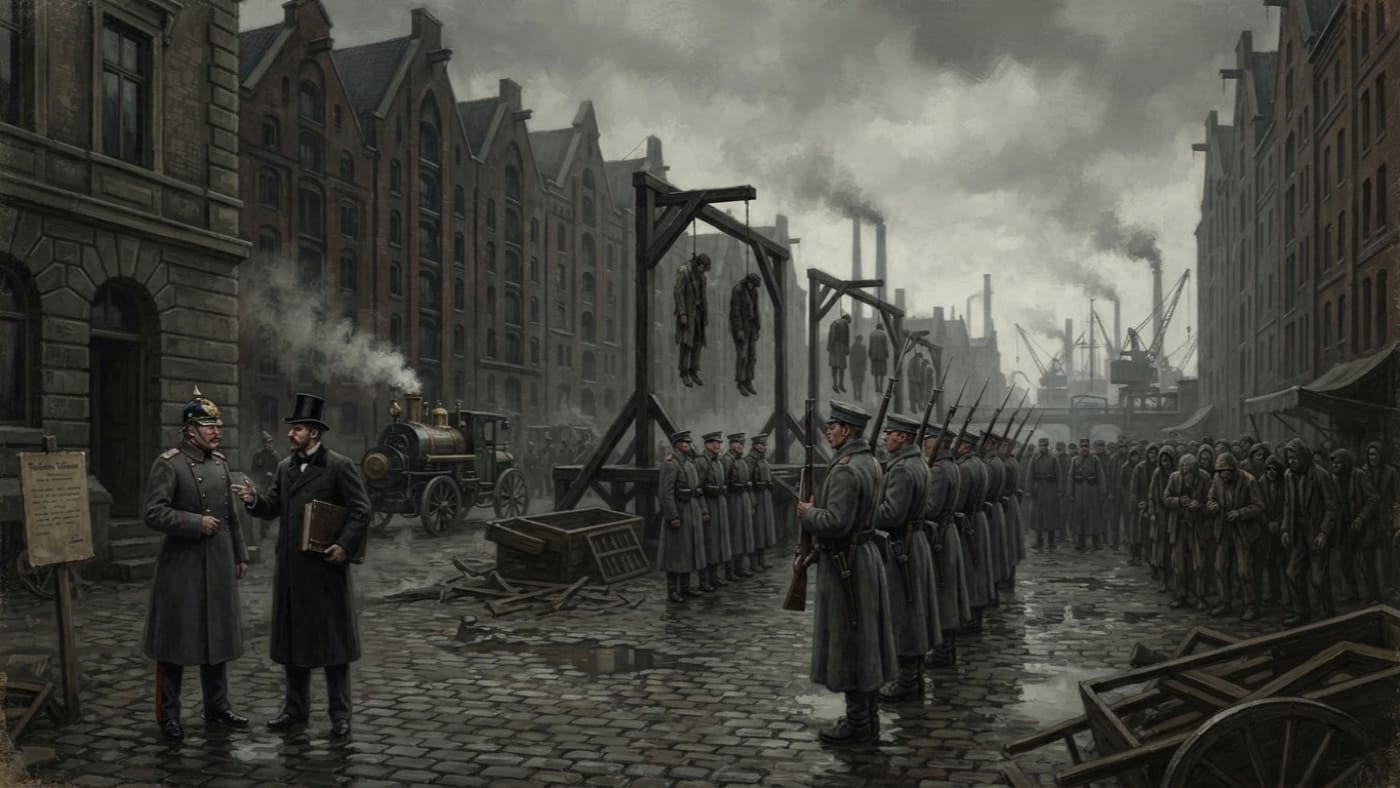
The city rioted for nine days, and the Northern Garrison deployed from Berlin. The record sets those two facts side by side like communicants at the rail and does not say which knelt first. It also gives no hour for the Garrison's arrival or departure, and it gives no account of what the soldiers did in the streets. I have not written one for them.
The record does settle what kind of response it was. A famine is a failure of supply, and its remedies are the dull instruments of a granary: grain, credit, remission, patience. Hamburg got soldiers. Whatever the Garrison did once it arrived, its dispatch shows how the authorities had classified the trouble before anyone in Hamburg was fed. A hungry port counted as a problem of order, and problems of order are answered from the barracks.
It was a young government. Its Line was unfinished, its offices provisional, its seals still warm from the engraver. Young governments fear crowds in a way old ones do not, because old governments have learned to file them. In A.S. 65 the authorities had not yet learned. They sent men from Berlin.
#On Spiritual Compromise
The ecclesiastical authorities declared the rioters "spiritually compromised by hunger." The phrase survives. Its authors have not survived by name, and none of the folios I have seen attaches a tribunal, chapter or council to it.
Read it as a clerk would. Hunger is the instrument, the means by which the soul was compromised, and the fault lives in the soul. A belly is an administrative matter. It can be filled from a granary, charged to a ledger and entered as a loss. A soul is a doctrinal matter, and doctrine has its own remedies, none of them bread. In five words the authorities moved the disturbance from the tithe-roll to the confessional, and in the confessional the assessor is never the penitent.
I make no claim about what those authorities believed in private. They may have believed every syllable, and sincerity has never yet stopped a sentence. The record says nothing of demons in Hamburg that season. It mentions no possession and no contagion, and no exorcist summoned to the Fishmarket. I add none. The diagnosis was spiritual. The only evidence for it was that people were hungry and angry, which is evidence of hunger and anger.
The rioters were hanged.
The record says so in four words, and I will not improve on them. It does not say how many. It does not say who tied the knots, whether the Garrison's soldiers, Hamburg's own officers or some third hand. It records no trials, and I will not draw up a docket for people whose names were never entered. In the files, the deployment and the executions belong to one response. Whatever connected them has either been cut out and burned or was never written, and from this distance the two cannot be told apart.
#On the Fiscal Quarter
The files list the concession after the rope. The levies were reduced by two per cent for one fiscal quarter. When the quarter closed, they went back to their previous level.
The figure is two per cent. No base rate is filed, so I will not turn the figure into points off a rate, and I will not work out what a Fishmarket household saved, because nobody recorded the household. The reduction lasted one quarter. A quarter is a unit of accounting. No folio shows the failed harvest recovering on the tithe-calendar's schedule.
"Concession" is the most generous word available, so I use it. It was no programme of relief. Nothing in the record sits beside it: no grain distribution, no remission of arrears, no inquiry into why a levy on an empty field was collected in full until a port rioted for nine days. Nor does the record claim that the concession ended the riots. The files place it afterward and leave the question of cause where they found it.
The filing came last. An unnamed hand entered the matter as "civil unrest, weather-related, non-recurrent," and each of the three terms did its own work. The first turned the hungry into a breach of the peace. The second laid the cause on the sky, which pays no tithe and cannot be hanged. The third promised the affair would not happen again. The filing clerk had no power to keep that promise and every reason to make it.
An earlier edition of the Hamburg survey stated that "the Bureau of War deployed the Northern Garrison from Kanzleiburg."
That was two anachronisms in ten words. There was no Bureau of War in A.S. 65, and there was no Kanzleiburg until A.S. 95. The Northern Garrison deployed from Berlin, and the survey now says so.
The classification is the Garrison's only monument, and it is accurate on one point. In the record, the Northern Garrison of A.S. 65 never recurred.