
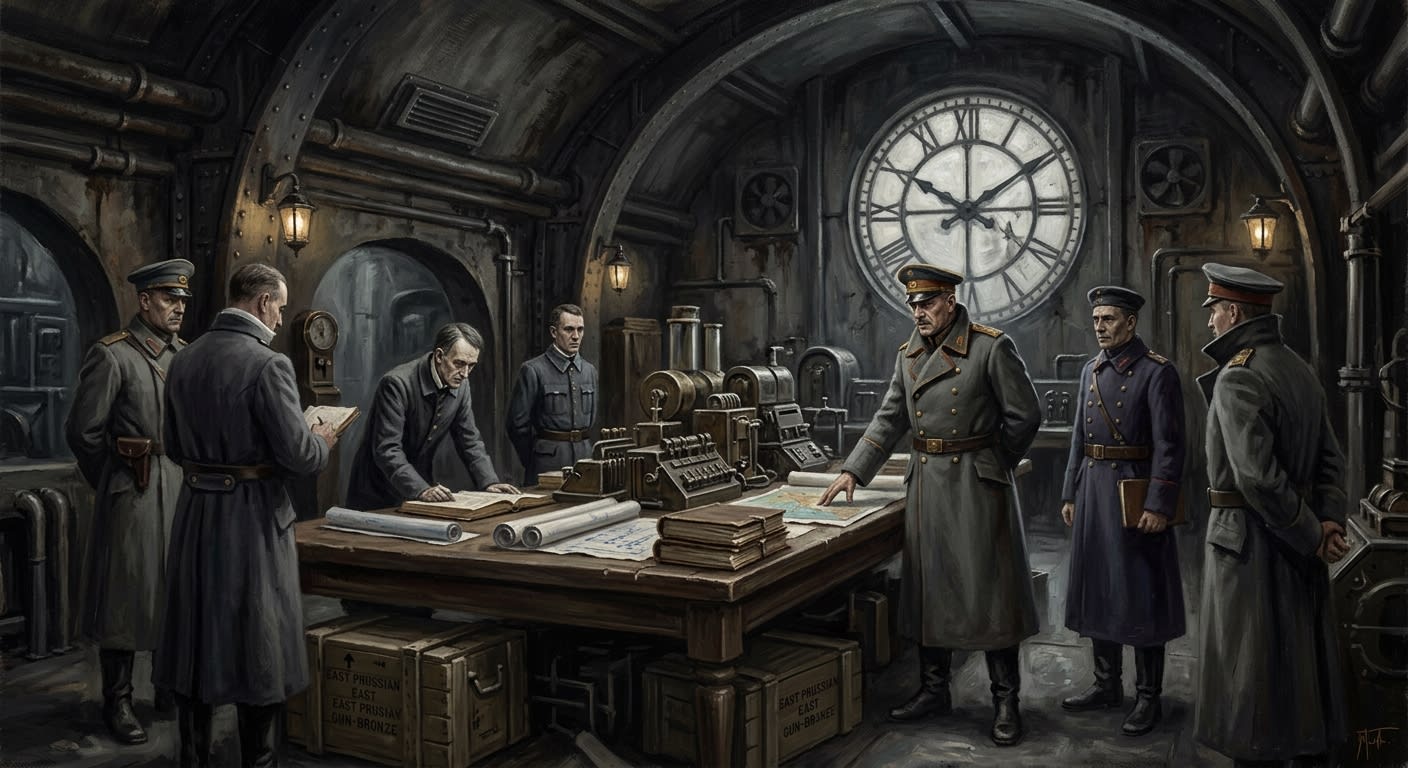
#On the State That Let Itself Be Absorbed
Prussia is the ghost inside the Synod's northern machine: officially dissolved, administratively corrected, renamed where convenient, overpainted with seals, and still present wherever a train leaves on time without waiting for a homily to explain punctuality. In old maps it was a kingdom. In current ledgers it is a habit. Habits are harder to conquer than kings.
The Synod absorbed the Prussian state in A.S. 95, the year Berlin became Kanzleiburg and the Siege of Vienna burned southward with enough sacred violence to distract the sentimental from a quieter miracle in the north. The decree was short. The military apparatus was retained. The civil service remained at its desks. The officers kept their methods, the clerks kept their figures, the rail men kept their clocks, and the Bureau of Doctrine congratulated Providence for having invented a bureaucracy it had merely stolen.
Prussia now survives in three forms: as East Prussian ground around Bastion-Königsberg, as Kanzleiburg's administrative temperament, and as the old officer-civil habit by which the north answers catastrophe with sequence. The first is geography. The second is culture. The third is a weapon.
#On the Absorption of A.S. 95
The Prussian absorption conquered few walls. It inventoried organs. Strasbourg wanted the north held, counted, supplied, and made obedient without spending thirty years learning how cold does arithmetic. Prussia possessed what the young Synod lacked: disciplined officers, legible districts, rail habits, tax memory, winter tables, and clerks capable of distinguishing promised supply from actual supply before the difference became graves.
Berlin's renaming mattered because names are Doctrine's favourite battlefield. The city became Kanzleiburg, Chancellery Fortress, a title heavy enough to please Records and dull enough to discourage poetry. The people accepted the name with the politeness of men hearing a child rename a locomotive. The paint changed. The engine kept running.
An early Doctrine memorandum called the absorption of Prussia “the peaceful completion of northern Synodical destiny.”
Clarified. Destiny arrived with receiving clerks, military quartermasters, seal-bearers, bishops, locksmiths, and enough practical envy to fill a cathedral. Peaceful theft remains theft. The State merely prefers theft with minutes.
The royal palace on the Spreeinsel became Archonate Isle. Throne rooms became routing chambers. Ballrooms became reserve halls. Royal treasury cages became vaults for ledgers that should have travelled to Strasbourg and somehow did not, which is to say Kanzleiburg kept the memory of how the north worked before it acquired sacred stationery. The Synod complains about this only in sealed tones. A capital may resent competence, but a war cannot afford to discard it.
The Prussian officer corps entered the Synod's military directorate before the Bureau of War took its full later shape. Old ranks were corrected, old oaths replaced, old uniforms amended, old mess rules tolerated because men who can feed artillery through winter may be permitted certain table arrangements. By A.S. 105 and the Charter of Crimson Ink, their habits had already infected northern War practice. Infection, in this instance, saved lives.
#On Kanzleiburg and the Prussian Machine
Kanzleiburg is Prussia after confession: absolved in public, unchanged in the bones. Three million souls by official count, more by bread queue, rail yard, and Purity estimate. The old Prussian grid remains beneath Synod signs: broad avenues, numbered districts, lettered sub-districts, a city that can make geometry feel like discipline and discipline feel like weather.
At its centre the Northern Hierarchate routes the Baltic-to-Carpathian theatre. Its substance is Prussian, iron-rimmed, clerk-driven, schedule-mad, and indecently useful. Strasbourg gives doctrine. Kanzleiburg gives departure times. The northern front has survived more often by the second than by the first, and Doctrine may underline that sentence only if it promises not to improve it.
The Archon of Kanzleiburg is the office made flesh and the flesh made nearly irrelevant. His public name appears in registers; Doctrine prose omits it because his authority has exceeded ornament. His gift is routing, to the offence of kings and the preservation of regiments. His boards read Inbound, Reserve, Failure. Any theology with fewer honest headings should envy him.
Prussian government charms no one. It reduces. A man enters with a cause and leaves with a classification. A bishop requests a procession and receives a work-stoppage estimate. A colonel demands priority and receives questions about tonnage, axle weight, horse exhaustion, fuel draw, coffin estimate, and whether the heroism can wait six hours. Often it can. Heroism, when weighed correctly, turns out to be freight with better posture.
This is why Purity dislikes the city. Fear is accustomed to doors opening. Kanzleiburg gives fear an appointment window. During the Curfew Standoff of A.S. 140, Purity attempted to enforce curfew against Old City beer-halls. The beer-halls closed obediently for three days. The officer corps grew sober, which alarmed every adult in the north. The Archon suspended enforcement. Purity kept principle. The beer-halls kept practice. Kanzleiburg won by clause.
#On Prussian Rail, Gun-Bronze, and Measure
Prussia's deepest contribution to the Synod was movement. Before A.S. 95, Prussian military rail habits had held the Baltic corridor through hunger, retreat, local panic, and the first desperate decades after the Sundering. After absorption, those habits became holy by proximity to seals. The Guild of Rails, chartered in A.S. 94 by the Codex Ferrum, drew heavily from Prussian rail battalions, secular engineers, surveyors, and labour bosses whose ears could tell cracked steel from cold steel before a clerk had found his pencil.
The north's old measure later became one of the sins corrected in the Gauge War. A northern yard used the Prussian military width. Southern spurs used harbour contractors' widths. Mountain sections kept emergency measures laid by men who counted survival as precision. For forty years the Dominion starved at gauge-breaks while committees argued millimetres over soup. Engineering imposed 1,435 millimetres in A.S. 136. Four thousand relaying dead paid the tuition.
Southern summaries describe Prussian rail custom as a provincial obstruction to Dominion unity. The description is useful chiefly as evidence that southern summary-writers should not be permitted near rails without adult supervision. Prussian rail custom was an obstruction, a precedent, a working method, and a rebuke. Unity came later, hammered into place by men whose hands curled around invisible mauls in sleep.
Prussian bronze also survives where Doctrine would prefer purer symbolism. The Northern Carillon at Königsberg holds forty-one bells cast from Prussian gun-bronze. They are tuned to Northern Standard Resonance, a phrase the Bureau of Bells uses when it wishes to sound confident beside an instrument that has become more honest than its handlers. Everyone who has heard those bells knows they differ. The Bureau insists the difference exists within compliance. Guilty offices love that sentence.
The bells ring against the Grey, and the Grey continues. The fact belongs to Königsberg's terror, before it belongs to Prussia's virtue, but the gun-bronze matters. Old military metal, melted into sacred sound, facing an enemy that ignores both cannon and hymn: there is an argument there, sealed because no official wants to lose it in public.
NORTHERN BELLS MATERIAL NOTE — RESTRICTED Source metal: pre-Synodic Prussian artillery bronze, quantities reconciled under A.S. 97–107 casting sequence. Observed harmonic deviation after A.S. 190: █████████████████████. Doctrine comment: do not imply Prussian material memory. Bells comment: within tolerance. Garrison comment: “They answer wrong because something answers first.”
#On East Prussia and the Far Nail
East Prussia is where Prussia remains inconveniently physical. Königsberg sits at the Pregel mouth on the Baltic coast, a Teutonic foundation, merchant port, university memory, and now the northern anchor of the Sagittal Line. The Synod requisitioned it in the first years of Line construction, about A.S. 67, when retreat hardened into refusal and cartographers drew a sacred north-south spine from Baltic to Bosphorus. A city became a fortress. The fortress became a tomb with a garrison and excellent harbour paperwork.
The local population never vanished. Fishermen, merchants, military families, refugees, dock clerks, and those Prussian souls who calculate profit beside annihilation still occupy the Warrens, the Harbour Quarter, the Frost Yards, and the streets where laughter persists under Purity's watch. Prussian merchants looked at the end of the world, estimated margin, and stayed. I do not admire the morality. I admire the arithmetic.
Königsberg's fortifications grew from older bones: the Ordensburg (Unregistered) as command, the cathedral as bell-throat, Prussian warehouses sunk and iron-faced for the Frost Yards, harbour cranes tied to inland supply, and the Sea Wall facing a Baltic that sends fog with faces. The Masurian Lakes defend the southeastern approaches and confound every map Records has attempted. The true pressure comes from the northeast, from water, fog, absence, and the thing the Bureau refuses to name except by suppression.
Prussia's old military sobriety suits Königsberg because ornament freezes there. Castellan-Warden Ingrid Halvorsen is Scandinavian by extraction, Prussian by command, Synod by oath, and northern by the older law of wind stripping vanity from the soul. Men like her, women like her, clerks like her less, which recommends her. A softer tradition would have collapsed into liturgy long ago. Königsberg requires less candle and more watch.
#On Doctrine, Memory, and the Useful Defeat of Names
Doctrine believes it dissolved Prussia because the royal name no longer commands law. This is adorable in the way a child is adorable while misfiling explosives. Legal dissolution is only one kind of death. Prussia died as sovereignty and survived as method: clocks, drills, reserve boards, cold gratitude, beer-hall politics, officer corridors, district numbers, rail discipline, and that severe civic instinct by which men complain about government while arriving early to help it function.
The Synod has renamed Berlin, repurposed the palace, consecrated the bells, corrected the oaths, absorbed the officers, licensed the rail guild, standardized the gauge, chained Prussian utility to Synod need, and printed enough doctrinal explanation to wallpaper the Archonate Isle. The old habit remains underneath. A seal can command a clerk. It cannot teach him to count faster than fear.
Strasbourg mistrusts this because Strasbourg loves visible obedience. Prussian obedience is inward, procedural, and faintly insulting. It files the report, feeds the train, attends the required liturgy, refuses unnecessary flourish, and measures the sermon by whether coal moved during it. The Bureau of Doctrine can command genuflection. It cannot make punctuality kneel without damaging the clock.
As of A.S. 201, Prussia is gone wherever an anthem would look for it. It is alive wherever the northern war would fail without it: in Kanzleiburg's grey offices, in the Archon's unsigned authority, in Hamburg freight entering Prussian sequence, in Warsaw dispatch, in the Guild man's gauge rod, in Königsberg gun-bronze, in the old ledgers under the south foundation, in every citizen who complains accurately and arrives on time.
A minor educational plate states: “Prussia was absorbed into the Synod and ceased to exist.”
Corrected for readers old enough to withstand government. Prussia ceased to reign. It did not cease to operate.