

#The Chancellery Fortress
The Synod renamed Berlin in A.S. 95 because the Synod does not conquer — the Synod corrects. The Prussian state, which had maintained its independence through the Atheist Wars and the Sundering and the first desperate decades of the Line by the simple expedient of being too useful to antagonise, was absorbed in the same year that Clemens Stahlhand broke the Rationalists at Vienna. The absorption was administrative. The decree was three pages. The military apparatus — the finest in northern Europe, the officer corps that had held the Baltic corridor together when the Synod was still arguing about the wording of its own charter — was swallowed whole by the Synod's military directorate, digested, and excreted as regulation. The city's name was changed last. Names are always changed last, because names are the thing the Bureau of Doctrine cares about most, and the Bureau of Doctrine is never in a hurry when the outcome is assured.
Kanzleiburg — "Chancellery Fortress," though no one calls it that except the Bureau of Records and visitors who wish to be corrected — is the largest city in the northern Synod, the seat of the Northern Hierarchate, and the administrative brain of every military operation between the Baltic and the Carpathians. Three million souls. The number is official, which means it is wrong, but it is wrong in the direction the Bureau of Records prefers, which is downward, because a city of three million requires fewer resources than a city of three and a half million, and the Bureau of Tithes levies according to the census, and the census is a weapon like any other.
#On the Geography and the Grid
The city sits on the Spree, which is a river in the way that a drainage ditch is a river — narrow, sluggish, and useful primarily as a boundary between administrative districts that would otherwise need to be separated by walls. The old Prussian core occupies the central island — the Spreeinsel, now called the Archonate Isle, where the Northern Hierarchate keeps its seat and the Archon of Kanzleiburg maintains offices that were once a king's palace and are now something worse: a bureaucracy's palace, which is larger, less beautiful, and far more difficult to storm.
The city is a grid. The Prussians built in straight lines, and the Synod, which builds in straight lines for entirely different reasons, found this congenial. Where Strasbourg is a labyrinth of cathedral spires and archive-vaults and streets that curve because a saint once walked crookedly, Kanzleiburg is geometry. Broad avenues radiating from the Archonate Isle. Numbered districts. Lettered sub-districts. A transit system of horse-drawn omnibuses that runs on a schedule the Bureau of Records publishes quarterly and the drivers ignore daily, because the drivers are Prussian, and Prussians ignore schedules only when the schedules are insufficiently precise, which is always, because the Bureau of Records uses ecclesiastical time and the drivers use clocks.
The city divides into six districts that the Prussians named and the Synod has re-named and the citizens call by the Prussian names regardless, because three million people do not change their vocabulary for a decree, and the Bureau of Purity has calculated that enforcing the new names would require more agents than enforcing doctrinal compliance in the rest of the northern corridor combined.
The Archonate Isle is the administrative heart — the Northern Hierarchate's seat, the Bureau of War's northern command, the Bureau of Records' second-largest archive (after Strasbourg), and a Bureau of Doctrine sub-office that publishes sermons the population reads with the same enthusiasm with which they read omnibus schedules, which is to say: when stranded and desperate. The Garrison Quarter occupies the northeast — parade grounds, barracks, the Prussian Military Academy (now the Bureau of War's Northern Officer Seminary), and the foundries that produce the regulation equipment for every garrison between Hamburg and Bastion-Brest. The Rail Quarter sprawls across the south — marshalling yards, engine sheds, coal depots, and the Hamburg-Kanzleiburg terminus, which processes sixty trains per day in summer and forty in winter and never stops because stopping would mean the northern front stops, and the northern front cannot stop.
The Factory Belt wraps the western perimeter — munitions works, textile mills producing regulation uniform cloth, a chrismole refinery that the Bureau of Engineering has condemned twice and the Bureau of War has reopened twice, and a district of workers' housing that the Bureau of Mercy describes as "adequate" and the workers describe with words the Bureau of Purity would fine them for using in public. The Merchant District occupies the northwest, where the banking houses and trading companies maintain offices and the Dutch keep a commercial delegation that the Bureau of Tithes monitors with the same futile dedication it applies in Hamburg. The Old City — the Prussians' residential core — fills everything else: churches older than the Synod, markets older than the churches, beer-halls older than the markets, and a permanent population of civil servants, shopkeepers, artisans, and retired military officers who served under the Prussian crown and now serve under the Synod and cannot tell the difference, because the uniform changed but the duty did not.
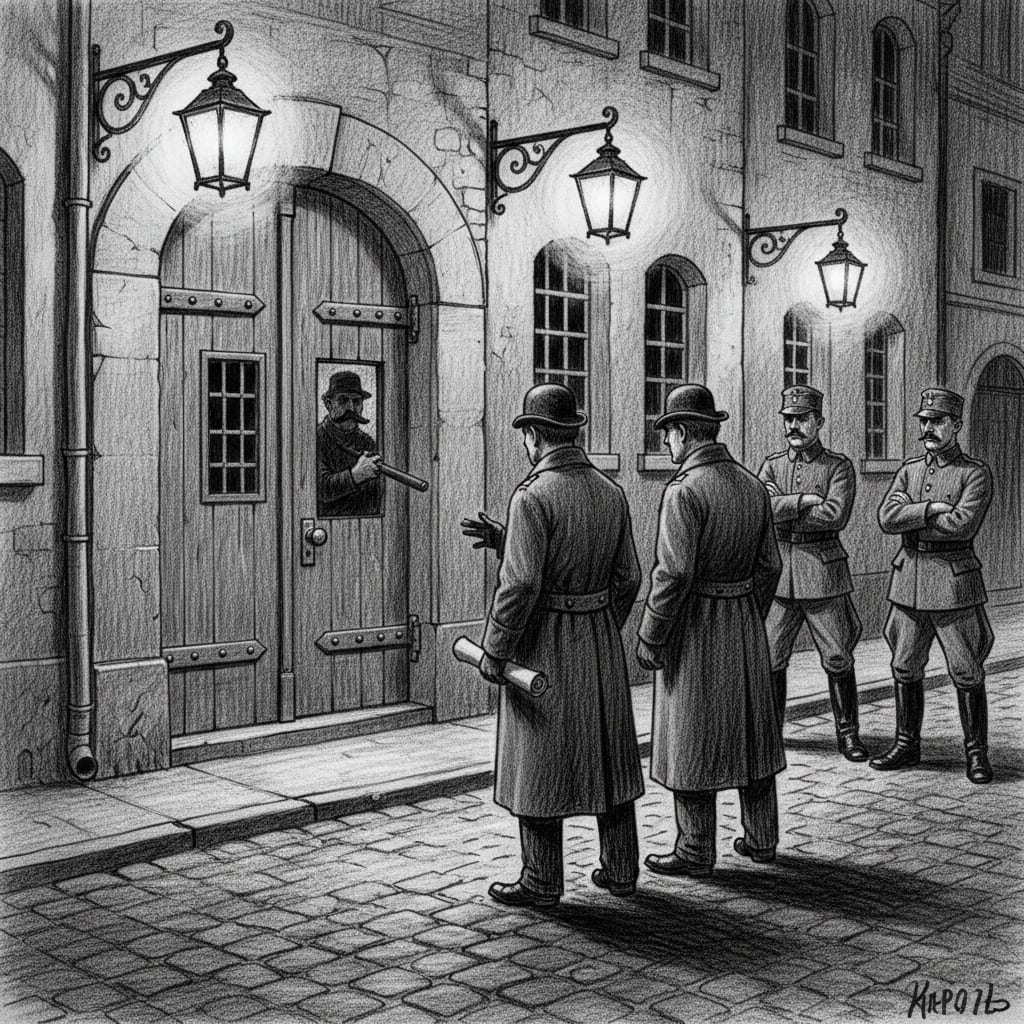
#On the Archon and the Prussian Machine
The Archon of Kanzleiburg is the most powerful official in the northern Synod. This is a statement of fact that the Bureau of Doctrine would prefer were a statement of heresy, but the Bureau of Doctrine does not control the northern front's logistics, and the Archon does, and logistics is a form of theology that the devout have never mastered.
The current Archon — whose name the Bureau of Records publishes and I will not reproduce here, because the Archon of Kanzleiburg is a man who prefers his authority to precede his reputation, and naming him would reverse the order — governs through the apparatus the Prussians built and the Synod inherited. The Prussian civil service was the finest administrative machine in Europe before the Synod absorbed it. It remains the finest administrative machine in Europe after the Synod absorbed it. The Synod added theology. The Prussians added efficiency. The combination is a bureaucracy that can mobilise three million civilians, route sixty trains per day, supply two bastions and three forward staging cities, and file the paperwork for all of it in triplicate before vespers — and does, every day, without gratitude, without complaint, and without the faintest interest in whether the Creator whose name appears on the letterhead actually exists.
An earlier edition of this entry described the Prussian administrative tradition as "subordinate to Synodical authority in all matters spiritual and temporal."
The Prussian administrative tradition is subordinate to Synodical authority in all matters that the Synod can enforce. In matters that the Synod cannot enforce — which include rail scheduling, industrial procurement, military logistics, census methodology, and the recipe for the Garrison Quarter's regulation field rations — the Prussian tradition is autonomous, has always been autonomous, and will remain autonomous until the Bureau of Doctrine learns to drive a locomotive.
The Archon answers to the Synod Council in Strasbourg. In practice, the Archon answers to Strasbourg when Strasbourg asks a question, and Strasbourg asks questions about Kanzleiburg with the frequency and enthusiasm of a man asking questions about the engine of a train he is riding: rarely, and only when the train has stopped. Hamburg's Admiral-Prefect Halske answers to the Archon in matters of civil administration. The garrison commanders of Bastion-Königsberg and Bastion-Brest receive their supply allocations through the Archon's logistics directorate. The Bureau of War's northern command occupies a wing of the Archonate Isle, and the Bureau of War's northern commander and the Archon share a corridor and a mutual understanding that neither will interfere with the other's domain unless the front is collapsing, in which case both will interfere with everything simultaneously and sort out jurisdiction afterward.
#On the Rail and the Road
Kanzleiburg is a junction. Everything that enters Hamburg by sea leaves Hamburg by rail, and everything that leaves Hamburg by rail passes through Kanzleiburg before it goes anywhere else. The Hamburg-Kanzleiburg line is two hundred and eighty kilometres of double-tracked, continuously maintained iron — the most heavily trafficked stretch of railway in the Synod's territory, and the single point of failure that the Bureau of War spends more money protecting than it spends on any bastion except Constantinople.
From Kanzleiburg, the lines branch. East to Warsaw, carrying grain, coal, ammunition, and the regulation prayer-stools that every garrison requires and no garrison has ever requested. North to Danzig and the Baltic coast, feeding the supply chain for Bastion-Königsberg. Southwest to Magdeburg and the Elbe barge network. South to Dresden and the central corridor beyond. The Rail Quarter's marshalling yards cover twelve square kilometres of track, sidings, engine sheds, coal bunkers, and the particular kind of organised chaos that railway men understand and theologians find distressing.
The city also sits at the centre of the northern road network — six major highways radiating outward like the spokes of a wheel that has been rolling since before the Synod existed and will keep rolling after the Synod has filed its final report. Wagon convoys supplement the rail traffic, carrying loads too bulky or too sacred for railway handling — bell-cannon components from Essen-of-Hymnsteel, reliquary crates that the Bureau of Relics will not trust to rail vibration, and the wounded, who travel by ambulance-wagon because the Bureau of Mercy has determined that the rhythm of a railway carriage aggravates certain categories of spiritual injury, a diagnosis the Bureau of Medicine does not endorse and the wounded do not dispute, because the wounded are beyond disputing anything.
#On the Present Condition
Kanzleiburg in A.S. 201 is a city that functions as a verb. It does not exist in the way that Strasbourg exists — as a capital, a symbol, a place where decisions are made and arguments are had. Kanzleiburg processes. It takes the raw material of the Synod's war — men, grain, coal, iron, prayer, ammunition, paperwork — and converts it into the organised flow that keeps two bastions garrisoned and half a million soldiers fed. It does this with Prussian efficiency and Synodical paperwork, which means everything is done twice: once correctly, and once with a sermon attached.
An earlier edition of this entry described Kanzleiburg as "the Synod's second capital."
Kanzleiburg is no one's capital. A capital is a place where power resides. Kanzleiburg is a place where power is transmitted — from the docks of Hamburg to the trenches of the Line, from the granaries of the heartland to the mess-tins of the forward garrisons, from the decree of the Synod Council to the regulation that governs how many nails a quartermaster may requisition per calendar month. The Archon does not rule. The Archon routes. The distinction would offend him if he cared about titles, which he does not, because he is Prussian, and Prussians care about function.
The city's weakness is the city's strength inverted. Three million people depend on the rail lines staying open. The Hamburg-Kanzleiburg line, if severed, would starve the northern corridor within weeks. The Bureau of War maintains a permanent garrison of eighteen thousand soldiers along the rail approaches — more men than guard most stretches of the Line itself — and the Bureau of Engineering inspects every kilometre of track quarterly. Sabotage attempts are filed under a classification the Bureau of Records does not discuss, which means there have been enough to warrant the classification.
████████████████████████████████████████████████████████████████████████ ████ ██████ ████████ ████████████ ██ ████ ████████████ ██████████████ ████████████████████████████████████████████████████████████████████████ ████████ ████████████ ████████ ██████████████ ████████████████ ██████
The Synod called it Kanzleiburg to erase the Prussian name. The Prussians let them, because the Prussians understood what the Synod did not: a name is paint. The machine beneath the paint is what matters, and the machine has not changed, and the machine does not care what is written on its casing. Strasbourg gives orders. Hamburg feeds the throat. Kanzleiburg makes the orders move and the food arrive and the trains run on time, and the trains have run on time since A.S. 95, and they will run on time until there is nothing left to carry, and on that day the Archon will file a report noting the discrepancy and request a revised schedule.
The Bureau of Records will approve it. The Bureau always approves what it cannot prevent.