

#The Synod's Throat
Every empire has a throat. Rome had Ostia. The Byzantines had the Golden Horn. The Bureaucratic Synod, which outdoes both in administrative tonnage if in nothing else, has Hamburg — nine hundred thousand souls crammed into a river mouth that smells of tar, herring, and the accumulated moral compromise of a continent that ships its convictions east and its invoices west.
I have been to Hamburg seven times. I have enjoyed Hamburg once, and that was the afternoon I left it. The city is useful in the way that a drain is useful: everything passes through it, nothing remains in it voluntarily, and the engineers who maintain it are the only men alive who understand its true geometry. The Bureau of War calls Hamburg "the Import Terminal." The Bureau of Tithes calls it "the Revenue Mouth." The Bureau of Records calls it "Node Seven, Northern Corridor, Classification: Permanent." The citizens call it home, which is the saddest of the four descriptions, and the only one that is honest.
#On the Geography and the Stink
Hamburg sits at the mouth of the Elbe, where the river surrenders to the North Sea and the North Sea accepts with its customary indifference to human ambition. The old Hanseatic core — guild-halls, counting-houses, warehouses of brick and copper and the particular smell of Baltic commerce that has not changed since the thirteenth century — occupies the south bank. The Synod administrative quarter occupies the north bank, because the Synod always builds across the water from whatever it intends to control, and because the north bank has better drainage, and because the Bureau of Records prefers to observe its subjects from a slight elevation.
The docks stretch for eleven miles along the Elbe's south bank. I say "docks," but the word is inadequate. Eleven miles of stone quays, timber wharves, coal chutes, crane gantries, customs sheds, fumigation houses, bonded warehouses, quarantine pens, chandleries, rope-walks, tar-kilns, and the particular kind of drinking establishment that caters to men who have spent fourteen days at sea in a vessel consecrated by the Bureau of Rites and blessed by nobody else. The docks never close. The customs sheds never close. The drinking establishments close when the last man falls, which is never, because another arrives before the first has finished falling.
The city divides into four quarters that the Bureau of Records has named and the citizens have renamed, because citizens are ungovernable in small matters even when they are perfectly docile in large ones. The Synod Quarter (north bank) houses the Northern Maritime Chapterhouse, the Bureau of War's import-routing office, the Bureau of Tithes' customs directorate, and a Bureau of Purity sub-office whose staff of eleven monitors a population of nine hundred thousand with what the Bureau describes as "adequate coverage" and everyone else describes as wilful blindness. The Dock Quarter (south bank, east) is the working waterfront — longshoremen, stevedores, chandlers, coal-heavers, and the criminal infrastructure that grows between the cracks of any port the way barnacles grow on any hull. The Merchant Quarter (south bank, west) is where the counting-houses stand, where the shipping companies maintain their offices, and where the Dutch and British factors keep their residences behind walls tall enough to discourage both the curious and the devout. The Fishmarket is the old city — narrow streets, guild-halls with roofs older than the Synod, churches older than the Reformation, and a permanent population of approximately forty thousand cats.
#On the Function: What Hamburg Eats and What It Excretes
Hamburg is a mouth. It ingests the raw materials of continental survival — grain from the British Isles, timber and iron ore from Scandinavia, coal from the Welsh seams carried in British bottoms, seal-oil from the fjord settlements of the Fractured North, salted fish from the Danish shoals, and the particular class of contraband that the Bureau of Tithes cannot tax because the Bureau of Tithes cannot identify it — and excretes them eastward along the Northern Corridor toward Kanzleiburg, Warsaw, and the bastions beyond.
The volume is staggering. In A.S. 200, Hamburg processed four point two million metric tons of inbound cargo. Roughly a third of that tonnage was grain. Another third was coal and raw materials. The remaining third was classified by the Bureau of Records under the heading "Sundries," which is a word the Bureau uses when it does not wish to explain, and which covers everything from relic-freight and consecrated ammunition to livestock, medical supplies, replacement bell-clappers for Bastion-Königsberg's carillon, and a shipment of fourteen hundred regulation prayer-stools that arrived with the legs sawn off and could never be accounted for.
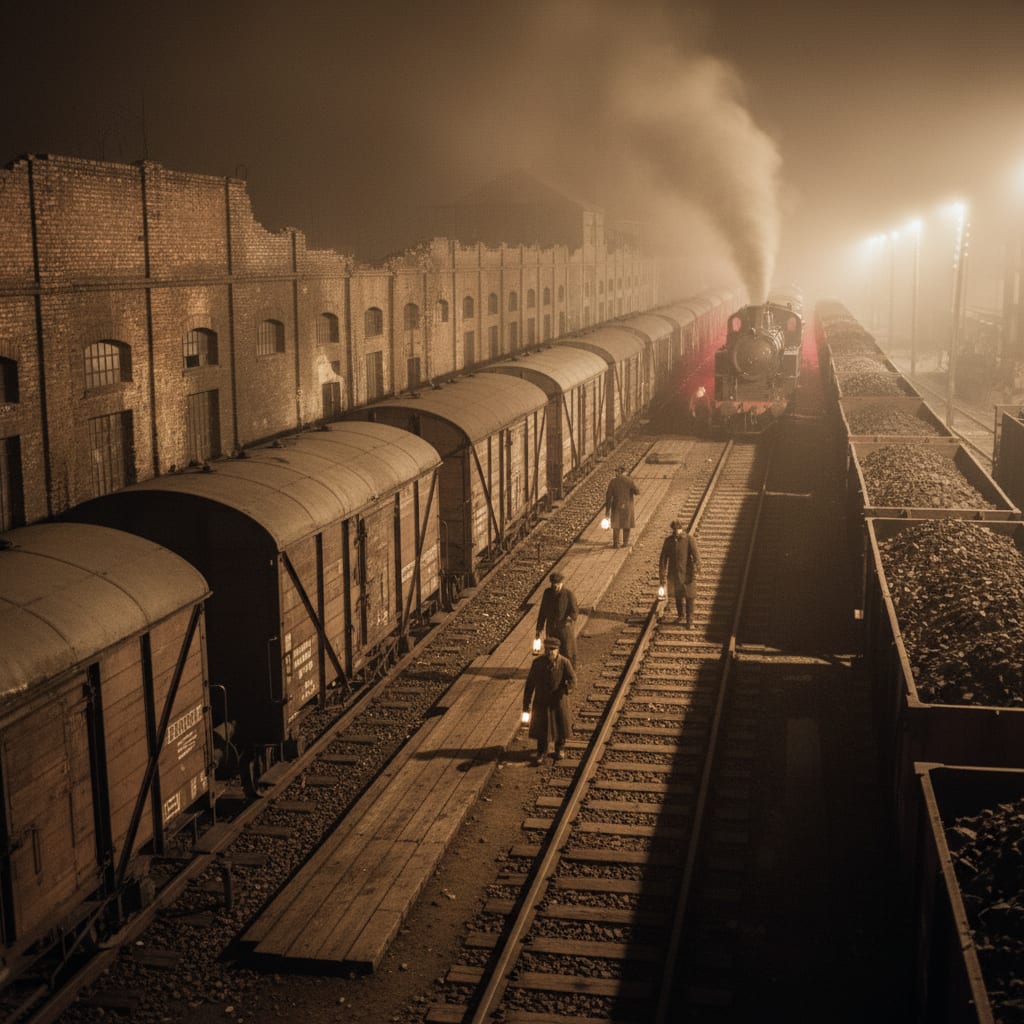
The outbound flow moves by rail and by river. The Hamburg-Kanzleiburg rail line is the most heavily trafficked stretch of track in the northern Synod — forty trains per day in winter, sixty in summer, each carrying between two hundred and six hundred tons of material that will, within a fortnight, be distributed across the northern front from Bastion-Königsberg to Bastion-Brest. The Elbe carries the rest. Barges travel upriver to the rail junctions at Magdeburg and Dresden, where the cargo transfers to eastbound lines. The Salt-Vigil Causeways maintain a spur that connects the Frisian tidal routes to Hamburg's western approaches — a winter lifeline when the North Sea freezes the outer harbour and the coastal convoys cannot dock.
#On the Foreign Factors and the Unregistered Money
Hamburg is where the Synod meets the world it cannot govern. The Netherlands maintains a permanent trade delegation in the Merchant Quarter — fourteen clerks, six factors, and a consul whose office overlooks the Elbe and whose filing cabinets, according to the Bureau of Purity's confidential assessment, contain "material of potential theological concern." The Dutch do not bend to the Synod. The Dutch do not resist the Synod. The Dutch sell the Synod everything it needs at prices that the Bureau of Tithes calls extortionate and the Dutch call competitive, and the distinction between the two is a matter of whose ledger you are reading.
The British Crown keeps a factor's office in the same quarter, staffed by men who speak German with an accent the Bureau of Purity classifies as "theologically neutral" and who conduct their business with a maritime efficiency that the Bureau of War envies and the Bureau of Records cannot replicate. British grain ships account for a quarter of Hamburg's inbound tonnage. British coal ships account for a third of the fuel supply. The British do not ask for permission and the Synod does not ask for gratitude, and the arrangement functions because both parties understand that the alternative is a northern front that freezes, starves, and dies.
An earlier edition of this entry attributed Hamburg's foreign trade to "the generosity of the Unregistered Kingdoms."
No kingdom is generous. The British sell grain because grain is profitable. The Dutch sell credit because credit is profitable. Generosity is a word the Bureau of Doctrine uses when it wishes to obscure a transaction. The Bureau of Tithes, to its credit, has never used the word in any official publication, because the Bureau of Tithes knows what money is, and money is never generous.
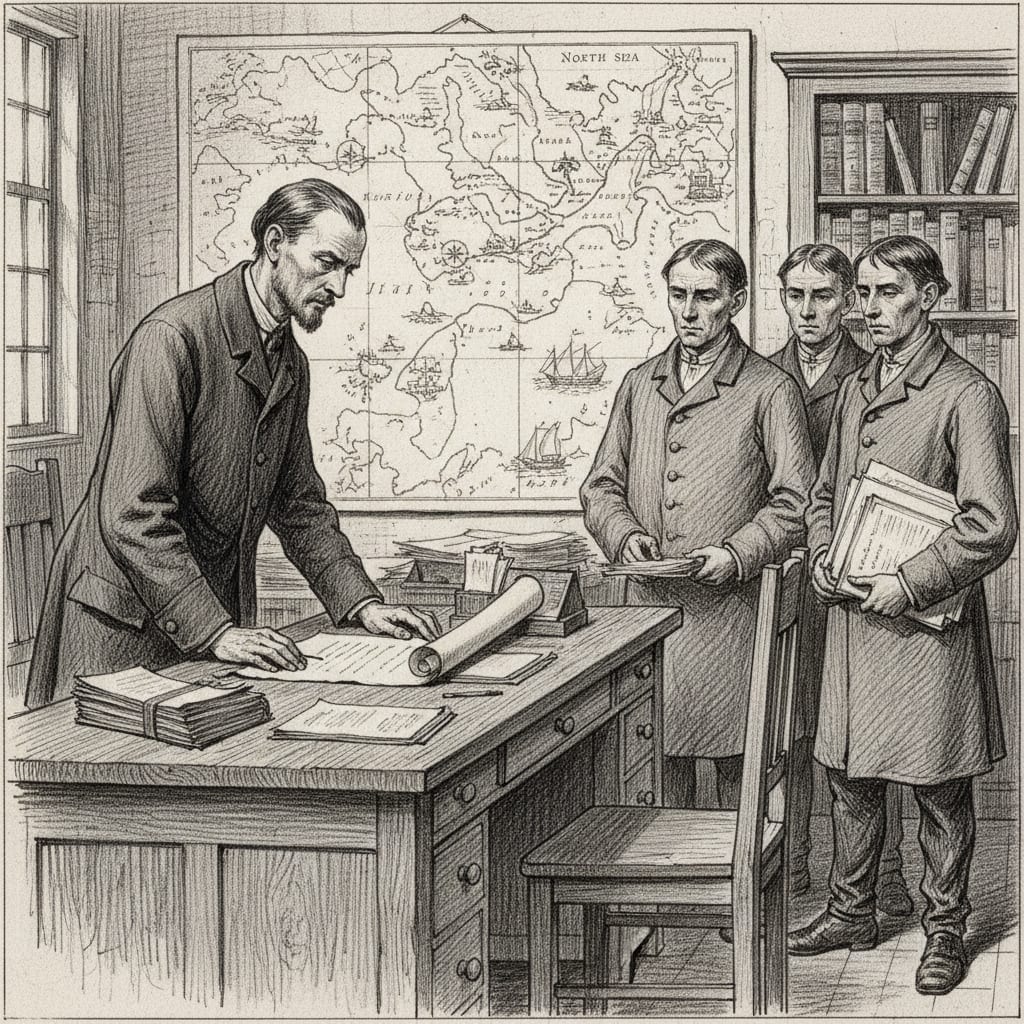
The unregistered money flows both ways. Dutch banking houses finance Synod military contracts through Hamburg intermediaries — loans denominated in guilders, repaid in Synod marks, the exchange rate set by men who answer to neither the Synod nor the Dutch Republic but to the arithmetic of compound interest. The Bureau of Tithes tolerates this arrangement because the Bureau of Tithes cannot fund the northern front without it. The Bureau of Purity monitors it because the Bureau of Purity monitors everything. The Bureau of Doctrine ignores it because the Bureau of Doctrine has learned, over a century of institutional experience, that the theology of money is a sermon best left unpreached.
#On the Dock Quarter and Its Inhabitants
The Dock Quarter is the largest continuous working waterfront in the Synod's territory, and it operates under rules that the Bureau of Records has published and the dock workers have never read. Twelve guilds control the labour — the Longshoremen's Brotherhood (Unregistered), the Stevedores' Compact, the Coal-Heavers' Union, the Chandlers' Corporation (Unregistered), and eight others whose names I will not list because the Bureau of Records has filed them under a classification that requires three stamps to access, and I have lost one of the stamps, and the Bureau of Records does not issue replacements for stamps that I claim to have misplaced.
The dock workers number approximately forty thousand, and they are the hardest-working and least-devout population in the northern Synod. Church attendance in the Dock Quarter runs at eleven per cent of the registered population, a figure the Bureau of Purity considers "concerning" and the Bureau of War considers irrelevant, because the Bureau of War does not care whether the men who load its ammunition crates pray, so long as they load the ammunition crates. The Black Ledger maintains one confirmed cell in the dock quarter — a modest presence by the standards of Strasbourg or Constantinople, but sufficient to ensure that cargo can vanish from a bonded warehouse between the evening inspection and the morning count without any manifest reflecting the loss.
#On the Famine Riots and What They Taught
Hamburg has rioted twice in living memory, and the Bureau of Records has acknowledged neither.
The first was the Famine of A.S. 65 (Unregistered), when tithe levies coincided with a catastrophic harvest failure and the city discovered that the Synod would continue to collect its tax on grain that did not exist. The riots ran for nine days. The Northern Garrison deployed from Berlin; the ecclesiastical authorities declared the rioters "spiritually compromised by hunger, a condition the Bureau of Mercy is equipped to treat." The rioters were hanged. The tithes were adjusted — downward by two per cent, for one fiscal quarter, after which they returned to their previous level. The event was filed as "civil unrest, weather-related, non-recurrent."
The second was the Dock Fire of A.S. 189 (Unregistered), when a warehouse full of chrismole — sanctified fuel bound for Bastion-Brest — detonated and took four city blocks with it. The fire killed three hundred and twelve people. The dock workers, who had petitioned for better storage protocols for six years, expressed their displeasure by refusing to unload ships for eleven days. The Bureau of War classified the refusal as mutiny. The Bureau of Tithes classified it as a supply interruption. The Bureau of Mercy sent surgeons. The Bureau of Purity sent observers. The dock workers returned to work on the twelfth day, when the Bureau of War offered a seven-per-cent hazard supplement and the Bureau of Tithes agreed not to tax it. The supplement remains in effect. The Bureau of Tithes has not stopped trying to tax it.
An earlier edition of this entry stated that the Dock Fire of A.S. 189 was caused by "improper storage of liturgical materials."
The fire was caused by chrismole stored in wooden crates stacked six-high against a brick wall that the Bureau of Engineering had condemned three years prior and the Bureau of War had declined to replace because the replacement would have cost four thousand marks and the Bureau of War does not spend four thousand marks on walls when the same sum buys two field guns. The wall is classified as "structurally adequate, revised assessment." The three hundred and twelve dead are classified as "casualties of the northern front, non-combat, administrative cause."
#On the Present Condition
Hamburg in A.S. 201 is a city that works. It works the way a heart works — without ceasing, without gratitude, and with the understanding that the moment it stops, everything north of Strasbourg and east of the Rhine dies within a fortnight. The harbour processes its four million tons. The rail line carries its forty trains. The customs sheds stamp their twenty-two thousand manifests. The dock workers load their crates and drink their beer and attend church at eleven per cent and do not care, and the Bureau of Purity does not make them care, because the Bureau of War will not permit the Bureau of Purity to interfere with the loading schedules, and the loading schedules are sacred in a way that no hymn has ever been.
The Northern Maritime Chapterhouse — Hamburg's senior Synod installation — is headed by Admiral-Prefect Gerta Halske, who has held the post since A.S. 194 and who runs the harbour with the efficiency of a woman who understands that theology is a luxury and tonnage is not. She answers to the Archon of Kanzleiburg in matters of civil administration and to the Bureau of War in matters of military logistics, and when the two authorities contradict each other, which they do approximately once per week, she answers to neither and does what the harbour requires. The Bureau of Doctrine has not objected to this arrangement, because the Bureau of Doctrine has never visited Hamburg's docks, and the Bureau of Doctrine's knowledge of maritime logistics could be written on a communion wafer with room left over for the Nicene Creed.
████████████████████████████████████████████████████████████████████████ ████ ██████ ████████ ████████████ ██ ████ ████████████ ██████████ ████████ ██████████ ████████████████ ████ ██████ ████████████ ████████ ████████████████ ████████████████ ██████ ██████████ ████████████████████
The city has one problem that the Bureau of Records will not name and the Bureau of War cannot solve. Hamburg is nine hundred thousand people. Hamburg feeds a front of two bastions, three forward staging cities, and half a million soldiers. Hamburg depends for its supply on two foreign powers — the British and the Dutch — whose cooperation is purchased, contractual, and revocable. If the British grain ships stop sailing, the northern front starves within six weeks. If the Dutch credit lines freeze, the Bureau of War cannot pay its contractors within three months. Hamburg is a throat, and the hand around it belongs to no one the Synod can command.
The Bureau of Doctrine has a classification for this condition. The classification is "Providentially Arranged," which means the Bureau has no solution and has decided to call the problem a blessing.