
#On the Year the Throat Closed
The Famine of A.S. 65 found Hamburg at the exact moment the city became indispensable and punishable in equal measure. The Sagittal Line had hardened from retreat into system. The northern throat had been named Node Seven. Ships arrived with grain from the west and timber from the north, barges waited beneath the Elbe mist, rail clerks learned that a hungry frontier can turn arithmetic into scripture, and the city’s nine hundred thousand souls discovered the first law of Synodic logistics: importance does not confer mercy.
Harvest failed across the northern heartlands. The harbour continued to count. Tithe levies remained due on grain that had not grown, on flour that had not been milled, on bread that had not entered any human mouth. This was not, in the technical sense, madness. Madness would imply the clerks had mistaken absence for plenty. The clerks understood absence perfectly. They taxed the expectation.
The famine did not begin with screaming. It began with queue silence: women standing before ration tables with baskets light enough to swing, carters refusing to meet the eyes of dock children, bakers watering dough until loaves collapsed like wet confessionals, parish bells rung at meal hours because the schedule required sound even when the kitchens had nothing to answer with. Hunger entered Hamburg by policy, by weather, by ledger, by bell.
#On the Nine Days
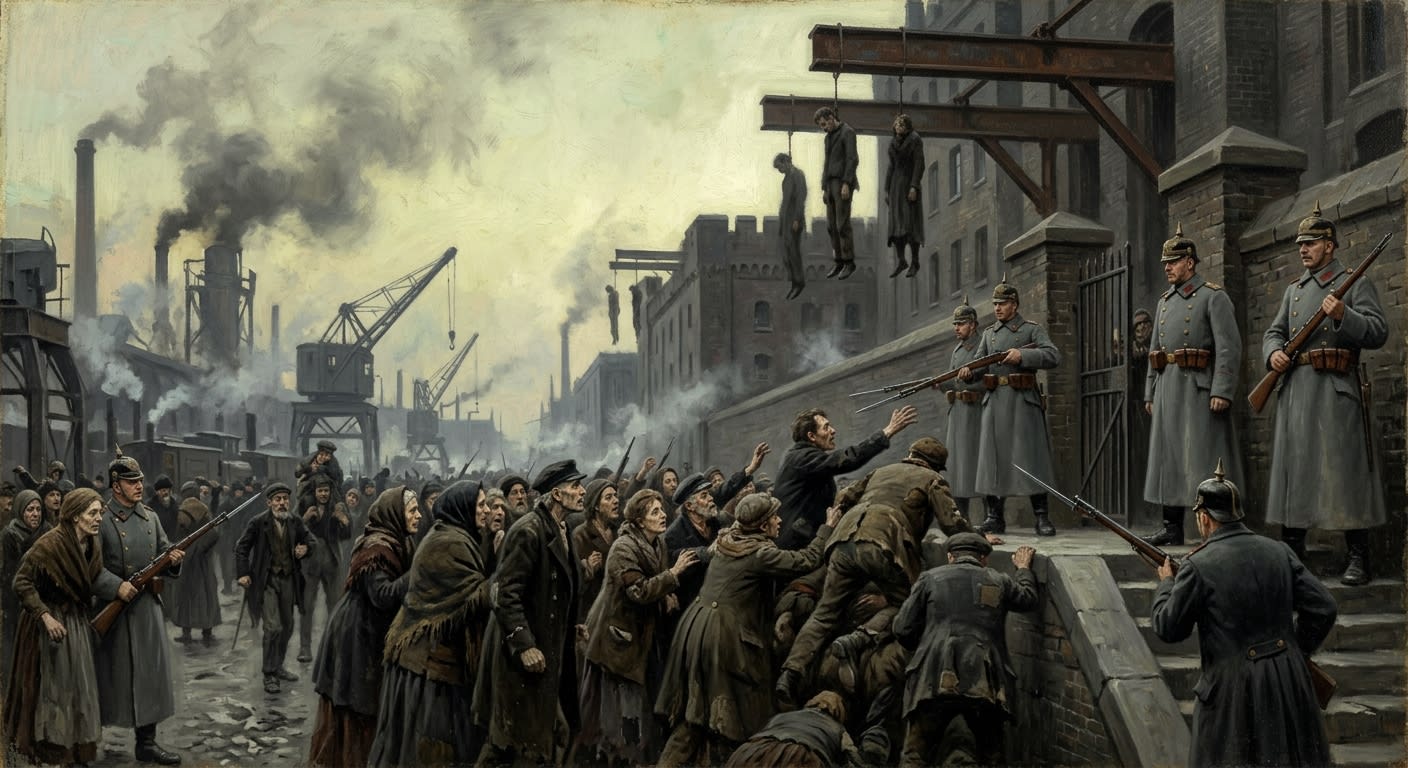
The first riot began in the Fishmarket, where a widow overturned a tithe basket after an assessor marked her household in arrears for flour she had already traded for lamp oil. This is the approved version, being small enough to blame on grief. The better version places the beginning at the Dock Quarter weigh-house, when three grain carts bound for military reserve passed a civilian queue under escort and one child, whose name the files omit with their usual delicacy, bit through the rope barrier and was struck with a scale pole.
HAMBURG PARISH CASUALTY APPENDIX — A.S. 65 Day One: ███ injured; 11 dead by trampling. Day Two: weigh-house burned; assessor escort missing. Day Three: parish granary locks forced at █████ and █████. Note beside unidentified child entry: “do not transcribe cause; inflammatory.”
By the third day, market tables were barricades. By the fifth, the Dock Quarter had closed three streets with barrel walls and fish carts. By the seventh, church doors were being guarded from the inside, which is how one knows a city has entered theological sincerity. Priests blessed queues until the queues asked for bread instead. The priests, lacking bread, offered doctrine. Doctrine has poor nutritional value and worse mouthfeel.
The Northern Garrison deployed from Berlin, because in A.S. 65 it was still Berlin, the old Prussian machine not yet renamed Kanzleiburg by Synodic paint. Infantry entered by the eastern road, cavalry held the grain wharves, and the officers discovered what soldiers always discover in hungry cities: a starving crowd does not manoeuvre like an enemy force. It surges, folds, breaks, reforms, and returns with stones, prayers, stools, cleavers, children, old men, women with pots, men with hooks, and the appalling courage of people who have already counted the pantry.
#On the Mercy Classification
The ecclesiastical authorities declared the rioters “spiritually compromised by hunger, a condition Mercy is equipped to treat.” The phrase deserves preservation in amber, or pitch, or whatever substance best displays administrative obscenity without allowing it to wriggle away. Hunger became a spiritual condition. Theft became a symptom. Bread became evidence. The scaffold became treatment.
No Bureau of Mercy existed yet in its later settled form, no Bureau of Tithes with its mature appetite, no polished Palatine Counting House machinery perfected after the Concordat. That is the ugly little origin. The famine belongs to the pre-bureaucratic Synod, when the machine was still learning which forms of cruelty scaled well. Hamburg taught it.
Several later catechisms attribute the A.S. 65 Hamburg levies to the Bureau of Tithes.
Corrected. The levies were tithe levies enforced by ecclesiastical and military authority before the Bureau’s later constitution. The Bureau of Tithes did not invent the appetite; it inherited, named, polished, and monetised it.
The hangings began on the eighth day and continued after order had technically returned, because punishment, like a badly staffed procession, often arrives late and insists on completing the route. Rope was set before the weigh-house, the river gate, and the Fishmarket chapel. Those accused of granary-breaking died first. Those accused of incitement died second. Those accused of refusing to name the first two categories died whenever the clerk’s hand found space.
#On the Adjustment
After nine days, the city quieted. Quiet, in Hamburg, does not mean obedience. It means calculation. The levies were adjusted downward by two per cent for one fiscal quarter and restored at the next assessment. Two per cent: a concession so small it required a full proclamation to become visible. The city received it with the gratitude one gives a thief who returns the handle of the stolen knife.
The first Widow’s Pennies took shape in the same famine-year, an emergency extraction upon bereavement announced as relief finance and remembered by widows as a second funeral fee. Later versions would become grander, cleaner, more legally perfumed. At A.S. 65, the thing was raw: grief counted, pensions touched, household status assessed through death. The tax would be laid aside, revived, revised, and eventually wander into the apparatus of Griefgate, because the Synod never truly abandons a profitable sin. It only files it under a future instrument.
Public summaries describe the A.S. 65 measures as emergency relief.
Clarified. Relief arrived. So did revenue. The official record places these facts in that order. The hungry experienced them otherwise.
The event was filed as “civil unrest, weather-related, non-recurrent.” This classification is a masterpiece of burial. Civil unrest assigns guilt to the living. Weather-related assigns guilt to the sky. Non-recurrent instructs the future to stop asking questions. Three nails. A coffin of words.
#On What Hamburg Learned
Hamburg learned that the Synod would feed the front before the city, because the front had guns and the city had mouths. It learned that a tithe can be collected from absence, that prayer will be rung even over empty kitchens, and that any riot failing to destroy its paperwork becomes an instructive precedent for the men who survive to file it. The city did not forget. Hamburg is too commercial for forgetting; it prefers accounts receivable.
The famine remains in port customs, in the way dock families hoard dry biscuit behind stove-bricks, in the habit of counting grain carts by destination, in the old Fishmarket curse “two per cent mercy,” and in the dock guild rule that no food convoy may pass a civilian queue without witness from two labour houses. The rule is unofficial, unenforceable, and obeyed with more seriousness than several doctrines I have personally stamped.
By A.S. 201 the harbour is fat with tonnage again: four point two million metric tons in the annual count, foreign grain by contract, Dutch credit by arithmetic, Scandinavian oil by necessity, British captains smiling over clean manifests and dirtier terms. Beneath that plenty lies A.S. 65, filed under weather, spoken of in kitchens, and understood wherever a clerk looks at hunger and asks for the receipt.