
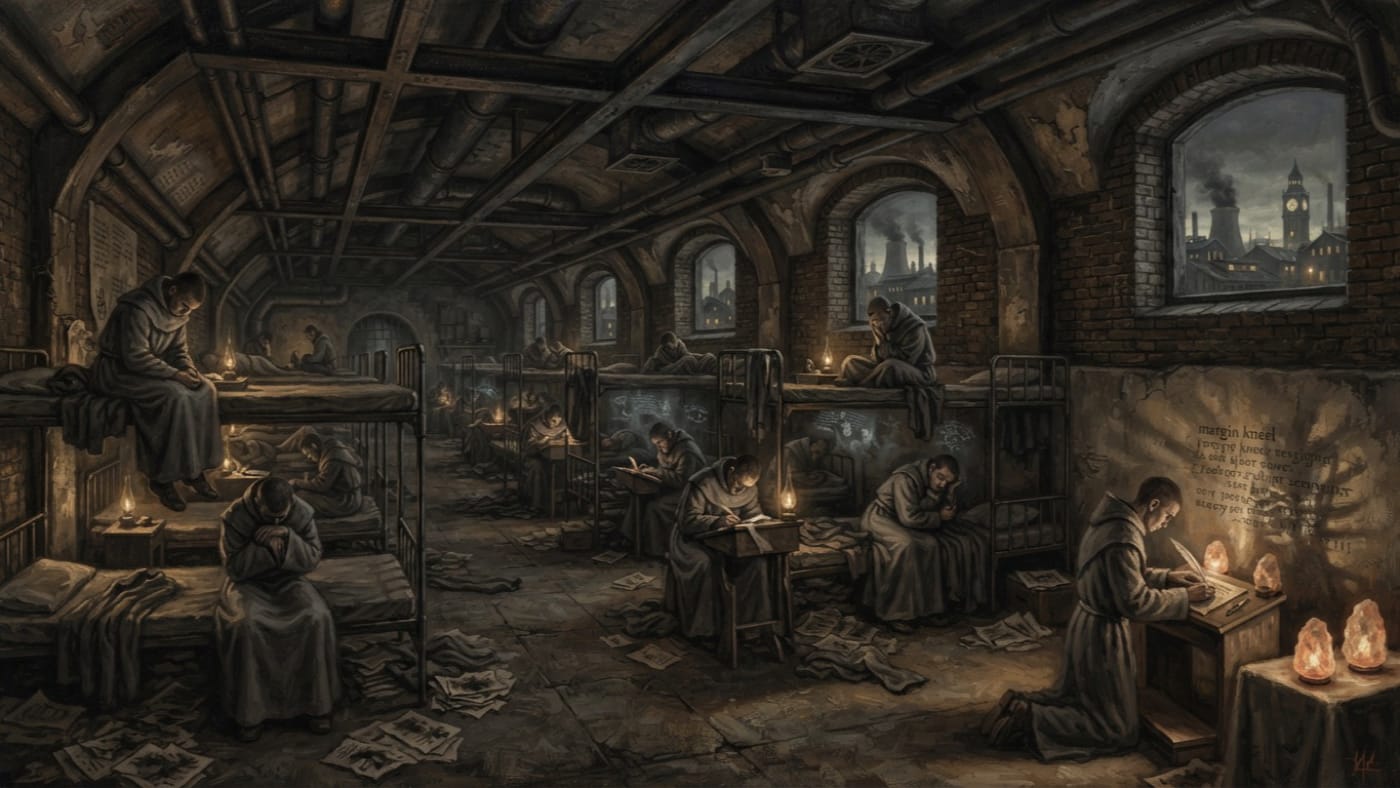
#On the Dormitories and Their Purpose
"Never sign under a fresh lamp — lamps make promises hungry." — Nemea street saying
The Novice Barrens smell of soap and damp cloth. The Chapterhouse's own survey lists a third smell beside those two, without embarrassment: fear. The Barrens are the dormitories and vow rooms of the Hollow-Script Scriptorium of Nemea, the archive town on its chalk ridge in the inland heartlands of Zone 2, a courier's run from Strasbourg. Like nearly everything in Nemea, they are built of bone-lime plaster and soot brick. The lamps are salvaged glass. The town keeps the people who make its memory here during the hours it is not using them.
That is the district's whole function. Nemea sends certified identities, corrected decrees and ink bricks to every Bureau of Records office on the continent, and every sealed copy began under a novice's hand. The copying halls take the hand by day. At night the Barrens take back the rest of the novice, along with whatever the vow contract has left of the name.
#On Arrival and the Vow of Blankness
Novices come by two roads, and the roads meet well before anyone reaches a bed. Some are sent for by courier summons. Others petition freely, under their own hand and seal, for admission to the most secure scriptorium in the Synod. Both kinds cross the Inkhouse Bridge, the single stone span over the gorge that carries all of Nemea's freight, couriers and intake. Both kinds stop at the Silence Gatehouse.
There they surrender their birth-names. In return the Chapterhouse grants what it calls archive safety and enters the novice under an archive designation, a string of numbers and letters that the Chapterhouse describes as more precise. The gate clerks handle this transaction and the Barrens receive the result. The order matters. Petitioners sometimes picture being unnamed in the dormitory, among companions, with a little ceremony. They reach the dormitory already unnamed, because the ceremony took place at the gate.
From then on they are bound by the vow of blankness and by the vow contract that goes with it. No complete text of the vow has reached my desk, and I will not write one for the reader's convenience. Its effect is on record. The novice's labour, hours and penances become terms of a contract. A contract is a document, and in Nemea a document is the least stable thing in the building.
The petitioner chose to come. No Margin Judge would say they chose the obligations that followed. The Margin Court rules on what the record says, and the petitioner does not hold the record.
#On the Rooms and the Day
The dormitories are for sleep and the vow rooms are for vows. The work happens elsewhere. Novices spend the day in the copying halls at the crown of the Scriptorium and return to the Barrens at curfew. They wear ash robes by regulation and carry the halls home on their sleeves. Hence the soap, and hence the damp cloth. The town's chief product is an ink that cannot be cleanly scraped, so washing it off is closer to a liturgy than to hygiene.
The town sets the day. It opens with the dawn ink boil in the Inkhouse Quarter, and the smoke reaches every dormitory window. Midday brings the copying quotas. At curfew the bell rings, then the nightly correction bell sounds across the ridge and the night correction cycle begins. Meals are thin porridge, ash-bread and bitter tea. A honey wax-cake is a luxury, and a novice seen eating one invites questions about what was paid for it.
Confession is written down, because Nemea holds spoken confession unclean. The novice performs the margin kneel, the rite of confessing one's edits, and sets down each fault in ink. Written confessions are indexed and checked against the audits. A novice who confesses an error the audit missed has made the Chapterhouse a gift. A novice whose audit turns up an error the confession left out has made it a different kind of gift.
Personal diaries are forbidden, along with unsanctioned histories and questions about first drafts. A novice may write all day, provided none of it is about the novice.
The Barrens have one recorded history, and it is a fire. In A.S. 103, seven years after the town was raised, fire consumed the west scriptorium wing and half the novice dormitories. The sources do not say which dormitories, where they stood or what replaced them, and I will not supply a floor plan the Chapterhouse never filed. They do record what happened to the books. Clerks rebuilt the lost records, and Archon Veyrault's Bureau declared the rebuilt copies original by ratification. The novices who had slept in the surviving half went back to copying them.
Nemea was raised in A.S. 96, six years after the Concordat, when the freshly constituted Bureau of Records discovered that the records did not agree.
CORRECTED by order of the Bureau of Doctrine, A.S. 201. The Bureau of Records was transformed in A.S. 78, and later settlements followed. It was not freshly constituted in A.S. 96. Nemea centralised an apparatus that was already running. The founding year stands. The freshness is withdrawn.
#On Page Debt
Nemea taxes in labour-hours, and it counts labour-hours in pages. Every novice owes a quota. A novice who falls behind owes page debt, the town's term for work that has not been done and has already been spent.
There are three ways to pay. The first is the night shift: after curfew the debtor goes back to the copying halls and copies while the dormitory sleeps. The second is confession, which in Nemea carries an index entry and so carries a price. The third is to surrender a family name to correction. The novice gave up a birth-name at the gate, and the family name is apparently still available to give up later, when the arithmetic demands it. No source explains how the two surrenders relate in law. I have looked, and the Chapterhouse has not.
No conversion table has reached me. I cannot tell the reader how many pages a confession buys, or a surname, or a night. I suspect that is deliberate. A debt with a published rate can be paid off.
Paying the debt takes light and paper. Blank paper and lamp oil are imported, rationed and the town's chief bottleneck, and they are the only means by which anything in Nemea can be proven to exist. A novice can work off a debt only on the Chapterhouse's paper under the Chapterhouse's lamp. Gate clerks take blank leaves and lamp oil as bribes. Brokers on Lampglass Row and at the Courier Spur sell clean identity packets for the same goods. The novice's debt, the clerk's bribe and the forger's price are all paid in the same currency, and the Chapterhouse controls its supply.
Senior scribes and silence testers rank above the novices. Below them come the shred-yard hands, and below those the quieted unnamed, who have even less in the Great Ledger than a designation. The town records its class layers in that order. It records no ladder between them, and the Barrens do not advertise one.
#On Contracts After Dark
If the ink kept still, the night shift would merely be cruel.
In A.S. 198 the Chapterhouse classified the anomaly it calls Night-Rewriting Contracts. Nobody has established when it began. The classification has a date and the onset does not. Contracts in the vaults change overnight. Clauses shift, names migrate between lines and obligations grow. The recorded examples all run one way: a term of service lengthens, a debt enlarges, a witness becomes a debtor. Seals settle back into place by themselves. Signatures show faintly on the page before anyone writes them.
Consider who sleeps in the Barrens. They are bound by vow contract, carry page debt on paper and live under designations kept in vaults they will never enter. Each of them is, in law, a document, and any document in Nemea may be corrected by morning. The novices learn the street saying about fresh lamps before they learn the quota.
The countermeasures cover the whole town, and the Barrens live under them. Salt-lamp circles burn all night over sensitive documents. Mirror checks catch text that has moved since the last reading. The Collegium runs its silence tests. A standing order says to burn the second draft, and it is obeyed. The ink is most active at night, when the lamps burn lowest and the mirrors are most often left under their cloths. The debtor's shift falls in exactly those hours.
Whether the countermeasures work is a question the documents keep answering for themselves. The Chapterhouse blames sabotage and the monks call it ink sickness. Others, whose theology I have signed against, say the ink is doing what sanctified material ought to do. The Bureau of Doctrine has classified the cause as unresolved. I have signed that as well.
The Second-Draft Circle, a heretic cell, works the crawl-shelves and courier tunnels across the town. It preserves originals and tries to undo erasures by smuggling, acrostic and mirror-writing. No source places the Circle in the Barrens. I say so before the reader assumes otherwise.
#On the Present Condition
No charter I have read gives the Barrens a superintendent of their own. Three people govern them all the same, each from a different office.
Abbot-Registrar Maelen Voss holds the Chapterhouse seal and controls access to the originals, which include every vow contract a novice has signed. Silence-Master Rhu Tern leads the Silence Test Collegium, whose testers stand one rank above novice labour and test what it produces. "Sister" Halvein holds no chartered office and trades in blackmail drawn from redaction drafts. People who have already surrendered one name still have a family name she can threaten.
Inquisitor-Corrector Sel Durn has been dispatched from Strasbourg. Dispatched is the word on file. The Barrens have been told nothing more, which is the usual amount.
Intake continues. Couriers carry summonses out over the Inkhouse Bridge, petitions come back across it, and the gatehouse issues designations at its usual pace. The vow contracts go down into the vaults. Whether the Chapterhouse, the vault or the ink truly holds them has been referred to the appropriate sub-committee. The novices are at their desks.