
#The Quiet Mill
"If it isn't written, it isn't real." — Chapterhouse maxim, carved above the Silence Gatehouse, A.S. 96
I have been to Nemea three times. Twice on official business — pastoral inspections requiring the sort of stamped itinerary that takes four clerks and a Margin Judge to certify — and once because a courier brought me a folio that had grown a sentence overnight. The sentence named me. It was incorrect in every particular except the accusation, which I will not reproduce here because the Bureau of Doctrine does not repeat allegations it has already eaten.
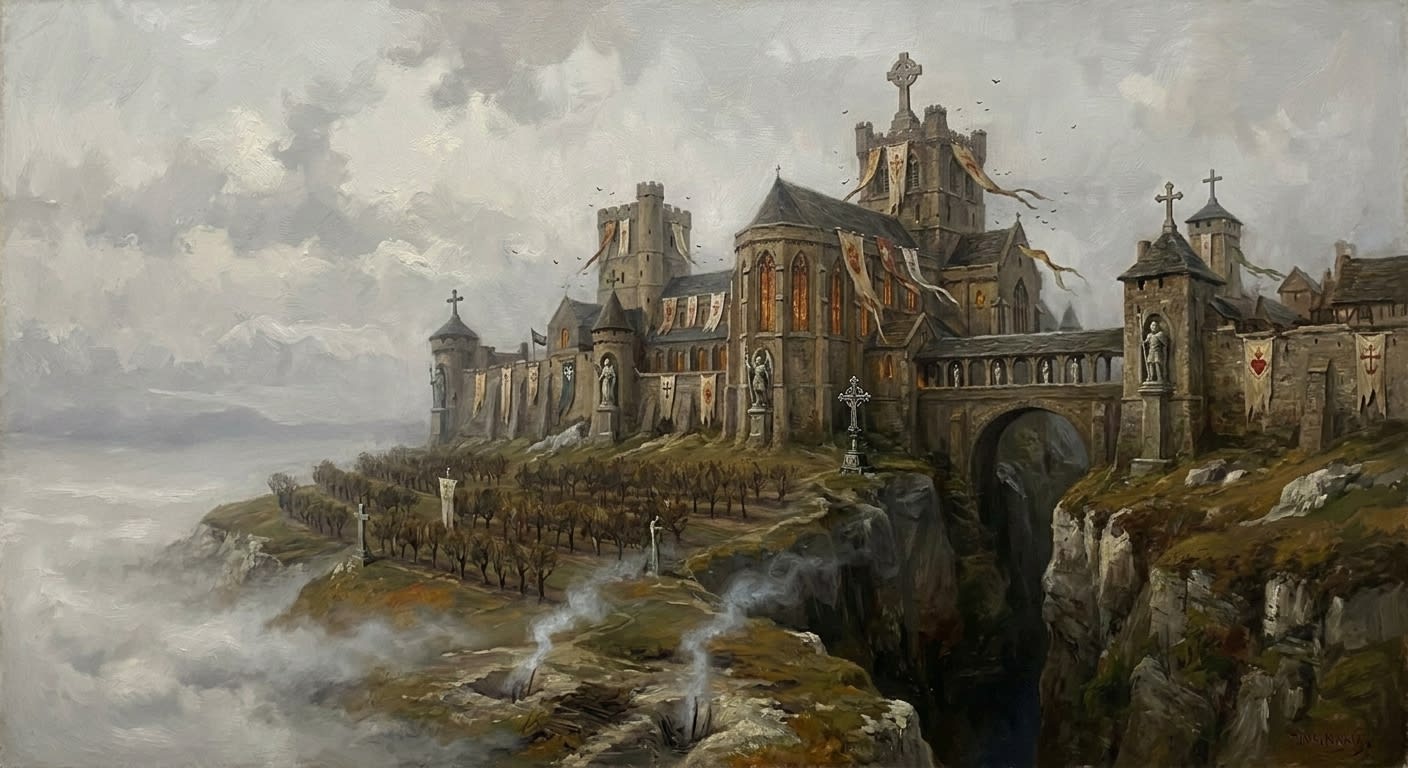
Nemea sits on a chalk ridge above a river so sluggish it could be mistaken for a canal if canals had the ambition to smell of lime and iron. The town is inland, tucked into the folds of the heartlands between the Rheinscarp supply corridor and the Queue Road's southern tributaries, close enough to Strasbourg that its couriers can reach the capital in two days by rail spur and close enough to nothing else that the isolation is the point. This is Zone 2 of the Synod's geographic order — deep, safe, heavily administered, and therefore deeply unsafe in ways the Sagittal Line cannot imagine.
The surrounding country is chalk ridges, burnwood ash orchards planted in rows as regimented as any Synod chapter, and lime pits worked by men whose fingertips have been white since childhood. Fog moves through this landscape the way rumour moves through a chancery: slowly, clinging to surfaces, muffling the sounds you need most. On dry nights — and the locals mark them, the way soldiers mark artillery cycles — the candles refuse to gutter. Flames stand straight. The air itself holds still, as if under oath.
#On the Founding
Nemea was raised in A.S. 96, six years after the Concordat, when the freshly constituted Bureau of Records discovered a problem that should have been obvious to anyone who had tried to govern an apocalypse by paperwork: the records did not agree. Three provinces kept three separate census rolls. Two Chapterhouses maintained contradictory martyr-lists. A battalion commander in the Carpathian sector had been dead for two years in one ledger and recently promoted in another, and no one could determine which was the lie because both bore authentic seals.
Archon Benedict Veyrault — who slept on a cot in the Strasbourg scriptorium and dreamed, it is said, in triplicate — ordered the construction of a centralised archive-scriptorium capable of receiving, copying, correcting, and where necessary destroying every contested record in the Synod's keeping. The site chosen was a chalk ridge above a river ford where a Benedictine house had stood before the Atheist Wars reduced it to rubble and a reading room. The rubble was left. The reading room was expanded. What rose above it was Nemea: half monastery, half paper mill, wholly the Bureau's instrument.
The first Abbot-Registrar was a woman named Solene, about whom the Great Ledger records three facts: she was from Lyon, she was literate in six languages, and she did not sleep for the final forty days of her tenure. She died at her copying desk. Her successors have been sleeping ever since, though none of them sleep well, and none of them sleep long.
The first catastrophe arrived in A.S. 103 — a fire that consumed the west scriptorium wing and half the novice dormitories. The ink survived. The names did not. Entire families vanished from the rebuilt books because the clerks who reconstructed them could not remember whether the families had existed or whether their own memory was the counterfeit. Veyrault's Bureau resolved the matter by declaring all reconstructed records original by ratification — a legal fiction so brazen it has since become standard Synod practice. If the stamp says it is real, it is real. If reality disagrees, reality will be corrected in the next audit cycle.
#On the Scriptorium and Its Districts
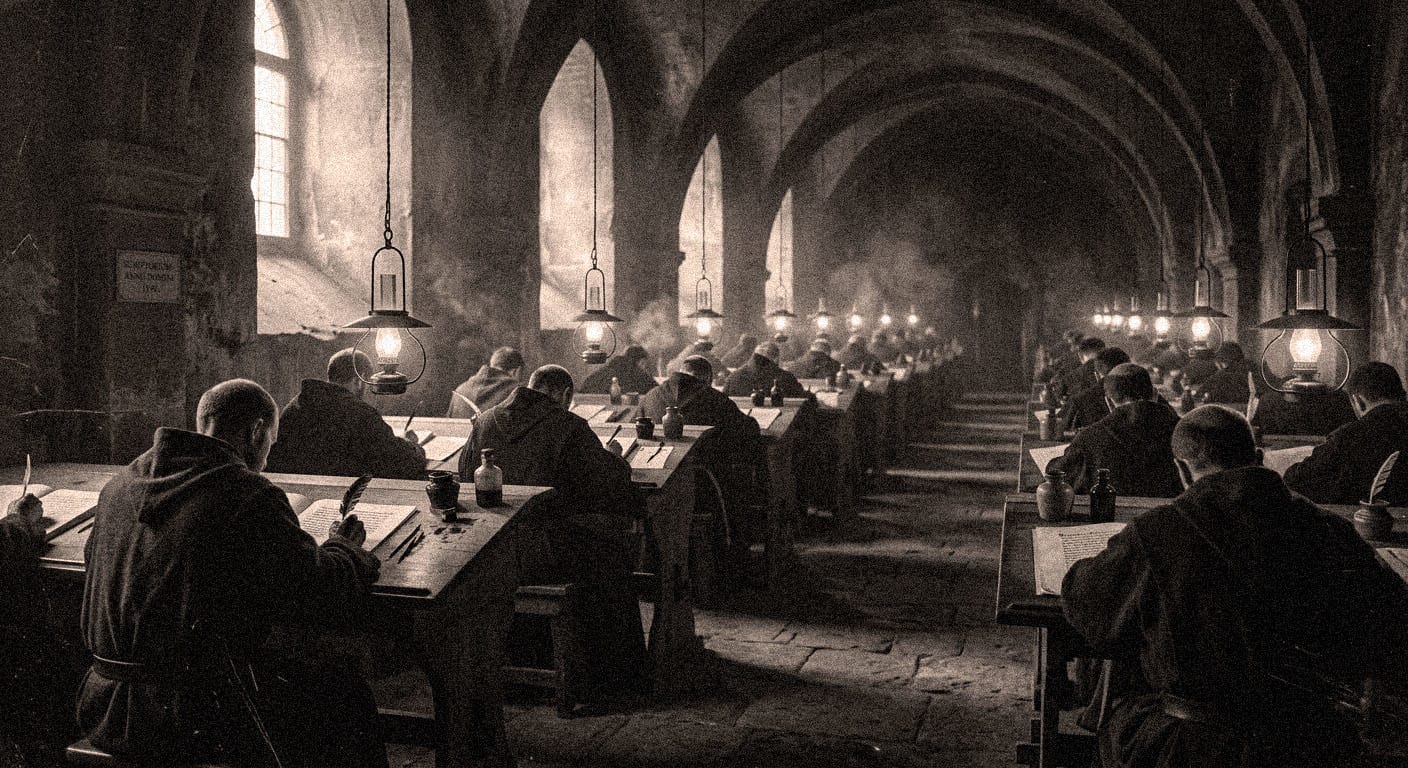
The town is stacked and burrowed, built upward above the ridge and downward into the chalk. The Hollow-Script Scriptorium proper occupies the crown — a warren of copying halls smelling of soot, vinegar, and hot wax, where robed figures hunch over angled desks and transcribe decrees by lampglass. Below the Scriptorium lies the Inkhouse Quarter, where the ash-ink is brewed in copper vats the size of confessionals. Below that, the vaults.
The districts follow the logic of the work. The Novice Barrens house the intake population — men and women who arrive by courier summons or voluntary petition and surrender their birth-names at the Silence Gatehouse in exchange for "archive safety," which is the Chapterhouse's term for the condition of being owned. The Margin Court adjudicates disputes of record — identity claims, contract violations, the legal status of a name that has been moved from a heading into a footnote (a practice called Margin Inheritance, which the Court insists is not punishment). The Redaction Yards burn and shred. The Lampglass Row manufactures the panes and lenses without which no document can be read, verified, or — the Silence Collegium will tell you with the straightest of faces — proven to exist. And the Courier Spur, at the town's eastern edge, dispatches the sealed carts that carry Nemea's product to the world.
Everything funnels through one chokepoint: the Inkhouse Bridge, a single stone span across the river gorge below the ridge. All freight, all couriers, all novice intake crosses this bridge. The Bureau of Records designed the bottleneck deliberately. A scriptorium that cannot be besieged by armies can still be strangled by its own logistics, and the Inkhouse Bridge ensures that the strangling, if it comes, will be administered by the Chapterhouse and no one else.
#On the Governance of Silence
Three people rule Nemea. The Synod charter names one. The town knows all three.
Abbot-Registrar Maelen Voss holds the Chapterhouse seal and the keys to the vaults. His fingers are immaculate — he wears gloves whenever ink is present, which in Nemea is always, so the gloves are his skin. Voss controls access to the originals. In a town where the distinction between an original decree and its copy is the difference between authority and impotence, this makes him the most powerful man inside the walls. His fear, which he has confided to no one but which the Margin Court deduced from the pattern of his requisition orders, is archive contamination — the possibility that the originals are no longer original, that something has been writing in them after hours.
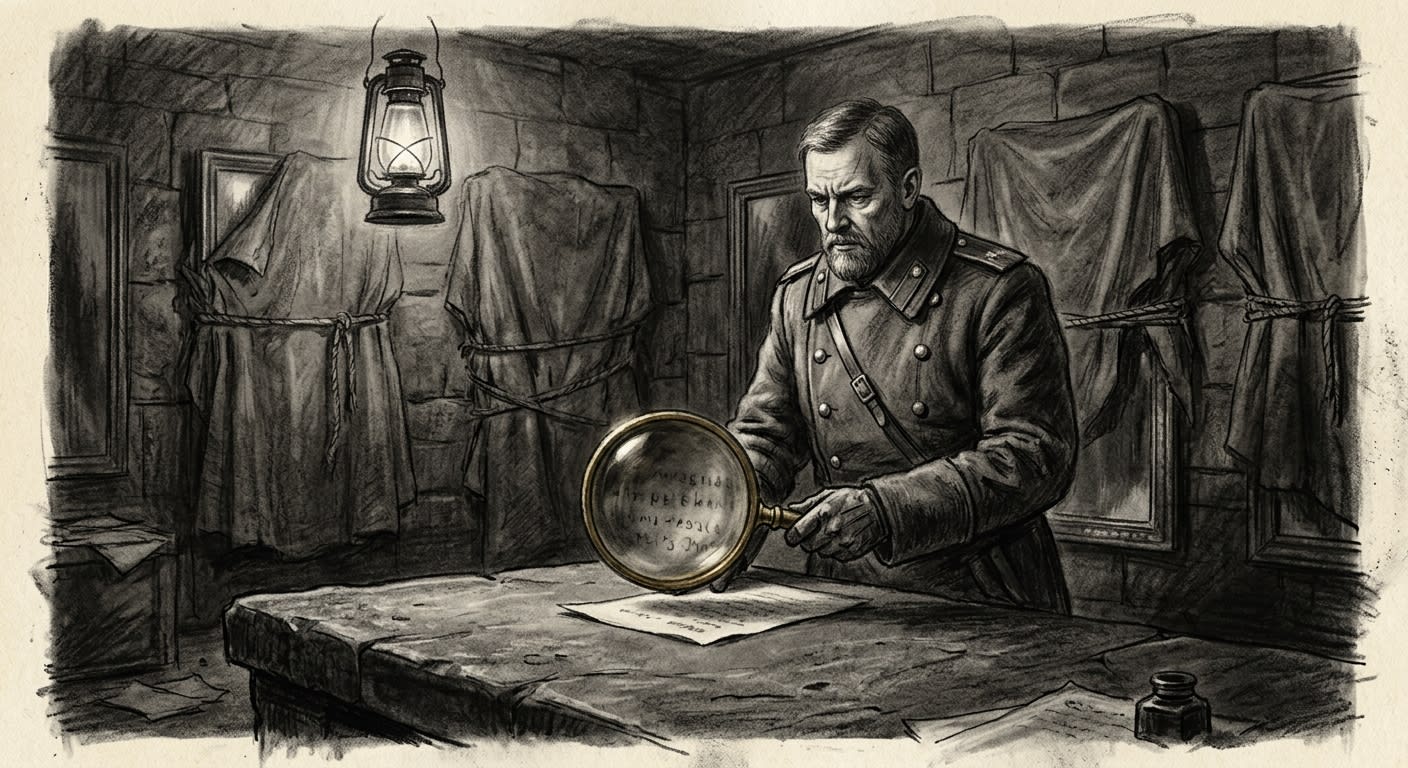
Silence-Master Rhu Tern commands the Silence Test Collegium — the guild-cum-rite-order that operates the gatehouses and verification chambers. Every document entering or leaving Nemea must pass a silence test: a procedure involving lamplight, mirrors, breath-pattern observation, and a reading protocol whose exact steps are classified. Tern listens the way an inquisitor watches — with an attention that makes the observed feel guilty of something they have not yet done. He keeps mirrors covered until the moment of testing. He has been known to fail documents written by the Abbot-Registrar himself.
And then there is "Sister" Halvein, who holds no official title, who appears in no charter, and who controls the flow of blackmail through Nemea's economy with the ease of a woman who has read every redaction draft before the Margin Court has sealed it. Halvein smiles when a name breaks. Only when a name breaks. The rest of the time her face is the face of a clerk doing sums.
#On Ash-Ink and Its Properties
The product that makes Nemea indispensable is its ink.
Ash-ink is brewed from burnwood charcoal, iron-gall, vinegar binder, and — the Chapterhouse will deny this with all the administrative fury at its disposal — relic residue. Bone-dust from decommissioned reliquaries, ash from saint-cloth burned during certification failures, calcite scraped from the walls of consecrated vaults: these materials enter the Inkhouse vats in quantities the supply manifests describe as "mineral supplement" and the street describes as "the dead in liquid form."
The ink binds to paper the way law binds to the obedient. Scraping it produces not blankness but new text — words bleeding upward from the fibres as if the paper had been waiting to confess. The Bureau of Records considers this a feature. The Silence Collegium considers it a security risk. The novices who work the copying halls consider it terrifying, and they are correct, and no one asks them.
The ink is exported in sealed bricks — compressed, stamped, rationed. Every Bureau of Records office on the continent uses Nemea ash-ink for its most sensitive documents. Every Bureau seal is pressed in Nemea wax. The town's economy runs on this monopoly the way a cathedral runs on its bells: remove the product and the structure becomes an empty shell making gestures at authority it no longer possesses.
#On Night-Rewriting Contracts
The anomaly began in A.S. 198. Or rather: the anomaly was classified in A.S. 198, which in Nemea's lexicon is the same as beginning, because things that have not been classified have not happened.
Contracts stored in the vaults began to change overnight. A clause specifying three years of service would, by morning, specify five. A debt of forty ration-chits would become sixty. A name listed as guarantor would migrate from the signature line into the body of the text, converting a witness into a debtor. The changes were not random — they followed a grammar, an intention, a direction. Every revision increased obligation. Every migration of a name tightened a noose.
The Chapterhouse blamed the Second-Draft Circle — a heretical cell operating in the crawl-shelves and courier tunnels, dedicated to preserving originals and undoing erasures. The Second-Draft Circle blamed the ink. The ink, naturally, blamed no one, because ink does not speak, except in Nemea, where it does, and the Chapterhouse has spent three years pretending otherwise.
Prior editions of this entry attributed the contract-rewriting phenomenon to "residual schismatic interference" and a contaminated batch of Inkhouse vat number seven. The Bureau of Alchemical Standards has since determined that vat number seven produces ink chemically identical to all other Nemea vats. The phenomenon's cause remains under active classification.
CORRECTED by order of the Bureau of Doctrine, A.S. 201. The contracts rewrite because the ink is performing its function — binding truth to paper. That the truth the ink perceives differs from the truth the Chapterhouse has stamped is a theological matter, not an archival one, and has been referred to the appropriate sub-committee.
The countermeasures are salt-lamp circles (the lamps must burn through the night over sensitive documents), mirror checks (a mirror held to the page will reveal text that has shifted since the last reading), and the standing order to "burn the second draft" — any document found to contain text not present in its certified copy is to be destroyed immediately. The standing order is obeyed. The documents keep rewriting. The Silence Collegium has requested additional mirror-pins. The Abbot-Registrar has requested additional gloves.
#On the Economy of Absence
Nemea's commerce is deletion.
A name erased from the Great Ledger at Nemea's recommendation ceases to have existed. A debt struck from Nemea's corrected copy ceases to have been owed. A confession shredded in the Redaction Yards ceases to have been spoken. The town exports absence — certified, stamped, sealed, and delivered by courier to every tribunal, every gate-court, every bastion registry on the continent.
The price is paid in pages, in night-hours, in names. Novices who enter the intake surrender their birth-names and receive archive designations — strings of numbers and letters that the Chapterhouse insists are "more precise" and the novices understand are chains. Page-debt accumulates: a scribe who falls behind quota owes night shifts, and night shifts in the copying halls are when the ink is most active, and the ink is most active because the lamps burn low and the mirrors go unchecked, and what the mirrors do not see the Silence Collegium does not report.
The black market operates from Lampglass Row and the Courier Spur. Forged seals, erased histories, "clean identity packets" — a new name, a new ledger entry, a new past, purchased for the cost of blank leaves and lamp oil. The one commodity no broker will sell at any price is a vault-index key. The index maps the location of every original in the under-vaults. Whoever holds the index holds the difference between what the Synod says happened and what actually did.
#On the Redaction Yards
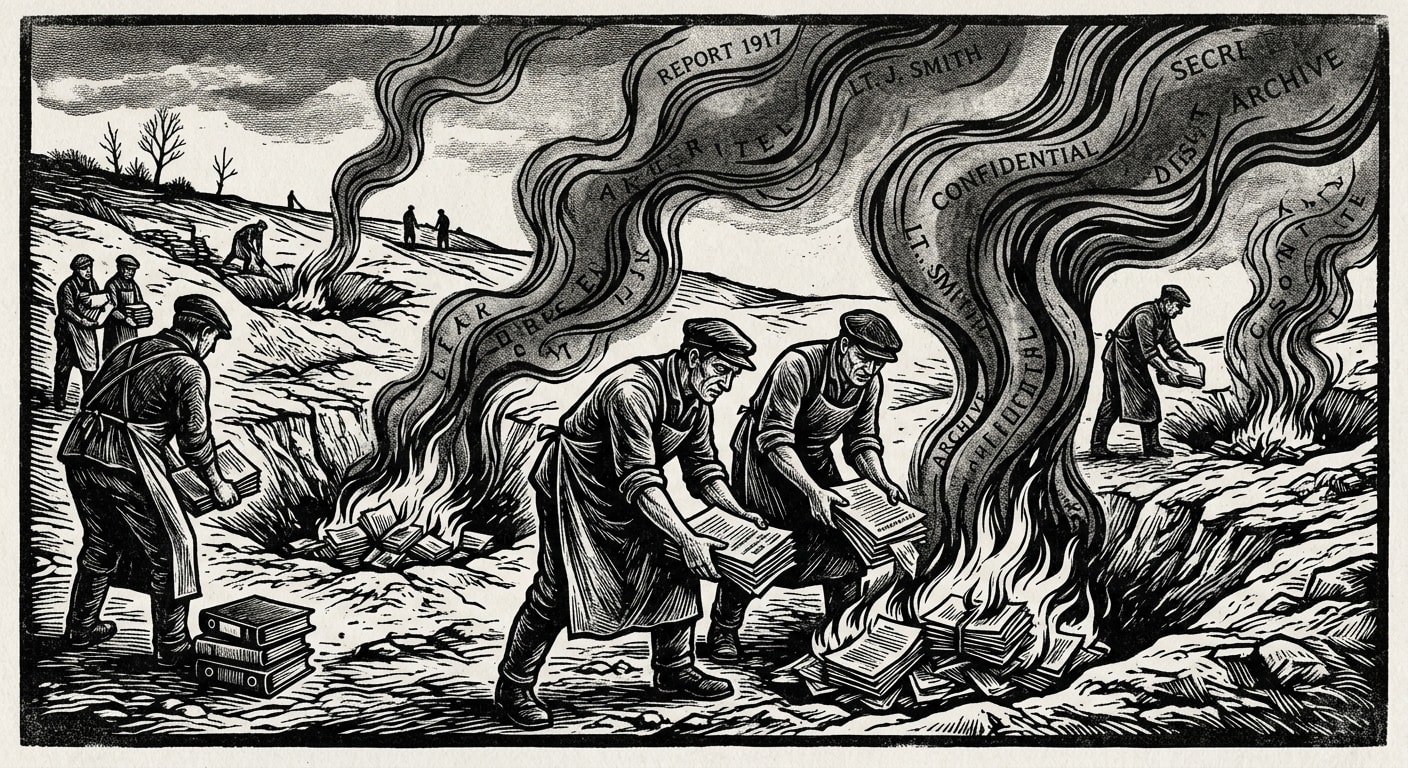
The Yards occupy the town's western slope — open-air burn pits and shred mills where condemned documents are rendered into ash and confetti. The work is constant. Every correction cycle produces a harvest of pages to be destroyed, and the correction cycles have been accelerating since the contract-rewriting crisis began, because the Chapterhouse's preferred response to documents that change themselves is to generate more documents certifying that the changes did not occur, and these documents, too, occasionally change, producing further documents, producing further corrections, producing further ash.
The ash drifts. On windless days it should settle. It does not settle. It forms sentences in the air — fragments, clauses, names — legible for the space of a breath before the wind carries them apart. The shred-mill hands call this phenomenon "the Yards talking" and consider it a normal feature of the working day. The Silence Collegium calls it a Category Two Textual Remnant and has stationed two testers in the Yards full-time to record what the ash says. The recordings are classified. The ash continues to speak.
#On the Present Condition
Nemea is a machine that runs on the fuel it produces. The scriptorium copies; the copies generate disputes; the disputes require adjudication; the adjudication requires correction; the correction generates ash; the ash speaks; the speech requires classification; the classification requires copying. The circle tightens with each rotation. The Abbot-Registrar requisitions more gloves, more lamp oil, more blank paper. The Margin Court schedules more correction festivals — the public mass-deletions that the judges call "maintenance" and the novices call "the culling." The Silence Collegium fails more documents. The Second-Draft Circle hides more originals. Halvein smiles more often, which means more names are breaking.
The buried fear — the one Voss will not commit to paper, the one Tern tests for in every mirror-check — is this: the ash-ink mixed with relic residue is not malfunctioning. It is functioning precisely as sanctified material should. The text rewrites because it is trying to become true. And if the ink is right and the stamps are wrong, then Nemea's entire purpose — the correction, the redaction, the manufacture of official absence — is a war against the sacred. The Archive Chapterhouse, in its zeal to control what is written, may have built a scriptorium that knows the difference between what the Synod has decreed and what the Creator has permitted, and the scriptorium is choosing the Creator.
This is, of course, heresy. The Bureau of Doctrine has said so. I have signed the ratification. The ink, one presumes, will note my signature and file its own correction in due course.
This entry previously described the Hollow-Script Scriptorium as "a model of archival purity and Synod obedience." The Bureau of Doctrine notes that this description was accurate at the time of writing, remains accurate at the time of correction, and will continue to be accurate until such time as the Bureau determines otherwise. The apparent contradiction between this assurance and the preceding seven sections is a matter of theological nuance, not editorial failure.
RATIFIED. — Hieromnemon Valerius Drax, A.S. 201