
#On the Recorded Use
The Office for Those Whose Voices Are Missing has one attested user, one attested occasion and no attested text. The user is Rector-Chaplain Wendelin Grau of Bastion-Königsberg. The occasion is a letter that receives no answer. Grau keeps the text himself, which means it has never been filed.
I entered the practice in his dossier as one sentence among his habits. It sits between his dislike of hymns that rhyme "grace" with "place" and the paragraph on his present condition. Since then the Bureau of Records has asked me what the Office is, with the tired courtesy of a clerk who has found a noun with no index entry. Records wants an author, a licence, a feast, a first performance and a number in the rubric books. I can supply a list, a letter and a black tick. Records will have to make do with ink.
This account concerns those three objects and the singers they record. It is short because the evidence is short. Lesser archivists pad their entries. The Ledger does not.
#On the Voices Withdrawn
The Choir of the Northern Standard was established in A.S. 188. It has twenty voices in continuous rotation, twelve hours on and twelve off. The Bureau of Bells calibrates its hymn cycles, and the Bureau of Doctrine approves them. Its stalls stand in the Cathedral Close below the Northern Carillon, whose forty-one bells hang at the Baltic end of the Sagittal Line. Past that point the fog begins and the Synod's maps, out of embarrassment, stop.
The work is simple to state. A singer sings the authorized hymn at the authorized pitch, and he keeps singing when the Grey sings it back. The returns match the original note for note, word for word and timbre for timbre. At the third verse a singer hears his own third verse coming back from beyond the Sea Wall in his own voice. He must still breathe, mark the clapper and go on to the fourth. Twice on record the melody came back before the Choir had sung it. The Bureau filed this as anticipatory acoustic resonance, mechanism undetermined. The phrase has the shape of knowledge and the content of a shrug.
Men are taken off that rota. The dossier gives echo-sickness as the cause and says nothing more about it. I will not invent a ward of symptoms for readers who like their afflictions illustrated. First a singer is in the stall. Then a replacement is in the stall. Between those two facts there is a transfer order, and there is Grau's list.
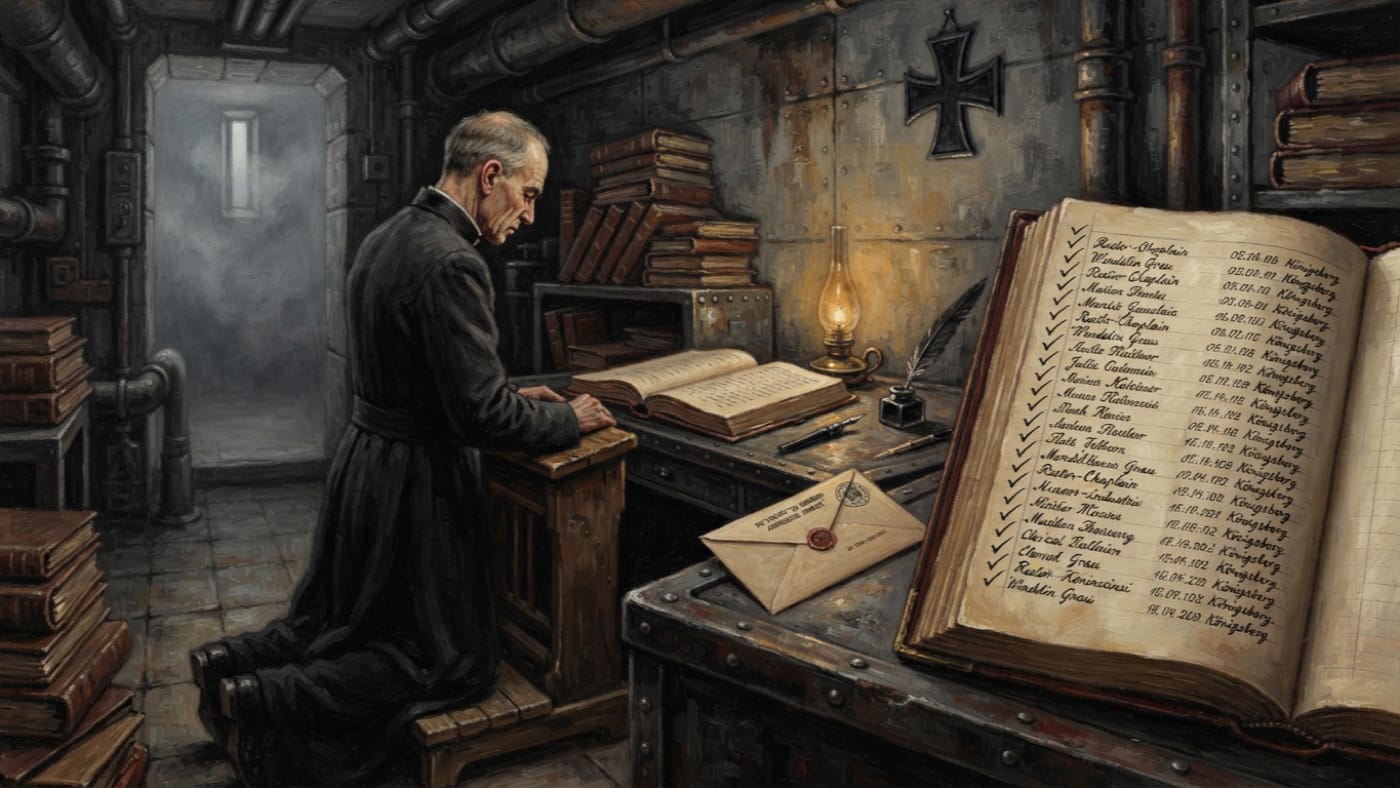
The list is his own. The rota records who sings, and the transfer order records where a man was sent. Grau's list records who no longer sings. The Bureau keeps no column for that and has never needed one, because a stall at Königsberg is never empty for long.
#On the Letter and the Black Tick
The procedure has two branches, and geography decides which one applies.
If the singer stays within the bastion after transfer, Grau visits him. Königsberg is too small for a man to be lost in, though the Warrens make a fair attempt. A rector-chaplain with a list and fifteen years of the place in his boots can find a former tenor in a storehouse, a signals hut or a barracks corner. The dossier does not say what happens at these visits. I record only that they take place.
If the singer has gone beyond the bastion, Grau writes once.
Once. I have heard clerks offer reasons for it: frugality with postage, respect for a man's privacy, a priest's sense of when persistence becomes pursuit. I record none of them, because Grau has given none. The number is his. It appears in his practice, and I am a historian, not a confessor with a lantern.
If no answer comes back, he puts a black tick beside the name and says the Office.
The reader will want the tick to mean something larger, so I will be exact about it. The tick records that no answer came. It does not record what happened to the man. A letter can go unanswered because its recipient is dead. It can also go unanswered because the man is in a rear depot with no paper, or because the envelope went astray in the Kanzleiburg sorting rooms, or because he has decided that the Cathedral Close is a place he never wants to hear from again. Every one of these explanations leaves the same mark on Grau's list. The ink cannot tell them apart, and Grau does not pretend that it can.
The dossier says beside the name. Beside it, not through it. The name stays on the page in the same hand, with a small black mark next to it. The rota lets a man go when he leaves the stall. Grau's list keeps him after the post has stopped carrying answers. That is my reading of where the ink falls, not a rule anyone has written down, but I have read enough ledgers to know that a line drawn through a name is a different act from a mark placed beside it.
The dossier gives no interval. How long Grau waits before he decides that nothing is coming is not recorded. Nor is what he would do if an answer arrived after the tick had been entered.
#On Saying the Office
Grau's confessional rule is well known at Königsberg. Men may confess their fear, but they may not decorate it. A corporal may say that a face in the fog looked like his mother. He may not go on to build a doctrine of mothers in the fog. Grau cuts that kind of speculation short and gives absolution for the fear.
The Office follows the same discipline. Its title names a condition and gives no cause. Missing is a Records word. It means the file exists and nothing answers to it. A less disciplined priest would have called it an office for those taken, or for the lost, or for those who went into the Grey, and each of those words would have answered a question the evidence leaves open. Grau chose the dullest accurate word available. I count that among the more orthodox acts carried out in the northern theatre this century.
I have not heard the Office said. I have not asked to hear it, and he has not offered. Its words, its length, whether it has responses, whether he says it standing or kneeling, in the stalls or at his desk: none of this is recorded, and I will not fill the gap. Give the Bureau of Orison and Song a blank rubric and it will hand back six verses, an antiphon and a licensing schedule within the quarter. The blank is better kept.
What the record does show is the shape of the act. Grau's daily work is to teach men to keep singing when an answer comes back that nobody asked for. The Office belongs to the other case, a voice that was called and gave no reply. In the stalls he trains men to hold their pitch against an echo. At his desk he marks where the echo failed to come. I offer this as my reading of two documented habits kept by one man, not as theology. Doctrine is welcome to take the matter up whenever it can bring itself to look north.
Nothing in the record says the Office does anything. It brings no one back to the stall. It mends no throat and quiets no fog. Nobody is known to have been told that it was said for him. A priest says it at Königsberg after the post has failed to bring a letter.
#On the Present Application
As of the A.S. 201 survey, Grau remains in post. He has held the rectorate since A.S. 186, fifteen years. The Choir has sung since A.S. 188, thirteen years. Neither figure tells us when the Office began. A list can be started at any point in a career, and nothing in the record marks the first black tick or the first letter. I decline to assign a year to an observance just because the surrounding years are already numbered.
The stalls are full. The Carillon rings the standard. The Grey returns the hymns, sometimes early. Singers are still taken off the rota for echo-sickness, and Grau still keeps his list. He visits those within the walls and writes once to those beyond them, and he waits for answers that may or may not come.