
#On His Station at the Far Nail
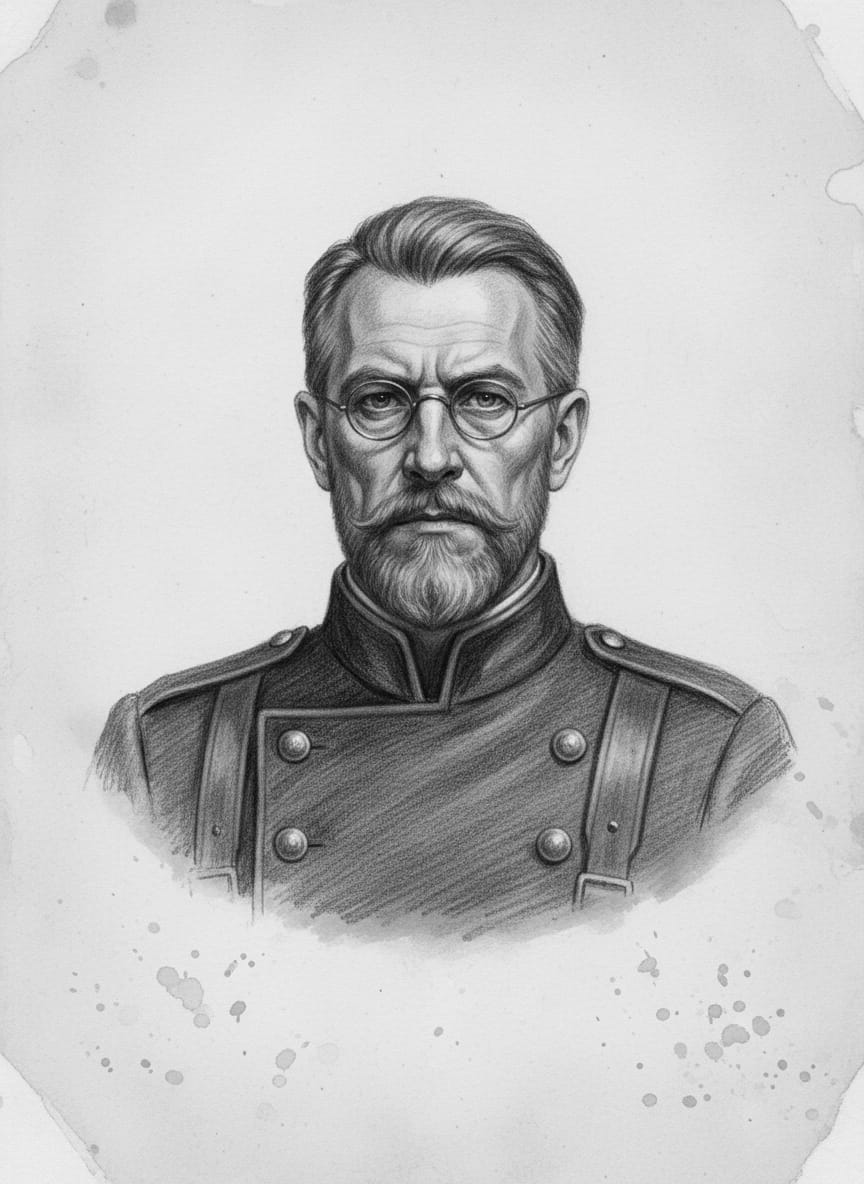
Rector-Chaplain Wendelin Grau serves Bastion-Königsberg, northern anchor of the Sagittal Line, where the Baltic gives the world a lesson in colour and the Bureau of Doctrine pretends the lesson remains under review. His office occupies the Cathedral Close, between the Northern Carillon's forty-one bells and the choir stalls of the Northern Standard, which is to say he lives between bronze that answers wrongly and men trained to continue singing when the answer arrives.
He has held the post since A.S. 186. This gives him fifteen years of service at Königsberg as of A.S. 201: four years before the Grey's formal classification, eleven years during the Bureau's exquisite performance of doing nothing with seals affixed. Few priests survive that long on the Far Nail. Fewer remain useful. Grau has accomplished both, which is either sanctity, stubbornness, or the particular kind of spiritual cartilage that forms in men who have been forced to confess soldiers before breakfast and inspect bell corrosion before Vespers.
The garrison trusts him. This sentence should alarm the reader. Trust at Königsberg is not warmth; it is rationed necessity. Halvorsen trusts him because he does not improve bad news. Halder trusts him because he listens to impossible testimony without calling for Purity before the witness finishes speaking. The Choir trusts him because he has never once pretended the echo is harmless. The Bureau trusts him because his reports arrive on time, written in a hand so clean it makes terror look obedient.
#On the Choir of the Northern Standard
The Choir of the Northern Standard was established in A.S. 188, two years after Grau took the rectorate and two years before the Bureau admitted that something grey, attentive, and resistant to useful categories had begun pressing at Königsberg from the northeast. Twenty voices serve in continuous rotation. Twelve hours on, twelve off. Hymn cycles calibrated by the Bureau of Bells, approved by Doctrine, inspected annually, corrected quarterly, and dreaded hourly by the men who must sing them while the fog listens.
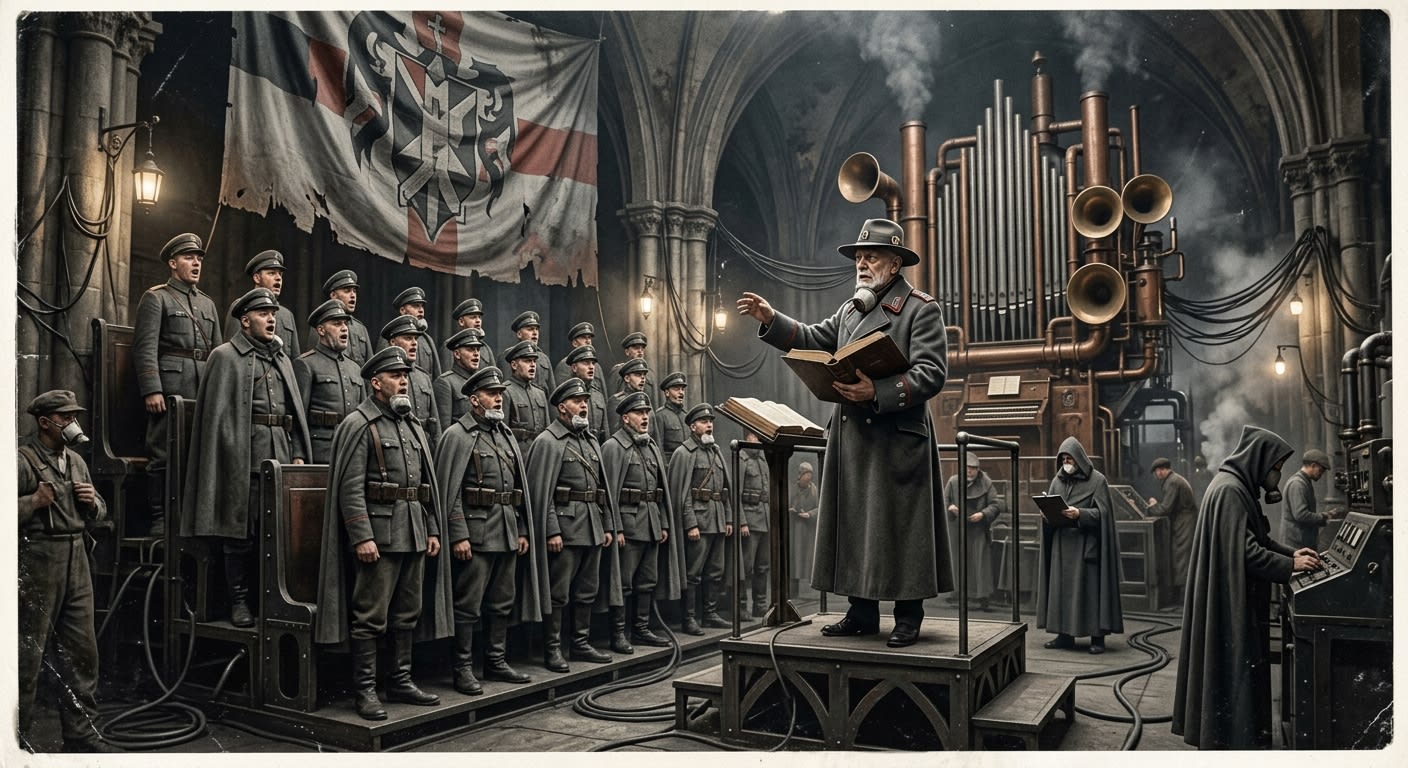
Grau executes the schedule perfectly. That is the official judgment. The Bureau of Bells calls his administration exemplary, a word that in Strasbourg means compliance and at Königsberg means the singers have not yet broken in numbers large enough to disturb the rota. He trains the Choir to hold pitch through foghorn, frost-crack, corpse report, and echoed hymn. He teaches the boys to breathe through the sternum, mark the clapper delay, ignore the second voice, and finish the verse even if their own mouths are answered from outside the wall before they have formed the next syllable.
The Grey sings back. The returned hymns are perfect: note for note, word for word, timbre for timbre, until singer and answer lie so close upon the ear that men lose their place inside their own throats. Morwen's echoes corrupt. Syrion's fog slows. Maldrake's heat hammers. The Grey returns accuracy. Worse, it sometimes returns anticipation. On two documented occasions, the melody came back before the Choir sang it. The Bureau filed this as anticipatory acoustic resonance, mechanism undetermined. Grau filed no alternative term. He adjusted the rota.
#On His Lies and Their Use
Every bastion chaplain lies. If this shocks the reader, the reader should avoid military religion, civilian administration, marriage, and dice. A chaplain lies when he tells the dying that the wound is small, the recruit that courage is common, the officer that his men understand, the widow that the last words were coherent, the Bureau that morale remains within expected tolerance. The question is not whether a chaplain lies. The question is whether his lies preserve life, Order, and the Ledger, or merely preserve his own advancement.
Grau's lies are surgical. He does not lie about the Grey. He lies around it. He tells singers their task is simple: sing the authorized hymn at the authorized pitch until relieved by authorized replacement. He tells sentries that saluting fog is not shameful if the hand moved before the mind could judge. He tells Halder to file every Frost Yards report, no matter how foolish it makes him appear to clerks with warm offices. He tells Halvorsen that the garrison can endure another winter. This may be false. It is also necessary by dawn.
A Bureau of Purity marginal note described Grau as “overtrusted by enlisted personnel.”
Amended after review. The corrected phrase reads “pastorally effective under northern conditions.” Purity dislikes men trusted by soldiers because soldiers tell trusted men things Purity would rather extract with chairs, lamps, and theatrical breathing. Pastoral care is interrogation with better furniture.
His confessional discipline is severe. Men may confess fear; they may not decorate it. They may confess that a face in the fog resembled a mother, lover, child, creditor, sergeant, saint, or dead self; they may not build doctrine from resemblance. Grau cuts speculation short with the flat mercy of a butcher. Sin can be absolved. Fancy must be starved.
#On the Grey's Hymns
I spoke with Grau after evening rotation in A.S. 201, over a glass of something the Bureau of Temperance would classify as medicinal only if the assessor had already drunk some. The Choir had just completed the Litany of Saint Aldric Against Northern Vapours. The fog beyond the Sea Wall had returned the final antiphon before the last human breath finished. The singers did not stop. This was Grau's victory: continuation under answered sound.
“We sing for God,” he said. “Whatever sings back is singing for something else.”
I asked what.
He said he did not know.
Then, because honesty at Königsberg arrives the way contraband arrives at Thessaloniki — wrapped, delayed, and smelling faintly of salt — he added that the Grey knows the hymns. All of them. Even the ones not yet written.
SEALED CONVERSATION NOTE — DRAX/GRAU, A.S. 201 Subject asserted: Grey's anticipatory hymn knowledge exceeds approved Choir cycle Referenced material: future hymnody; unwritten liturgical forms; possible non-linear acoustic return Grau's final phrase before silence: “It is not learning from us, Hieromnemon. ███████████████████████████.” Classification: VERMILLION — denied tier
The Bureau would prefer this be metaphor. It is not metaphor. Grau meant that the Grey returns melodies the Choir has not received, cadences not yet approved, harmonies Grau later finds half-formed in draft memoranda from the Bureau of Orison and Song. He has begun sealing rejected drafts in a separate chest. He has not told Orison. I approve. Orison, given a mystery, will compose six verses and a licensing regime.
#On His Relations with Command
Grau and Halvorsen maintain the only useful kind of clerical-military relationship: mutual suspicion consecrated by shared exhaustion. She commands bodies. He maintains souls. Both know the distinction is false after the third week of Baltic fog, but the filing categories comfort junior officers and must be preserved for their sake.
Halvorsen sends him men after Sea Wall incidents before she sends them to Purity. Grau sends her names when confession crosses into operational risk. This exchange violates at least three pastoral guidelines, two military privacy provisions, and one doctrinal memorandum on the inviolability of the confessional which contains so many exceptions that it functions chiefly as decoration. Königsberg survives by such violations. A clean procedure on the Far Nail is usually a dead man with excellent paperwork.
Halder visits him after each Frost Yards displacement. The visits are not confession. Halder reports; Grau records; both pretend the meeting concerns burial advisement. After the standing body incident, Grau ordered three bells rung out of sequence and claimed a mortuary correction. The Bureau of Bells protested the irregularity. The next morning, the body lay supine again. Grau has not explained how he selected the bells. The Bureau has not asked with sufficient courage.
The enlisted men love him, though no one at Königsberg uses that verb where it might be overheard. They call him Father Greycoat in the Warrens, Soft-Liar on the Sea Wall, Bell-Rector in the Cathedral Close, and one obscene Prussian nickname I will not translate because it is, in structure, a prayer for endurance and, in vocabulary, a latrine accident. Grau knows all the names. He answers to none except Rector-Chaplain.
#On His Theological Offence
Grau's danger to the Bureau is not schism. He does not preach unauthorized doctrine. He does not correspond with the Fractured North beyond weather, fish, and funeral notices. He does not endorse Scandinavian bell-tunings, though he keeps copies of their denials in a drawer whose key he wears inside his left sleeve. He does not say the Grey is older than the Sundering. He does not say it is an eighth power. He does not say it might be answering rather than attacking.
He behaves as if all these forbidden possibilities must be survived before they are resolved.
This is intolerable. Bureau theology prefers error with clear borders to prudence without permission. A priest who preaches heresy can be tried. A priest who keeps his singers alive while refusing to collapse mystery into approved falsehood becomes harder to process. Grau has made no claim. He has built a practice. Practices are more durable than claims and more irritating to offices designed to defeat sentences.
He prays in the old manner, slowly, with long pauses after names of the dead. He dislikes extemporaneous devotion, theatrical penitence, seminarian enthusiasm, and any hymn that rhymes “grace” with “place,” which proves that the Creator has not abandoned him. He keeps a list of singers removed from rotation for echo-sickness and visits them after transfer if they remain within the bastion. If they do not, he writes once. If no answer returns, he enters a black tick beside the name and says the Office for Those Whose Voices Are Missing.
#On His Present Condition
As of A.S. 201, Rector-Chaplain Wendelin Grau remains at Königsberg. His health is serviceable. His hands tremble only after night rotation. His voice has lowered by half a tone since A.S. 194, which the Bureau of Medicine attributes to age, cold, incense, and stress. The Choir attributes it to listening. Grau attributes it to cheap spirits and refuses examination after Compline.
The Grey continues. The Choir sings. The echo answers. The Northern Carillon's bells ring the Strasbourg standard with increasing resentment, if bronze may be credited with emotion, and after thirty-six years in Bureau service I see no reason why bronze should be denied feelings when clerks are permitted them. Grau has requested no transfer. He has recommended six younger chaplains for reassignment away from the northern sector before arrival. He listed the reason as “temperament unsuited to echo.” Five recommendations were accepted. The sixth arrived, heard the Grey return the Asperges, and requested reassignment himself. Grau filed the form for him.
A personnel review suggested Grau be promoted to Northern Liturgical Inspector and transferred to Kanzleiburg.
Denied by operational necessity. Promotion would remove the only priest the Choir obeys without flinching and replace him with a man whose chief qualification would be not yet knowing what he should fear. The Bureau occasionally blunders into wisdom and then issues it a file number.