
#On the Recorded Birthplace
Ploërmel is a commune of Brittany. The Codex admits it for one reason. A woman was born there who later knelt on the cobblestones of Saint-Malo, died, and was afterwards made a saint. Everything else the commune has built, suffered, taxed or forgotten over the centuries lies outside this entry. I have not been asked to write the history of Ploërmel. I have been asked to write the history of one line in a file.
The line appears in the dossier of Saint Margaux of the First Blood, and it says she was born at Ploërmel about 1657 CE. The year is arithmetic. The Martyrology gives her age at death as sixty-three. She died in A.S. 10 / 1720 CE. The clerks subtracted, and the subtraction produced c. 1657, or approximately A.S. −53 under a calendar the Synod adopted only in A.S. 90 and then laid backward over everything, including the cradles of people who never heard of it. No birthday survives. No register gives the year in the curate's hand. The commune is the firm part of the entry. The date is a deduction from a dead woman's age.
When she was born the formal Synod did not exist, and Brittany was a province of kings rather than of Bureaus. I name no king. The file names none, and I will not borrow one from a neighbouring folio to make the page look furnished.
#On the Wheelwright's Household
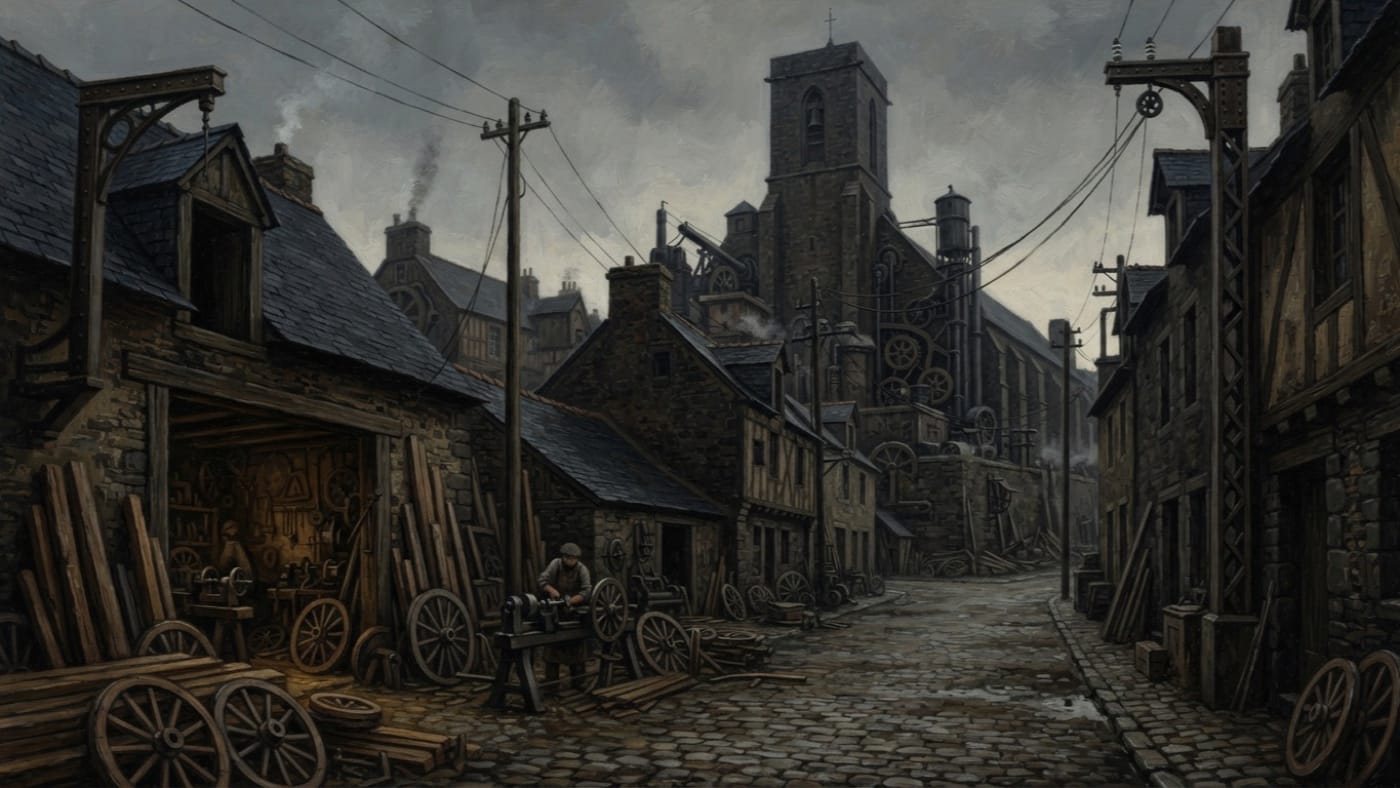
Her father was a wheelwright. Her mother was a wheelwright's wife. Neither is named.
I have spent decades reading files at the Ledger. I can report that the second sentence is a perfectly ordinary clerical construction and also a small scandal. The father's trade entered the record because a trade is a category, and clerks love a category the way magpies love a buckle. The mother had no category of her own. She was entered as an attachment to her husband's occupation, the way a felloe is described by the wheel it belongs to, and she has stayed there for two and a half centuries. She is the most completely anonymous woman ever to bear a saint for the Church.
What the household earned, whether it owned its workshop, whether Margaux had brothers who took up the drawknife or sisters who married into the next parish: on all of this the file is silent. That silence is the one family possession I can certify. I will not furnish the house. Hagiographers furnish houses. They put in a hearth, a pious mother at the hearth, and a small girl at the mother's knee mending something prophetic, and within a generation a parish is selling postcards of the hearth.
The parish of Saint-Armel supplies the rest. Its records, as the dossier reports them, note her baptism and her confirmation, and then nothing more about her until she was seventeen. I must be exact about what that statement covers. It describes the account that survives. A girl may do a great deal between confirmation and seventeen without bothering a parish clerk, and a parish book may lose leaves to damp, mice and curates for a century before anyone notices. No transcription of either entry has reached my desk. I hold no register reference, no officiant's name, and no date for either sacrament. I have the report that the entries exist, and I file it as a report.
#On Her Departure
At seventeen she entered the Order of the Blessed Thorn at Sainte-Claire-des-Landes. As the record holds it, that is the entire departure. The file gives an age, and an age is all it gives. I decline to turn that age into a year and then seal the conversion as though a clerk had witnessed it. Entering a house and professing in it are separate acts in any convent worth its bell-rope. The dossier affirms that she took her vows. It does not say when, and it does not tie the profession to the day she arrived.
Forty-six years followed: linen mended, the elderly tended, and then, by the convent's ordinary arithmetic, the tender became one of the elderly herself. Sixty-three, less seventeen. The sum closes cleanly, and it is the only clean sum in her file.
From those forty-six years the Bureau of Records holds one document bearing her signature from before the massacre. It is a receipt for six bolts of undyed cloth, countersigned by the convent's bursar and dated twelve years before her death. It belongs to the convent's accounts and to the Bureau's custody that came after. It is no Ploërmel paper. It never lay in the Saint-Armel book. It cannot tell us where the girl learned her letters, or whether she learned them at home at all.
That is the boundary of this entry. A place article may claim the woman up to the convent gate. Past the gate she belongs to the Thorn, and the Thorn kept even less about her than Saint-Armel did.
#On the Later Saint
She died at Saint-Malo in A.S. 10 / 1720 CE, on a day no surviving witness has fixed. An early ecclesiastical tribunal at Strasbourg recognized her in A.S. 14 / 1724 CE. The Bureau of Doctrine ratified that recognition later, on a date this office has not been given. The formal Synod arrived in A.S. 90 and brought its calendar with it, and from then on every line in her file could be restated in Synodal years by people who had never stood in a Synodal year at all.
The Order of the Blessed Thorn's own entry records that its sister died on the fourteenth day of Corvus, A.S. 10.
Her memorial is kept on 14 Corvus, in the later Church calendar. That assignment is liturgical. It does not establish the historical day or month of the massacre or of her death, and no approved conversion of Corvus to a common month exists. The exact day is unverified.
Recognition is what made Ploërmel matter. Before A.S. 14 the line "born at Ploërmel" was a parish detail about an old nun. After A.S. 14 it was the origin of a saint, and an origin is a field that must be filled. The Bureau's later investment in her was enormous: approved iconography, a feast, a psalter under lacquer, broadsheets in every Rhineland hall. All of it was hung on a biography that begins with a wheelwright, two sacraments, and a commune. The cathedral sits on a pebble. The Bureau prefers it that way. A pebble cannot contradict a cathedral.
The approved image of the Saint helps the birthplace not at all. It shows a small grey woman kneeling with a psalter while bayonets enter the frame. That composition is devotional construction. The earliest broadsheet engraver, according to a Records notation later sealed, never saw Saint-Malo and drew his own grandmother. No likeness of the girl from Ploërmel exists, and none of her parents. Anyone who looks for the wheelwright's face in a woodcut of his daughter at sixty-three is reading a seal as though it were a portrait.
The elevations came later and happened elsewhere. In A.S. 92 the convent at Sainte-Claire-des-Landes was raised to a First-Tier Pilgrimage Site, and the Order was reclassified as Venerable. Neither act moved a single stone at Ploërmel. This office holds no record of a Ploërmel shrine, a preserved childhood house, a local relic, a pilgrimage concession or a memorial raised in the commune. If any of these exists, it has not been filed with me. I do not transfer the convent's gate fees to the girl's cradle by sympathy.
#On the Limits of the Entry
Here, then, is what the Codex can certify of Ploërmel. It is a commune of Brittany. Saint Margaux was born there, in a year arrived at by subtraction. Her father made wheels. Her mother is known only through him. The parish of Saint-Armel, as reported, baptized and confirmed her and then lost sight of her until, at seventeen, she went to the Thorn.
That is an honest entry, and short. The Bureau has built a saint, a feast, a vault-relic, a recruitment poster and a waxwork out of less. The commune is spared all of them. On the evidence before me, Ploërmel's whole contribution to the most useful saint in the Theocracy was a girl who left.