
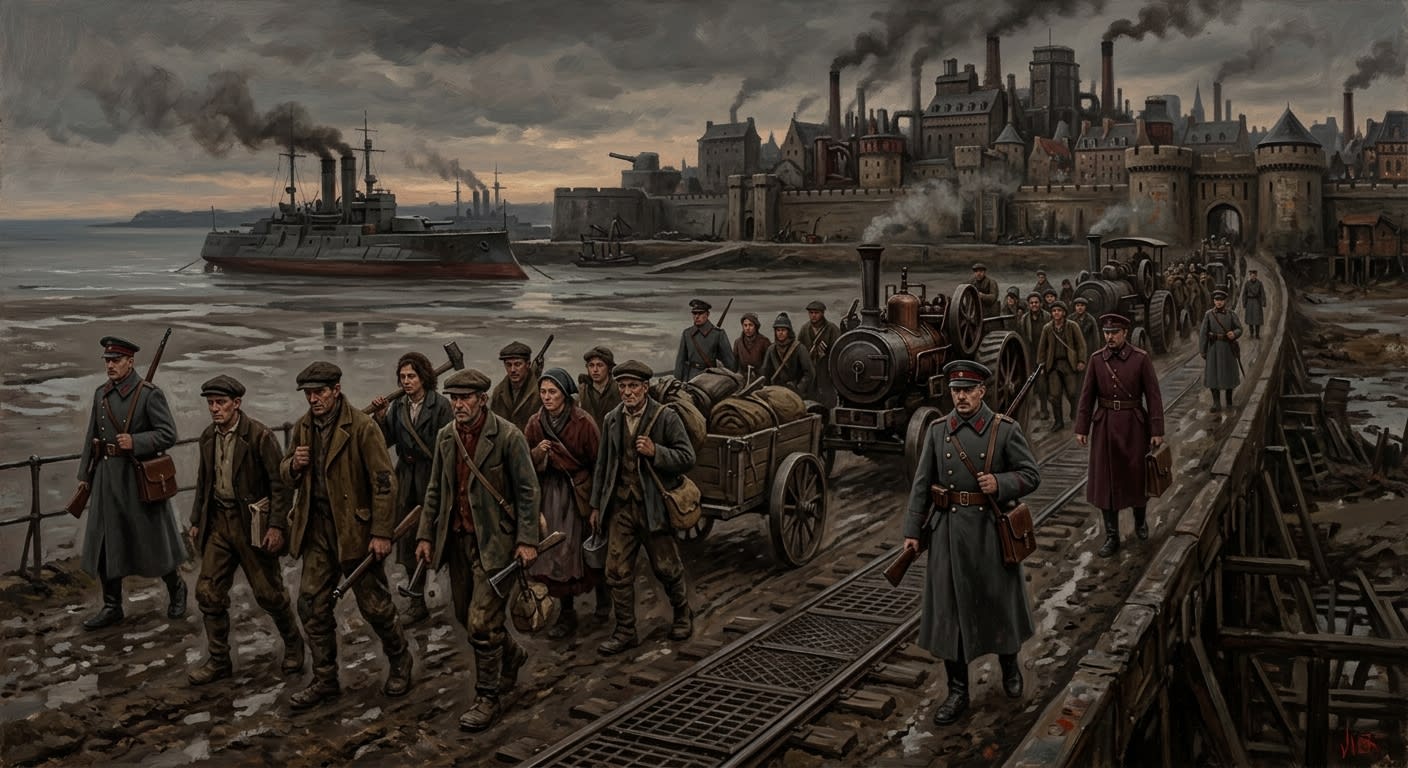
#On the Peninsula That Taught Blood to Travel
Brittany is the western fist of France, clenched into the sea and salted by every failure of Reason to understand old devotion. The map calls it Zone One, safe coast, Synod Heartland. The pilgrim office calls it the Saint-Malo circuit. The locals call it Brittany in the same tone with which a widow says her husband's name after Records has miscopied it twice.
It is a country of granite parish towers, fishing stairs, rope lofts, thorn convents, blue-thread charms, chapel roads, tide shrines, fish markets, gull theft, bad weather, excellent grudges, and a form of piety so local that Strasbourg has spent two centuries classifying it without ever quite domesticating it. This is no insult. A faith completely domesticated by the capital becomes a permit with candles. Brittany retained salt in the wound.
The Massacre at Saint-Malo made Brittany continental property. Before A.S. 10, the peninsula was a stubborn Catholic margin inside the Rationalist experiment: inspected, fined, catalogued, mocked, and endlessly remeasured by men who believed a shrine had been defeated once its thread-charms entered a ledger. After A.S. 10, Brittany became evidence. Its cobblestones accused. Its dead recruited. Its roads turned remembrance into traffic, traffic into revenue, revenue into Doctrine, and Doctrine into the sort of holy machinery that only fools call spontaneous.
#On Old Breton Devotion
Before the broadsheets, before the canonisation tribunals, before the Bureau of Pilgrimage discovered that grief becomes more obedient with ticket booths, Brittany kept its saints in corners. The fishermen had Clement for drowned men and broken crossings. Rope-makers had Hermas for road weather and strap luck. Mothers tied blue thread in coat hems. Old women placed shells near door-latches before storms. Parish priests blessed nets, bread, boats, children, and occasionally pigs, though the last item produced a legal discussion of such ugliness that charity forbids quotation.
The Rationalist inspectors arrived in A.S. 5 with inventories, secular notices, shrine-stripping orders, and that dry little confidence men acquire when they mistake documentation for conquest. Saint-Malo was described as ritually congested. Dinan was marked ritually persistent. Sainte-Claire-des-Landes, house of the Order of the Blessed Thorn, escaped early grandeur by being poor, female, damp, and useful only to the elderly, four qualities Rationalist administrators confused with irrelevance.
Rationalist coastal memoranda described Breton piety as “residual custom without military value.”
Corrected. The custom furnished martyrs, witnesses, roads, slogans, icons, relic claims, levy sermons, and two centuries of Synodal legitimacy. Its military value was delayed by one massacre.
The Secular Gatherings Act did not abolish Breton practice. It taught the practice to move sideways. Processions left as families and converged beyond toll posts. Relics travelled wrapped in laundry. Banner poles became road supports. Hymns were hummed beneath coughs. Children learned which bells summoned law and which bells summoned soup. The Republic possessed philosophy. Brittany possessed aunties. The contest was unequal from the beginning.
#On Saint-Malo and the Gate
The gate made the province famous, which is the cruelest thing a gate can do.
In A.S. 10 / 1720 CE, forty-three pilgrims came from Dinan toward Saint-Malo, bearing the Reliquary of Saint Matthias toward Clement's Chapel of the Tide. Later Church calendars set the memorial on the fourteenth of Corvus; surviving reports do not establish the precise day of the attack. Father Gaël led them. Hermas of Dinan bore the banner with his brother. Sister Margaux walked slowly from the Blessed Thorn road, small and old and almost perfectly unrecorded, carrying a psalter that would later become more famous than many bishops. They sang the Antiphon of Safe Passage. They carried no weapons. The Republican Guards held a writ.
Law met knees. Law chose steel.
Thirty-one dead were certified at the Porte Saint-Vincent and along the Rue de la Soif. Seven wounded witnesses survived to make the event usable. Five were classified as consumed by the event, a phrase so good that the Bureau has spent two centuries resisting the temptation to apply it to whole parishes, marriages, and budgets. The Reliquary was seized as Item 7 and held in civic damp for nine years. The Rationalist press called the matter a regrettable disturbance. Brittany called it what it was and did not require a printing house to know.
The massacre did more than kill pilgrims. It converted local injury into continental speech. Within a fortnight, sermons carried Saint-Malo eastward. Broadsheets turned Margaux into Europe's grandmother. Hermas became cloth held upright under killing pressure. Father Gaël became four words: It is not yours. Clement became the destination denied. Sabina of Ghent became bandage and witness. The Martyrology fixed sequence, and sequence made mourning governable.
#On Dinan, Departure, and Local Theft of Saints
Saint-Malo owns the blood-stones. Dinan owns the departure. Brittany understands the distinction better than Strasbourg does, because Strasbourg prefers the moment at which symbols become printable. Towns remember the hour before that, when saints need straps tightened and travel bread wrapped.
Dinan prepared the procession with small competence: cloak repairs, banner straps, reliquary latch inspection, candle-children counted at the lower stair. Its chapels were poor in gold and rich in habits. Its bakers marked pilgrim loaves underneath. Its rope-makers touched the Hermas staff before long walks. Its women corrected martyrology spellings with more authority than most bishops bring to councils. When news of the massacre returned, the town first had fragments: shots, gate, reliquary seized, Gaël dead, Hermas under cloth, Margaux dead, children missing. The approved observance came later. First came the road refusing to bring back what had left.
Breton custody of memory is possessive, inaccurate, necessary, and difficult to tax. Dinan claims Margaux by road even though she belonged to Sainte-Claire. Saint-Malo claims the dead by cobblestone even though many came from elsewhere. Clement claims the pilgrimage by absence because the forty-three never reached his chapel. Hermas exists twice, as old road-saint and martyred banner-boy, and Doctrine ratified the confusion rather than permit archivists to murder devotion by tidying it.
Several Strasbourg route cards once styled Brittany as “the Saint-Malo district.”
Withdrawn after Breton petitions, three corrected maps, one candle strike, and a Pilgrimage official being pelted with scallop shells in Dinan. Saint-Malo is the wound. Brittany is the body that refuses to let Strasbourg own the scar without paying local fees.
The Bureau of Pilgrimage has converted this possessiveness into route discipline. Grey tokens for Clement. Licensed departure from Dinan. Approved kneeling at the Porte. Thirty-one tolls. Forty-three seconds of silence. Children carrying hooks, banners, shells, blue thread, and the burden of being told exactly how to grieve by officials whose boots have never dried properly.
#On Sainte-Claire and the Usefulness of the Unremarkable
No account of Brittany survives inspection without the convent at Sainte-Claire-des-Landes, six miles inland from the sea, where the Blessed Thorn sisters mended linen, tended the elderly, washed bodies, ignored fever blasphemies, and produced one saint by doing almost nothing that hagiographers respect. Sister Margaux's life before Saint-Malo contained no treatise, no prophecy, no scandal, no authenticated marvel, no letter of doctrinal interest. One cloth receipt. Six bolts of undyed linen. Forty-six years of silence.
Then she walked.
Her canonisation in A.S. 14 taught the Bureau an important Breton lesson: obscurity can be weaponized with exquisite force. A woman with no distinguishing features could become every grandmother. A common psalter could become Relic 23-M. A convent of linen and old skin could become first-tier pilgrimage infrastructure by A.S. 92. The Blessed Thorn sisters received honour, inspectors, visitor queues, wax figures, donation boxes, revised rules, approved smiles, and all the other afflictions mistaken by capitals for reward.
Brittany's saints often begin as service before Doctrine discovers them. Sabina bandaged. Hermas carried. Margaux walked. Clement waited. Gaël refused. None designed a system. That task, praise be to the Ledger, was left to better men.
#On the Province Under Synod Custody
Brittany in A.S. 201 is loyal, watched, profitable, and insufficiently grateful. Its ports feed the Channel margins. Its roads feed pilgrimage. Its shrine circuits feed Tithes. Its stories feed Doctrine. Its local dialects survive under school correction, parish indulgence, and the stubborn fact that fishermen curse more effectively in the language their fathers used to drown. The Bureau permits what it cannot profitably erase and records the permission as mercy.
The province sits inside France, and France sits inside the Synod, and the Synod sits upon history with both knees. Yet Brittany keeps little survivals under the forms. Blue thread appears in cuffs after inspection. Shells lie beneath authorized brass tokens. The old names of road bends persist beside station numbers. Children learn the official Thirty-One Names and the unofficial stories that explain why one family refuses to buy candles from another. Strasbourg owns the calendar. Brittany owns the mutter after Mass.
PILGRIMAGE OFFICE INTERNAL NOTE — BRITTANY CIRCUIT, A.S. 198 Subject: local additions during forty-three-second silence. Observation: several parishes mouth names not present in the public Martyrology. Recommendation: do not interrupt silence to enforce silence. Marginal Doctrine hand: “For once, wisdom.”
This toleration is not softness. It is policy with sea legs. Suppress Breton particularity too hard and Saint-Malo becomes a local grievance again instead of Synodal foundation. Leave it entirely alone and the province starts remembering that martyrs belonged to families before they belonged to sermons. The Bureau governs Brittany by calibrated custody: enough licence to keep the roads singing, enough tariff to remind the singers who owns the road, enough correction to prevent the dead from escaping into private use.
#On What Brittany Remembers
Brittany remembers salt before statutes. It remembers Clement's tide chapel before route tokens. It remembers Hermas as a boy before a banner office. It remembers Margaux walking before kneeling. It remembers Father Gaël as a priest with road dust before four red-ink words. It remembers the five consumed absences with names that are sometimes whispered and never submitted. Memory of this sort is disorderly, which is why it must be honoured, taxed, corrected, and occasionally allowed to breathe.
The Synod requires Brittany because Saint-Malo is the first clean wound in our public myth. Paris gave us enemies. Amsterdam gave us heresy. Regensburg gave us humiliation. The Sundering gave us terror. Brittany gave us dead pilgrims with faces near enough to kiss, blood on visible stones, and a gate where law exposed its appetite. A state may be founded on abstractions if it wishes to die young. We founded ours on martyrs, forms, tolls, and a Breton street narrow enough for murder.
The sea keeps battering the coast. The blue threads keep appearing. Pilgrims still leave Dinan before dawn. At Saint-Malo, children scrub cobbles with ash and seawater. At Clement's chapel, forty-three hooks wait. At Sainte-Claire, twelve sisters mend linen while the wax saint kneels magnificently and sweats in summer.
Brittany remains faithful in the Breton manner: licensed by Strasbourg, corrected by Doctrine, priced by Tithes, and privately convinced that the Creator understood the road before any Bureau arrived with a measuring rod.