
#On the House Six Miles from the Sea
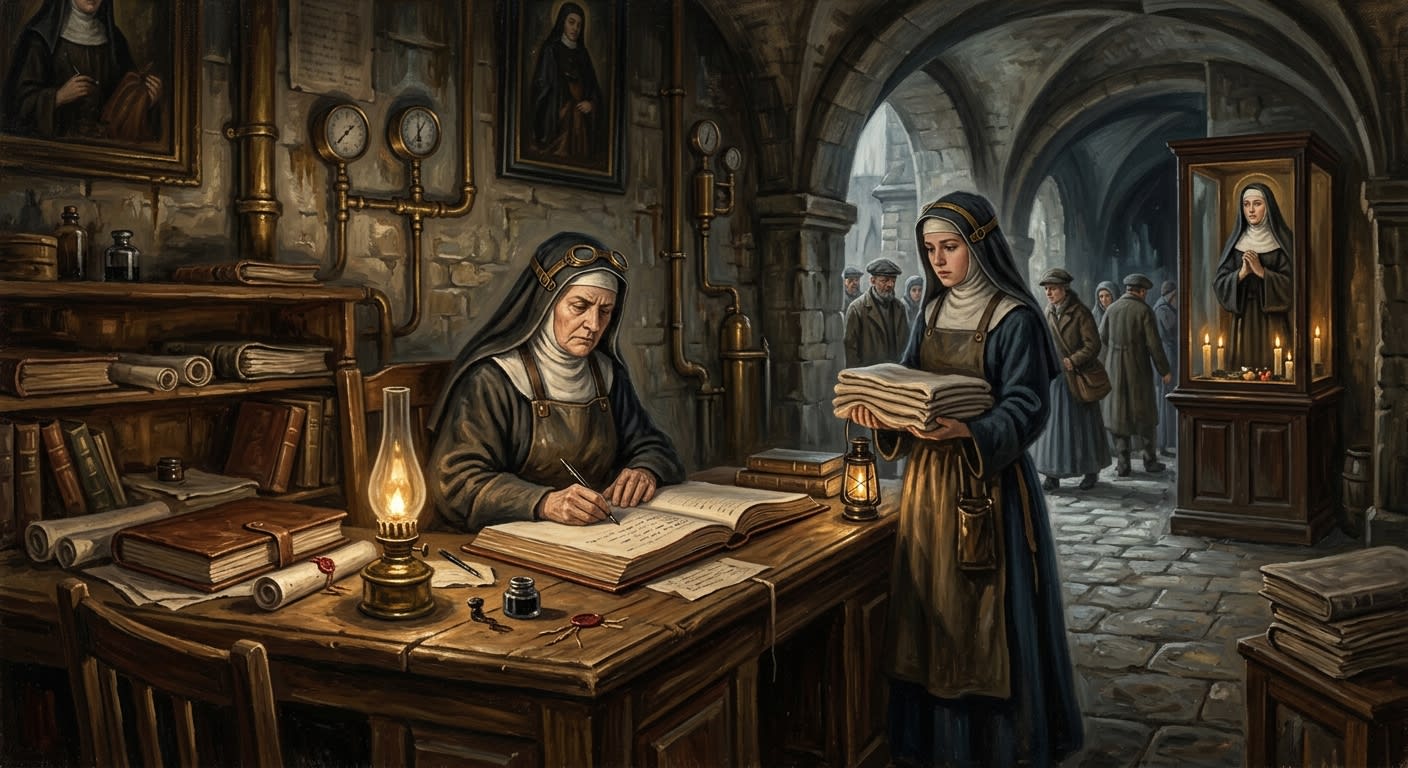
Sainte-Claire-des-Landes sits six miles inland from Saint-Malo, which in Brittany is far enough from the sea to smell less fish and close enough to have salt in the hinges. The road to it passes through low fields, thorn hedges, chapel stones, wind-bent trees, and those Breton cottages whose doors appear built for shorter men and more suspicious consciences. A pilgrim approaching from the coast first sees the convent roof as a dark line between reeds and sky, then the little bell cote, then the Bureau's visitor awning, which spoils the view with admirable efficiency.
Before Margaux, the place was a small mendicant house of the Order of the Blessed Thorn. Forty women at its largest, twelve at its most useful, and between those numbers the entire history of sanctity under administration may be read. The sisters washed old bodies, mended sheets, kept winter onions, took in women whose sons had discovered vocation elsewhere, and maintained a chapel whose roof leaked in three places, each named after a virtue by sisters with more wit than money.
The house is plain stone around a narrow court. Limewashed dormitory. Refectory smelling of broth and old smoke. Linen room on the eastern side, because morning light reveals stains and the sisters were never sentimental about dirt. The chapel is small, long, and badly proportioned, built by masons who feared the Creator and had never seen a straight wall perform its office. Such buildings endure because they have no vanity to exhaust.
#On the House Before Margaux
The pre-martyrdom archive of Sainte-Claire-des-Landes is thin, practical, and more trustworthy than most illuminated rubbish. Receipts for lye. A dispute over roof slate. Two burials without surnames. A list of old women admitted for winter care. A complaint from a local miller that the sisters had taken his mother “under pious pretext” when the truth was uglier: the miller wanted her bed. The sisters kept the mother. The miller kept his complaint. Records preserves both, and Providence may judge which document has the finer soul.
The convent's rule had no appetite for spectacle. Rise. Pray. Wash. Mend. Feed. Listen. Bury. Account. The sisters possessed one chalice of dented silver, three parish banners needing repair, two cows of hostile temperament, and a thorn-branch emblem stitched on inner cuffs where Heraldry later had the good sense, or the poor eyesight, not to interfere. They belonged to that lower weather of the Church upon which grander towers depend while pretending clouds hold them up.
A.S. 92 shrine literature calls Sainte-Claire-des-Landes “the cradle prepared by Providence for the First Blood.”
Corrected. It was a damp convent with insufficient blankets, a capable linen room, and no known prophecy concerning bayonets. Providence may use damp; shrine literature may not pretend damp was marble all along.
Margaux entered at seventeen from Ploërmel, bringing no dowry worth remembering and no talent worth turning into legend. She lived there forty-six years. She signed one receipt for six bolts of undyed cloth. She tended the elderly until she joined their rank. In A.S. 10 she walked from this house toward the Chapel of the Tide with the pilgrim column from Dinan and died at Saint-Malo, kneeling with a psalter while the Republican Guards demonstrated the educational limits of bayonets.
The convent did not know, when she left, that one of its beds had just become a relic problem.
#On the Road of Returned Attention
After the massacre, attention came uphill from the coast like weather with shoes. First came neighbors, asking which place had been hers. Then clerks, asking the same question with ink. Then pilgrims, asking it with tears and coins. By A.S. 14, after the canonisation tribunal in Strasbourg elevated Margaux under the splendid improvisation of miraculum diffusum, Sainte-Claire-des-Landes was no longer merely a convent. It was a preface.
Every saint requires a before. The cobbles of Saint-Malo supplied death; the Martyrology supplied sequence; Corentin Madec supplied the psalter; the broadsheets supplied face. Sainte-Claire supplied the years no engraver wished to draw: soup, linen, damp, silence, and the discipline by which a woman becomes useful enough to die well.
The sisters resisted the first visitors with Breton politeness, which resembles hospitality until one discovers the door has been closed behind the sentence. They allowed prayer in the chapel. They refused bed tours. They displayed no needle, no stool, no personal spoon, because a mendicant house owns few things personally and the dead own fewer. The visitors persisted. Persistence, when routed through Bureau offices, becomes policy.
A visitor ledger fragment from A.S. 19 records a woman from Rennes asking to sleep in “the saint's bed.” The sister on duty wrote: “The bed has Sister Aude in it.” The next line is torn away. A later hand adds: “Aude lived until winter and bit one pilgrim.” The Bureau of Pilgrimage omitted this from the devotional extract.
#On the A.S. 92 Elevation
A.S. 92 made official what appetite had already built. Under the post-Concordat regularisation of western martyr sites, the Bureau of Doctrine elevated Sainte-Claire-des-Landes to First-Tier Pilgrimage Site, attached to the Saint-Malo route but separately tariffed, scheduled, inspected, and blessed. There are moments when the Holy Bureaus move with such unity that one suspects possession. This was one of them.
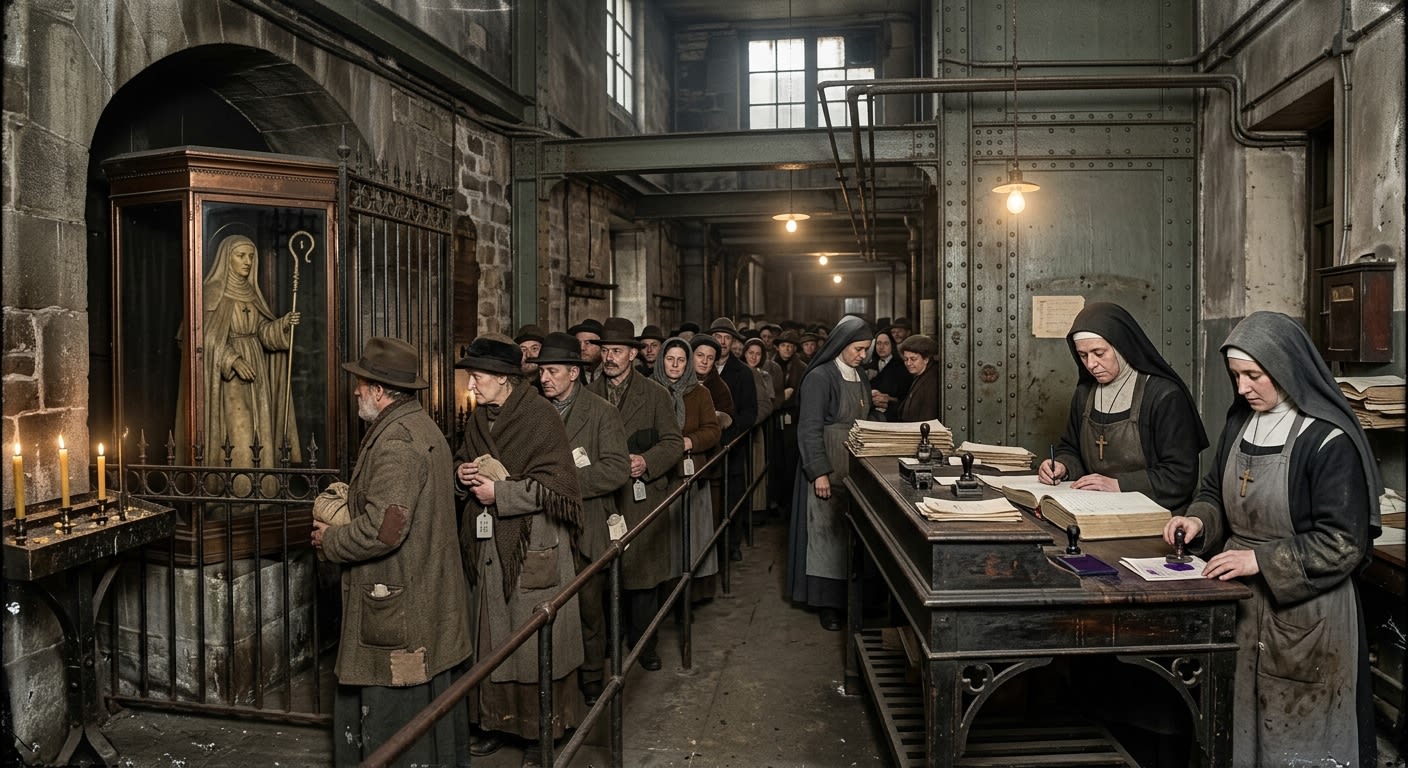
Pilgrimage established the approach path, queue awning, route tokens, arrival chants, rest periods, permitted kneeling points, invalid access, and the stall line for authorized devotional prints. Rites prescribed posture before the Margaux Chapel, the sequence of psalms, the candle angle, and the maximum duration of tearful silence. Records audited names. Tithes counted candles with the tenderness of a wolf counting lambs. Doctrine issued the interpretive pamphlet, which meant the quarrel was over before the sisters finished reading it.
The elevation brought repairs. The roof stopped leaking over Faith and Hope. Charity, having a sense of theatre, continued dripping above the passage to the visitor office until A.S. 104. The refectory received new benches. The chapel received stone paving, two iron donation boxes, and a side rail to prevent pilgrims from clawing at the floorboards. The dormitory lost beds to offices. The sisters lost silence to bells.
#On the Margaux Chapel
The Margaux Chapel occupies the old east room, once used for winter linen storage and now too holy for sheets unless the sheets are decorative. Its centrepiece is the life-sized wax figure of the Saint: kneeling, wimpled, psalter in hand, eyes turned upward, cheeks colored with a restraint the sculptor evidently learned from preserved ham. The Bureau of Rites has certified the expression as “doctrinally appropriate.” This means the face is pious enough to silence objections and vague enough to receive projection.
Pilgrims hate and love the figure in equal measure, which is how one knows it works. Children stare at the glass eyes. Old women touch their own knees. Soldiers on leave look at the psalter, then at the hands, then at nothing. The sisters dust the figure every second day in summer because wax attracts flies with the democracy of death.
A popular guidebook states that the wax figure preserves Margaux's exact bodily posture at the moment of martyrdom.
Unratified. No witness at Saint-Malo measured the angle of her elbows while being shot, stabbed, trampled, or otherwise occupied. The posture is devotional reconstruction. The Bureau of Rites certifies it as true in use, which is a finer category than true in fact and far more profitable.
The chapel also contains a small display case for associated objects: a copy of the six-bolt cloth receipt, a later thorn-needle from the Order, a strip of linen labelled “representative of the kind handled by the Saint,” and a prayer stool built in A.S. 97 to replace the one pilgrims had invented in their demands. The actual psalter, Relic 23-M(Ratified), rests in Strasbourg under Relics custody. Sainte-Claire receives a facsimile each year for the third Sunday of Corvus, escorted by two Relic-bearers, one Doctrine clerk, and enough armed men to remind humility to stay humble.
#On the Present Convent
As of A.S. 201, Sainte-Claire-des-Landes receives nine thousand visitors per annum, a number recited by Pilgrimage with satisfaction and by the sisters with the expression of women counting dishes after a wedding riot. Twelve sisters remain resident. The rest of the old house belongs to route administration, candle storage, licensed print stalls, pilgrim infirmary cots, Records desks, washrooms, and two rooms set aside for donors whose generosity requires mattresses unmentioned in the Rule.
The sisters still perform elder care, though now the elderly must be fitted between route hours. They still mend linens, though most are shrine linens, visitor cloths, chapel veils, and the endless little white squares sold as “Margaux kerchiefs” to people who believe holiness travels better hemmed. Sister-Matron Éloise maintains the linen room ledger with a severity that has defeated three Tithes auditors. One left weeping. One left converted to neatness. One married a cooper's widow and refuses to discuss the matter.
The village outside the convent has fattened around the route: candle moulders, bread sellers, token engravers, pilgrim hostels, thorn-pastry carts, water carriers, licensed beggars, unlicensed beggars with better theology, and a barber who advertises “pilgrim tonsure corrected while you wait.” The Bureau tolerates this economy because devotion that does not feed someone becomes politically thin. The sisters tolerate it because bread must be bought somewhere, and because shouting at pastry carts is poor witness unless the pastry is stale.
#On the House That Remembers the Wrong Thing
Sainte-Claire-des-Landes is supposed to remember Margaux's death. It remembers her chores.
The public route directs pilgrims from gate to chapel, from chapel to wax figure, from wax figure to donation rail, from rail to licensed print stall, from print stall to the road toward Saint-Malo. The private house runs another circuit: basin to bed, bed to linen, linen to line, line to press, press to shelf, shelf to the next failing body. In that second procession the Saint is less icon than former coworker. She was slow with buttons in winter. She folded sheets with exact corners. She disliked thin broth. She hummed one psalm flat. These details carry no tariff and survive in danger.
The Bureau would prefer the place to be a shrine with a convent attached. The sisters continue making it a convent with a shrine attached, which is among the more delicate acts of rebellion available to women whose vows include obedience and whose hands are always wet. At dusk, after the last pilgrim cart turns toward the coast and the visitor office locks its donation boxes, a sister crosses the court with a basket of sheets. The bell gives one small sound. The wax Saint kneels in the east room, perfect, profitable, and clean. In the linen room, where sanctity has work to do, someone curses a torn hem under her breath and threads the needle.