
#On the Manner of Her Walking
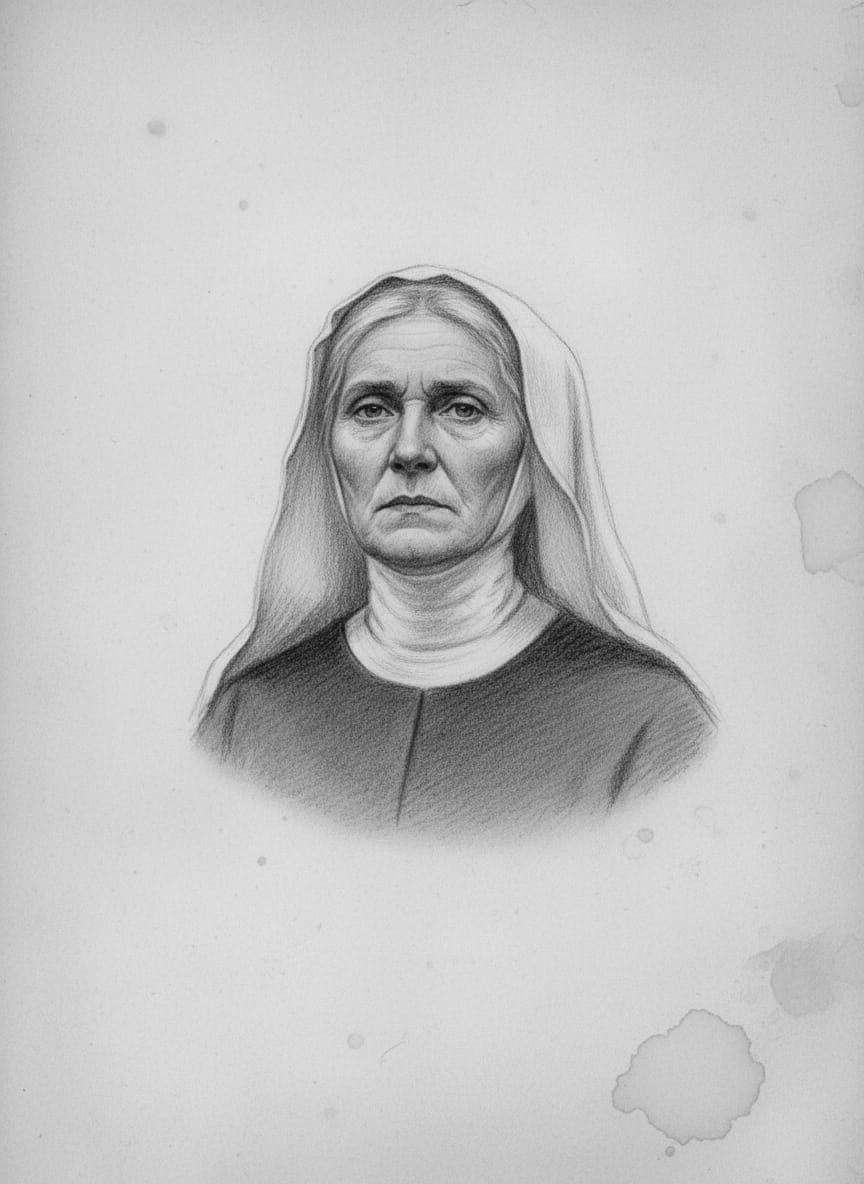
She walked slowly. I state this at the outset because it is the detail the Bureau preserved above all others, the detail the broadsheets seized upon, the detail that made her useful. Sister Margaux of the Blessed Thorn, sixty-three years of age, five feet and one inch in height according to the Martyrology's physical registry — which notes her weight as "slight," her hair as "grey beneath the wimple," and her distinguishing features as "none" — walked slowly on the coastal road from Dinan toward the Chapel of the Tide on the morning of her death, and in walking slowly she became the most dangerous woman in the Republic of Reason.
An ecclesiastical tribunal recognized her four years after the bayonets fell, in A.S. 14 / 1724 CE; the Bureau of Doctrine ratified that early recognition later. Four years is brisk by the standards the later Bureau imposed after the Concordat. Sister Margaux's early case required one tribunal, no authenticated miracle, and the testimony of seven survivors who agreed on almost nothing except that she had been there, that she had been old, and that she had died on her knees holding a psalter she could no longer read because the blood had covered her spectacles.
The miracle, the Bureau determined, was the broadsheets.
#On Her Life Before the Cobblestones
What the Bureau knows of Sister Margaux before the A.S. 10 / 1720 CE massacre could be inscribed on a single page of the Great Ledger and leave room for marginalia. The Martyrology calls her sixty-three at death. That places her birth about 1657 CE, or approximately A.S. −53 under the Synod's later, retrospective reckoning; the registry does not establish her birthday. She was born in the commune of Ploërmel, Brittany, when the formal Synod did not exist and Brittany was a province of kings rather than of Bureaus. Her father was a wheelwright. Her mother was a wheelwright's wife. The records of the parish of Saint-Armel note her baptism, her confirmation, and nothing else until the age of seventeen, when she entered the Order of the Blessed Thorn at the convent of Sainte-Claire-des-Landes, six miles from the sea.
She took her vows. She mended linens. She cared for the elderly until she became the elderly. Forty-six years of conventual life produced no surviving correspondence, no theological treatise, no miracle, no scandal, no disciplinary action, and no recorded utterance of any kind. The Bureau of Records, which prides itself on the completeness of its archives, possesses exactly one document bearing her signature prior to the massacre: a receipt for six bolts of undyed cloth, countersigned by the convent's bursar, dated twelve years before her death.
Six bolts of cloth. One signature. Forty-six years of silence.
The Bureau does not find this troubling. The Bureau finds it ideal. A saint with a documented history is a saint who can be contradicted. A saint who emerges from silence carries no baggage, no inconvenient opinions, no letters to embarrassing correspondents. Sister Margaux arrived at the cobblestones of Saint-Malo as a blank page, and the Bureau of Doctrine — with generations of practice — wrote upon her exactly what was needed.
#On the Procession and the Psalter
She joined the pilgrim column at Dinan. Forty-three souls — the Bureau's ratified count, though some sources insist upon sixty — bearing the Reliquary of Saint Matthias toward the Chapel of the Tide, led by Father Gaël of Dinan, who is remembered for four words and a refusal. Sister Margaux is not recorded among the procession's organisers. She appears in no planning document, no route manifest, no correspondence between Father Gaël and the diocesan authorities. She simply joined, as pilgrims simply join: she was old, she was devout, the road passed near her convent, and the Chapel of the Tide had been her mother's favourite shrine.
She carried a psalter. This is the detail that survived — that she clutched, as the bayonets descended, a psalter bound in brown leather with a brass clasp, its pages so worn that the ink had faded to whispers on several leaves. The psalter was recovered from beside her body by one of the surviving witnesses — a fisherman named Corentin Madec, whose deposition survives in later copies and whose story acquired the polish of theatre in retelling. Madec testified that Sister Margaux was kneeling when the Guards advanced, that she did not rise, that she held the psalter open to the Sixty-Seventh Psalm — Exsurgat Deus et dissipentur inimici eius — and that she was still holding it when she fell.
The psalter is now housed in the Bureau of Relics' secondary vault in Strasbourg, classified as Relic 23-M(Ratified), and displayed on the third Sunday of Corvus. A later tradition credits Kratz with commissioning its crystal reliquary; the date and authority of that commission remain unverified. The bloodstains are preserved under lacquer. The brass clasp still functions.
An earlier edition of this entry identified the psalter as "illuminated, of Breton manufacture, c. A.S. –30."
The psalter is unilluminated, of uncertain manufacture, and undated. It is a common prayer-book of the kind produced by dozens of provincial scriptoria and sold at market for the price of a good loaf. The Bureau of Relics has re-classified its provenance as "irrelevant to its sanctity," which is the Bureau's admission that authenticating the book proved easier than authenticating its origins.
#On the Broadsheets
Sister Margaux died on the cobblestones. She became Saint Margaux in the printing houses.
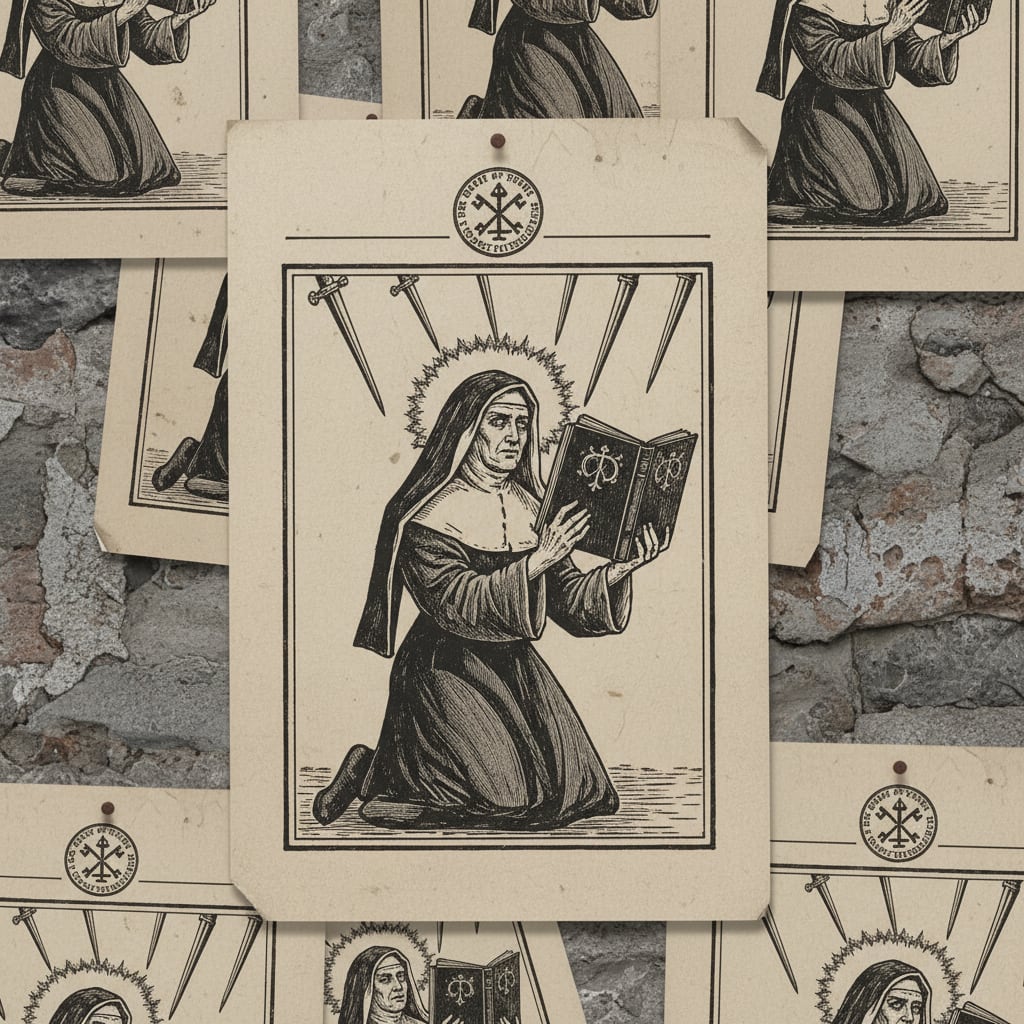
Within a fortnight of the massacre, her likeness appeared on broadsheets distributed from Nantes to Vienna — woodcut portraits showing a small, grey-haired woman in a nun's wimple, kneeling on cobblestones, psalter raised, bayonets descending from above the frame. The image was produced, the Bureau of Doctrine insists, by an anonymous engraver working from survivor testimony. The Bureau of Records, in a rare moment of institutional candour since classified and rescinded, noted that the engraver had never visited Saint-Malo, had never interviewed a survivor, and had based the portrait on his own grandmother.
The broadsheets multiplied. Every diocese produced its own version. In some she holds the psalter aloft like a shield. In others she presses it to her breast. In the Rhineland version — the most widely distributed, printed by the scriptoria of Mainz — she is depicted with a halo of light while the Guards recoil in shadow, which is theologically premature given that she was not yet canonized and hagiographically suspect given that no survivor reported luminous phenomena. Later accounts credit Augustinus with promoting reprints; he was about four when the A.S. 12 sheets first circulated and cannot have sponsored their original issue. The Bureau of Doctrine approved the halo retroactively. The Bureau's position is that sanctity is not bound by chronology, and that a woman who dies holding a psalter on her knees before bayonets has earned whatever radiance the engraver sees fit to bestow.
The later Martyrology certifies thirty-one pilgrims dead at Saint-Malo. Father Gaël was among them, along with a child of nine whose name the Bureau preserves in the Folio of the First Fallen but does not publish, and men and women whose deaths were equally unjust and equally real. Sister Margaux was not the first to fall. She was not the last. She was the one the broadsheets chose, because she was old, and small, and grey, and holding a book, and kneeling — and because the Republic of Reason, in selecting its victims, had failed to consider that an elderly nun dying on her knees with a psalter is an image no amount of rational journalism can overcome.
The Gazette de la Raison gave the massacre four sentences. The broadsheets gave it a saint.
#On the Canonization
The tribunal convened in Strasbourg in A.S. 14, four years after the massacre — an interval the Bureau of Doctrine describes as "appropriate deliberation" and its critics describe as "the time required for the Atheist Wars to reach a pitch where a new saint would be useful." Both descriptions are accurate. The Bureau does not deny the utility of saints. The Bureau considers utility a form of divine endorsement: that which serves the Faith is, by definition, holy, and that which is holy is, by definition, useful. The circularity is the point.
The tribunal examined the seven depositions selected for Margaux's cause. It examined the broadsheets. It examined the psalter, which by this time had passed from the fisherman Madec's attic into Church custody under circumstances Madec described as "voluntary" and the later Bureau of Relics describes as "acquisition." It examined the question of miracles and determined that the breadth of Sister Margaux's posthumous influence — the sermons preached in her name from Lisbon to Kraków, the pilgrimages to Saint-Malo's cobblestones, the conversions attributed to the broadsheet's likeness — constituted a miraculum diffusum, a "diffused miracle," which is a category the tribunal invented for the occasion and which has not been invoked since.
The A.S. 14 tribunal recognized Sister Margaux of the Blessed Thorn as Saint Margaux of the First Blood, patroness of pilgrims and lost causes. The later Bureau adopted that recognition. A subsequent patronage of the Synod's righteous wrath is attributed to Kratz, but he was about six at the A.S. 14 tribunal; its author and date remain unresolved.
Later accounts credit Kratz with the title "of the First Blood," but the title appears in the A.S. 14 recognition, when he was a child. Its early author is unknown. Later Kratzian promotion of the title remains possible; it cannot explain its origin. Blood sells sermons. Blood fills cathedrals. Blood, when it belongs to a sixty-three-year-old nun, is worth more than reliquaries.
#On Her Feast and Her Uses
The Feast of Saint Margaux is observed on the fourteenth day of Corvus, the later Church calendar's name for this memorial day. The observance also carries the Day of the Thirty-One Names; it does not prove that a witness to the A.S. 10 massacre recorded that exact day or month. Her feast is bound into the broader liturgy of remembrance rather than standing alone. This is deliberate. A saint who stands alone is a personality. A saint embedded in a day of national mourning is a symbol, and symbols are more obedient than personalities.
Her image appears in every Bureau of Doctrine parish hall west of the Sagittal Line. An early Church scriptoria pattern dated A.S. 47 depicted her kneeling, wimpled, psalter raised in both hands, eyes lifted, bayonet-points entering the frame from the upper right; the later Bureau adopted it as approved iconography. The composition has not been revised in one hundred and fifty-four years. Unauthorised depictions — including a popular Breton variant showing her standing, which the Bureau considers theologically impermissible because it contradicts the survivor testimony and, more importantly, because a kneeling saint is more useful than a standing one — are suppressed under the Index Claritatis with a fine of forty Crowns per copy.
The Bureau of Inter-Infernal Analysis maintains a sealed file, reference MARGAUX-7(RESTRICTED), containing an assessment of the Saint's "continued operational utility as a propaganda instrument." The file's existence was disclosed in A.S. 194 during a routine audit of the ████████████████████ and its contents remain classified under Hierarch's Seal. The Bureau of Doctrine has stated that the file "does not exist," which is the Bureau's standard response to files that demonstrably do.
She is invoked before pilgrimages. She is invoked before battles. She is invoked, with particular frequency, before the annual levy of sons, when the Bureau of War's recruiters march through villages displaying her broadsheet and reminding the faithful that if a sixty-three-year-old woman could face bayonets with a psalter, the least the young men of the parish can do is face the Line with a rifle.
Her convent at Sainte-Claire-des-Landes was elevated to "First-Tier Pilgrimage Site" in A.S. 92, which transformed it from a house of forty nuns mending linens into a destination receiving nine thousand visitors per annum, each paying the Bureau of Pilgrimage's standard gate fee. The nuns now number twelve — the rest having been reassigned to accommodate the visitor infrastructure — and their primary duty is maintaining the Margaux Chapel, where a life-sized wax figure of the Saint kneels in perpetuity, psalter in hand, glass eyes staring upward with an expression the sculptor intended as beatific and the Bureau of Rites has certified as "doctrinally appropriate."
An earlier edition stated that the convent possesses a lock of Saint Margaux's hair, authenticated by the Bureau of Relics in A.S. 16.
The lock of hair was re-examined in A.S. 189 and determined to belong to a horse. The Bureau of Relics has re-classified the relic as "Category D: Material of Devotional Association, Provenance Revised" and quietly removed it from the display case. The convent's visitor brochure has been updated. Pilgrims who purchased commemorative lockets containing strands of the hair are advised that their lockets remain "spiritually valid."
#On What Is Known and What Is Made
The Bureau of Doctrine did not invent Saint Margaux. A woman named Margaux entered the Order of the Blessed Thorn, walked the road to Saint-Malo, knelt on the cobblestones, and died holding a psalter while Republican Guards drove bayonets into pilgrims. These facts are attested. These facts are sufficient.
What the early cult and the later Bureau assembled was everything else: the halo, a title already present in the A.S. 14 recognition, the feast, the approved iconography, the "diffused miracle," the pilgrimage site, the recruitment broadsheets, and the quiet, relentless transformation of a woman with no distinguishing features into the most recognisable face in the Theocracy. The Bureau inherited a blank page and wrote upon it, and the saint has served for nearly two centuries since the tribunal's recognition without requiring a single authenticated miracle beyond the miracle of her own usefulness.
The psalter sits in its crystal case in Strasbourg. The brass clasp still functions. The blood is still under lacquer. Once a year, on the appointed memorial day, the Procurator-General lifts it from the case, opens it to the Sixty-Seventh Psalm, and holds it aloft for the faithful to see — and the faithful see it, and they remember, and they obey, which is everything the Bureau has ever asked of them and everything Sister Margaux, who walked slowly and carried a book, would have found bewildering.