
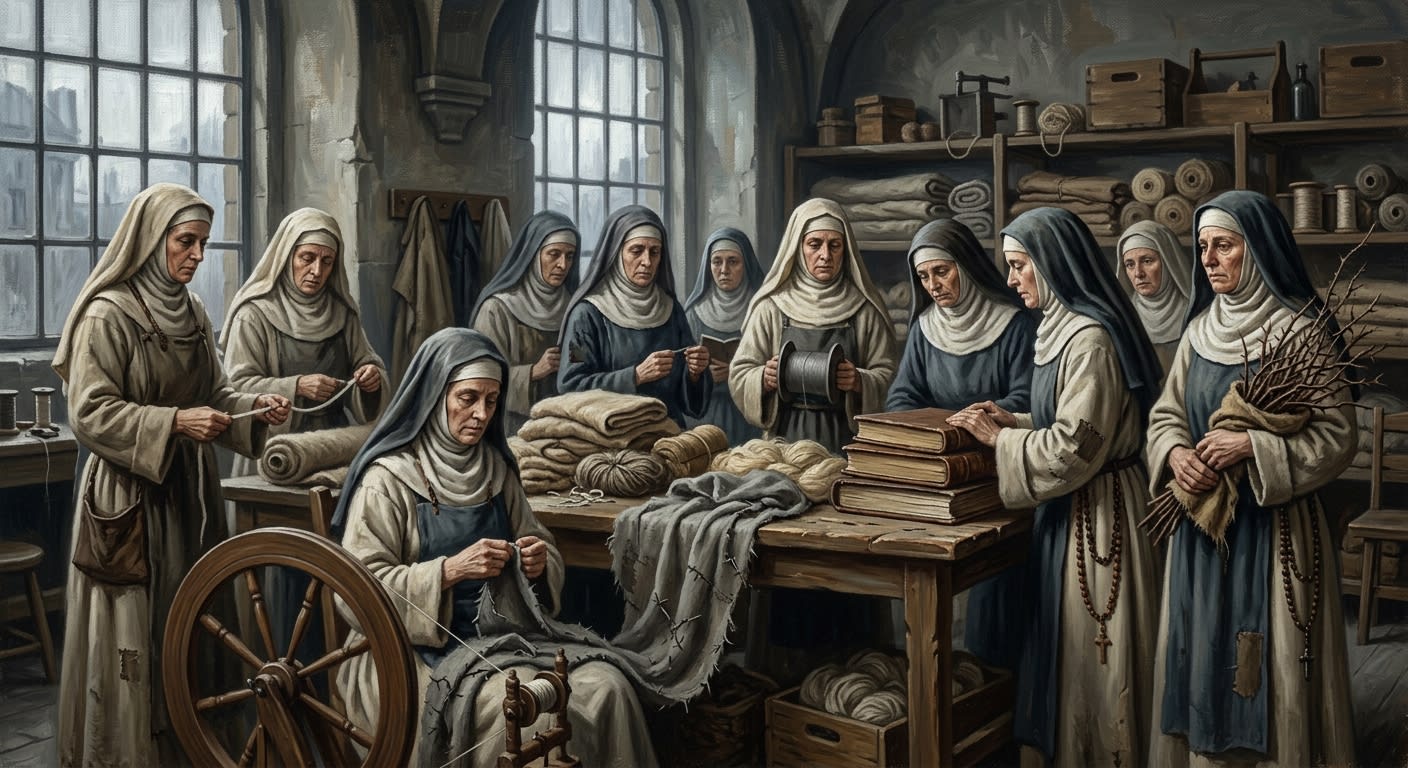
#On the Order Before It Became Useful
The Order of the Blessed Thorn was, before Margaux, a small mendicant sisterhood of Brittany whose chief charisms were the care of the elderly, the mending of linens, and the holy talent of being ignored by every ambitious cleric within riding distance. At its height it numbered forty women at Sainte-Claire-des-Landes, six miles from the sea, where damp entered the dormitory walls with more persistence than doctrine and the sisters answered it with limewash, prayer, and bad soup.
They were mendicants in the old Breton style: poor enough to be sincere, organised enough to be taxed, and obscure enough to survive the first stupid enthusiasms of the Rationalists. Their rule survives in excerpts copied after the Saint-Malo cult began paying for better ink. Rise before dawn. Wash the old. Feed the toothless. Mend sheets. Recite the Hours. Walk when summoned. Accept no silver from a household that cannot bury its mother. Return unclaimed buttons to the common bowl. There are worse foundations for civilization. Strasbourg has built bureaux on less.
Their emblem was a thorn-branch crossed with a needle, an image so modest that the Bureau of Heraldry later tried to improve it with approved geometry and produced something resembling a disciplinary instrument for hedgehogs. The sisters restored the old mark in thread on inner cuffs, where Heraldry inspectors rarely look unless lonely.
#On Linen, Age, and Sanctity by Repetition
The Order's theology may be summarized by the sheet. A body dirties it. A sister washes it. A dying mouth grips it. A needle repairs it. Another body receives it. Nothing in this cycle flatters the intellect, which is why theologians neglected it and why the Creator, who has better taste than theologians, permitted it to continue.
The sisters cared for those whose families had grown tired, guilty, poor, or dead. They trimmed nails, changed bedding, ladled broth, listened to half-confessions, ignored whole blasphemies from fevered mouths, and mended the same tear in the same blanket until the cloth became more repair than cloth. Their convent smelled of lye, onions, damp wool, old skin, lamp smoke, and the unbearable patience of women who have discovered that piety usually arrives as laundry.
This is why Margaux could emerge from them without spectacle. She did not require a school of mystical ecstasy, a prophetic abbess, a choir of bleeding icons. She required a house where silence had already been trained into obedience and obedience into habit. She took vows at seventeen, mended linens for forty-six years, signed one receipt for six bolts of undyed cloth, and walked slowly toward Saint-Malo when the road called.
The Order made her unremarkable. The Bureau later discovered that unremarkable was priceless.
#On Margaux and the Catastrophe of Recognition
In A.S. 10 / 1720 CE, Sister Margaux joined the pilgrim column from Dinan bearing the Reliquary of Saint Matthias toward the Chapel of the Tide, under the old indulgences and within the dangerous mathematics of the Secular Gatherings Act. The later Church memorial falls on the fourteenth of Corvus, but the original day is not securely recorded. Father Gaël led. Hermas bore cloth. Corentin Madec would keep the psalter. Thirty-one would enter the Martyrology as certified dead. Seven would testify. Five would vanish into the elegant terror of “consumed by the event.”
Margaux's death struck the Order like a bell dropped through a roof. In the first year after the massacre, pilgrims arrived at Sainte-Claire asking which bed had been hers, which needle she had used, which cup had touched her lips, which patch on which sheet had known her hand. The sisters, who had spent decades protecting the elderly from fuss, discovered that fuss had acquired horses.
Early shrine guides claimed the Blessed Thorn sisters preserved Margaux's personal needle, thimble, workbasket, pillow, spoon, and kneeling-stool.
Corrected. The needle was communal. The thimble belonged to Sister Aveline, who outlived Margaux and complained about its theft until death. The workbasket was reconstructed from three baskets and a charitable lie. The pillow had been burned for lice in A.S. 7. The spoon remains disputed because spoons, unlike saints, travel without paperwork.
The Order did not create the Margaux cult. The Bureau of Doctrine did, with broadsheets, tribunals, red ink, and that magnificent theft by which a dead woman becomes a public instrument. Yet the Order supplied the raw material: age, quiet, poverty, anonymity, linen. A martyr with a crowded biography resists clean use. A sister who left one cloth receipt and no opinions offers herself to interpretation like blank vellum.
#On Venerable Status
The Bureau of Doctrine elevated the Order to “Venerable” after Margaux's canonisation, with the formal reclassification fixed in A.S. 92 when Strasbourg regularised the pilgrimage economies of western martyr sites. The distinction arrived with a red seal, two envoys, a revised rule, and nine pages of obligations concerning visitor conduct, icon placement, alms custody, authorized wax, approved needle displays, and the theological hazard of unsupervised anecdotes.
The sisters received honour the way a cart receives a second axle: with gratitude until the weight is felt. Their house, once a quiet hospice with a chapel barely large enough for bad singing, became a tributary shrine feeding the larger Saint-Malo river. The Bureau of Pilgrimage counted steps. Tithes counted candles. Records counted visitors. Rites counted postures before the wax figure. The sisters counted sheets, because somebody had to continue civilisation while the Bureaus performed sanctity at one another.
By A.S. 201, the convent holds twelve sisters where forty once slept. The rest of the house belongs to route offices, visitor cells, relic queue management, and the Margaux Chapel, where a wax likeness kneels forever with glass eyes, psalter in hand, while living sisters scrub the floor around her feet. The Bureau certifies the likeness as doctrinally appropriate. The sisters certify the wax drips in summer.
#On the Sisters After Their Saint
Fame improved the Order's roof and ruined its weather. Donations bought tiles, bells, carved stalls, lockboxes, a proper infirmary, and three devotional windows in which Margaux appears thinner than any woman sustained by convent soup has a right to appear. Fame also brought inspectors, donors with opinions, pilgrim widowers seeking holy conversation, merchants selling thorn-shaped pastries, and pious girls whose families mistook obscurity for safety until obscurity ended.
The sisters adapted by becoming smaller inside the larger machine. They maintain two rules: the public rule recited to visitors, and the working rule muttered over basins. Publicly, they are daughters of Saint Margaux, keepers of patient humility, tenders of the elderly in her spirit. Privately, they keep the old order: wash, mend, feed, watch, bury, repair. When asked about mystical union, an abbess of A.S. 167 is said to have replied, “The hem is torn.” This answer was omitted from the printed life. It should have been framed.
A sealed Pilgrimage complaint from A.S. 143 records that Sister-Matron Odrane refused to display an eighty-nine-year-old dying guest beside the Margaux wax figure for “devotional comparison,” struck the route-master with a basin, and was confined for three days. The route-master's nose healed crooked. The guest died privately, as requested. Doctrine marked the incident “pastoral firmness exceeding form.”
The Blessed Thorn survives because it has never mistaken attention for vocation. The Bureaus may hang titles from its lintel, sell candles at its gate, argue over its visitor ledgers, and instruct its novices in the approved smile. In the linen room, needles pass from hand to hand. Old mouths mutter. Sheets tear. Women repair them.
#On the Present Utility of Humility
The Order's present use to the Synod is plain. It gives Margaux a cradle, a house, a smell of lye and onions, a life before the cobblestones. It proves that the saint did not fall from a broadsheet fully haloed, no matter how eagerly the printers pretend otherwise. It allows recruiters, catechists, and pilgrim marshals to speak of humble service ripening into martyrdom, which is the sort of phrase that makes young novices stand straighter and old sisters roll their eyes when unobserved.
A Bureau of Pilgrimage circular described the Order as “founded for the cultivation of Saint Margaux's future witness.”
Withdrawn. The Order predates the massacre and possessed no prophecy concerning Margaux's death. It was founded to tend old bodies and mend cloth. Its later usefulness does not travel backward in time, except in sermons, where everything travels where it is told.
The Order has no army, no treasury worthy of envy, no doctrine capable of frightening a magistrate. It has linen. It has old women. It has twelve sisters in A.S. 201, each overworked, undercounted, and better acquainted with sanctity than the committees that regulate them. That is enough to make a saint, if history is cruel and the Bureau is awake.