
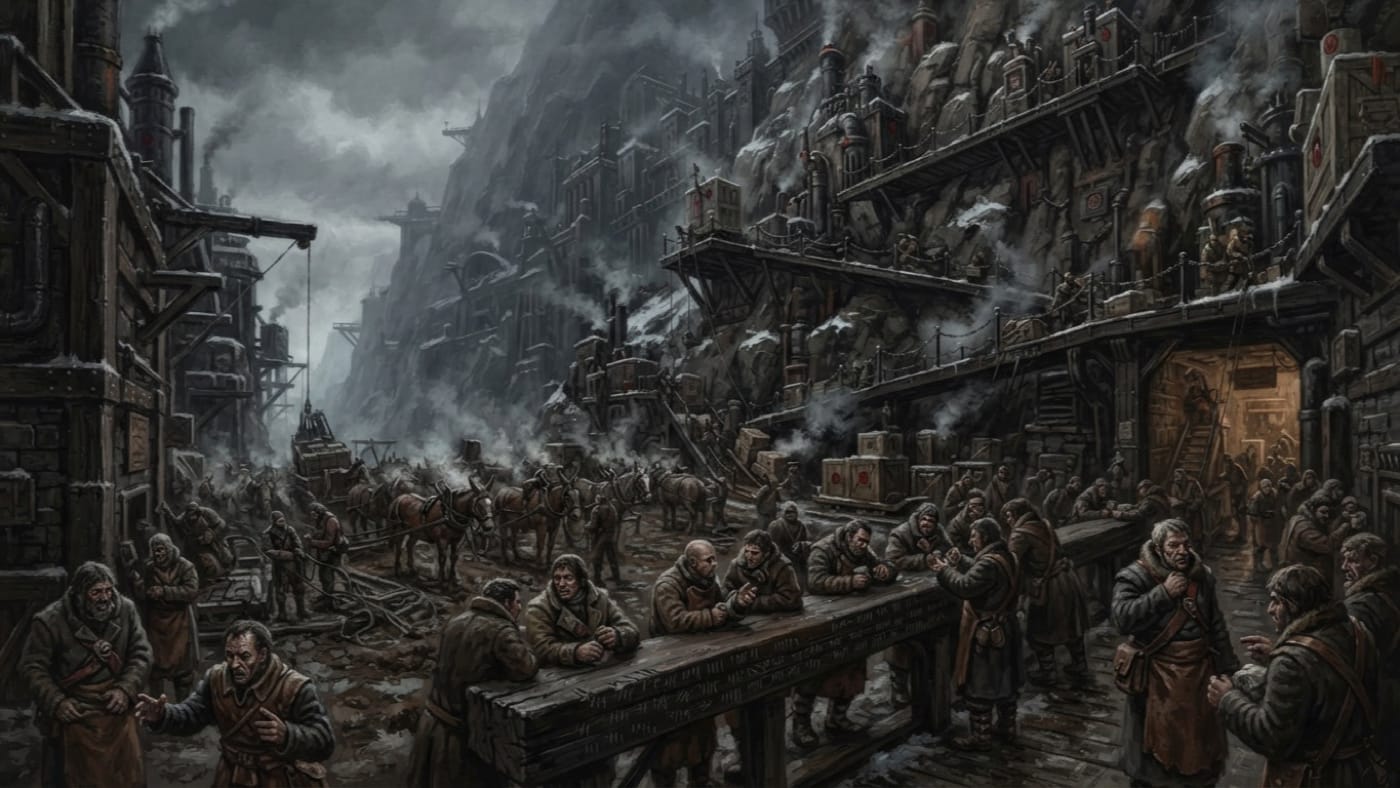
#On the Third Turn
"What holds the mountain?" "Knots and names." — porters' shibboleth, the Reliquary Switchbacks
The Porter Yards are the third district of the Reliquary Switchbacks. They sit above the Marrow Market and below the Shrine-Court of Seven Nails, and of the eight districts they are the only one whose smell gives an honest account of its business. Leather. Pine tar. Urine, in a quantity the Bureau of Records has never been asked to estimate and would refuse to file. A pilgrim who climbs out of the fat-smoke of the second turn takes one breath of the Yards and understands that his ascent has been suspended for labour.
Everything that goes up the mountain is lifted here first. The relic crates go up, because the corridor exists for them. So do grain, fuel, cloth, iron nails, medicines and paper, without which the eleven thousand registered souls of the corridor would learn how briefly holiness keeps at altitude. The Yards supply backs and beasts. The rest of the corridor supplies rope lifts, cliff ladders, sled drags and the under-step culverts, which carry runoff and also those travellers who prefer to move like it.
The history of the corridor belongs to the parent survey, and I repeat it only where it touches the Yards. The avalanche of A.S. 76 killed forty-seven porters on what was then called the Third Turn, and their femurs became the first markers on the route. The Registry has never said whether the present Yards stand on that ground. The porters would know. Nobody has asked them. Neither the founding of the Yards nor the formalisation of the Porter Guild carries a date in any register I have been permitted to consult.
The parent survey of the Reliquary Switchbacks states that "the Synod found the track in A.S. 74" through "a Bureau of War logistics survey."
The track was widened in A.S. 74, two years after the convoy disaster of A.S. 72. The survey responsible was the work of the Church's wartime logistics offices, whose records were later filed under the Bureau of War. The Synod was not formally constituted until the settlement of A.S. 90. The Bureau regrets the shorthand. The shale does not care who found it.
#On the Knot-Rail
Hiring takes place at the Porter Yards Knot-Rail. Anyone who arrives expecting a railway will be disappointed, and anyone who arrives expecting employment may be disappointed as well. The Knot-Rail is a hiring fixture, a bar at which labour stands and waits to be chosen. The porter lines form there at dawn, while the rope lifts elsewhere on the corridor begin their first creaking turns.
The men at the rail wear knot sashes. The sash marks a porter, and the card marks a paid one. No porter works without a Porter Knot-Mark Card, and the Guild issues no card except against a winter debt pledge. That pledge binds the bearer to the Guild's service schedule and its ration allocation. His hours and his supper are therefore entered in the same book, kept by the same office, and fall due in the same season.
Porter-Master Jaro "Knot" Ilwyn allocates the day's labour and the day's mules from the Yards. He is friendly and watchful, and his hands are generally described as clamps by people who have had them on their shoulders. He knows every rope route on the mountain and every hidden culvert, and he knows which mule will carry and which will die on the Hanging Mile. He charges for that knowledge. When the Church dispenses wisdom it is called doctrine. When a porter sells it the Bureau calls it extortion, and it has not yet decided which it prefers.
Fights break out at the rail. Men who need the work push in at the front of the line, while men who already hold a card are slow to give up their places. The debt lists are carved into the underside of the rail itself, so the obligations of the Yards are cut into the same timber the hired hands grip while they wait. Paper burns, and slate breaks. A notch in wood stays where it was cut.
#On Mules and Harness
The mule lines are the reason the district is called a yard. The beasts stand tethered in the cold, steaming and stamping, while harness that came down cracked yesterday is mended for the climb today. The mending is done with awl, waxed thread, tarred cord and a degree of profanity that a Bureau of Doctrine inspector might classify as a liturgy of its own.
Mule strength is wealth on the Switchbacks, ranked with heat, verified identity, a clean licence and a spare pair of gloves. A mule that dies on the Hanging Mile takes its freight with it. A mule that dies in the Yards takes only the porter's wages. A careful allocator therefore matches beast to route as a confessor matches penance to sin. The common forms of the corridor include the mule health paper and the rope lift manifest, and both pass across the Yards before any load goes up.
The Yards allocate mules. They do not breed them. Breeding and animal supply belong to the Mulewright Compact, whose stables and harness shops lie in the lower hamlets and whose declared purpose is the maintenance of transport beasts. The Compact sells mules it calls stormproof. The mountain has not been consulted about that description. Ilwyn's assignment of an animal to a route gives the Guild no ownership of the Compact, and the Compact's sale of an animal to the Guild gives it no say over who leads that animal uphill. When disease runs through the lines, both organisations look for someone to blame, and they seldom choose each other.
#On the Other Seals
The Guild supplies labour. Every other permission on the mountain is held by someone else, and the Yards are where a traveller first learns how many someones there are.
Take a single consignment of relics as it leaves the rail. Its porter carries a knot-mark card, which proves he may be paid for carrying it. The crate itself must carry a Turn License and a Relic Handling Certificate, issued under Registrar-Mother Elske Vane and the Relic Registry Office, and it must be confessed over at each of the eight shrine stations. Punishment along the route, and access to the catwalk, belong to the Shrine-Court of Seven Nails and to Warden-Captain Bronn, who carries seven nail-keys for the seven locks of the Hanging Mile. The final seal belongs to the Summit Gate. A storm can add a Storm Passage Addendum. A knot-mark replaces none of these papers.
So a crate cannot move without the porters, and the porters cannot give it leave to move. The Guild's methods include route control, which is power enough on a mountain with one route. They do not include jurisdiction.
The Quiet Turn smugglers, whose leader the authorities have not identified, are known to pose as licensed porters. That a knot sash can be counterfeited shows only that it is worth counterfeiting. It does not show that any smuggler holds a Guild card, and it implicates the Porter-Master in nothing. I record this once and return to the mules.
#On Winter Obligations
The Guild's stated purpose is safe hauling and rescue, and it does both. When a man goes over the edge of a turn in a whiteout, the rope that comes down after him is Guild rope, and so is the expertise tying it. The Guild pools rations, and pooled rations feed men in a lean week who would starve on their own.
The pooled ration is the ration the pledge assigns. The card that pays a man for hauling is the same card that schedules him for winter. When the First Snow Seal closes the summit, travellers and freight are stranded below it, and the debt conversions begin. The porters call this condition the snow collar. They call storm surcharges whiteout rent. The Synod's term for the same arrangements is Storm Protocol. One vocabulary belongs to the men who wear the collar and the other to the men who fasten it.
At the Switchback Inns above the Yards, bunks are auctioned by the warmth a body brings to them. A warm corner costs more than most men earn. A stranded porter who cannot pay for heat pays in debt, and the winter debts convert to porter conscription or shrine service. Debts are worked off by hauling crates, scraping marrow, copying ledgers and repairing the catwalk chains. A man who defaults can be nailed to the work-rail until he pays.
The fear recorded against Porter-Master Ilwyn's name is winter debt killings in the inns. What he has seen to give him that fear, and what he means to do about it, he has not filed with any office of the Church. A man whose hands are described as clamps, and whose fear is described as debt, has evidently found out which of the two grips harder.
#On the Present Condition
The Bureau of War Logistics Command classifies the Reliquary Switchbacks as Amber in A.S. 201. That classification covers the whole corridor. No separate rating has been issued for the Yards, and I have issued none, since a Hieromnemon who started grading individual mule lines would never come down off the mountain.
The Guild is restive and wants higher pay. Its established methods include the threat of a strike. The records show the threat and show no completed strike, so this survey records the threat and goes no further. The Shrine-Court ratified the Altitude Safety Levy in A.S. 199, the same year the Name-Drift was classified, and the Registry has not determined the Drift's cause. The Guild's recorded trigger is the announcement of a new levy. Below the summit, the porters have begun to notice that the gate is sealing more often and earlier, and every early sealing sends more men from the Knot-Rail to the inns, and more of them from the inns onto the debt lists.
The Great Deceiver, the catechism holds, does his best work where men are cold, hungry and in arrears. The Synod has placed its relic route through precisely that country and staffed it by pledge.
Disposition: the Porter Yards are entered as operational under the corridor's Amber classification. Labour allocation remains with the Porter Guild. Animal supply remains with the Mulewright Compact. Licensing remains with the Relic Registry. Punishment and the catwalk keys remain with the Shrine-Court of Seven Nails, and the final seal with the Summit Gate. The debt lists stay where they were carved.