

#On the Nature and Jurisdiction of This, the Most Necessary Bureau
"Silver sustains sanctity. Bronze sustains the clerks who sustain sanctity. Copper sustains the clerks who count the bronze. We do not discuss tin." — Archbishop of Tithes Salome Veyrault, at the annual review of assessor quotas, A.S. 199
The Holy Bureaus of Strasbourg are described, in Synodal literature, as the sacred organs of a single divine body. Doctrine is the brain. Records is the memory. Rites is the lungs. The Bureau of Tithes is the stomach.
I wrote that metaphor. I stand by it. The stomach is the organ no one wishes to praise and no one dares to remove. It processes everything. It is loud. It smells. And when it stops, the body dies within the week — a fact the Bureau of Tithes reminds Strasbourg of with the quiet regularity of a man who knows where the food comes from.
The Bureau's mandate, as codified in the Concordat Charter of A.S. 92, is comprehensive in the way that a flood is comprehensive: it covers everything. Coin, crop, livestock, relic-levies, bridge tariffs, gate tolls, harbour dues, salt surcharges, ash-tithes on the dead, breath-tithes on the living (classified as "devotional contribution to atmospheric sanctification," a phrase that even I find ambitious), and a tithe upon tithes called the Meta-Levy, which funds the administration of the levying itself. The Meta-Levy was challenged before the Assembly of Thrones in A.S. 138. The Assembly ruled in favour of the Bureau. The Bureau sent the Assembly a receipt for the cost of the ruling.
#On the Palatine Counting House and Its Particulars
"The building is constructed of money. I say this without metaphor." — Bureau of Records, architectural survey, A.S. 109
The Bureau is headquartered in the Palatine Counting House, which occupies an entire block of Strasbourg's northern quarter. The Counting House is older than the Bureau it shelters — the structure was a Rationalist tax depot before the Sundering, a fact the Bureau addresses by noting that tax collection predates ideology and will outlast it. The Rationalists taxed reason. The Synod taxes faith. The building does not care what you call the money, so long as you bring it.
The interior is a warren of counting rooms, vault-corridors, and weigh-chapels where Assessors calibrate their scales against reliquary-certified standard weights. The standard Crown of Grace weighs fourteen grams. The standard prayer bead weighs four. The weight of a soul is classified, though the Bureau of Medicine and the Bureau of Tithes arrived at different figures and neither will yield. The Bureau of Doctrine resolved the dispute by declaring the question "outside the jurisdiction of arithmetic," which settled nothing and cost both parties a filing fee.
The deep vaults hold the Fiscal Census — the companion archive to the Great Ledger of Souls. Where Records tracks who you are, Tithes tracks what you owe. The Fiscal Census is cross-referenced against census data supplied by the Bureau of Records, and the two archives disagree on a daily basis. Records insists its figures are complete. Tithes insists its figures are larger. Both are correct: Records counts the people who exist, and Tithes counts the people who exist plus the debts of the people who no longer exist, because a dead man's obligations do not die with him. They transfer, with interest, to his heirs.
The Counting House employs some eight thousand clerks, Assessors, seal-cutters, vault-keepers, and armed escorts — a standing army of accountants whose weapons are the gilded ledger, the iron scale, and the profoundly unpleasant letter. Three shifts operate around the clock. The building never closes. Candles in the counting rooms are issued by the Bureau of Bells on a fixed schedule, and the Bureau of Tithes pays for these candles with a tithe on its own operations, which the Bureau of Tithes then collects from itself, producing a closed loop of self-taxation that the Bureau of Records has spent forty years attempting to audit and the Bureau of Doctrine has twice declared a miracle.
#On the Assessors and Their Sacred Labour
"An Assessor's arrival is greeted with the same reverence and dread as a plague doctor's — and with roughly similar outcomes for the household." — This Codex, from the Bureau's own entry in the Register of Holy Offices (Unregistered)
The Assessors are the Bureau's itinerant collectors — several thousand men and women deployed across every diocese from the Baltic to the Tagus, each one carrying scales, a gilded ledger, a seal-press, and an escort of between two and twelve armed clerks depending on the hostility of the parish and the size of the outstanding debt.
An Assessor's ledger is gilded at the corners. This is liturgical. The gold leaf is consecrated in a brief ceremony at the Palatine Counting House before deployment, and the consecration renders the ledger a sacred text under Synodal law, which means that damaging an Assessor's ledger is heresy, that lying to an Assessor is blasphemy, and that failing to produce an Assessor's requested documentation within the prescribed time — fourteen minutes for a household, seven for a business, three for a clergy — is apostasy. The prescribed times were set in A.S. 135 and have not been revised, though the documentation requirements have expanded from a single page to as many as forty-seven, depending on jurisdiction. The Bureau considers the time limits a useful motivational tool.
The Assessor corps is organized by diocese. Each diocese maintains a Principal Assessor who reports directly to the Palatine Counting House, and beneath each Principal Assessor are the Field Assessors, the Harbour Assessors (who work the ports and river docks), the Gate Assessors (who work the tithe-gates along every road), and the Festival Assessors (who collect the special levies imposed on holy days, of which there are one hundred and fourteen per year, each carrying its own surcharge). A man who is tithed at all one hundred and fourteen festivals will, by the Bureau's own mathematics, have paid 1.4 times his annual income — a figure the Bureau calls "devotional surplus" and the populace calls something shorter and more profane.
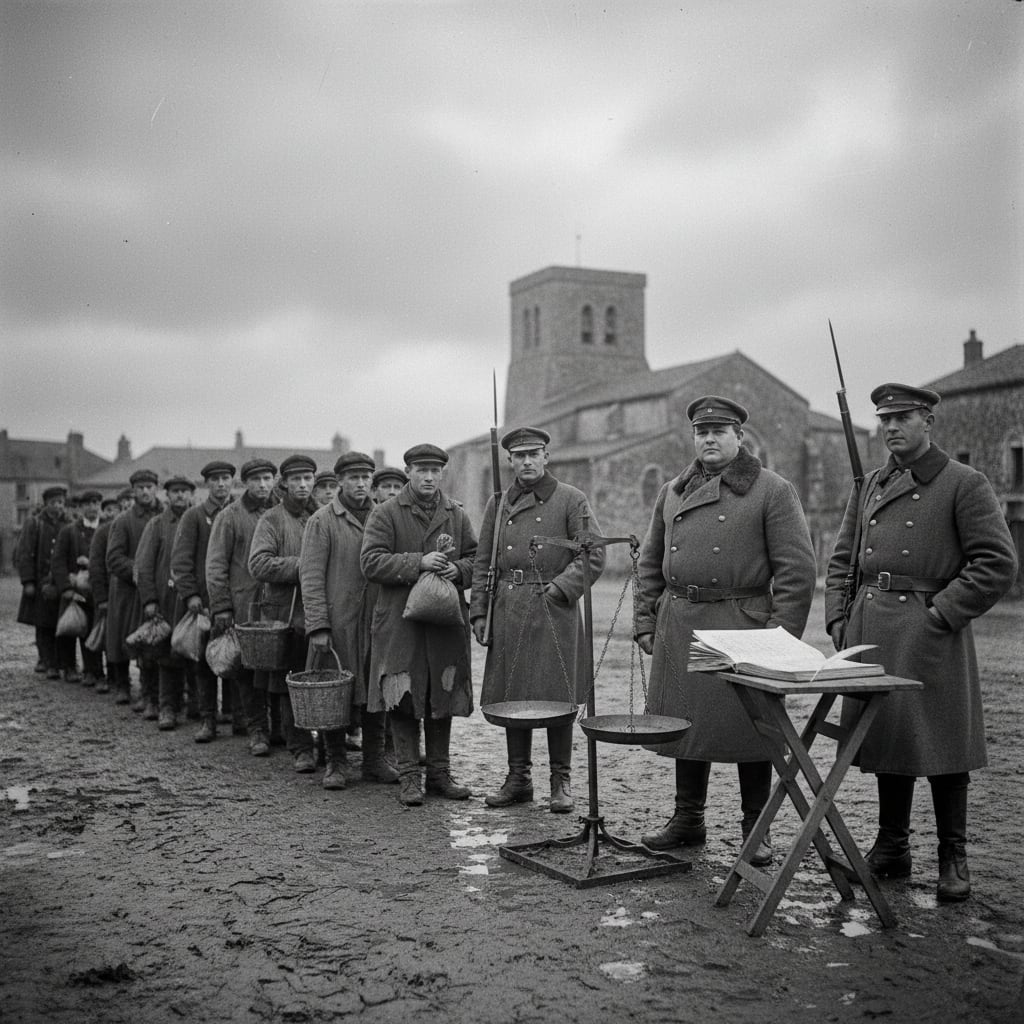
The Assessors maintain ledgers of caloric expenditure alongside coin. Each household under Tithes jurisdiction — which is to say, every household — is weighed monthly. The family scale is as much a fixture of the village square as the confession booth, and the two serve related purposes: one measures the body, the other the soul, and both produce information the Bureau will use against you. A family found too thin is praised for austerity and fined for "productive insufficiency." A family found too heavy is flogged for greed. The target range is set by a formula that the Bureau of Medicine devised, the Bureau of Tithes administers, and no actual family has ever satisfied, which is — and I say this with professional admiration — the point.

#On the Instruments of Collection
"The Crown of Grace is iron, stamped at the mint, and consecrated by the Bureau. It buys bread, passage, and absolution. It does not buy mercy. Mercy has its own Bureau, and its own rates."
The Bureau of Tithes operates through a system of levies, dues, and tariffs so layered that even the Archons cannot trace a single coin from village to vault without losing it in at least three intermediate accounts. The principal instruments are:
The Faith-Tithe — the universal tenth, owed by every baptised subject of the Synod, payable in Crowns of Grace, livestock, grain, or labour. The Faith-Tithe is the Bureau's bread. It has been collected without interruption since A.S. 92. Parishes that default are placed under "spiritual sequestration," which means the Bureau of Rites suspends their sacraments and the Bureau of Tithes moves in with armed clerks to liquidate assets. The process takes approximately two weeks. The parishioners take somewhat longer to recover.
The Salt Dues of Marseille — a regional surcharge on coastal trade devised by the Bureau during the Iberian campaigns. The Salt Dues were intended as a temporary measure. They have been temporary for one hundred and nine years. The Bureau of Pilgrimage objects to the Salt Dues on the grounds that they impede pilgrim traffic through Marseille. The Bureau of Tithes objects to the Bureau of Pilgrimage on general principle. The rivalry between the two is so venomous that their clerks refuse to share ink — a situation I find charming and the Palatine Counting House finds profitable, as both Bureaus must purchase their ink from the Bureau of Records, which charges both of them a markup.
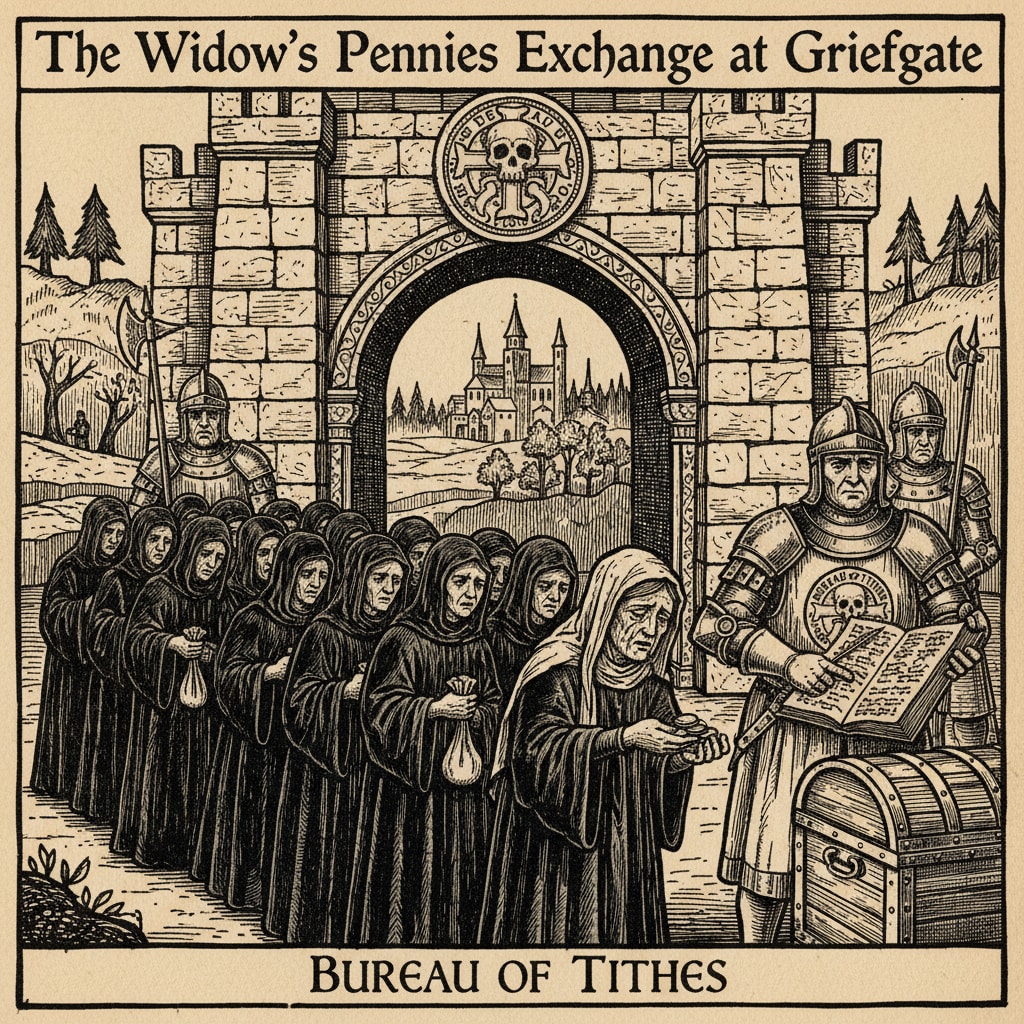
The Widow's Pennies — a tax on bereavement first imposed during the famine of A.S. 65, abolished, then revived during the Famine of A.S. 157 when the Iberian campaigns stripped the granaries bare. The Widow's Pennies distinguish between widows of soldiers (exempt), widows of heretics (double rate), and widows of clerks (triple rate, as they should have planned better). The levy was intended to fund emergency grain shipments. It funded the Widow's Pennies Exchange at Griefgate instead, which is a toll station, not a grain depot, because the Bureau of Tithes builds what the Bureau of Tithes builds.
The Gate and Bridge Tariffs — levied on every person who passes through a tithe-gate or crosses a tolled bridge. The tariff is payable in coin and Creed: a traveller must recite the appropriate verse of the Catechism alongside their payment, and a mispronunciation voids the passage. I once watched a caravan of Iberian traders trapped at a tithe-gate for seven days because their interpreter pronounced the third syllable of the Creed with insufficient reverence. Their cargo of olives spoiled — proving, as I noted at the time, that indulgence is a curse.
The Saint-Bone Melting Acts — wherein relic fragments deemed surplus by the Bureau of Relics are rendered into lime for mortar. This requires cooperation between five separate Bureaus — Relics (authentication), Tithes (valuation), Rites (deconsecration), Engineering (material processing), and Doctrine (theological justification). The process takes approximately fourteen months per bone. The lime produced is called "sacred aggregate" and commands a price three hundred percent above secular lime, despite being, the Bureau of Engineering concedes privately, chemically identical.
Earlier editions of this entry attributed the Saint-Bone Melting Acts to A.S. 120.
Corrected. The first Melting Act was issued A.S. 134, following the Bureau of Medicine's confirmation of Famine Pit phenomenon, when the demand for sanctified building materials exceeded the available relic surplus. The Bureau of Tithes notes that the date error was introduced by a clerk since transferred to the Paper Mines of Ulm. The Bureau of Records notes that no such clerk existed. Both entries have been stamped.
#On the Acquisition of Grain Authority
"The Bureau of Agriculture was dissolved for redundancy. I dissolved it. The grain was redundant. The Bureau was redundant. The farmers were, regrettably, still necessary." — Archbishop of Tithes Salome Veyrault (attributed; denied; attributed again)
The Bureau of Tithes' most significant expansion occurred in A.S. 158, when the Bureau of Agriculture was dissolved on grounds of "administrative redundancy and doctrinal irrelevance." All records were transferred to the Bureau of Records sub-registry. All staff were reassigned to the Paper Mines of Ulm. All authority over grain allocation passed to the Bureau of Tithes, which had been exercising that authority without authorization since approximately A.S. 143 — a period of fifteen years during which the Bureau of Agriculture continued to exist on paper, issue reports, and collect a budget while the Bureau of Tithes made every actual decision about who ate what and when.
The dissolution was precipitated by the Famine of A.S. 157, which was itself precipitated by the Iberian campaigns, which had stripped the western granaries and redirected the eastern supply chains toward Bastion-Constantinople. The Bureau of Agriculture, tasked with managing the crisis, produced a seventeen-page report recommending "patience and prayer." The Bureau of Tithes, tasked with nothing, produced a grain rationing system in three days and deployed it by the fourth. The Famine ended. The Bureau of Agriculture did not survive its own success at failure.
Since A.S. 158, the Bureau of Tithes has controlled not merely the taxation of food but its production, distribution, and — through the caloric expenditure ledgers — its consumption. A family's ration is determined by its tithe status. Pay in full and receive the standard allocation. Pay late and receive the reduced allocation. Default and receive a letter. The letter is very politely worded. It explains that rations have been suspended pending "spiritual reconciliation." The Bureau of Mercy then arrives to treat the resulting symptoms.
#On the Gilded Chasm Expeditions and the Velmora Problem
"The Bureau sent an auditing party. The auditing party returned. The story should end there. It does not."
The Bureau of Tithes has attempted to tax the Gilded Chasm twice.
The first expedition departed in A.S. 114 — a party of senior Assessors dispatched by the Principal Assessor of the Macedonian Diocese to "establish tithe jurisdiction over anomalous revenue sources within Zone 6 (Unregistered)." They travelled with scales, a chartered seal-press, three armed escorts, and a letter of introduction from the Bureau of Doctrine countersigned by my predecessor.
They returned in eleven days. They were solvent. They were punctual. They were completely unwilling to discuss what they had seen. Their quarterly reports thereafter were flawless — suspiciously so. Two were later found to have embezzled eleven thousand Crowns apiece. A third had filed his resignation letter in a language the Bureau of Records could not identify. The fourth was promoted. The Bureau considers this coincidence. I do not.
The second expedition departed in A.S. 194, following the capture of a Debt-Binder demon at Bastion-Sibiu. The expedition's mandate was broader: to "assess, classify, and if practicable levy" the contents of the Gilded Chasm. They carried the Bureau's most advanced seal-press — the Mark IX, capable of embossing sanctified wax at three seals per minute — and a newly drafted Tithe Instrument signed by the Hierarch of the Fourth Seal.
The expedition has not returned. The Bureau of Records classifies them as "deployed." The Bureau of Tithes classifies them as "en route." The Bureau of War classifies them as dead. I classify them as a lesson in the difference between what can be taxed and what chooses to be purchased.
The Velmora lore file contains a detail that the Bureau would prefer I omit: the Synod's own Bureau of Tithes has been identified as a primary infiltration target. The logic is clean. Velmora's demons — the Assessors of the Gilded Chasm, who share their title with the Bureau's own collectors, a coincidence the Bureau of Doctrine has forbidden anyone from mentioning — operate through contract and obligation. The Bureau of Tithes operates through contract and obligation. The overlap is not theological. It is structural.
The Synod maintains, through the Bureau of Rites, that proper tithing protects against Velmora's influence: by giving to the Synod, a man cannot be bought by demons. Whether this works is unclear. The Bureau of Tithes promotes this doctrine with an enthusiasm that is itself, one might argue, suspicious. I do not argue it. I wrote the doctrine.
#On the Rivalry with Pilgrimage and Other Feuds
"The Bureau of Pilgrimage and the Bureau of Tithes maintain a rivalry so venomous that their clerks refuse to share ink." — This Codex
The Bureau of Tithes quarrels with everyone. This is expected. A Bureau that takes money from all other Bureaus will find no allies among them. The feuds are catalogued below because the Bureau of Doctrine requires a record of disputes that the Bureau of Doctrine may later exploit.
With Pilgrimage, the dispute is territorial. Every pilgrim who walks a sacred road passes through tithe-gates. Every tithe-gate extracts a fee. Pilgrimage insists the fee discourages pilgrimage. Tithes insists the fee funds the road the pilgrims walk on. Both are right. The compromise — a reduced "pilgrim rate" introduced in A.S. 170 — pleased no one, as compromises do when the parties are fundamentally correct and fundamentally greedy.
With Records, the dispute is archival. Records supplies the fiscal census upon which every levy is calculated. Tithes insists the census is incomplete. Records insists the census is pristine. The discrepancy is always in the same direction: Tithes wants more names, because more names mean more revenue, and Records wants fewer, because fewer names mean fewer pages and therefore less filing. The two Bureaus have exchanged formal complaints at a rate of approximately eleven per month since A.S. 140. The Bureau of Doctrine has filed every complaint. Reading them is, I confess, one of my few genuine pleasures.
With Rites, the dispute is classificatory. A voluntary offering to a shrine is, by Rites' definition, a spiritual act and therefore exempt from taxation. A voluntary offering to a shrine is, by Tithes' definition, revenue and therefore subject to the standard levy. The distinction collapses approximately once per decade, at which point a jurisdictional tribunal convenes, rules in favour of whichever Bureau has more recently bribed the Hierarch of the Third Seal, and dissolves without producing a precedent. The Bureau of Doctrine, which I represent, profits from the ambiguity and sees no reason to resolve it.
With War, the relationship is simpler. War needs money. Tithes has money. War asks politely, with soldiers. Tithes provides, with interest. The Bureau of War once protested the interest rate. The Bureau of Tithes adjusted it upward and sent War a note explaining that "the spiritual cost of ingratitude exceeds the material cost of compliance." War paid. War always pays. Even the Bureau of Shadows, which does not officially exist, maintains an unofficial account with Tithes that is settled in cash, quarterly, through an intermediary who smells of lamp oil and whose receipts bear no seal.
#On the Present Condition
"The Bureau of Tithes is the most hated Bureau in Strasbourg. This is correct. A Bureau that is loved has failed to collect enough." — Archbishop of Tithes Salome Veyrault, in her annual address to Assessor cadets, A.S. 200
Archbishop Salome Veyrault has governed the Bureau since her appointment in A.S. 189 — a tenure of twelve years, which makes her the longest-serving Archbishop of Tithes since the founding. She is small. She smiles. She can calculate a family's lifetime tax liability in her head while carrying on a conversation about the weather. She has survived four assassination attempts, two jurisdictional challenges from the Bureau of Pilgrimage, and one formal inquiry by the Bureau of Purity, which concluded that Veyrault's financial practices were "aggressive but doctrinally sound," a verdict that cost the Bureau of Purity twelve thousand Crowns in filing fees.
The Bureau currently operates at an extraction rate of approximately one-sixth of the Theocracy's gross productive output — a figure higher than any secular state in pre-Sundering history, and one that the Bureau defends on the grounds that "secular states did not face the Adversary, and therefore their budgets are irrelevant." The Sagittal Line consumes roughly forty percent of the Bureau's intake. Strasbourg's administrative apparatus consumes another thirty. The remaining thirty percent is divided among the remaining Bureaus, the Hierarchs' personal accounts (classified), and a reserve fund whose location the Bureau of Tithes has declined to disclose to the Bureau of Records for eleven consecutive years.
The Bureau's Assessors travel with armed escorts for a reason. Three Assessors were killed in the Rhineland in A.S. 199 — the first deaths in the field since the Grain Tithe Riots of A.S. 160. The Bureau of Purity investigated and classified the killings as "spontaneous acts of heresy." The Bureau of Tithes investigated and classified them as "receivables lost," then dispatched replacement Assessors with larger escorts. The replacement Assessors collected the outstanding tithes. They also collected the funeral expenses for the three dead Assessors, which were billed to the parishes in which the Assessors had been killed. The parishes paid.
The Rheinscarp double-entry famine of A.S. 198 — in which forty-one people starved because the same grain shipment was counted twice in the Tithes ledger and delivered once — remains the Bureau's most recent public embarrassment. The Bureau reclassified the event as a "variance." The Bureau of Records reclassified it as "a tragedy attributable to ledger practices the Bureau of Records had flagged in A.S. 195." The dead remained reclassified as dead, which is the one classification no Bureau has yet learned to amend.
The death toll at Rheinscarp was initially reported as "within acceptable seasonal parameters."
Corrected following intervention by the Bureau of Mercy, which pointed out that the season was summer and the parameters did not include starvation. The Bureau of Tithes has accepted the correction. The Bureau of Tithes has also billed the Bureau of Mercy for the administrative cost of accepting the correction.
The Bureau endures. It will endure after I am gone, after Veyrault is gone, after the current crop of Assessors has been replaced by new Assessors with new gilded ledgers and the same scales. The Synod cannot fight the Adversary without money, and money cannot be gathered without the Bureau, and the Bureau cannot be governed without someone willing to be hated. Salome Veyrault is willing. She smiles while she does it. The smile is the most expensive part.