
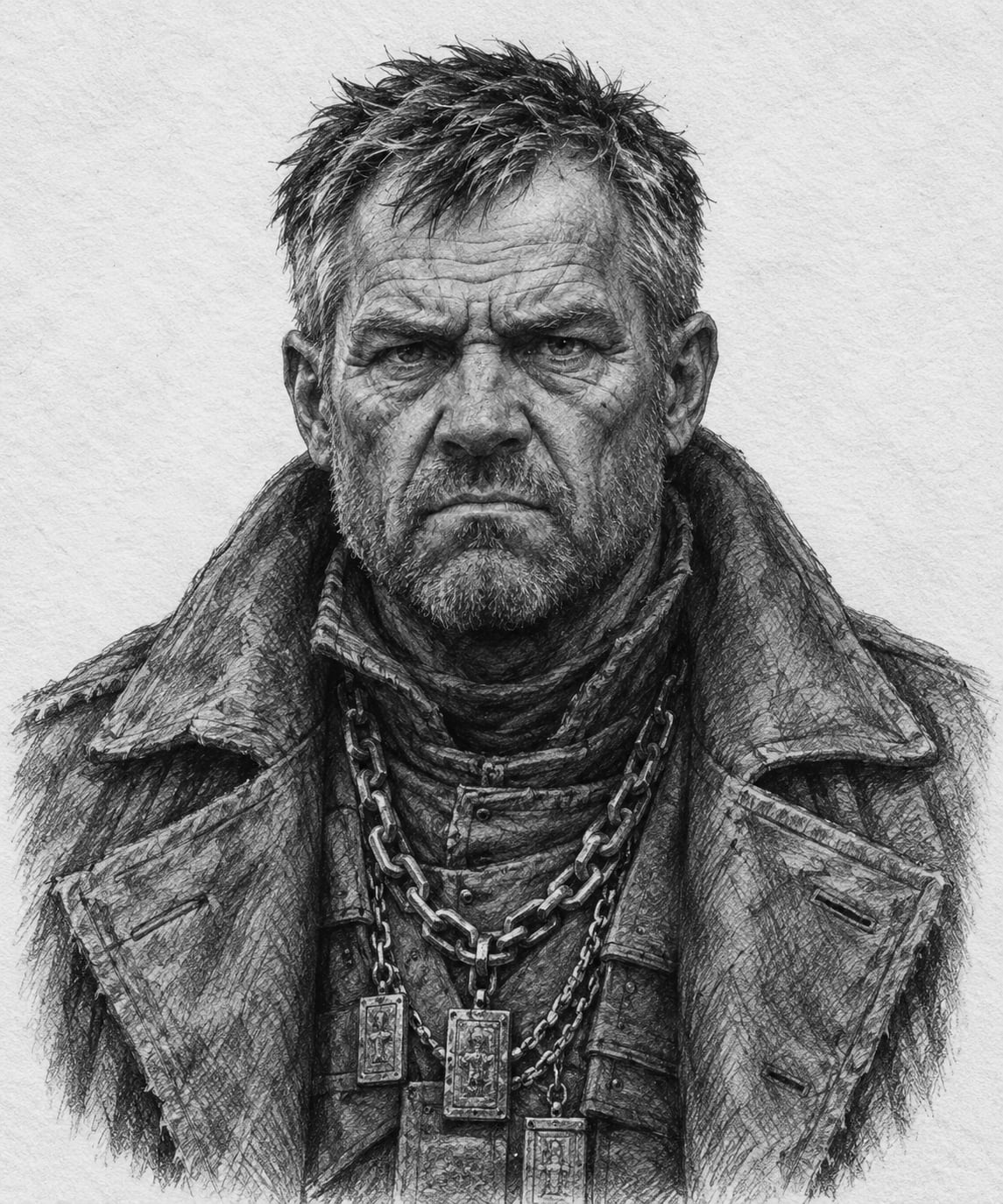
#On His Station
"Knots are cheaper than prayers." — porters' proverb, Porter Yards
Jaro Ilwyn, called Knot, is Porter-Master of the Porter Guild, which the mountain calls the Knots. He keeps his office in the Porter Yards, the third of the eight districts of the Reliquary Switchbacks. Below him the Marrow Market renders bone into tallow. Above him the Shrine-Court of Seven Nails renders pilgrims into confessions. Ilwyn renders men into labour, and of the three trades his is the only one that pays its raw material a wage.
The archive holds no birth record for him. It has no appointment and no predecessor, and no ledger shows how he came to the office. I have looked, and I do not enjoy looking for things that are absent. The Bureau of Records has his name, his nickname, his office and one recorded fear. Beyond that it files him as a man who is simply present at the Knot-Rail every dawn, as though the Guild had planed him out of the same timber. This dossier is a present-condition survey for A.S. 201. It pretends to nothing earlier.
The corridor knows him from the rail. Carriers line up along it before light, in wet wool, with breath steaming and the mules complaining in their harness behind them. Ilwyn walks the line and assigns the day: the man, the load, the mule and the rope-lift. Relics go uphill on his say, and so do flour, fuel, cloth, nails, medicines and the paper on which the Registry will later deny that any of this was commerce. A crate on the Switchbacks moves only when he has put a back under it.
#On the Day's Allocation
His competence is real. I record it with some reluctance, because competence in an unlicensed man makes the paperwork look ornamental.
Ilwyn knows the rope routes of the mountain. He knows the hidden culverts that carry meltwater and other things beneath the turns, which anchors will hold in frost, and how much each mule in the Yards can carry. Above all he knows which animals will get across the Hanging Mile and which will die on it. The Mile is three feet wide, a mile long and a thousand feet above anything soft. A mule that panics there takes its load with it, and sometimes its porter. The porters do not credit Ilwyn with prophecy. They credit him with years of watching beasts, which on a cliff is worth more than prophecy, and he sells it at the same rate.
He prices that knowledge without apology. A pilgrim who wants his crate sent with the right mule on the right morning pays for the judgement as well as the haul. The Guild calls this expertise. The Bureau of Tithes calls it an unassessed levy and resents that the levy is not theirs.
Rescue rests in his hands too. When a crossing goes wrong, Guild rope goes out after it, and Ilwyn decides who carries the rope. The ration pool, which keeps winter porters from starving in inn stairwells, is shared out under his allocation. Every protection the Guild offers runs through the same office that chooses who works. A carrier saved by the Knots learns gratitude, and he learns its address.
#On the Other Seals
A careless reader, and the Codex employs several, takes the Porter-Master for lord of the mountain. He is lord of the backs. Everything else belongs to someone else's stamp.
The Porter Knot-Mark Card that Ilwyn's Guild issues proves that the bearer may lift. That is all it proves. The Turn License and the Relic Handling Certificate come from the Relic Registry, under Registrar-Mother Elske Vane at the Turn of Saint Odrin, and they govern what may be carried and whose certified hands may touch it. The Summit Gate Seal governs leaving the mountain at all. Warden-Captain Bronn carries the seven nail-keys to the locks on the Hanging Mile. When Bronn seals a section, Ilwyn's best mule stands at the chain beside his worst.
Even the mules are only his to allocate. The Mulewright Compact breeds them and keeps the stables and harness shops of the lower hamlets. The Porter-Master chooses which beast climbs. The Compact chose that the beast should exist, and it sends him the invoice. His bargaining position is large, because nobody else on the mountain can move freight. It has a perimeter all the same, and three other offices patrol that perimeter.
Porter-Master Ilwyn controls passage on the Reliquary Switchbacks.
This shorthand was struck from the Codex entry on the Porter Guild and is struck again here, because clerks keep copying it into cross-references. Ilwyn allocates Guild labour and Guild mules. Passage is governed by Registry licences, the Shrine-Court's locks and the Summit Gate Seal. Without his porters a licensed crate stays where it is. With them it has a back under it and still no permission. The Bureau regrets the conflation, and the Porter-Master is understood to have found it flattering.
#On Winter Obligations
Every knot-mark is bought with a winter debt pledge. The porter signs it in the warm months, when winter is a rumour from the upper turns. The pledge binds him to the Guild's service schedule and to its ration allocation, so his hours and his stomach answer to the same desk. The porters call it the snow collar.
The collar tightens on the following schedule, and no villain is needed to run it. A storm closes the Summit Gate. Pilgrims, porters and freight are stranded wherever they stand. The Switchback Inns auction their bunks by body heat and charge whiteout rent for the privilege of breathing indoors. The porter cannot leave his load and cannot carry it. Each day he draws rations against the pledge and earns nothing. When the gate opens he owes more than he did when it closed.
Debt that outruns wages converts. It becomes porter conscription, or shrine service: hauling for the shrines, scraping marrow, copying ledgers, mending the catwalk chains with fingers that no longer close. A man who defaults outright may be nailed to the work-rail until the sum is met. The mountain calls this display a nail sermon, and it is the only sermon on the Switchbacks that nobody sleeps through.
The accounts are kept on the Knot-Rail itself, carved into its underside. A porter reads what he owes by kneeling beneath the same bar he leans on to be hired.
One more entry belongs in this section. The dedicated record states that Porter-Master Ilwyn fears the winter-debt killings in the inns. It does not say why. It names no victim, no confession and no incident that taught him the fear. I will supply none of them.
What can be set down is the shape of it. The man who allocates the pledges fears what the pledges do in a sealed inn at the end of a long closure, when a debtor and his creditors share one stairwell and one stove. Ilwyn may fear for his porters, or for his ledger. He may fear a reckoning that would begin at the rail. The record permits all three readings and confirms none. Nobody has seen Ilwyn reconcile the knife that carves the debt with the fear of what the debt does in the inns. Perhaps he does not try.
#On His Character and Associations
Ilwyn is friendly. Witnesses agree on it and do not seem comforted by it. He is watchful in the same breath, and his hands are described as clamps. I take this as a description of grip. I have no evidence of anything stranger. His friendliness is genuine, and it stays genuine at the moment it turns into a threat. The porters say his face does not change at that moment. A negotiation at the Knot-Rail opens warmly and ends warmly. At some point in between, the man across from him finds that he has agreed to a price.
His knowledge of culverts and underside ropes invites suspicion, and suspicion has been offered. The Quiet Turn smugglers work the rope beneath the Hanging Mile, the culverts and the inn basements, and they pass as licensed porters when it suits them. Their leader is unknown. A smuggler and a porter use the same rope, and that proves only that rope is rope. Nothing on file places Ilwyn at the Quiet Turn's head.
The Blank Saints keep to the crawlspaces under the inns and the cairn-backs of the Cairnfield Terrace. The Bureau of Purity has recorded no alliance between them and the Knots, though the Bureau has been invited to find one with some enthusiasm. A man who knows where the hidden places are is not thereby proved to be in them. That distinction keeps the Porter-Master off the inquisitors' docket. It does not keep him off their reading list.
#On the Present Condition
The corridor holds at Amber under the Bureau of War. That means freight moves and the losses are within the threshold the Bureau has agreed to tolerate. The classification describes the corridor. It says nothing about the Porter-Master's own standing.
In A.S. 201 the Knots are restive and the carved tally grows. The Name-Drift storms seal the Summit Gate more often and earlier in the season, and each new toll-turn the Registry stamps into existence is another stop the porter pays for out of wages he has already pledged. The Altitude Safety Levy, ratified by the Shrine-Court in A.S. 199, still stands. The Guild's demand for higher pay stands beside it. The Guild holds a strike in reserve, along with its routes and its ration pool. Pilgrims who can afford Martyr-Credits climb past the worst of the queue. Porters cannot afford them.
No strike has been called, and Ilwyn has announced no reform. The inns have not reported the killings he fears this season, and nobody on the mountain would call that a promise. The Registry needs its relics carried and the Bureau of War needs its flour carried. Every morning both are carried by men whom Ilwyn chose at the rail.