
#On the Knots
"Knots are cheaper than prayers." — porters' proverb, Porter Yards
The Porter Guild is the reason anything reaches the top of the Reliquary Switchbacks at all. The Registry licenses the relic and the Shrine-Court licenses the catwalk. The Guild supplies the back that carries both licences uphill. On a mountain of shale, chalk and ice, the back has always been the scarcer document.
The mountain calls them the Knots. They hold the Porter Yards, the third of the corridor's eight districts, above the Marrow Market and below the Shrine-Court of Seven Nails. The mule-lines form there before light, in air that smells of leather, pine tar and urine in roughly equal liturgical proportion. The Guild's declared office is safe hauling and rescue. It does both, and nobody else on the mountain can.
The corridor's first martyrs were porters. Winter A.S. 72 took the Przemyśl-bound convoy, as recorded in the file on Bastion-Przemyśl. Two years later the wartime logistics offices that the Codex now files under the Bureau of War widened the old goat-track. In A.S. 76 an avalanche on the Third Turn buried forty-seven carriers, and the first femur went into the shale. By A.S. 92 the Registry was licensing relic passage. I have found no ledger that records when the Guild was formalised. The local account holds that it began as an arrangement for keeping carriers alive. By stages nobody thought to stamp, it became an arrangement for deciding which carriers may work. Safety became a monopoly. The porters say the one followed from the other as surely as the closure bell follows the wind.
#On the Knot-Mark
A porter who wishes to carry on the Switchbacks needs a Porter Knot-Mark Card. A man without one may stand at the rail, lift a crate, even climb. He will not be paid. He will not eat from the Guild's stores. If he falls, nobody with rope will come looking for him.
The card is issued against a winter debt pledge. The pledge binds the bearer to the Guild's service schedule and to its ration allocation, so that his hours and his stomach answer to the same office. He signs it in the warm season, when winter is a rumour, and it falls due with the snow.
The wardens keep the card distinct from the corridor's other papers, and so must the reader. The Turn License and the Relic Handling Certificate are Registry instruments under the seal of Registrar-Mother Elske Vane. They govern what may be carried and whose authenticated hands may carry it. The Summit Gate Seal governs leaving the mountain. The knot-mark governs only who may lift. A porter can hold the knot-mark and still be refused at the Registry desk. A pilgrim can hold every paper the Registry prints and find no one willing to shoulder his crate. The two powers meet at the porter's shoulder and nowhere else.
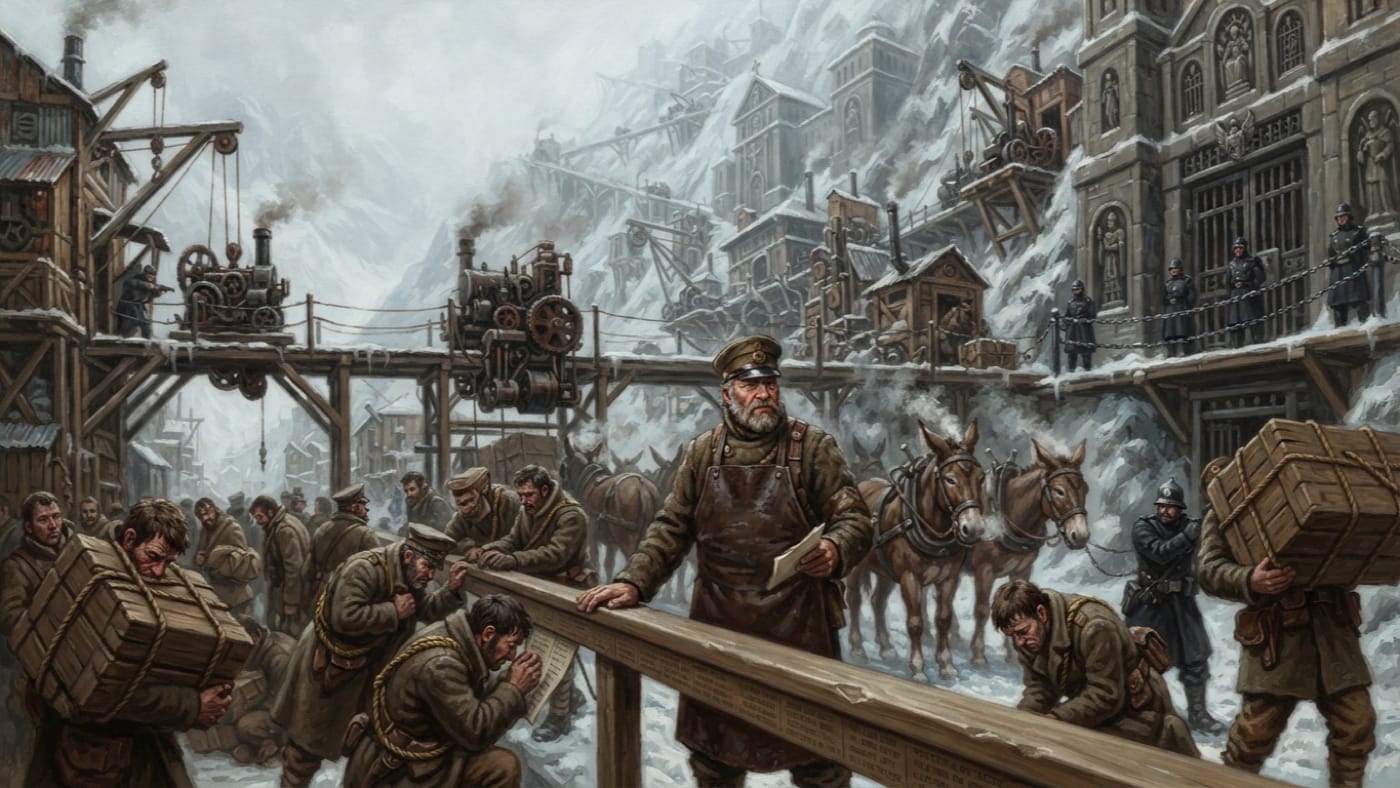
Hiring happens at the Knot-Rail, a timber bar in the Yards worn smooth by the hands of men waiting to be chosen. At dawn the lines form, the mules are brought round for harness, and the rope lifts creak into their first turns. The Porter-Master reads the line and allocates the day. Fights happen at the rail. So does prayer.
The debt lists are carved into the underside of the rail, where a standing man cannot read them without kneeling.
Earning the knot-mark is one of the mountain's rites of passage. It ranks with the first licensed climb and with surviving the Hanging Mile in whiteout. Porters wear knot sashes. Children in the lower turns tie sashes from scrap cord and are cuffed for impersonation. It is the Church's first lesson in credentials, and far from its harshest.
#On Rope, Mule, and Passage
The Guild's power rests on competence, and the competence is real. Its porters know the rope routes, the sled drags, the cliff ladders and the lifts that haul freight between turns. They know which stones are honest and which harness strap will part in the third hour of frost. By every account Porter-Master Jaro "Knot" Ilwyn knows which mule will carry across the Hanging Mile and which will die on it. He judges the beast before anyone asks it to try.
Those backs carry everything the corridor lives on. Relics go up, and the Registry likes to think relics are the point. Food goes up as well, with fuel, cloth, nails, medicines and paper. So does the coal for the Marrow Makers' vats, which render bone into tallow, wax and the mortar that holds the shrines together. The Bureau of War values the corridor for its relics. The corridor stays alive on sacks of flour.
Rescue is the Guild's public claim, and on this mountain rescue means rope. When a crossing goes wrong, the people who go out after it are the people who know the anchors. The Shrine-Court has wardens, and the wardens have nail-batons. No nail-baton has ever hauled a man up a cliff.
Knowing the rope is not the same as holding the key. Warden-Captain Bronn carries seven nail-keys for the seven locking points of the Hanging Mile. A section he has sealed stays sealed, however many Guild porters wait at its chain. The Guild decides who carries. The Court decides where carrying is allowed.
Porter-Master Ilwyn controls passage on the Reliquary Switchbacks.
Porter-Master Ilwyn allocates Guild labour and Guild mules from the Porter Yards. Passage is governed by the Relic Registry's licences, the Shrine-Court's locks and the Summit Gate Seal. A crate cannot move without his porters, but that does not give it leave to move with them. The Bureau regrets confusing a monopoly with a jurisdiction. The porters, I am told, do not.
#On Winter Obligations
The porters call it the snow collar. The pledge that bought the card in summer becomes a chain in winter.
The mechanism needs no villain, which is why it lasts. Storms close the Summit Gate, and the closure traps pilgrims, carriers and freight on the slope. The Switchback Inns auction bunks by body heat and sell warmth as the scarcest good on the mountain. Storm surcharges, which everyone calls whiteout rent, fall on all of them. They fall on porters first, because a porter cannot leave without his load. Every day of waiting means rations drawn and no wages earned. The ledger in the Yards grows longer, and the underside of the rail fills up.
The Guild pools rations. That much is established, and I record it in the Guild's favour. A porter who would otherwise freeze in an inn stairwell eats from that pool. I also record that a pool needs a keeper and that the keeper decides the shares. The corridor itself admits that rations get skimmed. A shared store feeds the many. It also teaches them whose hand holds the ladle.
When debt outruns wages, it converts. Winter debts become porter conscription or "shrine service": hauling crates for the shrines, scraping marrow, copying ledgers for the Bureau of Records, or mending the catwalk chains on the Mile with fingers that no longer bend. The corridor calls this charity, and the alternative is the rail. A porter who defaults may be nailed to the work-rail until the debt is paid. The mountain calls the display a nail sermon. The porters say it as a bitter joke. The Court does not joke about it.
Ilwyn's recorded fear is the winter-debt killings in the inns. The record says he fears them. It says nothing more, and neither shall I. A man who keeps the debt lists and fears the debt deaths is either a hypocrite or the only clerk on the mountain who has read his own ledger. Nobody has asked the Bureau to decide which.
#On the Porter-Master and the Other Seals
Ilwyn is friendly. Witnesses agree on that. They also agree that he is watchful and that his hands close like clamps. His friendliness is genuine until the moment it turns into a threat, and his face does not change when it does. He knows every rope route and hidden culvert on the mountain, and he charges for what he knows.
The Guild wants higher pay and says so plainly. It bargains with the threat of a strike, with control of the routes and with the ration pool. Its leverage is simple arithmetic. The Registry needs relics moved, the Bureau of War needs the corridor kept at Amber, and there is nobody else to move anything. When a new levy is announced, the Guild resists. The Bureau of Tithes calls this insolence. The Guild calls it a trade.
The Guild's reach stops where the other seals begin. Registrar-Mother Vane wants tighter relic control. Her signature can strip a carrier of his Handling Certificate, and with it the only work his knot-mark allows. Warden-Captain Bronn and the Shrine-Court hold both punishment and the catwalk. The Mulewright Compact breeds the mules and keeps the stables and harness shops of the lower hamlets. It supplies the animals that Ilwyn allocates. Allocating a mule is different from owning the stable it came from, and the Compact reminds anyone who confuses the two.
The borders nobody has proved are harder to map. The Quiet Turn smugglers run rope beneath the Hanging Mile and use the culverts and inn basements. When it suits them, they pass as licensed porters. Sharing the Guild's rope, routes and sashes proves only that rope is rope. Nothing on record puts Ilwyn at their head or makes them a Guild department. The Blank Saints work the spaces under the inns and the cairns of the Cairnfield Terrace, and no alliance between them and the Knots is on file with the Bureau of Purity. No warden has yet placed the Porter-Master beside a heretic. Several have tried.
#On the Present Condition
In A.S. 201 the Knots are restive. The Name-Drift storms seal the Summit Gate more often and earlier in the season. Each new toll-turn is another stop a porter pays for out of wages he has already pledged. The inns fill, and the debts convert. The Shrine-Court ratified the Altitude Safety Levy in A.S. 199. The Guild's demand for higher pay has stood beside it ever since, unanswered, in the same cold yard. Pilgrims who can afford Martyr-Credits climb past the worst of it. Porters cannot.
The corridor still moves because the Knots still carry. The Registry still licenses, the Court still locks, and the porters still kneel to read the underside of the rail.
The Bureau of War requests no change to Guild authority. The Bureau of Doctrine has asked for the debt lists to be copied onto paper for the archive. The Porter-Master has quoted a rate.