
#On the Traverse
"Odrin. Odrin. Odrin." — recited at each femur marker by porters crossing the Hanging Mile
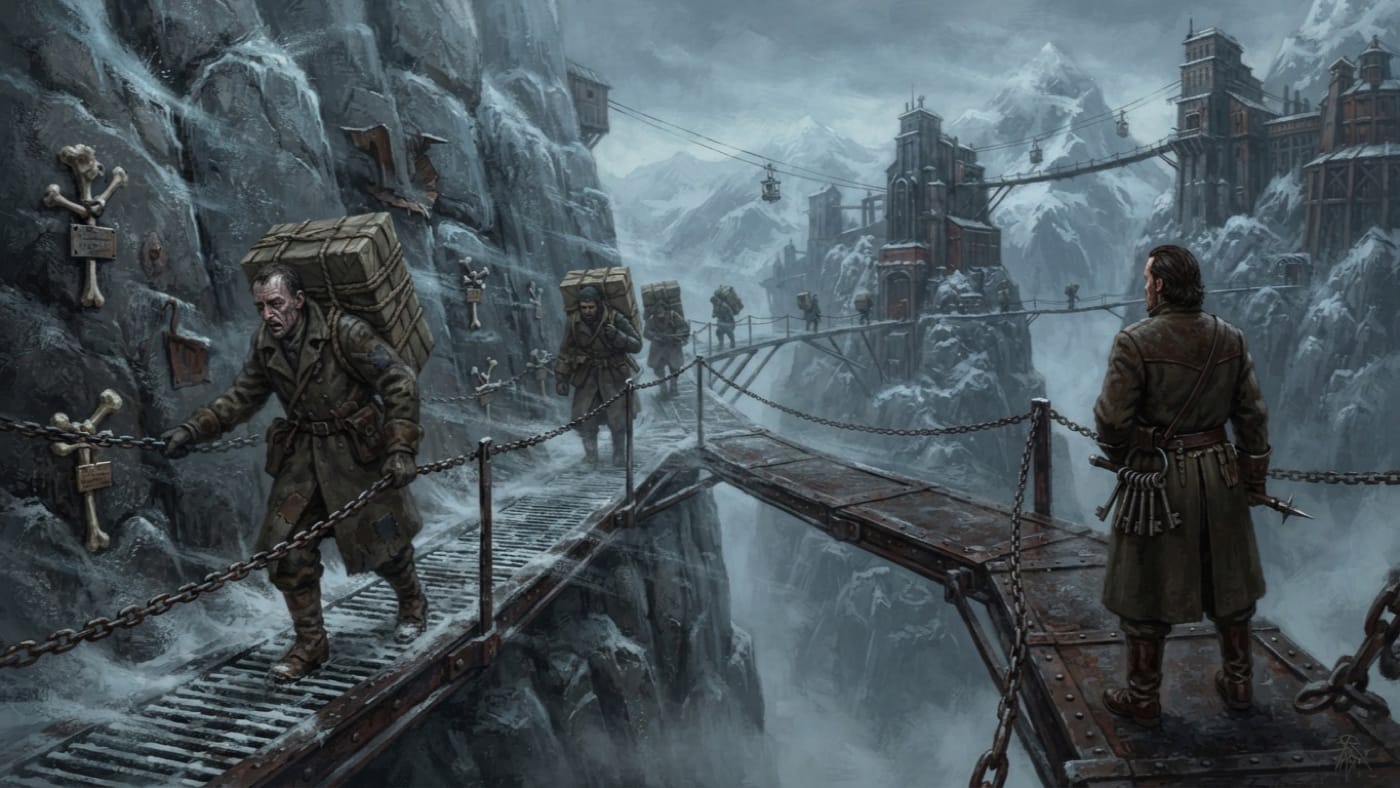
The Hanging Mile is the seventh district of the Reliquary Switchbacks. It is the only district a man can span with his elbows. It begins where Cairnfield Terrace runs out of level ground and ends at the approach to the Summit Gate Reliquary. Between those two points the Church has bolted an iron catwalk to a cliff in the Carpathian highlands, somewhere between 47° and 48° North. That is as close as the Bureau of Records will let a smuggler come to a map. The walk is one mile long and three feet wide, and the drop beneath it is a thousand feet. On one side there is shale. On the other there is a chain rail, and past the rail there is only weather, which the Creator did not see fit to fence.
The wind comes sideways. By evening the deck plates are glazed with ice, and the bolt-heads are white with frost. A femur is nailed into the cliff every ten paces, and every one of them creaks. The air is thin and smells of wet wool, pine tar and rope burn. Two people cannot pass on the Mile. Crates go single file on men's backs. A mule goes if the Porter Guild says it will survive, and the Guild is paid either way.
The corridor is better documented than the catwalk. A convoy bound for Przemyśl died in the winter of A.S. 72 (1782 CE). In A.S. 74 the Church's wartime logistics offices conducted the Sixth Carpathian Route Audit and widened the old shepherd track. I call those offices the Bureau of War only in hindsight, since the formal Synod did not sit until A.S. 90. The avalanche of A.S. 76 killed forty-seven porters and fourteen mules on the Third Turn and produced the first femur marker. By A.S. 82 every turn had a name, a marker and a toll, and by A.S. 92 the Registry was licensing passage. No clerk recorded when the first bolt went into this cliff. The Mile is the only thing on the mountain that never paid a fee for its birth certificate.
#On the Seven Locks
Warden-Captain Bronn commands the Shrine-Court of Seven Nails, and he carries the Mile on his belt. Seven nail-keys hang from his iron ring, one for each of the catwalk's seven locks. With them he seals sections at his discretion: for storms, for audits, for purity seasons, and at curfew because it is curfew. On a whiteout night a key keeps a pilgrim off the ice. The same key can keep an auditor off a section for as long as a conversation takes, or keep a porter on the Terrace for one more paid night. The Court has not found it necessary to keep separate keys for mercy and punishment.
The Court has not published where the locks sit or how a lock closes a section. I will not guess in a document the Quiet Turn can read.
The wardens carry nail-batons. These are short iron rods tipped with the shale-nails that pin the femurs, and the Bureau of Doctrine certified them in A.S. 94 as pastoral correction instruments. On a catwalk three feet wide, pastoral correction requires good footing from both parties. Bronn hates laughter, and no record says why. What he fears on the Mile is a crowd in panic. On a walk this narrow, that is a fear of arithmetic.
Speech is permitted here. Speech fines belong to the Silent Steps between the fourth and fifth turns. What the Mile forbids is the unlicensed song. I assume a licence can be had at the Turn of Saint Odrin at the usual rate.
The right to cross is decided lower down. Registrar-Mother Elske Vane's office issues the Turn License and the Relic Handling Certificate, and confessions are taken at each shrine station on the way up. Vane decides who may climb. Bronn decides whether the iron is open when they arrive. Both signatures can be valid while a man stands at a locked section with his licence freezing to his glove.
Prior editions of this Codex described the Shrine-Court of Seven Nails as a "judicial body operating under the standard Relic Registry charter."
The parent entry corrected that description. I correct it again here, where it matters most. Since the dispensation granted in A.S. 178 after the Counterfeit Crisis, the Court has punished relic-adjacent offences summarily, without appeal to the Registry. This catwalk exists to carry relics, and the Court has so far found very little on it that is not adjacent to one.
#On the Cost of Crossing
Nothing crosses the Mile on its own legs if another back can carry it. No porter works without a knot-mark card from Porter-Master Jaro "Knot" Ilwyn. He runs the Porter Guild from the Porter Yards, four districts below, and knows which mules will die on this catwalk before the mules do. No card is issued without a winter debt pledge. The porter signs the pledge at the Yards, and it falls due up here, on ice, a thousand feet above the rocks.
Payment takes the corridor's usual forms: coin, ration chits, stamped papers, bone tokens and martyr-credits. The Registry says it does not sell martyr-credits. They buy relief from scrutiny all the same. The Mile adds currencies of its own. To a man whose hands are bleeding on the chain, a dry pair of gloves is worth more than his Relic Handling Certificate. Below, body heat is auctioned nightly at the Switchback Inns.
The guides charge in confessions. A porter once offered to carry me up this mountain for three. The Registry cannot debase a confession, and the man who hears it keeps it.
When Bronn seals a section, the climb does not stop. It backs up onto Cairnfield Terrace, where the only goods are behind the cairns, and then down into the Inns, where the Bureau of Tithes counts every night of waiting as revenue. Pilgrims the Bureau of Pilgrimage has recorded as devout wait like everyone else, devoutly and at their own expense. A lock turned in the seventh district becomes a debt written in the third, and Porter-Master Ilwyn keeps that book.
#On the Route Beneath
The wardens patrol the top of the iron. The Quiet Turn uses the underside. Smugglers have driven anchor bolts into the catwalk's frame and strung braided cord between them. Along that line, at night, they move relics, fugitives and contraband from the Cairnfield caches toward the Summit Gate approach. Nobody on the deck can see the route. The wind that steals a pilgrim's voice also covers the sound of a body moving hand over hand beneath his boots.
The Quiet Turn's leader is unknown. Reports list bribed wardens and forged marks among its methods. No warden has been named, and the Bureau has not been shown any arrangement, if one exists. Seven keys lock the deck. Nothing on Bronn's ring locks the air beneath it.
For the Bureau of Purity, I note that cord and bolts lead nowhere useful. A fugitive hauled to the summit approach still has no seal. The genuine seal of the Summit Gate cannot be bought behind the cairns or under the catwalk. A smuggled relic arrives at the top as what it was at the bottom: contraband, only higher.
The Blank Saints share some of the same hidden ground, but the Codex keeps the two groups apart. The Quiet Turn sells passage. The Blank Saints steal seals, forge Registry slates and swap turn-names to discredit the martyr list. Hiding behind the same cairn does not make two groups one congregation. The lowercase blank saints, the bones without names, belong to neither group and answer to no one.
#On the Names and the Present Condition
Two sounds on the Mile are beyond dispute. The chain rail hums and clinks in the wind. And below freezing, the femur markers give off a high, thin, sustained note. The Bureau of Alchemical Standards classifies that note as a Category Two Localised Acoustic Anomaly. The porters call it the mountain singing for the dead. The Bureau has given the note a category and the porters have given it an audience, but nobody has given it an explanation that would survive a whiteout.
Neither sound is the Name-Drift, though the porters do not always keep them apart. The Name-Drift is reported across the whole corridor. In storms, the report holds, the wind carries names that are not on the martyr list, the femurs vibrate to them, and ink bleeds across slate into their shapes. Afterwards the Registry adds the name, a marker and a toll. The Registry classified the matter in A.S. 199. That is the year it was acknowledged. Nobody with a seal will say when it began.
The Blank Saints allege that the Registry exploits the storms, or engineers them, to manufacture its discoveries. The allegation is theirs, and the Codex records it as theirs. The Registry's A.S. 200 certificate of martyrological integrity, counter-signed by the Bureau of Records at Strasbourg, confirms that the records are in order. It does not explain the weather, and it does not claim to.
On the iron, porters recite Saint Odrin's name at every marker. Others carry bell-cards or wax their tongues before they cross. None of these practices has been shown to keep anyone on the catwalk. None has been shown to fail either, because the dead make poor witnesses.
The Altitude Safety Levy, which the Shrine-Court ratified in A.S. 199, remains in force. In A.S. 201 the Bureau of War rates the Reliquary Switchbacks Amber: operational, with losses within the accepted figure. The rating covers the whole corridor. The Hanging Mile has no assessment of its own and shares the Amber as the seventh district of eight. That means the relics move and the deaths stay within the figure. It promises no traveller safe footing. The Summit Gate seals more often and earlier than it used to. Bronn locks and unlocks the Mile as he sees fit. Below freezing, the femurs sing.