
#On the Scope of This Survey
This survey, compiled in A.S. 201, covers an embarrassment roughly a century old and the testing practice that embarrassment left to the gates. The embarrassment is called the Priority Plague. The name misleads the nervous. No fever travelled the forward roads and no physician was called to lance anything. What spread was a mark. A forged priority stamp, pressed onto a manifest, told a gate that a crate mattered more than it did, and the gate believed it.
The episode falls within the decade after the Queue-Marshal Corps was constituted in A.S. 102. The archive declines to be more exact, and so do I. No principal year survives. No list of depots survives. No name survives for any forger, merchant or careless clerk, and this survey will not invent one to make the shelf look tidy.
What survives is a sequence, and the sequence is short enough to recite like a litany. Forged marks put cargo ahead of medicine, the medicine rotted, the Records bureau wrote seventeen memoranda, a reagent was issued that told the truth in warm weather and lied in frost, and the Marshals were left at the rope with a blue paper in their hands and a decision nobody had prepared them to make.
#On Forged Precedence
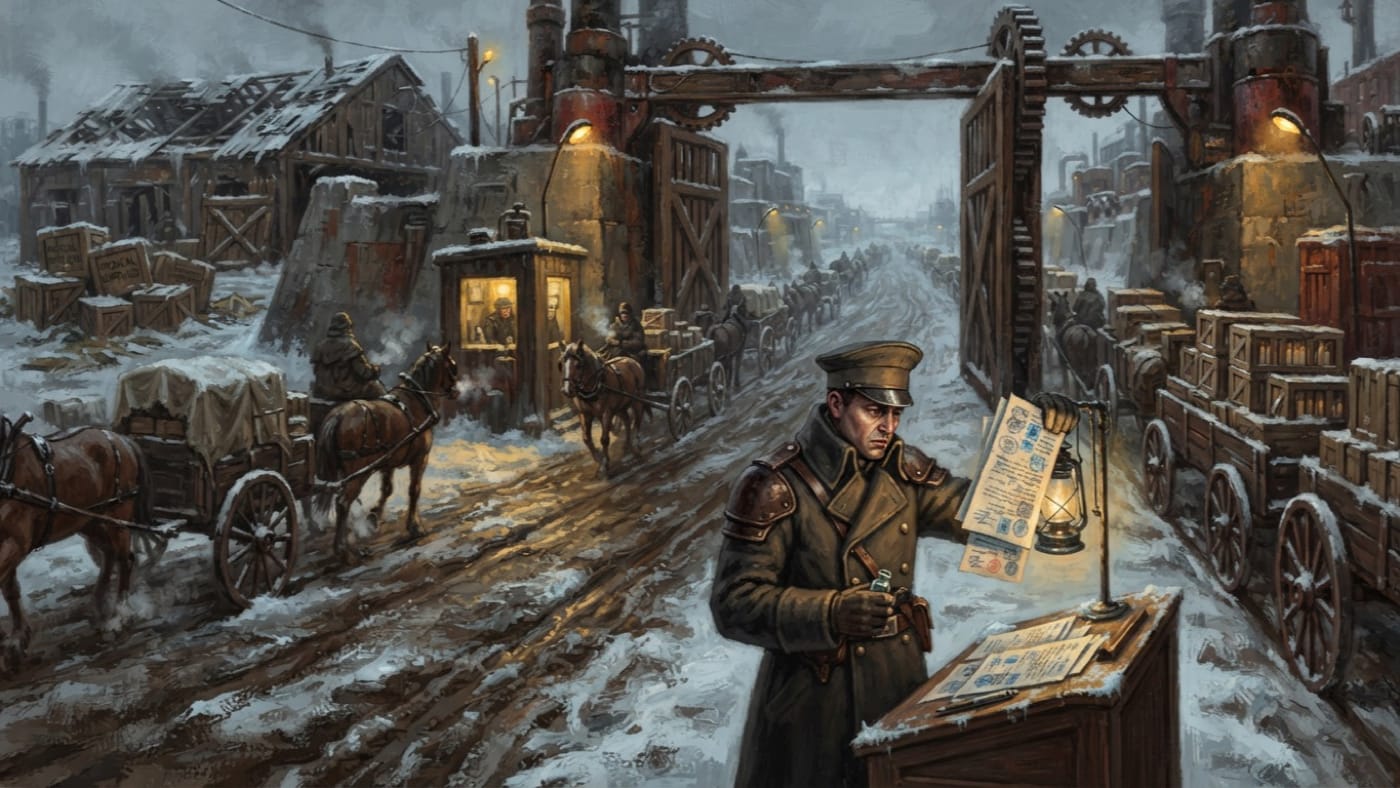
On the forward roads, papers move cargo. Horses only pull it. Every wagon that reaches a gate arrives as a bundle of documents, and the gate reads the bundle before anyone looks at the load. The Stamp Verifier sits at the chokepoint with the lamp. The Marshal assigns the stack. The lane is only so wide and the gate opens only so often, so whatever goes forward makes something else wait.
A priority mark is a small instrument of grace. It lifts one crate over a hundred others without anyone having to open it, argue about it or weigh it against the need of the regiment three miles on. That was the whole efficiency of the system and its whole exposure. Once a counterfeit mark cleared the lamp, the gate did exactly what it had been built to do. It honoured precedence, with all the obedience of a well-catechised child.
By the account preserved in the Corps survey, forged priority stamps sent luxury crates forward while medical supplies sat behind them, and those supplies rotted in a dozen forward depots. The survey does not name the depots and neither shall I. It gives one concrete contrast. Regiments went without bandages while a merchant's consignment of devotional candles passed gate after gate on papers so fresh the ink was still wet. That contrast establishes the kind of failure. It establishes nothing about the merchant, and it does not prove that every displaced crate held candles. I will not stretch one consignment to cover every crate in the stack.
Whoever cut those stamps belonged to the trade this Codex catalogues under the counterfeit stampers. Beyond that, this survey can say only that the stampers were good at their work. A Caravan Factor, who reconciles a convoy gate by gate, can tell you what was sent and what arrived. A ledger alone cannot tell you which mark on which manifest was a lie. The lie looks like every other line in the ledger until the bandages go missing.
#On the Seventeen Memoranda
The Bureau of Records responded the way Records responds to every wound. It wrote. Seventeen memoranda in nine days. I set that figure down with real professional admiration. Most offices of the Synod cannot agree on a heading in nine days, and Records produced a small bound volume.
Readers should be clear about what the nine days measure. They measure the memoranda. They do not measure the Plague. The record establishes how long the Bureau took to write, and nothing establishes how long the forged marks had circulated before anyone noticed, or how long they went on circulating afterward. Anyone who tells you the Priority Plague lasted nine days has mistaken the paperwork for the disease. In this Bureau that is an easy mistake to make.
The material surveyed preserves no titles, numbers or signatories for the seventeen, and no record of a dissenting faction among the clerks. It preserves the result. The memoranda created the ink-verification rite, which required stamp-clerks to test priority marks with a reagent. The lamp had failed, so the lamp got a chemical confessor to help it.
#On the Blue Verdict
The reagent turned counterfeit ink blue. The clerks dabbed it on, the false mark coloured, and the gate had what it had never had before: a confession that showed up on the page.
It also turned legitimate ink blue when the ambient temperature fell below freezing.
That second fact does not merely add a caveat to the first. It undoes it. A test is worth exactly as much as the difference between what it does to the guilty and what it does to the innocent. Above freezing, the reagent made that difference visible. Below freezing, it coloured the honest quartermaster's stamp and the forger's stamp the same shade, and at that point it had stopped being evidence and become an expensive way of dyeing paper. The clerk at the lamp watched the blue rise and learned only that the day was cold, which the clerk already knew.
The Corps survey says that frost held the forward roads for five months of the year. I repeat that as the survey's account. It is not a measurement taken at each of the dozen depots, and it does not prove the season in which the Plague ran. Even on the most generous reading, though, the forward roads were exactly where the reagent was needed and exactly where the weather made it unreliable.
This survey holds no formula for the reagent. It holds no reaction time, no strength of dilution, no rate of accuracy, and no approved method for correcting the result in cold weather. It cannot certify that a mark which stayed uncoloured was therefore honest. It records the colour, the cold and the overlap between them.
SURVEY ERRATUM — A.S. 201 In the Corps survey, for "The reagent worked," read "The reagent turned counterfeit ink blue." The first wording claims a verdict. The second records a colour. Below freezing, legitimate ink also turned blue, and the Bureau will not certify a verdict that the weather could overturn.
#On the Marshal's Discretion
The record says that the Marshals improvised. It says nothing more, and I will not dress that up as a doctrine.
The Marshal's duties are well established and gave no relief in frost. Check the papers. Assign the stacks. Settle the disputes. Keep the supplies moving. Every one of those duties assumes that a mark can be read. When the rite produced the same blue for every priority paper at a winter gate, the Marshal faced the queue with two bad readings and no third. Holding every blue mark would hold the honest consignments with the false ones, and the medicine would wait again behind a different kind of error. Passing every blue mark would put the gate back where it had been before the seventeen memoranda.
The queue does not wait while a Marshal deliberates. Wagons press, rope creaks, and somebody at the back starts to shout. Whatever the Marshals did in those conditions, they did it at the rope and in the moment, and they wrote down less than this survey would like. Which workarounds were tried, which held up, and which made things worse are not established. I will not award any of them a saint's day or a success.
A Marshal's commission sits between two masters. The rite demands compliance. The regiment demands bandages. In frost those two demands could no longer be met by the same act, and the record gives no sign that any memorandum told the Marshal which master to disappoint. Records had issued an instrument. The Bureau of War, whose regiments needed the cargo, had sent nothing to the gate. The rope was in the Marshal's hand.
#On the Ensuing Practice
This survey was commissioned because of the practice. The episode came with it. Verification of priority marks continues at the forward gates, and in A.S. 201 it remains the profession's narrowest and most dangerous point. The Corps survey describes counterfeit stamp charts that the Permit Directorate of the Queue Road updates weekly, and that the forgers update daily. Every verifier who has held a paper to the lamp since then has inherited the contest the Priority Plague exposed.
I cannot tell you that the forgeries ended. I cannot tell you that they recur every winter, that the reagent survived unchanged until today, or that some later office settled the matter for good. The material surveyed supports none of those claims, and I have spent a century's worth of reading learning which claims the Ledger will bear.
What the Ledger bears is this. Precedence is a sacrament administered in ink. Ink can be forged. The test the Bureau made to catch the forgery could not tell guilt from frost. Somewhere forward, in a dozen depots the archive does not name, the bandages turned to rot while the candles went through on the strength of a counterfeit mark.