
Caravan Factor
"Weight is truth." — inscription above the Factors' Chapel, Strasbourg Wayhouse District
The Caravan Factor is the Synod's confession that geography is ungovernable.
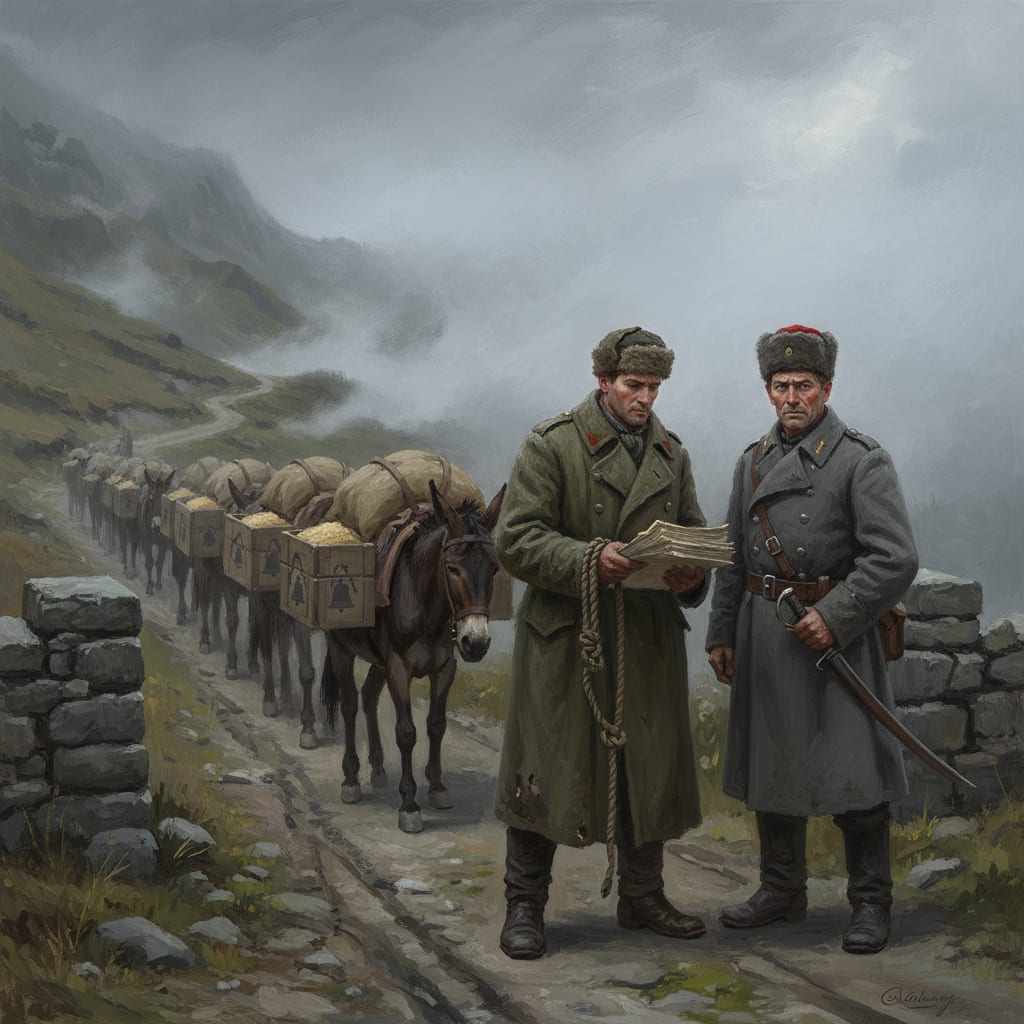
Every ridge between the Sagittal Line and Strasbourg argues with the map. Passes close in fog. Bridges rot between surveys. Mules die on gradients that the Bureau of Engineering swore were "traversable under standard hymnological conditions." And the cargo — grain, chrismole, munitions, relic-crates sealed with bell-stamps and nested in psalter-straw — must arrive at the trenchline regardless, because a bastion that misses its resupply window does not write a polite memorandum. It writes a casualty list.
The Factor exists in the gap between the Bureau's filed route-plan and the road's actual condition. He is part cartographer, part accountant, part diplomat, and part criminal — though the Synod prefers the term Transit Factor or, when feeling charitable, Ridgeward Logistics Agent. The soldiers who depend on him call him the Road-Reader. The clerks who audit him call him the Seal-Juggler. The checkpoint marshals who shake him down at every gate call him nothing at all, because names cost extra.
#On the Origin and Licensing
The profession predates its licence by half a century.
In the years following the establishment of the Sagittal Line — when the Synod's logistical ambition outstripped its logistical competence by a margin the Bureau of Records has never satisfactorily quantified — goods moved by faith, mule, and improvisation. Quartermasters in Strasbourg drew routes on vellum; the routes, being vellum, had no opinion about landslides. Convoys set out with sealed manifests and returned as scattered mules, scattered men, and scattered seals — the seals, naturally, in the best condition, having been designed to survive precisely this eventuality.
The first Factors were not appointed. They grew, the way mould grows on bread left too long in a sacristy. Former soldiers who knew the passes. Widows of wagoneers who knew which gate-sergeant accepted grain and which demanded wax. Failed clerks whose talent for forgery exceeded their talent for orthodoxy. By A.S. 100, the Carpathian corridor from Budapest to Bastion-Sibiu could not function without them, and the Bureau of Tithes — having failed to collect tariffs from unlicensed movement for three consecutive fiscal quarters — responded with the only weapon it respects: a stamp.
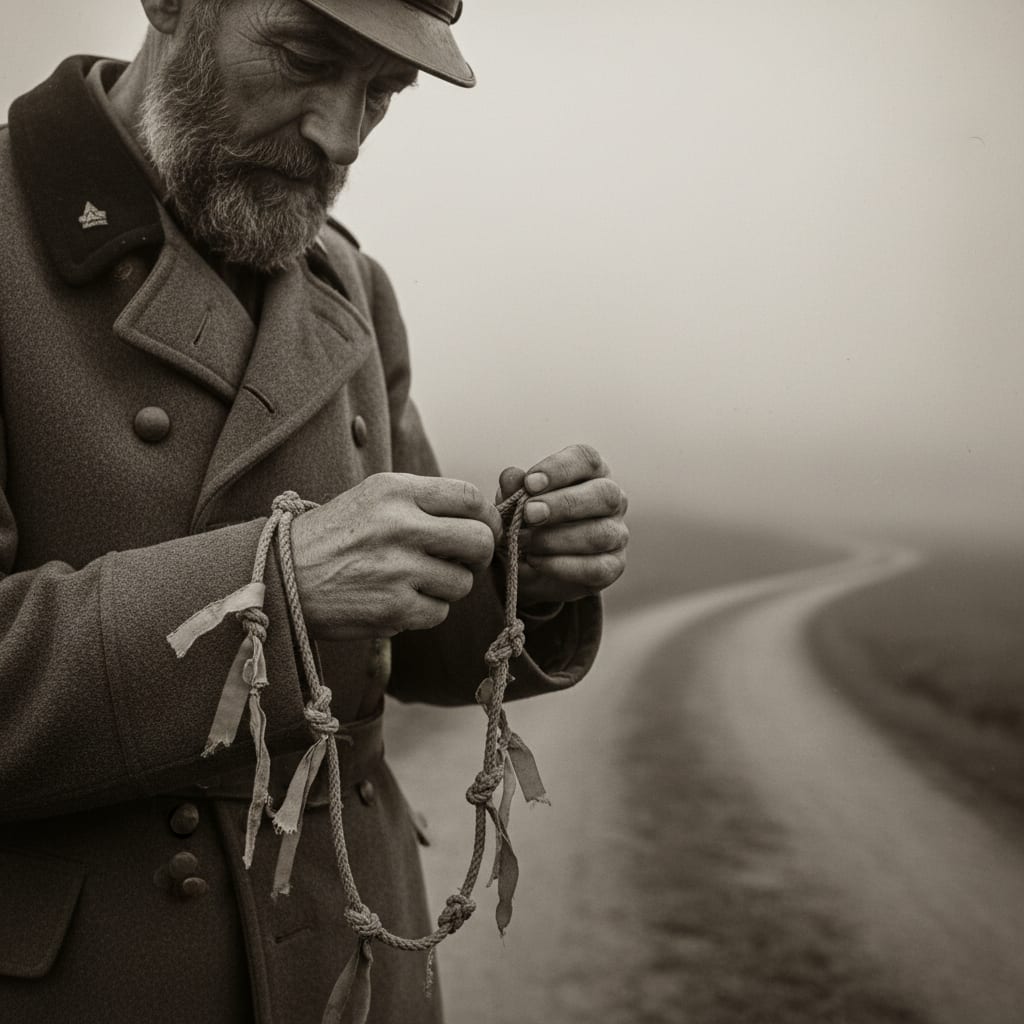
The Transit Licensing Decree (Unregistered) of A.S. 134 made the profession official, which is to say it made the profession taxable. A licensed Factor carries a seal folio, a standardised manifest, a knotted route-cord calibrated to the mile, and a debt to the Bureau of Tithes that compounds whether the convoy moves or sits in the rain.
#On the Substance of the Work
A convoy is a prayer in motion. Like all prayers, it requires preparation, faith, and the quiet certainty that someone, somewhere, is listening with hostile intent.
The Factor's day begins before dawn — inventory, weight tallies, seal verification, and the grim arithmetic of what fits and what gets left behind. Every sack is counted. Every relic-crate is weighed against its bell-stamp certification, because the Bureau of Bells assigns time-credits to each consignment and a crate that arrives outside its credit window is classified as expired devotion, which is bureaucratically indistinguishable from heresy. A loaf of bread in the Synod's supply chain costs flour, fire, three tolls of Saint Odric's Bell (Unregistered), one absolution slip, and a signed hymn from the choir. The Factor does not bake. He schedules the baking into existence.
Then the road. Every mile of a Synod supply route is punctuated by ration-stones carved with the name of a saint — One meal to Saint Edras, Three fasts to Theophania — and by tithe-gates, where the Factor presents his manifests and his convoy recites the Creed. The Creed must be pronounced correctly. I have personally witnessed an Iberian trade caravan trapped at a tithe-gate for seven days because their interpreter stumbled on the third syllable. Their olives spoiled. The Bureau of Tithes recorded the spoilage as "divine commentary on the relationship between commerce and diction."
The Factor's real expertise is in the grey gates — the checkpoints where the posted sergeant has not been paid in four months, where the seal-reader is drunk or dead or replaced by a cousin who cannot read seals at all, where the posted tariff bears no relationship to the tariff demanded. Here the Factor earns his name. He reads moods as others read maps. He knows when grain opens a gate and when grain gets confiscated. He knows when to present the real seal and when to present the burner — a second, expendable stamp carried for precisely such occasions, its loss regrettable but survivable.
The standing order is observed with the same rigour as the prohibition against whistling on ridge-tops at dusk — which is to say, universally acknowledged, universally violated, and universally blamed on the previous Factor when consequences arrive.
#On the Hazards Peculiar to the Profession
Three things kill Caravan Factors: arithmetic, weather, and the Bureau of Purity.
The arithmetic is straightforward. A convoy that arrives one bell-credit late loses its ration priority. A convoy that loses a single relic-crate loses its seal authority. A convoy that cannot reconcile its manifest — weight tallied against weight delivered, name counted against name arrived — faces audit, and audit in the Synod's supply chain is an ecclesiastical proceeding, not an accounting exercise. The charge is weight sacrilege (Unregistered): the theological proposition that a discrepancy between the Ledger and reality constitutes a lie told to Creation itself. The punishment ranges from demotion to immurement, depending on the size of the discrepancy and the mood of the auditor.
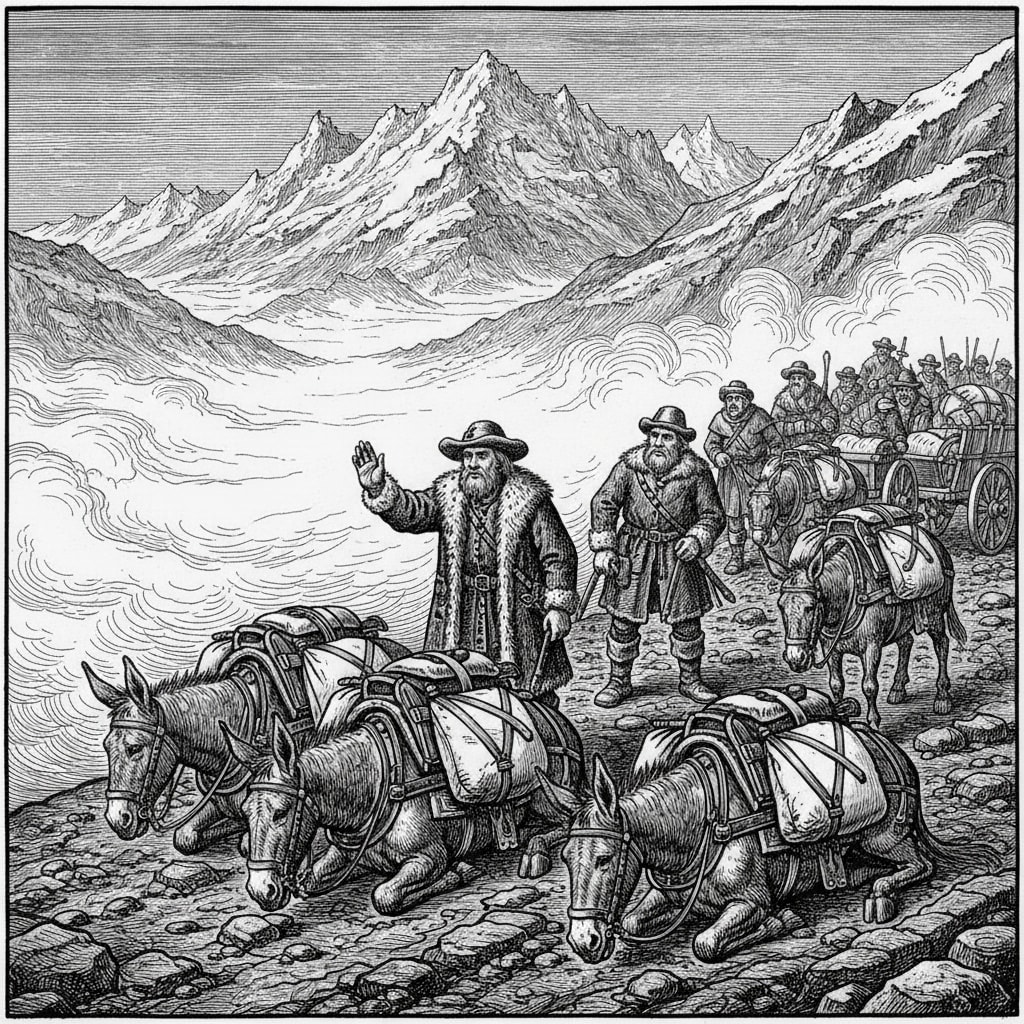
The weather is less predictable and more honest. Ridge-passes above the tree line close without warning. Syrion's fog drifts westward from Bastion-Shipka and lingers in the Carpathian saddles — the Factors call it singing weather, because the fog hums at frequencies that loosen harness buckles and convince mules to sit down. Convoys caught in singing weather must halt, enforce silence protocols, and wait. The waiting kills more men than the fog, because a stopped convoy is a visible convoy, and visibility on a ridge-pass invites attention from Black Ledger raiders, from Peregrine Wardens enforcing route compliance, and from the Rot-Oxen — those necrotic beasts that lumber along the enemy's own supply corridors and whose proximity causes iron to weep rust and bread to darken in the sack.
The Bureau of Purity is the third killer, and the most patient. A Factor who moves cargo is useful. A Factor who moves people — unpersoned refugees, deserters travelling under false manifests, families whose names have been struck from the Great Ledger — is a heretic. The distinction between "cargo" and "people" is clear in doctrine and fluid in practice. Every convoy carries passengers. Every Factor knows which passengers have papers and which are listed as "hands" — labourers attached to the manifest, technically cargo, legally invisible. The practice is universal. The punishment, when the Bureau of Purity investigates, is erasure.
#On the Factor's Place in the Greater Machinery
The Factor sits at the intersection of every Bureau and answers to none of them satisfactorily.
The Bureau of Tithes taxes his movement. The Bureau of Bells schedules his arrival. The Bureau of Pilgrimage claims jurisdiction over his routes — or at least over the pilgrim-traffic that shares them, which amounts to the same thing one token at a time. The Bureau of War issues his forward-zone permits. The Bureau of Oaths insists his sworn testimony at each gate be witnessed by a licensed Witnesser, though the nearest Witnesser may be forty miles behind and the gate-sergeant's patience extends approximately as far as his empty grain-sack.
The Factor navigates this architecture of competing stamps the way a rat navigates a cathedral — by knowing which walls are hollow and which saints are watching.
His upstream suppliers are commerce clerks, tariff-chapel weighers, and refinery rationers who pack the cargo. His downstream dependents are trench commissaries, bastion granaries, and the factory yards that turn raw chrismole into fuel for the war machines. Between them: the Factor, his mules, his knotted cord, his split manifests, and the permanent question of whether the road ahead is passable, payable, and doctrinally acceptable in that order.
STAMPED ERRATUM (Bureau of Records, 4th Revision, A.S. 200): "All references to 'bribe chain' in Transit Factor operational manuals are hereby amended to read 'devotional facilitation sequence.' The Bureau reminds all personnel that the Synod does not recognise the concept of bribery, only the concept of insufficient documentation."
#On the Present Condition
The Caravan Factor is, as of this writing, the most indispensable and least honoured profession in the Synod's logistics apparatus. Approximately eleven hundred licensed Factors operate between Strasbourg and the forward bastions. The actual number — including unlicensed operators, seasonal ridge-runners, and the spectral class of Factors who work exclusively in the grey space between the Bureau of Tithes' jurisdiction and the Bureau of War's tolerance — is unknown, because the Bureau of Records counts only what has been stamped, and much of the Factor's work exists precisely in the gap where stamps do not reach.
In the Carpathian corridor, where ridges kill convoys with the regularity of a bell schedule, the Factor is a figure of grudging reverence. Bastion quartermasters who would not share a meal with a Factor will share a route-plan, because the alternative is starvation. Gate-sergeants who fine Factors at every checkpoint will also warn them when the audit teams are inbound, because the alternative is a gate that no convoy approaches and a sergeant who starves alongside his principles.
The Factors themselves will tell you that the work is simple. "Weight is truth," they say, and "A clean seal beats a brave heart," and "If the road takes your name, you owed it." These are not slogans. They are epitaphs written in advance, carried in the knotted cords that hang from every Factor's wrist, readable only by touch, legible only to those who have walked the route and paid the gates and counted every sack that arrived against every sack that departed and reconciled the difference with a prayer that the auditor accepts the number.
The Bureau accepts the number. The Bureau always accepts the number. The Bureau merely reserves the right to revisit the number at a later date, under different arithmetic, with different conclusions.