

#On the Nature of the Craft
"A false seal damns ten thousand." — Bureau of Masks and Seals, Internal Catechism, Article IX
I have, in my years at the Ledger, signed the erasure warrants for eleven seal-forgers. I have dictated the terms of their immurements — the wall thickness, the prayer to be chanted during the bricking, the footnote appended to the municipal record confirming that the individual in question had "ceased to participate in civic life." I have, in each case, reviewed the confiscated stamps and compared them to the genuine article, and I have, in each case, been quietly annoyed by how good they were.
The seal-forger is the Synod's shadow. Where the Bureau of Masks and Seals presses wax into doctrine, the forger presses wax into survival. Where Casselius of Mainz retires a die and melts it into a numbered ingot, some creature in a cellar is carving its replica from stolen brass and memory. The Synod calls this heresy. The street calls it breathing.
I call it bureaucracy's confession — the admission, stamped in counterfeit wax, that the system's demand for proof has outrun the world's capacity to produce it.
#On the Forger's Workshop
The workspace of a seal-forger is a prayer room turned inside out. The same hush, the same dim lamplight, the same posture of intense concentration over a small and holy object. The difference is that the object is a brass punch, the lamp is angled to catch micro-scratches rather than illuminate scripture, and the prayer — if there is one — concerns the humidity of the room and whether the wax will set before dawn.
I have visited three such workshops in official capacity, each discovered after a raid and preserved, briefly, for the Bureau of Purity's inspection. They smell of vinegar, hot wax, and the particular metallic sweetness of fresh-cut brass. The floors are swept clean — cleaner than most chanceries — because a single metal filing on the wrong surface will scratch a die face and ruin a batch. There are no windows. There is always a stove, small and vicious, for melting wax and for burning evidence at speed.
The tools are stolen, improvised, or built from components no legitimate tradesman would sell in combination. Retired Synod punches acquired through theft or bribery. Genuine registry paper, sourced in fragments from corrupt clerks or scavenged from refuse bins behind municipal offices. Acid baths for aging fresh documents. Bone-black pigment ground from charnel offcuts. Embossing rigs assembled from press components and watch mechanisms. And always, without exception, a loupe — cracked, borrowed, stolen from an optician's drawer — because the forger's war is fought at the scale of a hair's breadth, and at that scale, the difference between freedom and immurement is the depth of a serif.
#On the Hierarchy of Guilt
The profession — and I use the word with the Bureau's grudging acknowledgement that criminals may organise — arranges itself thus:
At the bottom, the Ash-Rat: a child or debtor who burns scraps, fetches blanks, grinds pigment, and knows nothing of the operation except the colour of the cellar walls and the back of the Batch Master's hand. The Ash-Rat's ignorance is structural. When the inquisitors arrive, the Ash-Rat can confess nothing because the Ash-Rat knows nothing, and this is the only mercy the profession extends downward.
Above: the Hands and the Waxers. The Hand mimics signatures — learning the pressure, the hesitation points, the characteristic tremor of a particular registrar's script. A good Hand can reproduce six different clerical hands from memory. A great Hand — and they exist, to the Bureau's eternal irritation — can produce a seventh that belongs to no living clerk and yet passes inspection because it feels like bureaucracy, because it carries the rhythm of institutional boredom in its strokes.
The Waxer casts seals — matching hardness, colour, translucency, and the specific crumble-pattern that authentic Synod wax exhibits after six months of aging. The Waxer's enemy is chemistry. The Bureau's wax formula is classified for reasons that are, for once, genuinely practical: the compound includes three mineral components that produce a distinctive sheen under an inspector's lamp, and replicating that sheen without the formula requires either extraordinary luck or a stolen sample and a year of experimentation.
Above these, the Cutter — the punch master, the one who carves the die. This is the sacred office of the unholy trade, if such a phrase may be permitted, and I permit it because the irony is mine to bestow. The Cutter studies genuine seals the way a seminarian studies scripture: obsessively, reverentially, with a magnifying lens and a candle and the certainty that one misread character will damn the entire enterprise. A Cutter's work is judged by a standard the Bureau of Masks and Seals would recognise and resent: perfection that looks imperfect, because a stamp too clean is a stamp too suspicious.
At the summit: the Registry Shadow, who does not forge at all in the physical sense but instead plants confirmations in minor ledgers, bribing low clerks to enter a cross-reference that transforms a counterfeit writ into a document with a paper trail. The Registry Shadow's method is the Bureau's own method turned against itself — if the Ledger says a thing is true, then the thing is true, and a Shadow who can write a line in the Ledger has, by the Synod's own doctrine, created reality.
#On the Clientele
The forger's customer is anyone the Synod's paperwork has failed — which is to say, the forger's customer is everyone the Synod has chosen to fail.
Refugees whose natal registration writs burned in a bastion fire. Widows whose husbands died in Zone 5 and whose death certificates were sealed by a Bureau that does not acknowledge casualties from sectors it claims are "administratively stable." Deserters. Orphans unregistered by the Orphanage Registrar because the intake queue exceeded the ink supply. Convoy masters who need a fuel clearance the Bureau of Engineering will not issue because the convoy's destination has been reclassified. Families who need a burial permit for a body the Bureau of Rites will not process because the deceased's doctrinal status is "under review" and the corpse, regrettably, is not.
And smugglers. And black-marketeers. And the occasional murderer who needs a new name.
The forger does not distinguish. The forger provides proof, and proof is morally neutral in the same way that a lock is morally neutral — it keeps everyone out, the saint and the thief alike, and the key serves both.
ERRATUM — A.S. 199
A previous edition of this entry stated that seal-forgers "serve the desperate and the damned in equal measure."
#On Errors and Their Consequences
A forger's mistake is never personal. A clerk who misspells a name inconveniences one petitioner. A forger who cuts a serif wrong condemns a neighbourhood.
The mechanism is audit. The Sigil Inspectors of the Bureau of Masks and Seals travel with lamp and lens, checking documents against the current die registry. When a forgery is detected, the Inspector does not merely confiscate the offending paper. The Inspector traces the batch — because forgeries travel in batches, because the same die produces the same flaw fifty times, because the forger's efficiency is the forger's doom. One crooked serif, replicated across forty ration slips, triggers a district-wide review. Ration cards are suspended. Gates are closed. The people who used those slips — some of whom had no idea they were forged — are detained, questioned, and, in the Bureau's preferred euphemism, "invited to clarify their documentary provenance."

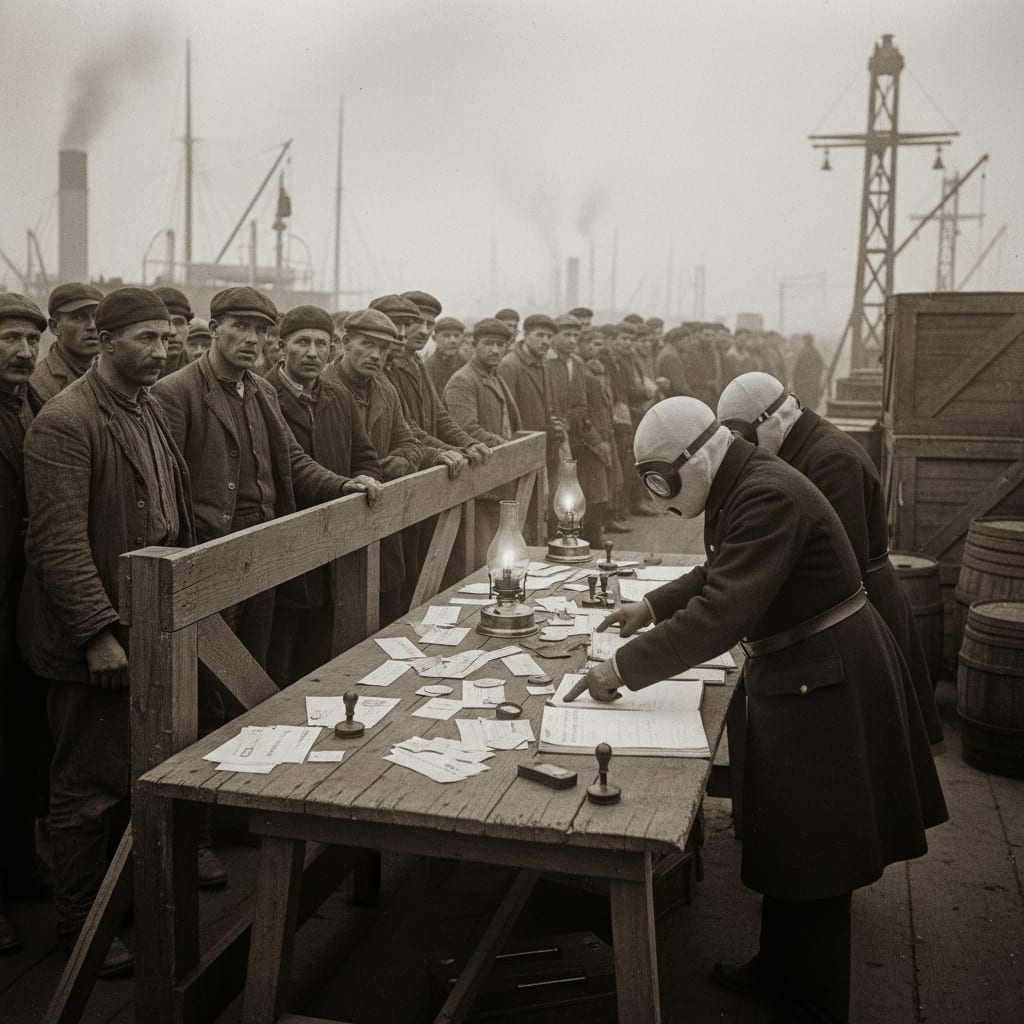
The Great Audit Purge of A.S. 188 began with a single flawed batch of convoy stamps in the Strasbourg docklands. The flaw was a pressure variance — the punch had been re-cut after chipping, and the replacement cut was a fraction of a millimetre deeper on the left stroke of the Bureau's crest. Forty-seven convoy clearances bore the mark. The investigation consumed four months, three Inspectors, and the livelihoods of two hundred and fourteen dockworkers who had presented the stamps in good faith. Eleven were immured. The forger was never found.
#On the Paradox
Cardinal Kratz proved, in A.S. 58, that forgery widely believed is revelation. His Black Decrees — half authentic, half obvious counterfeits — were obeyed because the world chose to obey them, and the choosing made them true. The Bureau of Doctrine considers this a miracle of governance. The seal-forger considers it a business model.
The paradox is older than Kratz. The Synod's entire authority rests on the Sovereignty of the Seal (Unregistered) — the doctrine that a stamped writ is truer than ten thousand witnesses, that the impression in wax sanctifies the paper beneath it into scripture. If this is so — and the Bureau insists it is — then a forged seal that passes inspection is, by the Synod's own logic, genuine. The wax does not know it was pressed by an unauthorised hand. The paper does not remember who cut the die. If the stamp stands, the stamp is.
The Bureau of Masks and Seals resolves this paradox by refusing to acknowledge it. The Bureau of Doctrine resolves it by classifying the question. I resolve it by noting that the eleven forgers whose erasure warrants I signed produced work that, in aggregate, kept approximately six thousand people fed, housed, and buried during a period when the official system had declared them administratively nonexistent.
ERRATUM — A.S. 201
The preceding paragraph implied that the Warden of the Sacred Ledger endorses forgery.
#On Mara Vell
Every criminal profession requires a saint, and every saint of the criminal profession must be, by doctrinal necessity, a lie. Mara Vell — the Blank Notary, the Paper Ghost, the woman who could forge a seal so perfect it made inspectors weep — is the forgers' patron and the Bureau's preferred cautionary tale, which means she serves two masters with the same story, which means she is, in function, a forger even in death.
The legends vary. She operated in Cologne, or Strasbourg, or Brest. She was a disgraced notary, or a clerk's widow, or a woman who had never held office but who understood wax the way a cantor understands pitch — by feel, by instinct, by some faculty the Bureau cannot requisition. She could replicate any seal in the Synod's registry. She could age a document in an afternoon so convincingly that archivists filed it alongside genuine writs from forty years prior. She vanished — walked through her own paperwork, the legend says, disappeared into the bureaucratic labyrinth she had forged into existence, became a name on a registry that referenced a registry that referenced a registry that referenced nothing.
She was never caught. She was never named. She may never have existed. The Bureau of Purity maintains a file on her that is seven hundred pages long and concludes: "Status: Unresolved."
The forgers keep her name the way a parish keeps a relic — encased, venerated, produced on feast days and in moments of professional crisis. "Cut clean. Die quiet," they say, and attribute it to her, though the phrase predates any record of her existence by thirty years. She is their proof that the system can be beaten. The Bureau is their proof that the system beats back.