
#On the Quiet Turn
There is no ninth turn on the Reliquary Switchbacks. The Registry counts eight, nails eight femurs and collects eight tolls. The Relic Registry Office (Unregistered) would sooner lose a saint than admit to a ninth. The porters still speak of the Quiet Turn as though a man could stand on it, and in a narrow sense they are right. It is the turn a traveller takes when the other eight have priced him off the mountain.
The Quiet Turn Smugglers are a cartel. They are composed of the Porter Guild's own carriers, who work the underside by night under the same knot-mark cards they carry by day. On the Reliquary Switchbacks they look like every other bent back under a crate, in wet wool and pine-tarred harness. Their trade is moving relics and fugitives by culvert and night rail, along with other contraband, on a line the Synod's maps decline to show. Their product is passage. Their price is silence.
Who commands them is unknown. I record this as a finding and not as a failure. The Bureau of Records holds no name, no seat, no charter and no line of succession. I have declined to supply any of them from imagination, which is more restraint than several provincial registrars can claim.
The cartel sells a fine distinction, and the Church has spent a century making it expensive. To be carried up a mountain takes rope, legs and weather. To be permitted up a mountain takes a Turn License, a Relic Handling Certificate, eight confessions on slate and a seal at the summit. The Quiet Turn deals in the first. It cannot deal in the second. The corridor's whole system of extraction lives in the gap between them.
#On the Route Beneath
The Hanging Mile is three feet of iron bolted to a cliff above a thousand feet of air. Its chain rail is locked at seven points by the seven nail-keys on Warden-Captain Bronn's ring. Its wardens walk the deck by lantern, and its femur markers creak at ten-pace intervals. By every measure the Shrine-Court of Seven Nails (Unregistered) recognises, its surface is the most closely watched mile on the mountain.
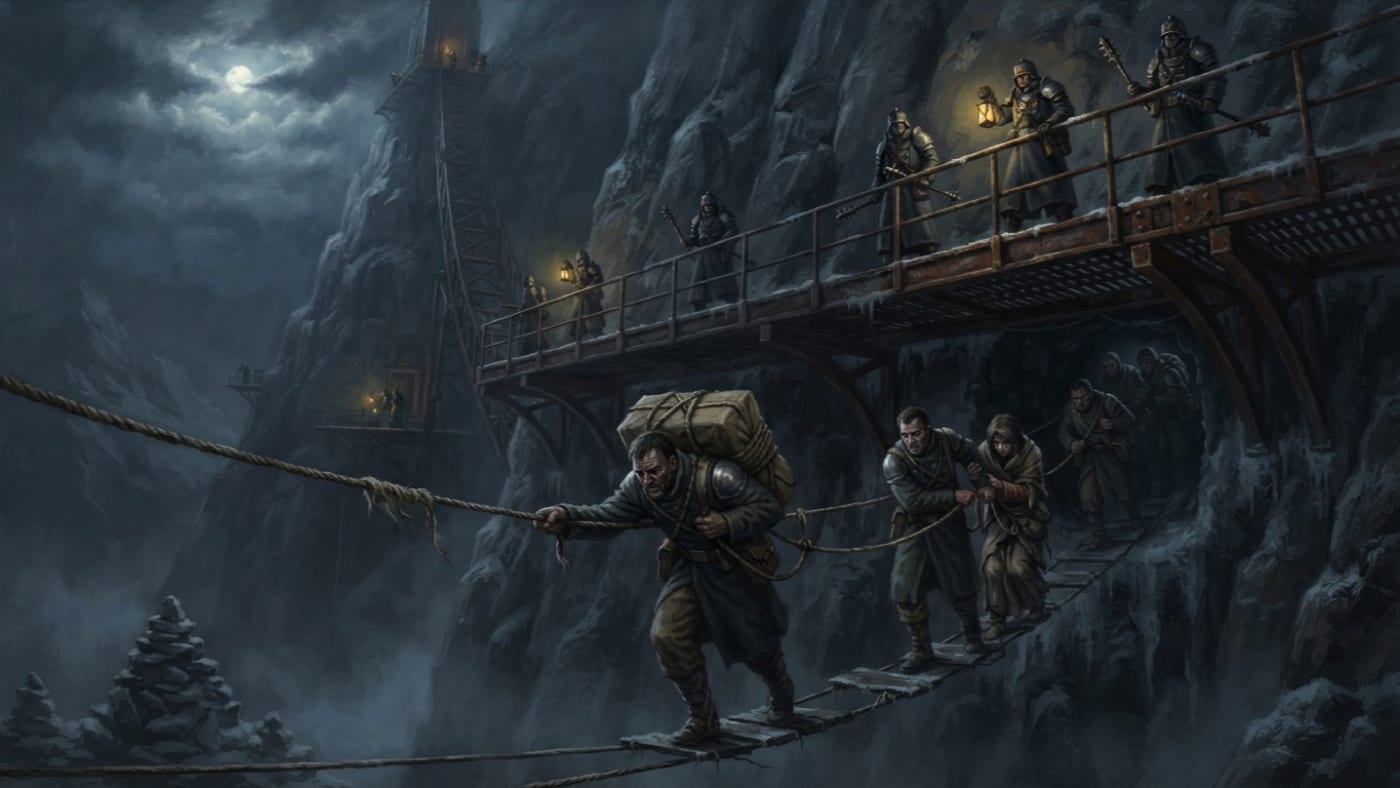
Its underside is not. Braided cord and anchor bolts are fixed into the catwalk's iron frame. By these the Quiet Turn moves its cargo between the caches of Cairnfield Terrace and the approaches to the Summit Gate Reliquary (Unregistered). The work is done at night, with the wardens directly overhead. The carriers are separated from them by a plate of rusted iron and by the wind, which at that altitude arrives sideways and loud enough to swallow a boot-scrape, a cough, or a parcel knocking against a strut.
No Bureau report will describe what this involves, so I will. A carrier hangs from cord beneath a walkway in the dark and the frost. A wrapped relic is lashed to his back, or a living fugitive is roped to his belt. Above him walks a warden of the Court with a nail-baton, close enough that the carrier could hear a key turn if the wind dropped, and with no idea. There is shale below and iron above, and between them a man holding his breath for a mile.
The Mile is the famous part of the route but not the whole of it. The survey also puts the cartel's ground in the basements of the Switchback Inns (Unregistered). Lower down, the corridor's runoff culverts serve the same purpose. They were dug under the steps to carry off meltwater, which means they are already dug for anyone with a reason to crawl. The Terrace keeps a culvert mouth behind the stone the locals call the Saint's Cairn. I will not join these places into one surveyed tunnel, because nobody has surveyed one. A map drawn from rumour is the first document an inquisitor confiscates and the last he forgives.
#On the Price of Passage
The cartel does not need to create demand. The corridor creates it. A Turn License costs money, and so does a Relic Handling Certificate. Each of the eight confessions costs a toll in coin and a further toll in whatever the slate records. Winter debt turns into porter conscription. Bunks at the inns are auctioned by body heat. The summit gate seals in storms, and lately it seals more often. Some travellers cannot pay, cannot wait, or cannot afford to have their names copied onto paper beneath the Turn of Saint Odrin. They have few options, and the Quiet Turn is the one that does not end on the work-rail.
I will not pretend that every client is a debtor fleeing the Guild, that every parcel is counterfeit, or that every crossing is an act of mercy. Some of what goes under the Mile is stolen. Some of it is holy. Some is both, and the Bureau of Purity has never produced a test that can tell them apart.
Silence is a condition of the bargain. The sources do not say the cartel works for nothing, and whatever else changes hands, the client never speaks of the route, the cache, the carrier or the hour. This is a different kind of silence from the one the Court fines for on the Silent Steps between the fourth and fifth turns. The Court enforces silence so that speech can be recorded. The cartel enforces it so that nothing is.
The cartel uses four instruments, and the Court would do well to keep them apart:
- Caches on the Terrace hold cargo between movements.
- Bribed wardens look elsewhere at the agreed hour. No record names one, and I name none.
- Forged shrine and turn marks let a carrier skip a station's scrutiny.
- Fake martyr-credits imitate the Registry's devotion favours. These must not be confused with genuine credits bought through corrupt but official channels. That is a separate sin, committed by a better class of sinner, whom the Creator will sort out in His own time.
None of these is the true seal. By the corridor's own law, and by its black market's own admission, the master seal of the Summit Gate is not for sale. The cartel delivers toward the summit, not through it. What happens to a fugitive who reaches the summit approach with no lawful seal on his papers is recorded nowhere I can reach.
#On the Court and the Other Carriers
Warden-Captain Bronn commands the surface. His Court licenses punishment, his wardens patrol the turns, and his seven keys decide which sections of the Mile are open on any given night. The cartel's whole method is an answer to him: if the deck is his, the underside must belong to someone else. It is established that some wardens have taken money. No document I have seen implicates Bronn himself. I write that sentence with the care of a man who means to climb the Mile again.
Registrar-Mother Elske Vane controls licenses and authenticity stamps. Every mark the cartel forges is a copy of something that leaves her office. That makes her its unwilling patron, in the way the mint is patron to the coiner.
Porter-Master Jaro "Knot" Ilwyn allocates labour and mules from the Porter Yards and knows the hidden routes. On the Switchbacks, knowing the hidden routes is less a suspicion than a job description. Knowing a route does not mean commanding the people who use it.
They are composed of the Porter Guild's own carriers, who work the underside by night under the same knot-mark cards they carry by day.
The Quiet Turn presents itself as licensed porterage. It is not established whether any given member holds a genuine knot-mark card. The harness and the wool prove only that a porter's appearance is cheap to acquire. Nothing on file makes the cartel a department of the Guild, or makes Porter-Master Ilwyn its master.
The Cairn Wardens hold Cairnfield Terrace, bless its stones and control access to the hidden routes behind them. The cartel's caches lie in their ground. The record does not say on what terms.
The Blank Saints use the same crawlspaces under the inns and the same hollows behind the cairns. They forge Registry slates to prove the martyr list a fabrication. The cartel forges marks to get cargo past that list. Sharing hiding places is unavoidable on a crowded mountain. Nothing on file shows a shared leader, a shared purpose or an alliance. The reader should also not confuse that cell with the lowercase blank saints, the unnamed bones, which have no politics at all.
#On the Present Traffic
As of A.S. 201, the Bureau of War rates the corridor Amber, and it remains operational. The Quiet Turn has no rating of its own, because the Bureau does not grade what it does not admit exists. The storms are worsening and the summit closures come earlier. The Court grows harsher and the inns colder. Each of these grows the cartel's clientele as surely as a toll increase grows the Registry's revenue.
What the cartel answers to is the inquisitor. Inquisitors attend the summit in purity seasons, and their arrival days are the other thing on the mountain that cannot be bought. The survey lists an inquisitor's arrival as the event that sets the Quiet Turn in motion. The Court has oath-collars waiting for smugglers it catches. Moving relics at night without a witness is one of the corridor's red lines. Moving relics at night without a witness is the cartel's entire business.
This office files the Quiet Turn for information only. Its leader is unrecorded and its route unsurveyed. The silence its clients pay is, as far as I can find, the only contract on the mountain honoured in full.