
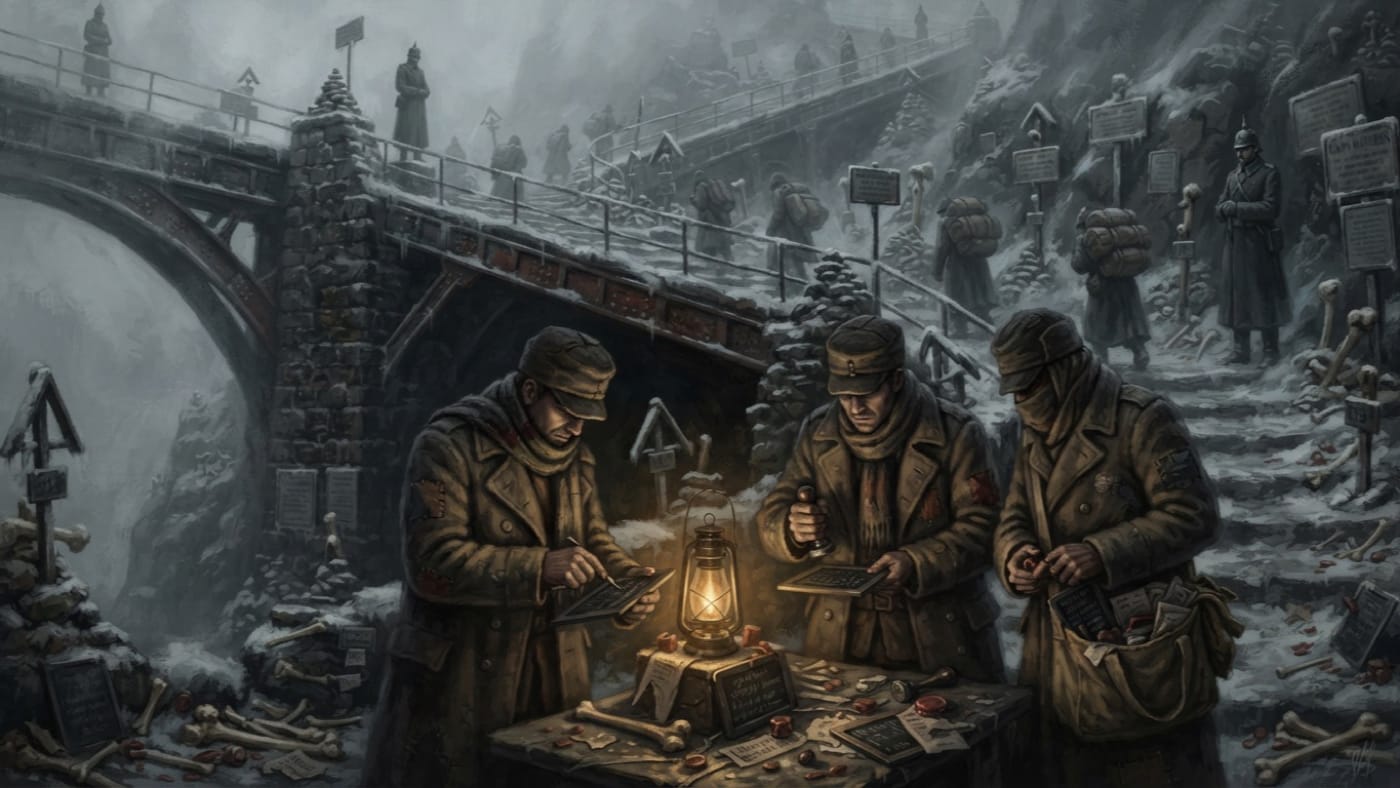
#On the Name Without a Martyr
"If the turn speaks first, don't answer." — saying of the Switchback porters
On the Reliquary Switchbacks, a blank saint is a bone without a name. It has no tag, no Registry entry, no confession slate and no right of passage. The corridor's contraband schedule lists it beside forged turn-marks and loose seal wax, and no licensed porter will carry it up the four miles of Carpathian shale between the Turn of Saint Odrin and the Summit Gate. The phrase is also an insult. A porter who calls another porter a blank saint means a body nobody will pay to bury.
With capitals, the Blank Saints are a heretic cell. They have no public face, no chapel, no printed program and, so far as the Shrine-Court of Seven Nails has established, no roll. Nobody knows whether they took the insult as a banner or had it shouted at them by wardens. They work from the crawlspaces beneath the Switchback Inns and from the lee of the memorial cairns on Cairnfield Terrace. Their object is simple enough to fit on one slate: to prove that the martyr list of the Switchbacks is manufactured, and to break the authority by which a name, once it has been entered, decides who climbs, who pays and who is accused.
I decline to date their founding. Any year I gave would date the Registry's diligence and nothing else.
#On the Registry's Mountain
Every recognised turn on the Switchbacks has three things and charges for a fourth: a martyr's name, an entry in the Relic Registry Office, a femur nailed into the rock, and a toll. The custom began with Saint Odrin's femur after the avalanche of A.S. 76. By A.S. 82 every turn had all four. By A.S. 92 the Registry had formalised passage licensing, so that no relic moved without a Turn License, a Relic Handling Certificate and a confession at each shrine station. The Bureau of Pilgrimage calls these devotional stations. Confessions are taken on slate and then copied to paper. The slate is the first witness, but only the paper survives.
A name on that list does arithmetic. It fixes the toll at its turn. It fixes what a carrier must declare there, to whom he declares it and what he must confess. It authenticates the bones beside it and condemns any bone that lacks a name. Registrar-Mother Elske Vane holds the licences and the authenticity stamps. Whatever her stamp touches gains provenance. Whatever it refuses to touch becomes a blank saint.
The martyr-credit runs beside the licences. It is a devotional favour backed by the Registry, which shows that the bearer has contributed enough to the martyrological record to be spared certain scrutinies. The Registry denies that credits are sold. Credits are sold. The Bureau of Tithes follows the receipts with professional affection.
The porter feels all of this in his body. Under a disputed name he pays a disputed toll in coin he does not have. He covers it with a winter debt to the Porter Guild, then sits out the summit closure in a breath-bunk he cannot afford, waiting for a gate that now seals earlier each season. One wrong name costs him a cold night. Enough of them cost him a burial, and the Registry gains another femur.
#On Slates, Seals, and Storm Knowledge
The cell has two methods, and both are clerical. Its members swap turn-names, and they forge Registry slates.
Swapping is the cruder art. They chalk over a turn-mark, reverse a shrine tag, or scrape a femur's name and rewrite it in the dark before the clerks climb. For one morning the turn answers to a saint it did not have the day before. Pilgrims pay the wrong toll and confess to the wrong martyr. Porters, who say a name-swapper changes fate with chalk and nerve, step around the altered markers. On its own a swap proves nothing about the Registry. It shows only that a hand put the name on the stone, and that a hand can take it off.
Forgery is the finer art and the more dangerous. Using stolen Registry seals, the Blank Saints write slates that would pass in a clerk's satchel. They enter martyrs who never lived and then watch where each entry goes. Does a toll attach to it? Is a marker ordered? Is a confession copied to paper under a name they made up beside a tallow lamp under an inn? By the cell's reckoning, each forged entry the Registry accepts is evidence that it accepts entries it cannot verify.
Here the heretics have argued themselves into the confessional. A forger who proves that the Registry admits forgeries has first proved that he is a forger. Any slate the cell presents to the Bureau is a slate the cell could have made. The Shrine-Court has no need to answer the accusation. It reads the seal and charges the hand. For the sake of evidentiary hygiene, I add that a forger's slate cannot clear the Registry either. It proves that a seal was stolen and nothing more.
Their third resource is the weather. On the Switchbacks, storm knowledge means knowing which closures trap which crowds, how long the inns stay sealed, when the wardens take shelter, and which cairn-backs hold their snow and which drift open. The cell moves when the mountain is shut, because a sealed summit pins the wardens to their posts as firmly as it pins pilgrims to their bunks.
Others use the same hidden ground. The Quiet Turn smugglers run rope routes under the Hanging Mile and sell passage, relics and fugitives. The Blank Saints sell nothing. The Cairn Wardens bless every stone on the Terrace and have given no opinion on whatever crouches behind them. Porter-Master Jaro "Knot" Ilwyn knows every culvert on the mountain, and no warden has yet placed the Porter-Master beside a heretic.
#On the Names the Wind Supplies
The Name-Drift is weather before it is doctrine. In heavy storms the wind over the Switchbacks carries syllables, and some of those syllables are names that are not on the martyr list. The femur markers hum against the shale. Lantern flames lie flat. On the clerks' slates the ink bleeds into letters the clerks can read but cannot trace to any source. The Registry classified, or acknowledged, the phenomenon in A.S. 199. It has declined to say whether it began then.
After each storm the Registry adds the name. The entry is retroactive and arrives complete, with ledger line, femur marker and toll. New turn-names and toll-turns keep appearing on a corridor whose eight districts have otherwise not been redrawn. The Registry has not said whether each new turn is new stone or an old bend with a new invoice.
The Blank Saints say the Registry writes these names itself. In their account it exploits the storms, or engineers them, so that its inventions look like discoveries. The cell has not decided between exploitation and engineering, and neither has anyone else who holds a seal.
The Bureau of Alchemical Standards puts the voices down to air forced through shrine spires and femur-hollows, which makes sounds the ear takes for speech. Its report is inconclusive. Even the most obliging draught has not explained why it picked a name the Registry did not hold. The Bureau was asked to stop investigating, and it stopped.
The Bureau of Purity sent auditors. They climbed the corridor, examined the slates and interviewed the wardens. They found the Registry's records in order and the cell's theology "incompatible with the established martyrological framework." I accept the finding in full. It tells us what the framework will tolerate. The porters keep asking why new toll-turns follow the storms, and the auditors' reports do not answer that question.
Registrar-Mother Vane has filed her own report. It is conclusive. It is classified. I have not read it, so I cannot tell you that it settles anything.
MARTYROLOGICAL INTEGRITY: CONFIRMED — RELIC REGISTRY OFFICE, A.S. 200. COUNTER-SIGNED: BUREAU OF RECORDS, STRASBOURG.
The certification stands, and its reach is hereby specified. It confirms that the Registry's entries agree with the Registry's copies, that its seals are its own, and that the Bureau of Records found the ledger in good order. Its jurisdiction ends at the ink. It does not cover the bones, the storms, or who first spoke any name. Anyone who cited it against the Blank Saints as proof of provenance must cite it more narrowly from now on.
#On the Present Pursuit
As of A.S. 201 the storms are worse, the cell is bolder and the Shrine-Court of Seven Nails is harsher. Which of these came first depends on whose file you read. This section is a current assessment. It records no founding, no new condemnation and no victory.
Warden-Captain Bronn commands the pursuit. The Warden-Captain holds the seven nail-keys to the seven catwalk locks on the Hanging Mile and has wardens with nail-batons on every turn. The dispensation granted after the Counterfeit Crisis of A.S. 178 lets the Court punish "relic-adjacent" offences summarily, and that phrase now covers speech, mispronounced martyr-names and untagged bones. A suspected Blank Saint can therefore be charged for holding a bone, for saying a saint's name wrongly, or for asking aloud which saint's name he was supposed to say. The Silent Steps between the fourth and fifth turns finish the work. A protest there earns a fine, an appeal against the fine requires speech, and that speech counts as a second confession.
Vane's office handles the rest on paper. Each licence revoked from a suspect leaves one more porter who cannot work above the Porter Yards. Each debt that follows becomes conscription when winter comes. The Porter Guild is restive, but it has not stated why in any form the Court can enter, and the Court has not asked in any form the porters can answer. Of all the toll-roads in the Carpathian passes, this is the one where a question costs more than the answer.
The cell waits for a storm that carries a name so wrong the Registry cannot stamp it into legitimacy. No such name has been recorded yet. So far the Registry has found a way to accept every name the wind has offered. The femurs keep arriving.