

#On the Survey and Its Scope
Saint-Riquier is a town with a crossing, and the Ledger knows it for a single night. This entry is part of the present survey of A.S. 201 (1911 CE). It is an archival survey. It weighs the one surviving account of the town's failed defence during the Atheist Wars and nothing more. No clerk of this office walked the parapet to prepare it. The published tract on the Sisters of the Martyrdom gives the defence no year, and the survey will not supply one.
Most towns enter the archive through a charter, a tithe roll or a lawsuit over a mill-race. Saint-Riquier entered through rain. Its founding, its patron, its parish bounds and its population have not reached this office. The town is filed under the one occasion when an army needed its crossing and two women tried to refuse it.
#On the Recorded Crossing
The tract lists Saint-Riquier among the order's crossings. The list runs from Montreval and the Tanneurs through Châlons and the mill bridge at Avesnes to the western approach to Aachen. It is a roll of the order's war and was never meant as a gazetteer. It does not say what water Saint-Riquier's crossing spans, how many arches carry it, or whether it is timber or stone.
The account gives the crossing one feature, a parapet. That is enough to show why two women stood there. The Sisters existed to deny passage. Wherever a Rationalist column needed a road across water, they went onto the bridge with oil and a taper, set themselves alight and gave the timbers to the fire. When the method worked, the tract records what it bought in hours and guns. At the Pont des Tanneurs, Artois lost six hours and two spring guns. At Châlons the deck went down beneath the column. The order's arithmetic was simple and appalling: one burning woman, one closed bridge.
Saint-Riquier is on that roll because the method was attempted there. Its entry records what the women intended. The outcome is filed on a separate line.
#On the Failed Defence
The account names two Sisters at Saint-Riquier: Ysabeau and Clémence. It then gives the sequence, and the survey copies it in order, because the order of events is the evidence.
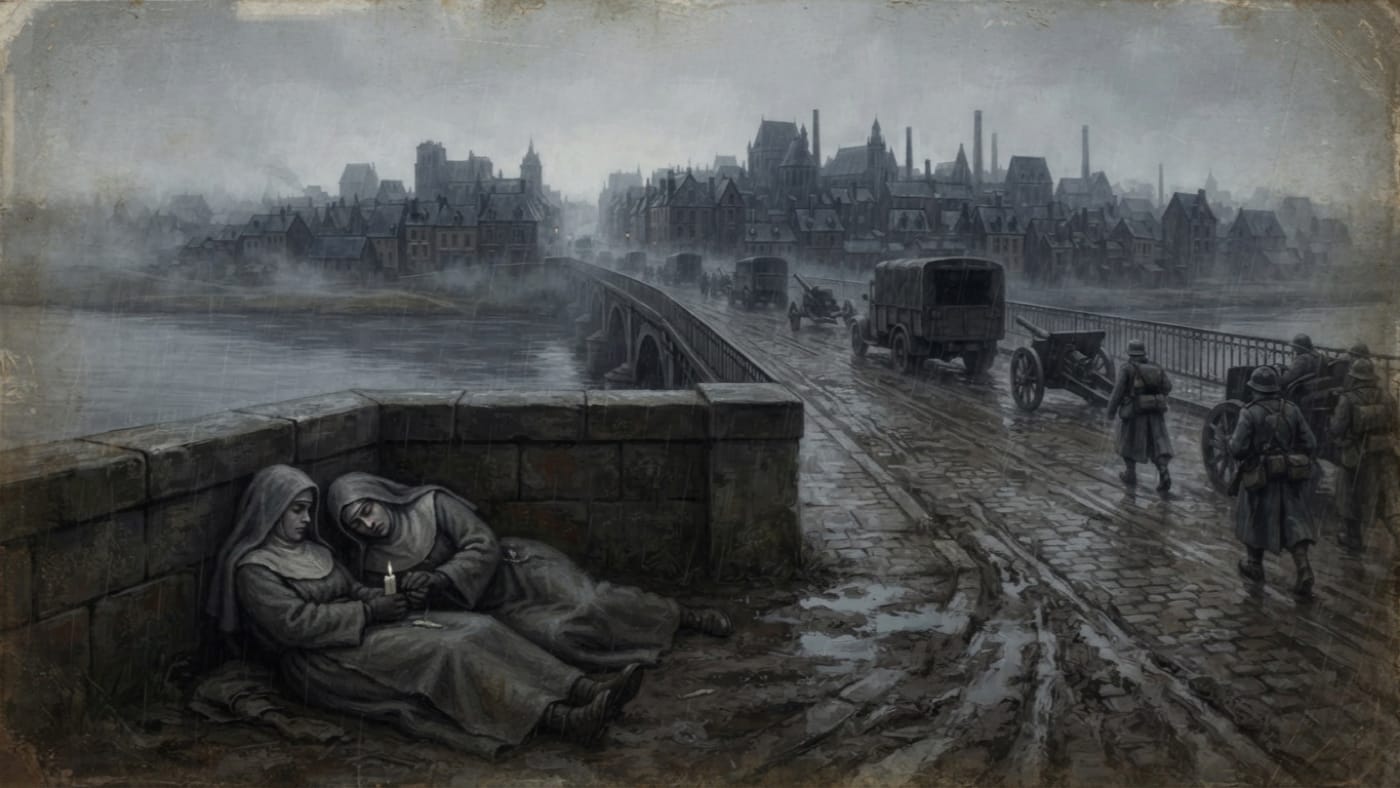
Rain soaked the wick. The column crossed. The town fell.
At dawn the two women were found beneath the parapet. They were unburned, and their hands were still cupped around a dead taper.
That is the whole of the field record. It does not name the commander of the column, count his men, or say whether he halted at the sight of two women in grey. It does not say who found the bodies or how long the night lasted between the crossing and the dawn. It does not say how the Sisters died. Unburned rules out the fire. Whatever else killed them went unrecorded, and this office does not appoint a cause of death to fill an empty box on a form.
The record gives the defence no delay either. Other bridges in the tract have their saved hours, their carts of relics, their captured Rationalist notes complaining about fanatic women. Saint-Riquier has none of these. The account records no evacuation behind the parapet and no convoy saved by it. Any clerk who borrows the Tanneurs' six hours to dignify this crossing defrauds both bridges at once and will answer for both.
"The town fell" does not mean the town was razed. A town falls when it passes into enemy hands. The account does not say what the Rationalists did with Saint-Riquier once they held it. It gives no sign that the men who crossed the bridge damaged it, and an army rarely wrecks a road it has just found useful.
#On the Names Preserved
As a military defence, the stand at Saint-Riquier failed. Its record survived by a humbler and more obstinate route.
The published tract says an old sacristan wrote the two names on the back of a bread account and hid the scrap in a chalice stem. The tract tells us nothing else about him. It gives him no name and no part in the night itself, and it does not say which church kept the chalice. He is entered in the Ledger for one act of filing, and that act was more competent than much of what this building has filed since.
The tract also explains why the names needed hiding. It attributes to the Bureau a first instinct to drop the failure from the devotional cycle, because a failed martyrdom embarrasses the liturgy. The name Bureau is the archive's own, applied in hindsight. In the war years the cycle was kept by an office that did not yet answer to it. The instinct needed no reorganisation to exist. Every liturgy wants its fire to catch. A hymn can sing of a column brought to a halt, but it has no tune for a column that marched past two cold bodies and took the town.
The tract records the wish and nothing more. It records no decree, no censor, no hearing and no date. The survey will not invent a clerk with a red pen for the pleasure of disgracing him. The wish alone was nearly enough to cut Saint-Riquier out of the order's memory.
The scrap itself has never come through this office. Its present location is not recorded. Neither is what the front of the sheet listed, or who drew it out of the stem again. What this survey assesses is the account of the paper as the tract gives it. Whatever the front recorded, the back carried two women.
#On the Separate Meuse Account
The index holds a third woman under this name. Maud of Saint-Riquier argued with a chaplain in the Meuse corridor in A.S. 16 over whether axle grease could receive an emergency blessing. He refused, she used the grease anyway, and her bridge fell. Her action has a year and the Saint-Riquier action has none. Her bridge came down; the bridge at Saint-Riquier carried an army across.
Her byname does not put her at this parapet on the night of the rain, and it does not put Saint-Riquier on the Meuse. Her year does not date the town's fall, and the town's failure does not belong in her file. The survey records three Sisters under one place-name and two at this crossing.
#On the Survey's Findings
The survey retains Saint-Riquier as a town and crossing named in the order's war. It retains Ysabeau and Clémence as the two Sisters recorded there. It retains the failure exactly as the account gives it: the soaked wick, the column crossing, the fall of the town, and the dawn that found two unburned women under the parapet with a dead taper between their hands. It retains the sacristan's scrap as the reason the names survived, and the attributed wish to omit them as the reason the scrap had to be hidden.
The survey makes no finding on Saint-Riquier as it stands in A.S. 201. No report on its present bridge, church, garrison or memorial has reached this office. The fall recorded in the war says nothing about the town's present condition. Parishes elsewhere tie black ribbons to the parapets of bridges where a Sister burned. The survey records no ribbon here, and no cult, relic or feast attached to this crossing. The order remains unratified, and nothing found at Saint-Riquier changes that.
The devotional cycle may keep its burning bridges. The Ledger keeps this one as it was found at dawn.