

#On a Small Span Below the Tanneries
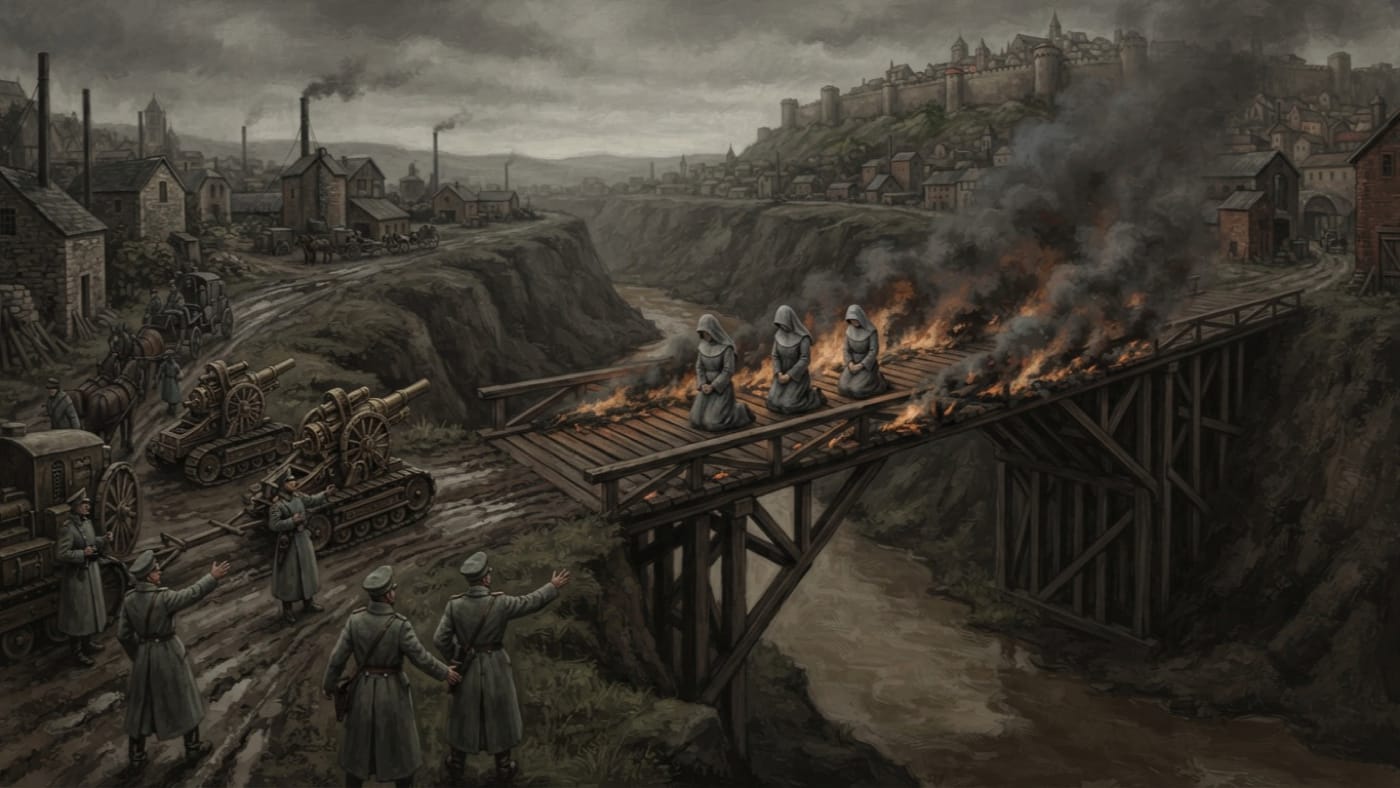
The Pont des Tanneurs was a timber crossing on the ravine road below the tanneries of Montreval. It no longer exists. In A.S. 15, five years after Saint-Malo and a year after Margaux received her early recognition, three women in grey habits died on it. A Rationalist column lost six hours on the wrong side of the ravine as a result. That is the schoolroom version, and its only fault is that it is short.
The Codex gives this span its own entry because it is the earliest confirmed action of the Sisters of the Martyrdom. Note the word confirmed. Women may have burned at crossings before Tanneurs where no clerk was standing, and the order may have had a rule, a mother, and a founding night. None of that survives. No charter has been authenticated and no roll has been completed. What survives is a field account, a town account, a chapel list, a quantity of song, and two masses of stone below a tannery where the candle trade now does excellent business.
#On the Crossing Below the Tanneries
Montreval was a pass-town on the southern faithful front of the Atheist Wars. Cardinal-Marshal Severin of Avignon held it with garrisons that were starving before the campaign had properly begun. Against him came Lucien Artois, the Iron Rationalist, with his clockwork artillery. Those guns needed roads the way a bishop needs deference: constantly, and in good condition.
Tanneurs was not the largest approach to the town. It was the most convenient one for guns after rain. The town account gives the reason with the bluntness of people who had pushed carts up it. The higher road went slick when wet, and the lower ford swallowed wheel hubs. That left a timber deck on stone abutments over a ravine whose water ran brown from the tanning pits. To an artillery officer it was worth more than every cathedral in the district. Artois needed his pontoon train and his batteries brought forward. Severin needed them late.
The Ledger does not know who built the bridge, when, how long it was, or what name the stream in the ravine carried. Several devotional guidebooks supply all four. I have confiscated two of them, and I would confiscate the rest if the Bureau of Pilgrimage did not sell them.
#On the Second Bell
At second bell the Rationalist column reached the crossing. That is the hour in the local reckoning of the time, and I decline to convert it into a schedule the town would not adopt for generations. Three women stood at midspan in grey habits.
The column halted. Its officers took the scene for a parley. Three unarmed religious women on a bridge invited that reading, and it was the last reasonable judgement the column made that morning. The women knelt and touched tapers to their garments. The timbers beneath them had been prepared the night before, and they caught from below. The deck burned with the women on it. All three died, and the bridge was destroyed.
Wool does not flash the way linen does. It smokes, then catches, then clings to the body. The order's own tract records that most Sisters lived between ninety seconds and six minutes after ignition. Nobody wrote down how long these three lived. The icon painters show them serene and upright, framed in tidy gold flame. Those pictures are lies, and the Bureau that licenses them knows it.
This entry follows the field account preserved with the Sisters' record. That account is thin. Later material is thicker and worse. Montreval tradition holds a witness strip, said to have been recovered in A.S. 19, which gives one named woman a sequence of steps, a wound and a final moment. The Sisters' record does not corroborate it, and I do not reproduce it. A dying woman's last movements are not to be invented so that a sermon has choreography.
Where was Severin? The songs put him in a tower, blessing the women as they burned. The field-note tradition puts him in a tannery cellar, feverish and vomiting. The archive does not let me choose between them, so I leave him in both places. He has kept worse company.
#On the Six Hours
Artois lost six hours and two spring guns. The field account says so and says nothing more about the guns. It does not say whether they went into the ravine, burned on the approach or were abandoned by crews with other plans. No enemy death toll has been established. In the paper that reached the faithful, Rationalist losses at Tanneurs were counted in hours and guns. The men were not counted at all.
What the faithful moved during that interval is recorded in two places, and they should be kept apart. The field account tallies the relic transit as two carts, one chest, and one object sealed. It does not say whether the chest rode in a cart or whether the sealed object rode in the chest. The clerk counted what he counted. The Montreval town account adds grain wagons brought in through the west mule gate and the relief of a shattered parish company before it broke up. Those additions belong to the town, and I record them as the town's. Merging the two lists would produce a manifest that nobody ever wrote.
Artois's engineers then cut a bypass, dragged the guns through wet ground and carried on toward Montreval. The fortress held through the campaigns that followed, and Tanneurs was one morning in them. The Bureau likes to say the Sisters saved the town. They bought six hours for a threatened front, which is something a garrison under artillery can actually spend.
A Rationalist note preserved in the same field account reads: "Fanatic women; adjust advance timetables." Artois adjusted them. His later columns swept crossings and inspected oil before committing guns to any span. A woman on a bridge had become an engineering problem, which is the highest honour a Rationalist can bestow.
#On the Orders and the Names
A later chapel list names the three women Aude, Mariette, and Sister Colombe. Severin's field account names none of them. The chapel list is a local attribution made after the event by a parish that wanted names. No surviving document confirms that these names belong to these women. Parishioners light candles to Aude, Mariette, and Colombe. The Creator presumably knows whom those candles reach. The Bureau of Records does not.
Then there is the question of command. Severin denied sending the Sisters to the bridge, and six letters preserve that denial. Supply manifests, preserved with equal care, record oil, cord, white linen, and a chapel custody transfer associated with the bridge-women. Severin's own dossier states flatly that he ordered the Sisters to the bridgeheads. Montreval's entry is more careful: it sets the letters against the manifests and lets them argue. No original order for this span has been authenticated.
What the manifests show is that someone under Severin's authority issued the materials. They do not show what was said at Tanneurs or who said it. They also do not show whether each of the three women chose the bridge or was sent to it, and the Codex will not decide that on behalf of the dead.
This bridge should not be confused with the two western bridges Severin ordered burned in A.S. 25 after the Aachen dispatch. That later order survives in three versions, and he never troubled to deny it. Deniability is apparently a habit for a man's early career.
The Bureau of Shadows keeps a later dossier under Seal Obsidian. Its summary credits Cardinal Kratz with organizing and funding the order in its early years. In A.S. 15 Kratz was a child. The summary is a later reading of procurement papers whose provenance is unproven. The Bureau of Doctrine does not acknowledge the seal at all, which spares it the trouble of disputing what is under it.
Early organization and funding of the Sisters, including the Tanneurs action: Cardinal Kratz. (Seal Obsidian summary)
Not accepted for Pont des Tanneurs. The attribution was made later and does not establish early history. In A.S. 15 its subject was a child with no means of funding anything larger than a sweet. The three women's agency is not to be handed to a later administrator on the strength of a file summary, and the Ledger names no hidden organizer in his place.
#On the Remaining Abutments
As of A.S. 201, the bridge is gone. Its stone abutments remain below the tanneries, and the Bureau of Pilgrimage has fenced the site. Doctrine, the Bureau of War, and the local candle guild all claim its memory. Doctrine wants an exemplar of voluntary zeal. War wants a precedent for its officers' lectures on transit denial. The guild wants to sell the bridge-shaped votive.
Open flame on the site requires a licence. The rule is broken every year and enforced only now and then, and slowly when it is enforced. The abutments are listed among Montreval's restricted zones. Pilgrims are therefore fenced out of the one place in town where the women's ash may actually lie and steered toward the stalls above it.
The Sisters remain an unratified order. Their local cults are tolerated. Relic ash is accepted provisionally, case by case, on condition that no claim is made about the ash's original consent. The three chapel names receive candles and petitions every year. The Codex certifies none of them as saints and none of them as the women who burned.